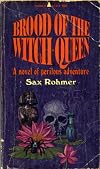
Brood of the Witch-Queen
by Sax Rohmer
On This Page
Description
Although best known as the creator of the Fu-Manchu series of mystery novels, British author Arthur Henry Sarsfield Ward (who usually wrote under the pseudonym Sax Rohmer) also penned a number of science fiction, fantasy, and supernatural novels. Long himself associated with the occult, Rohmer brings captivating depth and detail to his story of a dabbler in the supernatural whose dark interests spin out of control—with tragic results..
Tags
Recommendations
























Member Reviews
I enjoyed this book on several planes. It is a well written book dealing with Egyptian occult with numerous twists and turns. You know who the protagonist is right away. The question is how to control/stop him. It is also interesting because it was written in the early twentieth century, affecting the writing style and imparting customs and speech of that time period. At times this made it a bit harder to follow, but this was minimal and certainly did not distract from the book.
Found this rather disappointing. It had great potential but the horror moments failed to unnerve me and often they came across as lackluster or melodramatic.
The characters were not strong enough to make me feel anything for them. The story had some good moments, hence my awarding it two stars rather than one, but on the whole I did not feel engaged by this work. I thought the ending was especially lame.
The characters were not strong enough to make me feel anything for them. The story had some good moments, hence my awarding it two stars rather than one, but on the whole I did not feel engaged by this work. I thought the ending was especially lame.
Ratings
Members
- Recently Added By
Lists

Lovecraft's 'Supernatural Horror in Literature' Reading List
216 works; 8 members
Author Information

189+ Works 6,131 Members
Sax Rohmer was born in Birmingham, Warwickshire. At the age of 18, he adopted the name Sarsfield, the name of a famous Irish general admired by Rohmer's mother. He married Rose Elizabeth Knox in 1909 and, at his wife's insistence, began using the name Sax Rohmer for his fiction, eventually employing the pseudonym as his actual name. Rohmer was show more basically a self-taught scholar. He started writing as a journalist; his beat was the Limehouse underworld in London. Rohmer had a difficult time breaking into the professional fiction markets, but once he did, he became a household name for exotic adventure both in England and in America. Although his writing brought Rohmer success and money, he was never much of a businessman, and most of his wealth was squandered because of his extravagance and through financial mismanagement. Rohmer eventually moved to New York City. One of Rohmer's great intellectual interests was the occult and supernatural, and these elements frequently appeared as motifs in his fiction. His most famous creation was the evil oriental mastermind, Dr. Fu Manchu, first presented in the novel The Mystery of Fu Manchu in 1913 (later retitled The Insidious Dr. Fu Manchu for its American publication, also in 1913). Most espionage or adventure fiction exploits the social paranoias of its time, and Rohmer himself effectively tapped the Westerner's fear of the stereotyped "yellow peril" threat---the negatively perceived belief that Orientals will conquer the world. The Fu Manchu adventures were patterned, in part, after Arthur Conan Doyle's Sherlock Holmes stories. Rohmer's protagonists in these adventures, Sir Denis Nayland Smith and his companion Dr. Petrie, look very much like Doyle's Holmes and Watson, but, whereas Doyle centered his narratives on the heroes and specifically on the elaborate process of detection, Rohmer focused his attention on the villain and on slam-bang action. Fu Manchu was a master of both Western science and Eastern mysticism, and his efforts at world domination caused no end of problems for Smith and Petrie. In Fu Manchu, Rohmer had created the most famous villain in popular fiction (although Rohmer maintained that Fu Manchu was based on an actual Limehouse criminal). Despite Rohmer's use of outrageous racial stereotyping, many of his novels hold up well today and provide superior examples of how to create narrative pacing and suspense. (Bowker Author Biography) show less
Some Editions
Series
Belongs to Publisher Series
Common Knowledge
- Canonical title
- Brood of the Witch-Queen
- Original publication date
- 1918
- People/Characters
- Robert Cairn; Anthony Ferrara; Sime; Dr. Bruce Cairn
- Important places
- Cairo, Egypt; London, England, UK; Limehouse, London, England, UK
- First words
- Robert Cairn looked out across the quadrangle. The moon had just arisen, and it softened the beauty of the old college buildings, mellowed the harshness of time, casting shadow pools beneath the cloisteresque arches to the we... (show all)st and setting out the ivy in stronger relief upon the ancient walls. The barred shadow on the lichened stones beyond the elm was cast by the hidden gate; and straight ahead, where, between a quaint chimney-stack and a bartizan, a triangular patch of blue showed like spangled velvet, lay the Thames. It was from there the cooling breeze came.
- Last words
- (Click to show. Warning: May contain spoilers.)That night brought no repetition of the uncanny attack; and in the gray half light before the dawn Dr. Cairn and his son, themselves like two phantoms, again crept across the field to the barn. The padlock hung loose in the ring. "Stay where you are, Rob!" cautioned the doctor. He gently pushed the door open--wider--wider--and looked in. There was an overpowering odour of burning flesh. He turned to Robert, and spoke in a steady voice. "The brood of the Witch-Queen is extinct!" he said.
- Disambiguation notice
- Originally serialized in the Premier Magazine, May, 1914-January, 1915.
Classifications
Statistics
- Members
- 227
- Popularity
- 143,349
- Reviews
- 2
- Rating
- (3.37)
- Languages
- 5 — Czech, English, German, Polish, Portuguese
- Media
- Paper, Ebook
- ISBNs
- 41
- ASINs
- 22