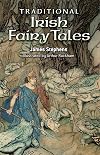
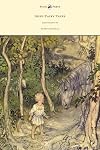
Irish Fairy Tales
by James Stephens, Arthur Rackham (Illustrator)
On This Page
Description
Take a trip through the rich folklore of Ireland in this enchanting volume from author James Stephens. Fairy kings, femmes fatales, bewitched animals, epic feuds—these action-packed stories traverse a broad spectrum of themes and settings. Folklore fans and readers interested in Gaelic and Celtic culture will appreciate this collection..
Tags
Recommendations













Member Reviews
We've managed in the space of three volumes to run the available gamut of titles for books of tales of Irish fairies and come full circle, as it were. These aren't even the sort of fairy tales I was looking for, being mostly about Finn and the Fianna, but actually, there's a good deal of fairy stuff in here, so I think it was worthwhile from that point of view.
So it opens with the story of a man here since the first people came to Ireland after the flood and follows on down through mythical settlements and invasions, with the man transforming into a beast at each juncture and enjoying a long exuberant life as king of that species, until finally he becomes king of the salmon, gets caught by a fisherman of the King of Ulster, is eaten by show more the queen and born to her as a son. There's a lovely giddy logic to it.
Next comes the Boyhood of Fionn, a justly praised literary masterpiece, gorgeously lyrical, and I began to question why this wasn't part of a work with the stature of something like The Once And Future King. It's a work for grown-ups, maybe, more so at least than The Sword In The Stone, but it has flashes of rare wit here and there and is extremely readable. The Irish, however, have a complicated relationship with our mythical heroes. Like leprechauns they're to be pitied for the way in which they have become embarrassing cliches and caricatures, and of course the inevitable association of a glorious warriors past doesn't help, but neither does the humiliation of hundreds of years of defeat and foreign rule. There's that speech in Trainspotting about what is there to be proud of in being Scottish. Most Irish people internalised that lesson long ago.
Nonetheless, there is something here that surely transcends national ambivalence, something that surely should be part of the canon of fantasy literature. Except this is not a novel, despite containing the start to a great novel within it. Once Fionn becomes leader, his nature changes, the stories become episodic, Fionn is sidelined or barely present, and often powerless and even humiliated. The final story doesn't mention him at all, and one assumes it isn't a Fionn story until a line at the end which is the sort of cheat no 20th century audience would put up with for a moment.
No doubt someone has written a novel about Fionn - I remember Rosemary Sutcliffe's book fondly - but it's an awful pity James Stephens didn't because it would have been definitive and influential. Though it should be noted that there appear to be issues with women that are hard to parse. Most of the major female roles are negative, and it's hard to say whether it's because of the source material or the author, or even at times the author poking fun at the misogyny of the source material, though by the end he seems to embrace it fully. On the other hand, the relationship between Fionn and Goll mor mac Morna is an amazing one, uniquely Irish I would have thought.
A rich book, product of the great Anglo Irish Celtic Revival, it's just a pity he decided to let the fragmentary nature of the ancient oral tradition dictate the form, leaving us with yet another book of tales, rather than a brilliant novel. show less
So it opens with the story of a man here since the first people came to Ireland after the flood and follows on down through mythical settlements and invasions, with the man transforming into a beast at each juncture and enjoying a long exuberant life as king of that species, until finally he becomes king of the salmon, gets caught by a fisherman of the King of Ulster, is eaten by show more the queen and born to her as a son. There's a lovely giddy logic to it.
Next comes the Boyhood of Fionn, a justly praised literary masterpiece, gorgeously lyrical, and I began to question why this wasn't part of a work with the stature of something like The Once And Future King. It's a work for grown-ups, maybe, more so at least than The Sword In The Stone, but it has flashes of rare wit here and there and is extremely readable. The Irish, however, have a complicated relationship with our mythical heroes. Like leprechauns they're to be pitied for the way in which they have become embarrassing cliches and caricatures, and of course the inevitable association of a glorious warriors past doesn't help, but neither does the humiliation of hundreds of years of defeat and foreign rule. There's that speech in Trainspotting about what is there to be proud of in being Scottish. Most Irish people internalised that lesson long ago.
Nonetheless, there is something here that surely transcends national ambivalence, something that surely should be part of the canon of fantasy literature. Except this is not a novel, despite containing the start to a great novel within it. Once Fionn becomes leader, his nature changes, the stories become episodic, Fionn is sidelined or barely present, and often powerless and even humiliated. The final story doesn't mention him at all, and one assumes it isn't a Fionn story until a line at the end which is the sort of cheat no 20th century audience would put up with for a moment.
No doubt someone has written a novel about Fionn - I remember Rosemary Sutcliffe's book fondly - but it's an awful pity James Stephens didn't because it would have been definitive and influential. Though it should be noted that there appear to be issues with women that are hard to parse. Most of the major female roles are negative, and it's hard to say whether it's because of the source material or the author, or even at times the author poking fun at the misogyny of the source material, though by the end he seems to embrace it fully. On the other hand, the relationship between Fionn and Goll mor mac Morna is an amazing one, uniquely Irish I would have thought.
A rich book, product of the great Anglo Irish Celtic Revival, it's just a pity he decided to let the fragmentary nature of the ancient oral tradition dictate the form, leaving us with yet another book of tales, rather than a brilliant novel. show less
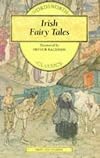
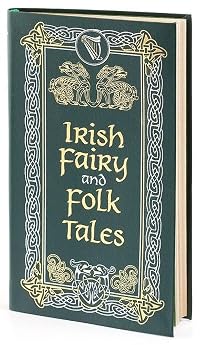
The Myths and Magic of Old Ireland, these stories are classic Irish folk tales which weave in and out of Faery and our world, with heroes such as Fionn mac Uail, lord of the Fianna. These are almost like reading poems, they have a rhythm and a cadence to them which becomes mesmerizing, especially when characters are speaking. I found it hard going at first, but after the first few stories, my interest was drawn and by the end of the book, I couldn't put it down. There is subtle humor in the dialog. At times, it felt as though I were reading the history of the Nac Mac Feegle from Discworld. I am a lover and collector of books with Arthur Rackham illustrations, so that is what drew me to this, but Fall River Press has made a lovely book show more in total, with a fine feel to the cloth cover, thick pages made to look like vellum and a design of print which feels as if you have found an ancient book written by monks. show less
My copy is called "Irish Fairy Tales" but it has the same content and the Arthur Rackham illustrations. I suspect that James Stephens never retold an Irish legend without making it fascinating and splendid.
10 stories of Finn and other champions of Ireland and Faery. Some tales are good and some are corny. But over all a fun read.
I liked the description of Conaran's daughters in "The Enchanted Cave of Crab Corran". As I imagine these girls, I had to laugh.
Full of adventure, magic, love, and betrayal.
I liked the description of Conaran's daughters in "The Enchanted Cave of Crab Corran". As I imagine these girls, I had to laugh.
Full of adventure, magic, love, and betrayal.
Thsi reprint of a book originally published in 1920, includes beautiful color illustrations and a story-telling style that preserves the lyricism of Irish speech and idiom. A grand collection of heros, spells, fate, sorrows and joyous daring exploits. You can almost smell the peat smoke from the old Irish hearths where Stephens collected his tales.
This is one of those books you should read simply to expand your knowledge of Irish heritage and culture. A fascinating insight into historical standards in society, particularly women's roles, as well as a broader world view and belief system.
I found this very interesting and highly entertaining.... some Irish folklore is wild! Lol!
Members
- Recently Added By
Lists

A Child's Book Tour of Ireland
62 works; 3 members
Author Information

60+ Works 2,199 Members

Arthur Rackham was born in London, England. At the age of 18, he worked as a clerk at the Westminster Fire Office and began studying part-time at the Lambeth School of Art. In 1892 he left his job and started working for The Westminster Budget as a reporter and illustrator. His first book illustrations were published in 1893 in To the Other Side show more by Thomas Rhodes, but his first serious commission was in 1894 for The Dolly Dialogues, the collected sketches of Anthony Hope, who later went on to write The Prisoner of Zenda. Book illustrating then became Rackham's career for the rest of his life. Rackham invented his own unique technique which resembled photographic reproduction; he would first sketch an outline of his drawing, then lightly block in shapes and details. Afterwards he would add lines in pen and India ink, removing the pencil traces after it had dried. With color pictures, he would then apply multiple washes of color until transparent tints were created. Arthur Rackham died in 1939 of cancer in his home in Limpsfield, Surrey. (Bowker Author Biography) show less
Some Editions
Series
Belongs to Publisher Series
Common Knowledge
- Original publication date
- 1920 (retelling by James Stephens) (retelling by James Stephens)
- People/Characters
- Finnian of Moville; Tuan mac Cairill; Fionn mac Uail
- Important places
- Ulster, Ireland; Leinster, Ireland
- Dedication
- To Seumas and Iris and to Helen Fraser
Classifications
Statistics
- Members
- 811
- Popularity
- 34,318
- Reviews
- 10
- Rating
- (3.93)
- Languages
- English, German, Italian
- Media
- Paper, Audiobook, Ebook
- ISBNs
- 93
- UPCs
- 1
- ASINs
- 32