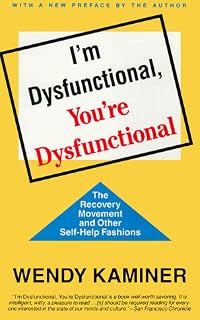
I'm Dysfunctional, You're Dysfunctional: The Recovery Movement and Other Self-Help
by Wendy Kaminer
On This Page
Description
"If a Nobel Prize were awarded for clarity and sanity in a world gone mad, Wendy Kaminer would be on her way to Stockholm." -- Newsday Anyone who's ever wondered why talking about addiction has become so fashionable, shuddered on hearing an "adult child" compare his upbringing with the Holocaust, or felt that admitting one's powerlessness is a frightening prospect for a participatory democracy will be delighted by this bracingly outspoken and intelligent work of social criticism. Whether she show more is infiltrating twelve-step meetings and codependency workshops or evaluating the claims of gurus from Shirley MacLaine to M. Scott Peck, Wendy Kaminer deftly diagnoses a national movement (and multi-million-dollar industry) with a strong tendency toward authoritarianism, a cult of victimhood, and a nasty streak of covert religiosity. Controversial, original, and brilliantly reasoned, I'm Dysfunctional, You're Dysfunctional changes the way we think about self-help -- and helps us to think for ourselves. "Explores...the ominous effect of all this institutionalized whining on our culture and politics...an incisive and provocative argument." -- Washington Post "Extremely witty...Ms. Kaminer has a real gift for honing her anger to an epigrammatic edge....We can make good use of [her] skepticism." -- The New York Times Book Review show lessTags
Recommendations













































Member Reviews
I have long been frustrated with the self-help movement. To me, all those books out there are saying, "You aren't good enough." And they are written, for the most part, by people who have a limited experience with the wide range of people who might be looking at their book. Writers, in other words, who don't really know what they are talking about.
So I loved finding this book. Although written in the early 1990s it holds true today. Kaminer examines several types of "recovery" movements, then moves into other self-help movements. She examines what the authors are saying and determines that most of them contradict themselves, are not based on clear thinking, and, worst of all, encourage a status of victimhood and dependency. "You can't show more help it." "You need help." "You can't do it alone".
Kaminer is especially ruthless when she discusses how this movement has muddied the waters of what is really abuse. Now any kind of difficulty can be labeled as abuse, as traumatic, "as bad as being in a concentration camp". The notion is absurd but I happen to know someone who has bought exactly this argument about her own childhood, that it was worse than being in a concentration camp. Come on! It's so ridiculous. And Kaminer is not afraid to say so, often with laugh-out-loud humor.
More people need to read this book. It might shake them loose of that feeling that they need someone else to approve what they do, to tell them what to do. show less
So I loved finding this book. Although written in the early 1990s it holds true today. Kaminer examines several types of "recovery" movements, then moves into other self-help movements. She examines what the authors are saying and determines that most of them contradict themselves, are not based on clear thinking, and, worst of all, encourage a status of victimhood and dependency. "You can't show more help it." "You need help." "You can't do it alone".
Kaminer is especially ruthless when she discusses how this movement has muddied the waters of what is really abuse. Now any kind of difficulty can be labeled as abuse, as traumatic, "as bad as being in a concentration camp". The notion is absurd but I happen to know someone who has bought exactly this argument about her own childhood, that it was worse than being in a concentration camp. Come on! It's so ridiculous. And Kaminer is not afraid to say so, often with laugh-out-loud humor.
More people need to read this book. It might shake them loose of that feeling that they need someone else to approve what they do, to tell them what to do. show less
A cutting, and often humorous, analysis of the self help and recovery movement. I read it when it came out, and it seems even more relevant now. After all these years I remember the section where she compares a shopaholics anonymous-like meeting to a meeting of Cambodian refugees. Should be read by anyone who takes themselves too seriously.
I really enjoyed this book. Kaminer honestly tells the reader her thoughts and doesn't try to cloud them in some kind of authoritarian mist. She critiques the self help movement without stooping to it's level. Not providing answer but spurring the reader to think for herself by providing questions and insights.
Ratings
Members
- Recently Added By
Lists

Therapeutic Society
61 works; 1 member

Shaykh Hamza's Book Recommendations
439 works; 3 members
Author Information

13+ Works 632 Members
Wendy Kaminer is the author of many books, including Free for All: Defending Liberty in America Today; I'm Dysfunctional, You're Dysfunctional: The Recovery Movement and Other Self-Help Fashions; and Sleeping with Extra-Terrestrials: The Rise of Irrationalism and Perils of Piety. She lives in Boston.
Common Knowledge
- Original publication date
- 1993-04
- Dedication
- To my brother Billy
- First words
- (Preface to the Vintage edition): Shortly after the hardcover publication of I'm Dysfunctional, You're Dysfunctional, I dreamed that Bill Clinton appeared on "Oprah" and confessed he was codependent.
(Introduction): This is not a book about my life or yours.
Instead of a self-help section, my local bookstore has a section called recovery, right around the corner from the one called New Age. - Last words
- (Click to show. Warning: May contain spoilers.)Self-help is how we skate.
Classifications
Statistics
- Members
- 156
- Popularity
- 209,259
- Reviews
- 3
- Rating
- (3.68)
- Languages
- English
- Media
- Paper
- ISBNs
- 3