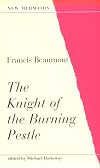
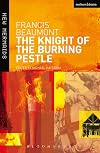
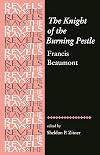
The Knight of the Burning Pestle
by Francis Beaumont, John Fletcher (traditionally (but probably falsely) listed as co-author)
On This Page
Description
'Let him kill a lion with a pestle, husband; let him kill a lion with a pestle.' So exclaims the Grocer's wife who, with her husband and servants, is attending one of the London's elite playhouses where a theatre comany has just begun to perform. Peeved at the fact that all the plays they see are satires on the lives and values of London's citizenry, the Grocer and his wife interrupt and demand a play that instead contains chivalric quests and courtly love. What's more, they nominate their show more apprentice Rafe to take on the hero's role of the knight in this entirely new play. The author, Francis Beaumont, ends up not just satirising the grocers' naive taste for romance but parodying his own example of citizen comedy. This play-within-a-play becomes a pastiche of contemporary plays that scorned those who were not courtiers or at least gentlemen or ladies. Like Cervantes in Don Quixote, Beaumont exposes the folly of those that take representations for realities, but also celebrates their idealism and love of adventure. The editor, Michael Hattaway, is editor of plays by Shakespeare and Jonson as well as of several volumes of critical essays, and author of Elizabethan Popular Theatre, Hamlet: The Critics Debate, and Renaissance and Reformations: An Introduction to Early Modern English Literature. He is Professor Emeritus of English Literature in the University of Sheffield. show lessTags
Recommendations

















Member Reviews
Around 1607, about the time he began his famous collaboration with John Fletcher, Francis Beaumont penned this play, perhaps his most celebrated solo work, for a company of boy actors. Within a decade he would be dead, but the fruits of the relatively brief collaboration would eclipse even Shakespeare's popularity in decades to come.
KBP is most admired as a metatheatrical satire of middle-class London merchants, filled with snatches of song by the lighthearted Master Merrythought. The main plot is the familiar romantic conflict of runaway lovers being kept apart by a father, a London merchant who wishes his daughter Luce to wed his old friend Humphrey, not his apprentice Jasper. But though the boy actors try valiantly to keep the story show more on track, their play is repeatedly and hilariously interrupted by auditors who become actors. A grocer and his wife climb from the audience to take up stools on the stage and demand that Rafe their apprentice be given a knightly costume and made the star of the performance. Soon he is acting out his own adventure, taken from popular prose romances of the time, featuring knights errant pricking across desert plains on their palfreys to rescue distressed damsels.
The adventurer Rafe, the titular "Knight of the Burning Pestle," undertakes quests worthy of Don Quixote though patriotically English - vanquishing the giant Barbaroso and releasing his syphilitic clients, charming the Princess of Moldavia, performing as Lord of May Day, mustering all of London's apprentices in a skirmish, and ending the comedy with a mournful death-speech. Though Rafe the knight momentarily loses in his duel with Jasper the lover, the story of the grocer's apprentice quite eclipses the plotted drama of the love-contest for the hand of Luce -- in part because of the deep pockets of the grocer, who is called upon in medias res to pay the bills incurred by Rafe's adventures. Throughout the performance the two chatty spectators argue with the players and each other, but by the end both stories are knitted up - and like Rosalind in As You Like It, the grocer's wife gets the last word in an epilogue.
This Regents Renaissance Drama edition offers a brief introduction to the play and two extensive, helpful appendices: the music for the nearly 20 songs that fill the play, and a century's chronology of crucial dates relevant to early modern drama. show less
KBP is most admired as a metatheatrical satire of middle-class London merchants, filled with snatches of song by the lighthearted Master Merrythought. The main plot is the familiar romantic conflict of runaway lovers being kept apart by a father, a London merchant who wishes his daughter Luce to wed his old friend Humphrey, not his apprentice Jasper. But though the boy actors try valiantly to keep the story show more on track, their play is repeatedly and hilariously interrupted by auditors who become actors. A grocer and his wife climb from the audience to take up stools on the stage and demand that Rafe their apprentice be given a knightly costume and made the star of the performance. Soon he is acting out his own adventure, taken from popular prose romances of the time, featuring knights errant pricking across desert plains on their palfreys to rescue distressed damsels.
The adventurer Rafe, the titular "Knight of the Burning Pestle," undertakes quests worthy of Don Quixote though patriotically English - vanquishing the giant Barbaroso and releasing his syphilitic clients, charming the Princess of Moldavia, performing as Lord of May Day, mustering all of London's apprentices in a skirmish, and ending the comedy with a mournful death-speech. Though Rafe the knight momentarily loses in his duel with Jasper the lover, the story of the grocer's apprentice quite eclipses the plotted drama of the love-contest for the hand of Luce -- in part because of the deep pockets of the grocer, who is called upon in medias res to pay the bills incurred by Rafe's adventures. Throughout the performance the two chatty spectators argue with the players and each other, but by the end both stories are knitted up - and like Rosalind in As You Like It, the grocer's wife gets the last word in an epilogue.
This Regents Renaissance Drama edition offers a brief introduction to the play and two extensive, helpful appendices: the music for the nearly 20 songs that fill the play, and a century's chronology of crucial dates relevant to early modern drama. show less
Ratings
Members
- Recently Added By
Lists

Best Early Modern Plays Not By Shakespeare
78 works; 8 members

Plays I Like
230 works; 31 members

100 Books to Read in a Lifetime (That Are Older Than 200 Years)
415 works; 174 members
My Play Collection
769 works; 3 members
Author Information

82+ Works 885 Members
Francis Beaumont (1584-1616) and his collaborator John Fletcher (1579-1625) wrote some of the most popular dramas of Elizabethan England. Beaumont and Fletcher began to work together in about 1606 and continued their partnership until Beaumont's retirement in 1613. Beaumont apparently was the primary plotter of their plays, while Fletcher had a show more strong flair for language. Their comedies and tragedies include The Woman Hater, The Coxcomb, A Maid's Tragedy, The Knight of the Burning Pestle, Wit Without Money, and Philaster, Or Love Lies A Bleeding. Fletcher authored several other plays alone, such as the comedy The Wild Goose Chase (1621) and the tragedy Bonduca (1614). Cardenio, or the Second Maiden's Tragedy, and Two Noble Kinsmen are attributed to Fletcher, although there has been some speculation that he collaborated with Shakespeare on the plays. Beaumont and Fletcher's work is energetic, rich in stage thrills, declamatory speeches and bizarre plots. Although their work is not as unified as that of some of their contemporaries including Shakespeare and Webster, it influenced the development of Restoration comedy and tragedy, and thus played an important role in the history of drama. (Bowker Author Biography) show less

The team of Francis Beaumont (1584-1616) and John Fletcher (1579-1625) wrote some of the most popular dramas of Elizabethan England. Beaumont and Fletcher began to work together in about 1606 and continued their partnership until Beaumont's retirement in 1613. Beaumont apparently was the primary plotter of their plays, while Fletcher had a strong show more flair for language. Their comedies and tragedies include The Woman Hater, The Coxcomb, A Maid's Tragedy, The Knight of the Burning Pestle, Wit Without Money, and Philaster, Or Love Lies A Bleeding. Fletcher wrote several plays alone as well, such as the comedy The Wild Goose Chase (1621) and the tragedy Bonduca (1614). Cardenio, or the Second Maiden's Tragedy, and Two Noble Kinsmen are attributed to Fletcher, although there has been some speculation he collaborated on these with Shakespeare. Beaumont and Fletcher's work is energetic, full of stage thrills, declamatory speeches and bizarre plots. Though it is not as rich and unified as that of some of their contemporaries including Shakespeare and Webster, it influenced the development of Restoration comedy and tragedy, and thus played an important role in the history of drama. (Bowker Author Biography) show less
Some Editions
Series
Belongs to Publisher Series
Work Relationships
Is contained in
Common Knowledge
- Canonical title
- The Knight of the Burning Pestle
- Original publication date
- 1613; 1984 (Revels Plays edition) (Revels Plays edition); 1969 (New Mermaids first edition) (New Mermaids first edition); 2002 (New Mermaids second edition) (New Mermaids second edition)
- People/Characters
- Old Merrythought; Mistress Merrythought; Master Humphrey; Rafe
- First words
- Prologue. From all that's near the court, from all that's great,
Within the compass of the city walls,
We now have brought our scene. - Disambiguation notice
- Most editors believe this play is by Beaumont alone; no Fletcher -- but plays by both playwrights whether apart, separately or with other collaborators are traditionally credited to "Beaumont & Fletcher".
Classifications
Statistics
- Members
- 277
- Popularity
- 115,468
- Reviews
- 2
- Rating
- (3.61)
- Languages
- English, Italian, Russian
- Media
- Paper, Ebook
- ISBNs
- 34
- ASINs
- 10