
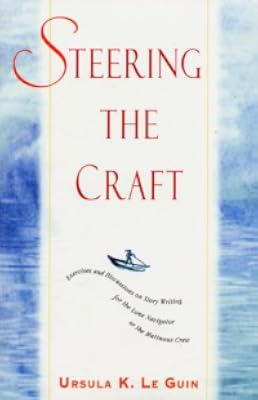
Steering the Craft: Exercises and Discussions on Story Writing for the Lone Navigator or the Mutinous Crew
by Ursula K. Le Guin
On This Page
Description
From the celebrated Ursula K. Le Guin, "a writer of enormous intelligence and wit, a master storyteller" (Boston Globe), the revised and updated edition of her classic guide to the essentials of a writer's craft. Completely revised and rewritten to address modern challenges and opportunities, this handbook is a short, deceptively simple guide to the craft of writing. Le Guin lays out ten chapters that address the most fundamental components of narrative, from the sound of language to show more sentence construction to point of view. Each chapter combines illustrative examples from the global canon with Le Guin's own witty commentary and an exercise that the writer can do solo or in a group. She also offers a comprehensive guide to working in writing groups, both actual and online. Masterly and concise, Steering the Craft deserves a place on every writer's shelf. show lessTags
Recommendations




Member Reviews
I actually started working through this book with a small writing group. We made it to lesson 7 before stalling out, and I decided to finish reading the book solo without continuing the exercises.
I'm an experienced author with two series with a Big 5 publisher, a Nebula nomination, and a whole lot of publications with my byline. This book taught me something new in every chapter. For me, a great deal of writing is intuitive. I don't know all of the rules of grammar, and I still shudder at the thought of the diagramming I did in 8th grade. Le Guin gently explains matters like pacing and points of view and shares fantastic examples, and she gives names to the techniques that I utilize in ignorance.
This is a book that really should be show more done in a small writing group; there is a lot to be gained through sharing different approaches to the exercises and discussing why some of them are incredibly challenging. Highly recommend this to all writers who want to push themselves to learn more about their craft. show less
I'm an experienced author with two series with a Big 5 publisher, a Nebula nomination, and a whole lot of publications with my byline. This book taught me something new in every chapter. For me, a great deal of writing is intuitive. I don't know all of the rules of grammar, and I still shudder at the thought of the diagramming I did in 8th grade. Le Guin gently explains matters like pacing and points of view and shares fantastic examples, and she gives names to the techniques that I utilize in ignorance.
This is a book that really should be show more done in a small writing group; there is a lot to be gained through sharing different approaches to the exercises and discussing why some of them are incredibly challenging. Highly recommend this to all writers who want to push themselves to learn more about their craft. show less
Ursula Le Guin’s Steering the Craft is so much more than just another book on writing. This craft is a yacht steered on ocean waves, not a rubber toy bobbing in the tub. And this book is filled with wise advice, clear and well-described examples, and great exercises for people who don’t just want to write—they want to write well. It’s a book for people who love “the sound of language” and long to remove whatever is “ugly, unclear, unnecessary, preachy, careless... what doesn’t work” from their own pages to make them sound like music.
With excerpts from authors as diverse as Rudyard Kipling and Patrick O’Neil, or Zora Neale Hurston and Jane Austen, with exercises that feed into and build on each other, and with a show more nicely nuanced approach to grammar and other tools of the trade, the author assists our writing, so our writing can assist other people’s reading, and so the whole will be something worth both reading and listening to.
Memorable one-liners stay in the mind long after reading. Authors are reminded to take responsibility for what they write—nothing happens “somehow” without the author’s intervention. Memorable asides make lessons long-learned finally make sense—did you know grammar and punctuation exist to assist sound? And each reader will surely have their favorite lesson and favorite point. For me, the reminder that story comes first, not conflict, is a lesson that will ease my conflicted writing of tales.
Highly recommended; enjoyably readable; and filled with the sort of exercises every writing group should take time to tackle; Steering the Craft is a must-add to any writer’s bookshelf.
Disclosure: My thanks to the friend who loaned it to me from her shelf. show less
With excerpts from authors as diverse as Rudyard Kipling and Patrick O’Neil, or Zora Neale Hurston and Jane Austen, with exercises that feed into and build on each other, and with a show more nicely nuanced approach to grammar and other tools of the trade, the author assists our writing, so our writing can assist other people’s reading, and so the whole will be something worth both reading and listening to.
Memorable one-liners stay in the mind long after reading. Authors are reminded to take responsibility for what they write—nothing happens “somehow” without the author’s intervention. Memorable asides make lessons long-learned finally make sense—did you know grammar and punctuation exist to assist sound? And each reader will surely have their favorite lesson and favorite point. For me, the reminder that story comes first, not conflict, is a lesson that will ease my conflicted writing of tales.
Highly recommended; enjoyably readable; and filled with the sort of exercises every writing group should take time to tackle; Steering the Craft is a must-add to any writer’s bookshelf.
Disclosure: My thanks to the friend who loaned it to me from her shelf. show less
It's kinda funny, and rather sad actually, that the required read I put off until the very last is the book I probably should have read first off. Le Guin's how-to book on creative writing isn't about plot or character or the dreaded beginnings-middles-ends, but rather the nuts and bolts of the craft of writing itself. Le Guin is a fantasy/SF writer, but this book is aimed for fiction and non-fiction writers of all kinds.
Steering the Craft is a book that is aimed at those writers who look at writing as an art, as a craft. People who are interested in writing as a skill. With this in mind, Le Guin discusses the sound of language, punctuation, syntax, the narrative sentence and paragraph, rhythm and repetition, adjectives and adverbs, show more tense and person of the verb, voice and point of view, implicit narration: imparting information, crowding, leaping, focus, and control. She also offers a nifty glossary full of terms that writers may not know or may not remember, as well as a lovely appendix on the peer group workshop and an even better one on forms of the verb.
It's a good book for all writers, no matter where they are in their craft, to have and refer to. Le Guin provides a great many exercises that I of course did not participate in (I have issues interrupting my reading, so sue me), but plan to use in the future. There's a lot of stuff in here that made better sense to me now after hearing my mentor harp on certain things for so long, which made me wish I'd had this book right when I started working with him, so that I'd have another point of reference to go to.
The book is also filled with a number of examples for each topic, mostly pulled from literature, and while I'll admit I would've liked to see some more modern examples of the same thing, I understand the reason Le Guin used the examples she did. So many writers aren't familiar with the classics, or are afraid of them, and it's a cool thing when you can read something out of your time and still understand it. Better still, when you can study the craft and learn something from it. I'm no stranger to classical literature, and I even enjoy it from time to time, but since I rarely read it anymore, it's not a bad thing I was forced to look at those examples.
There's so many good things in this book, though I'll be the first to admit that there were some sections that felt woefully short. At times, I'd turn a page to continue reading and then flip back, thinking I missed something. But on the whole, I feel this will be an excellent resource to have as I continue to work on my own craft, especially when it comes to revision. Again, I really should've read this book long before now.
Le Guin makes several important statements through-out the book in regards to writing and writers. But the most important, in my personal opinion, was this (emphasis mine):
Ultimately, you write alone. And ultimately you and you alone can judge your work. The judgment that a work is complete . . . can only come from the writer, and it can be made rightly only by a writer who's learned to read her own work (8).
In some ways, this book can teach writers how to "rightly read [their] own work," and will also encourage writers to seek out environments that will help them to do so. show less
Steering the Craft is a book that is aimed at those writers who look at writing as an art, as a craft. People who are interested in writing as a skill. With this in mind, Le Guin discusses the sound of language, punctuation, syntax, the narrative sentence and paragraph, rhythm and repetition, adjectives and adverbs, show more tense and person of the verb, voice and point of view, implicit narration: imparting information, crowding, leaping, focus, and control. She also offers a nifty glossary full of terms that writers may not know or may not remember, as well as a lovely appendix on the peer group workshop and an even better one on forms of the verb.
It's a good book for all writers, no matter where they are in their craft, to have and refer to. Le Guin provides a great many exercises that I of course did not participate in (I have issues interrupting my reading, so sue me), but plan to use in the future. There's a lot of stuff in here that made better sense to me now after hearing my mentor harp on certain things for so long, which made me wish I'd had this book right when I started working with him, so that I'd have another point of reference to go to.
The book is also filled with a number of examples for each topic, mostly pulled from literature, and while I'll admit I would've liked to see some more modern examples of the same thing, I understand the reason Le Guin used the examples she did. So many writers aren't familiar with the classics, or are afraid of them, and it's a cool thing when you can read something out of your time and still understand it. Better still, when you can study the craft and learn something from it. I'm no stranger to classical literature, and I even enjoy it from time to time, but since I rarely read it anymore, it's not a bad thing I was forced to look at those examples.
There's so many good things in this book, though I'll be the first to admit that there were some sections that felt woefully short. At times, I'd turn a page to continue reading and then flip back, thinking I missed something. But on the whole, I feel this will be an excellent resource to have as I continue to work on my own craft, especially when it comes to revision. Again, I really should've read this book long before now.
Le Guin makes several important statements through-out the book in regards to writing and writers. But the most important, in my personal opinion, was this (emphasis mine):
Ultimately, you write alone. And ultimately you and you alone can judge your work. The judgment that a work is complete . . . can only come from the writer, and it can be made rightly only by a writer who's learned to read her own work (8).
In some ways, this book can teach writers how to "rightly read [their] own work," and will also encourage writers to seek out environments that will help them to do so. show less
I think this might be my favorite book on writing I’ve read so far! Definitely recommending Steering the Craft to all of my teen creative writing students. If you’re a less experienced writer, this will cover important basics and fill in gaps in your writing. If you're a more experienced writer, the exercises and examples will still stretch you. Because this book has writing exercises that you can repeat over and over again, it feels well worth buying a copy to keep.
The structure of this book is quite simple but surprisingly useful. Each chapter covers a certain aspect of writing (point of view, description, dialogue, etc.), beginning with a brief overview, giving sample passages from other works, and ending with an exercise. The exercise comes with critiquing suggestions for those writing in groups and things to consider for those working alone. The occasional opinion essay comes up now and again, always labeled as such, so you know when you're learning a rule and when you're just getting another angle on the topic. I admit I didn't actually do any of the exercises, but they were interesting and worthy. Much better than your standard "describe your morning routine" exercises that show up in most show more writing books. I also felt like I was being treated like an adult. Le Guin is not taking you by the hand here; she is showing you the path. There is no talk of publication or rejection letters, nothing about recapturing your creativity or affirming your right to write. This book was clearly not written for people looking to write a bestselling novel or take up a brand new hobby. It is, in short, a book for people who enjoy writing and would like to do so better. Would that more writing books were of this calibre. show less
Profound insights on writing presented with grace, charm and wit.
Ursula Le Guin describes Steering the Craft, A 21st-Century Guide to Sailing the Sea of Story, as “A handbook for storytellers - writers of narrative prose and not for beginners.”
Indeed, it is not a book for beginners as much of what she addresses would be beyond the comprehension of novices. What it does concentrate on are those problems that challenge writers and impede the tone an flow of the narrative.
For example, she asks you to listen to the sound of your writing which involves diction and syntax.
Sophisticated consideration is given to verbs: person and tense, as well as point of view and changing point of view.
Indirection narration or what tells including show more avoiding expository lumps is discussed in depth.
There’s an excellent chapter entitled Crowding and Leaping which involves the necessity of focusing on some areas while leaping ahead in other parts while still following a fixed trajectory.
Steering the Craft is primarily a workbook with “exercise consciousness-raisers that aim to clarify and intensify your awareness of certain elements of prose writing and certain techniques and modes of storytelling."
These exercises are challenging but illuminating. I particularly benefitted from one called A Terrible Thing to Do that involved writing a narrative of about 500 words and then cutting it by half still keeping the narrative clear and not replacing specifics by generalities.
The book also includes the best advice I’ve read on running peer group writing workshops.
This slim volume has profound insights on writing and presents them with grace, charm an wit. The goal, according to the author, is to help you develop skills that free you to write want you to write.
Or as Le Guin puts it so that you’re “ready to let the story tell itself; having the skills, knowing the craft so that when the magic boat comes by, you can step into it and guide it where it wants to go, where it ought to go.” show less
Ursula Le Guin describes Steering the Craft, A 21st-Century Guide to Sailing the Sea of Story, as “A handbook for storytellers - writers of narrative prose and not for beginners.”
Indeed, it is not a book for beginners as much of what she addresses would be beyond the comprehension of novices. What it does concentrate on are those problems that challenge writers and impede the tone an flow of the narrative.
For example, she asks you to listen to the sound of your writing which involves diction and syntax.
Sophisticated consideration is given to verbs: person and tense, as well as point of view and changing point of view.
Indirection narration or what tells including show more avoiding expository lumps is discussed in depth.
There’s an excellent chapter entitled Crowding and Leaping which involves the necessity of focusing on some areas while leaping ahead in other parts while still following a fixed trajectory.
Steering the Craft is primarily a workbook with “exercise consciousness-raisers that aim to clarify and intensify your awareness of certain elements of prose writing and certain techniques and modes of storytelling."
These exercises are challenging but illuminating. I particularly benefitted from one called A Terrible Thing to Do that involved writing a narrative of about 500 words and then cutting it by half still keeping the narrative clear and not replacing specifics by generalities.
The book also includes the best advice I’ve read on running peer group writing workshops.
This slim volume has profound insights on writing and presents them with grace, charm an wit. The goal, according to the author, is to help you develop skills that free you to write want you to write.
Or as Le Guin puts it so that you’re “ready to let the story tell itself; having the skills, knowing the craft so that when the magic boat comes by, you can step into it and guide it where it wants to go, where it ought to go.” show less
Unsurprisingly, given the author, this is very good, very deft, very wise. It has excellent advice and exercises for freeing style from the "thou shalt (nots)" that abound these days, and some elegant insight into story.
Members
- Recently Added By
Lists

Best Books on Writing for Writers
36 works; 19 members

Books recommended by Calgary Public Library staff
1,588 works; 4 members
Author Information

491+ Works 166,875 Members
Ursula K. Le Guin was born Ursula Kroeber in Berkeley, California on October 21, 1929. She received a bachelor's degree from Radcliffe College in 1951 and a master's degree in romance literature of the Middle Ages and Renaissance from Columbia University in 1952. She won a Fulbright fellowship in 1953 to study in Paris, where she met and married show more Charles Le Guin. Her first science-fiction novel, Rocannon's World, was published in 1966. Her other books included the Earthsea series, The Left Hand of Darkness, The Dispossessed: An Ambiguous Utopia, The Lathe of Heaven, Four Ways to Forgiveness, and The Telling. A Wizard of Earthsea received an American Library Association Notable Book citation, a Horn Book Honor List citation, and the Lewis Carroll Shelf Award in 1979. She received the Medal for Distinguished Contribution to American Letters in 2014. She also received the Nebula Award and the Hugo Award. She also wrote books of poetry, short stories collections, collections of essays, children's books, a guide for writers, and volumes of translation including the Tao Te Ching of Lao Tzu and selected poems by Gabriela Mistral. She died on January 22, 2018 at the age of 88. (Bowker Author Biography) show less
Some Editions
Common Knowledge
- Original title
- Steering the Craft: Exercises and Discussions on Story Writing for the Lone Navigator or the Mutinous Crew
- Original publication date
- 1998
- First words
- The sound of the language is where it all begins and what it all comes back to.
- Last words
- (Click to show. Warning: May contain spoilers.)Everything I've talked about in this book has to do with being ready to let a story tell itself: having the skills, knowing the craft, so that when the magic boat comes by, you can step into it and guide it where it wants to go, where it ought to go.
Classifications
Statistics
- Members
- 1,884
- Popularity
- 11,369
- Reviews
- 28
- Rating
- (4.04)
- Languages
- 6 — Chinese, English, French, German, Russian, Turkish
- Media
- Paper, Ebook
- ISBNs
- 13
- ASINs
- 8