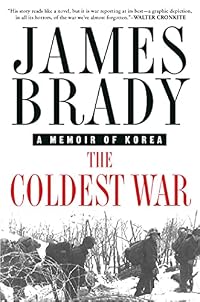
The Coldest War: A Memoir of Korea
by James Brady
On This Page
Description
America's "forgotten war" lasted just thirty-seven months, yet 54,246 Americans died in that time -- nearly as many as died in ten years in Vietnam. On the fiftieth anniversary of this devastating conflict, James Brady tells the story of his life as a young marine lieutenant in Korea.In 1947, seeking to avoid the draft, nineteen-year-old Jim Brady volunteered for a Marine Corps program that made him a lieutenant in the reserves on the day he graduated college. He didn't plan to find himself show more in command of a rifle platoon three years later facing a real enemy, but that is exactly what happened after the Chinese turned a so-called police action into a war.The Coldest War vividly describes Brady's rapid education in the realities of war and the pressures of command. Opportunities for bold offensives sink in the miasma of trench warfare; death comes in fits and starts as too-accurate artillery on both sides seeks out men in their bunkers; constant alertness is crucial for survival, while brutal cold and a seductive silence conspire to lull soldiers into an often fatal stupor.The Korean War affected the lives of all Americans, yet is little known beyond the antics of "M*A*S*H." Here is the inside story that deserves to be told, and James Brady is a powerful witness to a vital chapter of our history. show lessTags
Recommendations


















Member Reviews
"Marine platoon leader memoir" is one of my favorite micro-genres of literature, and among stories of leadership, heroism, maturation, and fear, The Coldest War stands a cut above for its clarity, candor, and writing. More Americans died in 3 years in Korea than in 10 years in Vietnam, and the war is still not officially over, yet most civilians are entirely ignorant of the conflict, let alone what it was like to serve in the coldest war.
Sent to Korea in November of 1952, Lt Brady faced a bloody, static war more remiscint of World War I than anything else. Americans and Chinese faced off across frozen mountains, where artillery made it too dangerous to move by daylight. In this war, men died by dribs and drabs, in raids, shellings, and show more accidents. There was no strategy, just a slow grinding of privates and platoon leaders against the communist adversaries.
Brady went onto to make a living as a novelist, and it shows in the precisely written descriptions of characters, terrain, and combat. A truly amazing story. show less
Sent to Korea in November of 1952, Lt Brady faced a bloody, static war more remiscint of World War I than anything else. Americans and Chinese faced off across frozen mountains, where artillery made it too dangerous to move by daylight. In this war, men died by dribs and drabs, in raids, shellings, and show more accidents. There was no strategy, just a slow grinding of privates and platoon leaders against the communist adversaries.
Brady went onto to make a living as a novelist, and it shows in the precisely written descriptions of characters, terrain, and combat. A truly amazing story. show less
Very good memoir about the less sensational aspects of the Korean War. Brady arrives after all the see sawing and settles in to learn how to be a Marine officer on what later became the borders between North and South Korean. He is honest, unflinching and tells it like it is.
May 29, 2014Piratical
Ratings
Members
- Recently Added By
Author Information

18+ Works 1,081 Members
Journalist and author James Brady was born in Brooklyn, New York on November 15, 1928. He graduated from Manhattan College in 1950. During the Korean War, he served in the Marine Corps and was awarded the Bronze Star with Combat V for a firefight against the Chinese army on May 31, 1952 in November 2001. He held numerous jobs in journalism show more including the publisher of Women's Wear Daily from 1964 to 1971 and writer of the celebrity profile column In Step With for Parade magazine for almost 25 years. He also wrote numerous fiction and nonfiction works including The Coldest War (1990), Further Lane (1997), The Marines of Autumn (2000), The Scariest Place in the World: A Marine Returns to North Korea (2005), and Why Marines Fight (2007). He died on January 26, 2009 at the age of 80. (Bowker Author Biography) show less
Common Knowledge
- Important places
- Korea
- Important events
- Korean War
Classifications
Statistics
- Members
- 236
- Popularity
- 137,158
- Reviews
- 2
- Rating
- (3.88)
- Languages
- English
- Media
- Paper, Ebook
- ISBNs
- 6
- ASINs
- 3