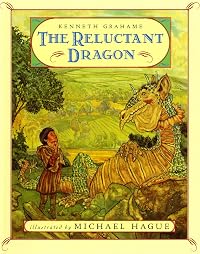
The Reluctant Dragon
by Kenneth Grahame
On This Page
Description
In this illustrated, abridged version of the original, the boy who finds the dragon in the cave knows it is a kindly, harmless one, but how can he convince the frightened villagers and, especially, St. George the dragon killer that there is no cause for concern?Tags
Recommendations






Member Recommendations

Member Reviews
I had never read this short story before, and I was pleasantly surprised by how much I enjoyed it. Stories from so long ago don't always hold up, especially in terms of vocabulary that a kid can grasp. No such worries here, while there were a couple words that were unusual, they didn't get in the way of my kid's comprehension. There's a frame story that was cute, rather than a waste of time as they generally are, which I appreciated. The actual story, after it gets going, pokes fun at the whole idea of knights slaying dragons in a way that was funny to me, and it entertained my 5 year old immensely.
A very fun short story about a lazy dragon who can’t be bothered fighting and a saint who gets tricked by the townsfolk into fighting the dragon because of how many grievances the dragon supposedly caused. Explores the themes of dishonesty, gossip, violence and quarrelling in a very fun but satirical manner. Solid, quick read!
Lovely little fable. Dated, of course, and more applicable to Grahame's time. But the illustrations (from Winnie-the-pooh's Shepherd) were delightful. And I loved it anyway.
This is the tale of The Boy, who is not at all surprised to find a Dragon living in the hillside. Naturally, the two soon become fast friends, and when St. George arrives to battle the Dragon, whom he's sure must be a danger to the countryside, the Boy, the Dragon, and the Saint hold a surprising contest...which just might end up satisfying one and all.
The Reluctant Dragon is about a little boy who discovers and dragon new to the neighborhood, whom he convinces to put on a false battle with St. George in order to win the hearts of the skeptical townspeople. The dragon willingly obliges, and the three participants become heroes to the village. Although this story is a twisted take on the life of Saint George, this would be a fantastic introduction of the saint to young children.
A new dragon has moved in and befriended a local boy who knows a lot about literature. Though he’s harmless and a philosopher rather than a fighter, the locals call in a knight. Suddenly there are people wanting a fight, and the dragon has to stage one to get the peace and acceptance he so desires.
Whimsical story of a dragon who isn't interested in fighting, even when the infamous St George arrives to remove "the scourge". Adults will appreciate the subtle humor.
Members
- Recently Added By
Lists

Favorite Childhood Books
1,646 works; 518 members

Mensa for Kids Excellence in Reading Award Program (Grades K-3)
64 works; 6 members

Best Friendship Stories
205 works; 16 members

Works That Inspired Disney Movies
119 works; 13 members
Honey For a Child's Heart
1,152 works; 25 members

Satori Smiles Children's Book List
262 works; 7 members

CCE 1000 Good Books List
1,033 works; 12 members

The Story of the World: History for the Classical Child: Activity Book Two
415 works; 2 members

HMS: Make Your Child a Lover of Books, Ages 5-7
17 works; 2 members

Favorite Picture Books
479 works; 160 members

Books Read in 2024
4,623 works; 126 members

Best Fantasy Novels
821 works; 361 members

Books Read in 2023
5,547 works; 145 members

Books With the Most Memorable Titles
478 works; 158 members

Books Read in 2020
4,379 works; 124 members

Favourite Short Stories
153 works; 9 members

Here There Be Dragons
143 works; 23 members

Favorite Fairy Tales
269 works; 103 members
Author Information

320+ Works 36,594 Members
Kenneth Grahame was born in Edinburgh on March 3, 1859. When he was five years old, his mother died of scarlet fever and he nearly died himself, of the same disease. His father became an alcoholic and sent the children to Berkshire to live with relatives. They were later reunited with their father, but after a failed year, the children never heard show more from him again. Sometime later, one of his brothers died at the age of fifteen. He attended St. Edward's School as a child and intended to go on to Oxford University, but his relatives wanted him to go into banking. He worked in his uncle's office, in Westminster, for two years then went to work at the Bank of England as a clerk in 1879. He spent nearly thirty years there and became the Secretary of the Bank at the age of thirty-nine. He retired from the bank right before The Wind in the Willows was published in 1908. He wrote essays on topics that included smoking, walking and idleness. Many of the essays were published as the book Pagan Papers (1893) and the five orphan characters featured in the papers were developed into the books The Golden Age (1895) and Dream Days (1898). The Wind in the Willows (1908) was based on bedtime stories and letters to his son and it is where the characters Rat, Badger, Mole and Toad were created. In 1930, Milne's stage version was brought to another audience in Toad of Toad Hall. Grahame died on July 6, 1932. (Bowker Author Biography) show less
Some Editions
Awards and Honors
Work Relationships
Is contained in
Is retold in
Has the adaptation
Common Knowledge
- Canonical title
- The Reluctant Dragon
- Original publication date
- 1898 (text) (text); 1983 (illustrations) (illustrations)
- People/Characters
- The Reluctant Dragon; Saint George
- Important places
- Berkshire Downs, Oxfordshire, England, UK; Oxfordshire, England, UK; England, UK
- Important events
- Middle Ages
- Related movies
- The Reluctant Dragon (1941 | IMDb); CBS Library: Misunderstood Monsters (1981 | IMDb)
- First words
- Long ago - might have been hundreds of years ago - in a cottage half-way between this village and yonder shoulder of the downs up there, a shepherd lived with his wife and their little son.
- Last words
- (Click to show. Warning: May contain spoilers.)I can't be certain which of them was singing, but I think it was the dragon!
- Original language
- English
Classifications
Statistics
- Members
- 2,116
- Popularity
- 9,689
- Reviews
- 27
- Rating
- (4.03)
- Languages
- 9 — Dutch, English, French, German, Hungarian, Italian, Norwegian, Spanish, Swedish
- Media
- Paper, Audiobook, Ebook
- ISBNs
- 105
- UPCs
- 3
- ASINs
- 53