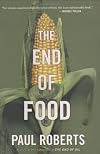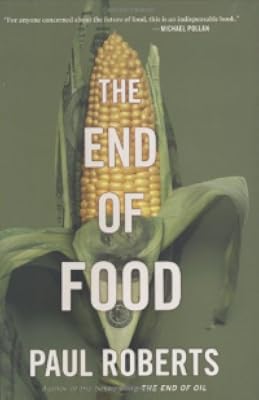
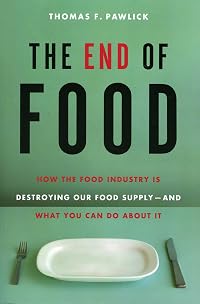
The End of Food
by Paul Roberts
On This Page
Description
The bestselling author of "The End of Oil" turns his attention to food and finds that the system entrusted with meeting one of the most basic needs is dramatically failing us. With his trademark comprehensive global approach, Roberts investigates the startling truth about the modern food system.Tags
Recommendations

Member Reviews
I really hated this book from the very first, when the author goes back to the amazing Paleolithic era when people ate so much meat and never died of diseases of "affluence" (except they did die of childbirth, routine infections, getting eaten by bears, starvation, and other really enjoyable things) and thus meat eating is what makes us human. Also, this guy is really into eating meat. And makes a lot of reductionist arguments. I just have a hard time taking anybody who seems to care about preventing the spread of preventable diseases (what? you mean taking away CAFOs and feedlots would help? but then there would be no more cheap bacon!!) who also thinks that people have no other protein source than dead cows, dead chickens, dead pigs, show more and other dead animals. Global warming, starvation, and pollution aren't going to end if everybody goes vegan. Not everybody will go vegan, or even vegetarian, and that's OK. But questioning if really cheap hamburgers and bacon is contributing to the problems is probably a first step in remedying the problems. But I think the author just has too much faith in the "free market" and capitalism and the mythical invisible hand to fix it first. show less
Do you currently, or have you ever eaten food? If your answer is yes, then this book is for you!
Paul Roberts takes the reader on a data-rich journey towards understanding the food that sits in front of them. If you've never taken the opportunity to think about the origin of your food, the journey in The End of Food will be enlightening and apocryphal at the same time. From the origin of seeds to the politics of import/export, the complexity of the food system is bluntly detailed in this book.
It is more common than not in this date and age (especially in America) to look for the "right" quick fix. Roberts doesn't offer a single, correct solution for problems evident within in the food system. Instead, the wisdom put forth is that show more sustainability must be achieved in order to gain the time to address the complex problems with complex solutions.
This book is the perfect reference tool to help the eater make more well-informed, sustainable, and healthy (for person and environment) decisions. show less
Paul Roberts takes the reader on a data-rich journey towards understanding the food that sits in front of them. If you've never taken the opportunity to think about the origin of your food, the journey in The End of Food will be enlightening and apocryphal at the same time. From the origin of seeds to the politics of import/export, the complexity of the food system is bluntly detailed in this book.
It is more common than not in this date and age (especially in America) to look for the "right" quick fix. Roberts doesn't offer a single, correct solution for problems evident within in the food system. Instead, the wisdom put forth is that show more sustainability must be achieved in order to gain the time to address the complex problems with complex solutions.
This book is the perfect reference tool to help the eater make more well-informed, sustainable, and healthy (for person and environment) decisions. show less
This is another indictment of CAPO meat assembly lines, processed food, and the unsustainability of current or "green"/"organic" methods. From reading Pollan, etc. I am used to this depressing stateof affairs. What I like about Roberts is the focus on the economic angle (people have to go from the expectation of cheap food to a historical hefty part of the house budget) and especially the cultural angle. What have we lost in the togetherness of lnegthy, communal food preparation and dining times?
This is one of the best food-related books I've read in a while. Packed with tons of facts about a huge range of food-related topics, this book somehow still managed to be an easy-reading page-turner.
It looks at the current food system - how produce and animals are treated as a commodity with the highest concern being expense, not nutrition or safety - and delves into how that affects the world. Everything from grain prices, international trade, world hunger, pandemics and consumer health are discussed. It's fantastic and my copy is so flagged with Post-It notes that it looks like I've tried to give it ruffles.
It looks at the current food system - how produce and animals are treated as a commodity with the highest concern being expense, not nutrition or safety - and delves into how that affects the world. Everything from grain prices, international trade, world hunger, pandemics and consumer health are discussed. It's fantastic and my copy is so flagged with Post-It notes that it looks like I've tried to give it ruffles.
An interesting, and some-what worrying look at the emergence, ultimate costs and short-term benefits of large-scale food production over the world and the coming crisis in the world food industry. A bit USA-centric. This isn't a "fun' book to read, but it is informative and fairly well-written.
This book definitely has an agenda, but was packed with interesting information about the production of food and the supply chains that keep supermarkets filled with food. And the description of a system that may be on the brink of collapse. One thing I think should have been included but was not was a discussion of how our pollinators are in danger from habitat loss, climate change, and the heavy use of pesticides. There are parts of China with such high residues of pesticides that bees are locally extinct and the farmers must hand-pollinate their fruit trees. In [b:Fruitless Fall: The Collapse of the Honey Bee and the Coming Agricultural Crisis|3507618|Fruitless Fall The Collapse of the Honey Bee and the Coming Agricultural show more Crisis|Rowan Jacobsen|https://i.gr-assets.com/images/S/compressed.photo.goodreads.com/books/1388522623l/3507618._SY75_.jpg|3549288], there was an interesting discussion of how colony collapse disorder may be more of a response to shipping bees around the county to pollinate huge monocultures than an actual disease. I actually think this is at least as much of a danger to our food supply as the things discussed in the book, because while our principal cereal grains are wind-pollinated, most of our vegetable, fruit, and nut producing plants require pollinators to produce at all. Of the ones that can self-pollinate, they will do so only as a last resort and will experience a severe reduction in both yield and quantity. If a reduction in meat consumption (as advocated by this book) is to be at all successful, we've got to get serious about protecting our pollinators. This issue needs a great deal more attention than it's gotten, and I think a book like this should have included it.
I also think some more of the issues surrounding organic agriculture should have been discussed, as well as the increasing loss of genetic diversity among our food crops and animals. The loss of pollinators and the continued loss of genetic diversity are at least as large of a threat to the current system as anything discussed in the book, but they weren't discussed at all. That's not to say the issues described in the book aren't serious, because they are, but simply that there are even more problems that are every bit as serious in the long run that also need to be discussed. show less
I also think some more of the issues surrounding organic agriculture should have been discussed, as well as the increasing loss of genetic diversity among our food crops and animals. The loss of pollinators and the continued loss of genetic diversity are at least as large of a threat to the current system as anything discussed in the book, but they weren't discussed at all. That's not to say the issues described in the book aren't serious, because they are, but simply that there are even more problems that are every bit as serious in the long run that also need to be discussed. show less
This book definitely has an agenda, but was packed with interesting information about the production of food and the supply chains that keep supermarkets filled with food. And the description of a system that may be on the brink of collapse. One thing I think should have been included but was not was a discussion of how our pollinators are in danger from habitat loss, climate change, and the heavy use of pesticides. There are parts of China with such high residues of pesticides that bees are locally extinct and the farmers must hand-pollinate their fruit trees. In [b:Fruitless Fall: The Collapse of the Honey Bee and the Coming Agricultural Crisis|3507618|Fruitless Fall The Collapse of the Honey Bee and the Coming Agricultural show more Crisis|Rowan Jacobsen|https://i.gr-assets.com/images/S/compressed.photo.goodreads.com/books/1388522623l/3507618._SY75_.jpg|3549288], there was an interesting discussion of how colony collapse disorder may be more of a response to shipping bees around the county to pollinate huge monocultures than an actual disease. I actually think this is at least as much of a danger to our food supply as the things discussed in the book, because while our principal cereal grains are wind-pollinated, most of our vegetable, fruit, and nut producing plants require pollinators to produce at all. Of the ones that can self-pollinate, they will do so only as a last resort and will experience a severe reduction in both yield and quantity. If a reduction in meat consumption (as advocated by this book) is to be at all successful, we've got to get serious about protecting our pollinators. This issue needs a great deal more attention than it's gotten, and I think a book like this should have included it.
I also think some more of the issues surrounding organic agriculture should have been discussed, as well as the increasing loss of genetic diversity among our food crops and animals. The loss of pollinators and the continued loss of genetic diversity are at least as large of a threat to the current system as anything discussed in the book, but they weren't discussed at all. That's not to say the issues described in the book aren't serious, because they are, but simply that there are even more problems that are every bit as serious in the long run that also need to be discussed. show less
I also think some more of the issues surrounding organic agriculture should have been discussed, as well as the increasing loss of genetic diversity among our food crops and animals. The loss of pollinators and the continued loss of genetic diversity are at least as large of a threat to the current system as anything discussed in the book, but they weren't discussed at all. That's not to say the issues described in the book aren't serious, because they are, but simply that there are even more problems that are every bit as serious in the long run that also need to be discussed. show less
Members
- Recently Added By
Lists

Houghton Mifflin Harcourt
45 works; 1 member

Books That Changed Our Perspective
423 works; 168 members

Books that don't know they belong in a bathroom
41 works; 3 members
Author Information

3 Works 1,261 Members
Paul Roberts is a regular contributor to Harper's Magazine, for which he has written about the timber industry, the auto industry, and the destruction of the Florida Everglades. A longtime observer of both business and environmental issues, Roberts is an expert on the complex interplay of economics, technology, and the environment. He lives in show more Leavenworth, Washington show less
Some Editions
Awards and Honors
Common Knowledge
- Canonical title*
- La fine del cibo
- Original title
- The End of Food
- Original publication date
- 2008
- Epigraph
- None
- Dedication
- For Hannah and Isaac
- First words
- In late October of 2006, seven weeks after the first reports that E. coli O157:H7 had been found in bags of fresh spinach, investigators working the farms in California's Salinas Valley got a break. - Prologue
In the late 1940s, anglers who fished the waters of the Hudson River near Orangetown, New York, noticed something odd about the trout they were reeling in: every year, the fish were getting larger. - Chapter 1 - Last words
- (Click to show. Warning: May contain spoilers.)Hunger has always been an invitation to make a better world, and it remains so. - Epilogue
(Click to show. Warning: May contain spoilers.)Yet as the inertia of the current system grows, it is more and more likely that whatever changes we make to our systems of food production won't be the result of a carefully considered vision for how the future of food ought to be but a series of emergency reactions to a system in overload. - Chapter 10 - Original language
- English
*Some information comes from Common Knowledge in other languages. Click "Edit" for more information.
Classifications
- Genres
- Economics, Nonfiction, General Nonfiction, Science & Nature, Food & Cooking
- DDC/MDS
- 363.8 — Society, government, & culture Social problems and social services Public Safety - Police, Crime Investigation Food supply
- LCC
- HD9000.5 .R578 — Social sciences Industries. Land use. Labor Industries. Land use. Labor Special industries and trades Agricultural industries
- BISAC
Statistics
- Members
- 502
- Popularity
- 60,158
- Reviews
- 12
- Rating
- (3.60)
- Languages
- English, Italian, Spanish
- Media
- Paper, Audiobook, Ebook
- ISBNs
- 11
- UPCs
- 1
- ASINs
- 3