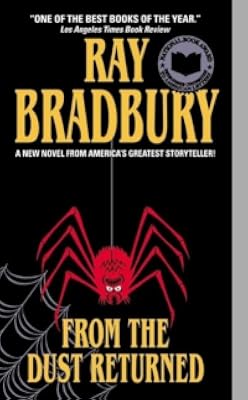
From the Dust Returned
by Ray Bradbury
On This Page
Description
Ray Bradbury, America's most beloved storyteller, has spent a lifetime carrying readers to exhilarating and dangerous places, from dark street corners in unfamiliar cities and towns to the edge of the universe. Now, in an extraordinary flight of the imagination a half-century in the making, he takes us to a most wondrous destination: into the heart of an Eternal Family.They have lived for centuries in a house of legend and mystery in upper Illinois-and they are not like other Midwesterners. show more Rarely encountered in daylight hours, their children are curious and wild; their old ones have survived since before the Sphinx first sank its paws deep in Egyptian sands. And some sleep in beds with lids.Now the house is being readied in anticipation of the gala homecoming that will gather together the far-flung branches of this odd and remarkable family. In the past-midnight stillness can be detected the soft fluttering of Uncle Einar's wings. From her realm of sleep, Cecy, the fairest and most special daughter, can feel the approach of many a welcome being-shapeshifter, telepath, somnambulist, vampire-as she flies high in the consciousness of bird and bat.But in the midst of eager anticipation, a sense of doom pervades. For the world is changing. And death, no stranger, will always shadow this most singular family: Father, arisen from the Earth; Mother, who never sleeps but dreams; A Thousand Times Great Grandmére; Grandfather, who keeps the wildness of youth between his ears.And the boy who, more than anyone, carries the burden of time on his shoulders: Timothy, the sad and different foundling son who must share it all, remember, and tell … and who, alone out of all of them, must one day age and wither and die.By turns lyrical, wistful, poignant, and chilling, From the Dust Returned will surely be numbered among Ray Bradbury's most enduring masterworks. "Bradbury weaves his magic as he introduces the Elliot family…a bit at a time." "Funny, beautiful, sad, and wise…Full of wide-eyed wonder and dazzling imagery, the story retains as an integrated whole all its original freshness and charm." "Written in trademark Bradbury style, the book reads like liquid poetry while telling the interconnected stories of a number of unusual yet strangely familiar family members…A new novel by Bradbury is an event worth noting, and this is a necessary purchase for all public libraries.". show lessTags
Recommendations


















Member Recommendations
isabelx Otherworldly extended families.
Member Reviews
Nobody writes like Ray Bradbury wrote. His word choice is sublime, and his sentences are lyrical masterpieces. His stories, especially in this volume, are amusing, and thought-provoking, but above all, they speak directly to your heart.
This is a low-key story of a strange and wonderful family who might be vampires, but they may be something else too. And I think that's one of the things I love about Bradbury...he tells you wonderful stories, but he also leaves a lot of room for the reader to roam around in and make their own discoveries.
In some ways, I found this book to be the spiritual brother to The Martian Chronicles, but with a more horror leaning, instead of a science fiction one.
I adored every line of this book. I wish more show more authors could write like this. I think the closest we have now is Neil Gaiman, though there's times Charles L. Grant and Clive Barker wandered into Bradbury's sandbox to play as well.
But nobody can do Bradbury like Bradbury. I miss him. show less
This is a low-key story of a strange and wonderful family who might be vampires, but they may be something else too. And I think that's one of the things I love about Bradbury...he tells you wonderful stories, but he also leaves a lot of room for the reader to roam around in and make their own discoveries.
In some ways, I found this book to be the spiritual brother to The Martian Chronicles, but with a more horror leaning, instead of a science fiction one.
I adored every line of this book. I wish more show more authors could write like this. I think the closest we have now is Neil Gaiman, though there's times Charles L. Grant and Clive Barker wandered into Bradbury's sandbox to play as well.
But nobody can do Bradbury like Bradbury. I miss him. show less
FROM THE DUST RETURNED [William Morrow,2001] is a collection of Bradbury's short stories, written over many decades, with new material added to connect them into a cohesive narrative, concerning the macabre, loving and supernatural Elliott family, who gather for a festive homecoming at their Illinois ancestral home.
"The Addams Family" and "The Munsters" -- without the comedic kitsch. Charles Addams cover art for the dustjacket comes from Ray's story "Homecoming"'s first appearance in MADEMOISELLE magazine, OCT 1946, where the editors and publisher "had debated changing the story to fit the magazine, but instead (changed) the magazine to fit the story." [p.202]
This is a tale of "family, immortality, and the human condition seen through show more the eyes of its monstrous yet heartfelt characters," including the boy Timothy, who is different from the rest of his immortal family by being "natural," non-monstrous, mundane.
That is: human.
And, as demonstrated by his loving supernatural family, that is just fine.
Be you.
Be loved. ❤️ show less
"The Addams Family" and "The Munsters" -- without the comedic kitsch. Charles Addams cover art for the dustjacket comes from Ray's story "Homecoming"'s first appearance in MADEMOISELLE magazine, OCT 1946, where the editors and publisher "had debated changing the story to fit the magazine, but instead (changed) the magazine to fit the story." [p.202]
This is a tale of "family, immortality, and the human condition seen through show more the eyes of its monstrous yet heartfelt characters," including the boy Timothy, who is different from the rest of his immortal family by being "natural," non-monstrous, mundane.
That is: human.
And, as demonstrated by his loving supernatural family, that is just fine.
Be you.
Be loved. ❤️ show less
The family that Bradbury chronicles in this novel are truely the October People. They are everything that dwells in the shadows, takes wing during the night, whispers secrets of death and dying, and whom live among us in disguise. These characters with their strange powers are frightening in premise, but Bradbury writes them like they are any extended, worldly family full of strange aunts, uncles, and nephews. They interact with eachother as any family does, fighting or convalescing at times, but they have a distance of blood that separates them from the world. All told, this novel is written with poetic distinction and the perfect amount of linguistic flourish to capture those of us who are October Readers at heart.
Ray Bradbury is one of my favorite authors. The more I read his work, the more I admire him. The man is a genius with words and creates some of the most interesting characters ever to grace a page. From the Dust Returned is no exception. It is the extended play version of his brilliant short story, The Homecoming,
As with many of Bradbury's novels, From the Dust Returned is actually a compilation of short stories, several of which have been published individually over the past 60 years. The stories are held together with loosely connecting chapters which gives them the continuity needed to form a novel.
What is really neat about From the Dust Returned is that we learn the beginnings of the Elliot family, their wonderfully creepy house, show more and just how the human boy Timothy came to be part of this ghoulish family. It also extends the events after the Homecoming, and surprisingly, reveals a huge dilemma for the dead: no one believes in them any more. Because of this, all the ghosts and ghouls are being forced from their homes and into oblivion.
One of the most moving chapters was the story of Miss Minerva Halliday, a nurse and passenger on the Orient Express, and the ghost she encounters and befriends on her journey. He seems to be visibly melting before her eyes:
"He arrived this night, moving with a terrible slowness, to sit across the aisle from this woman of some years, her bosom like a fortress, her brow serene, her eyes filled with a kindness that had mellowed with time. There was a black medical bag at her side, and a thermometer tucked in her mannish lapel pocket. The ghastly man's paleness caused her left hand to crawl up along her lapel to touch her thermometer.
"Oh, dear," whispered Miss Minerva Halliday. The maitre d' was passing. She touched his elbow and nodded across the aisle.
"Pardon, but where is that poor man going?" "Calais and London, madam. If God is willing." And he hurried off.
Minerva Halliday, her appetite gone, stared across at that skeleton made of snow. The man and the cutlery laid before him seemed one. The knives, forks and spoons jingled with a silvery cold sound. He listened, fascinated, as if to the voice of his inner soul as the cutlery crept, touched, chimed; a tintinnabulation from another sphere. His hands lay in his lap like lonely pets, and when the train swerved around a long curve his body, mindless, swayed now this way, now that, toppling.
At which moment the train took a greater curve, and knocked the silverware chittering. A woman at a far table, laughing, cried out: "I don't believe it!" To which a man with a louder laugh shouted: "Nor do I!" This coincidence caused, in the ghastly passenger, a terrible melting. The doubting laughter had pierced his ears. He visibly shrank. His eyes hollowed and one could almost imagine a cold vapor gasped from his mouth.
Miss Minerva Halliday, shocked, leaned forward and put out one hand. She heard herself whisper: "I believe." The effect was instantaneous. The ghastly passenger sat up. Color returned to his white cheeks. His eyes glowed with a rebirth of fire." (pgs. 103-105)
Bradbury's message in this book is clear. He wants us to remember these stories, these ghouls and ghosts, and to not forget those who have gone before us. show less
As with many of Bradbury's novels, From the Dust Returned is actually a compilation of short stories, several of which have been published individually over the past 60 years. The stories are held together with loosely connecting chapters which gives them the continuity needed to form a novel.
What is really neat about From the Dust Returned is that we learn the beginnings of the Elliot family, their wonderfully creepy house, show more and just how the human boy Timothy came to be part of this ghoulish family. It also extends the events after the Homecoming, and surprisingly, reveals a huge dilemma for the dead: no one believes in them any more. Because of this, all the ghosts and ghouls are being forced from their homes and into oblivion.
One of the most moving chapters was the story of Miss Minerva Halliday, a nurse and passenger on the Orient Express, and the ghost she encounters and befriends on her journey. He seems to be visibly melting before her eyes:
"He arrived this night, moving with a terrible slowness, to sit across the aisle from this woman of some years, her bosom like a fortress, her brow serene, her eyes filled with a kindness that had mellowed with time. There was a black medical bag at her side, and a thermometer tucked in her mannish lapel pocket. The ghastly man's paleness caused her left hand to crawl up along her lapel to touch her thermometer.
"Oh, dear," whispered Miss Minerva Halliday. The maitre d' was passing. She touched his elbow and nodded across the aisle.
"Pardon, but where is that poor man going?" "Calais and London, madam. If God is willing." And he hurried off.
Minerva Halliday, her appetite gone, stared across at that skeleton made of snow. The man and the cutlery laid before him seemed one. The knives, forks and spoons jingled with a silvery cold sound. He listened, fascinated, as if to the voice of his inner soul as the cutlery crept, touched, chimed; a tintinnabulation from another sphere. His hands lay in his lap like lonely pets, and when the train swerved around a long curve his body, mindless, swayed now this way, now that, toppling.
At which moment the train took a greater curve, and knocked the silverware chittering. A woman at a far table, laughing, cried out: "I don't believe it!" To which a man with a louder laugh shouted: "Nor do I!" This coincidence caused, in the ghastly passenger, a terrible melting. The doubting laughter had pierced his ears. He visibly shrank. His eyes hollowed and one could almost imagine a cold vapor gasped from his mouth.
Miss Minerva Halliday, shocked, leaned forward and put out one hand. She heard herself whisper: "I believe." The effect was instantaneous. The ghastly passenger sat up. Color returned to his white cheeks. His eyes glowed with a rebirth of fire." (pgs. 103-105)
Bradbury's message in this book is clear. He wants us to remember these stories, these ghouls and ghosts, and to not forget those who have gone before us. show less
From the Dust Returned is an interesting little novel, partially about a young human boy who is adopted by a house haunted by a family of immortal beings. Some have wings and can fly, some can send their minds into other living things and experience life through them, and some just like to sleep all day in coffins in the basement. It is frequently compared to The Addams Family - of course due in part because Charles Addams did the art for the cover - but it's not an unfair comparison. It's pleasantly macabre, with cousins who sleep in coffins, uncles who have wings, and women rising from their graves to give advice on life and death to a 10 year old. I suppose you could say it's mysterious and spooky (and altogether ooky?) and to say it show more is similar to The Addams Family or A Nightmare Before Christmas is perfectly reasonable.
I say it's "partially" about the adopted boy because it is also, to some extent, a collection of short stories, dipping out of the main storyline frequently to give you a little snippet of one of the family member's lives. These portions of the novel were a bit of a drag, unfortunately. When Bradbury focuses on the main story, on the house and it's occupants (Timmy, Cecy, and their parents) I found the story and the writing to be absolutely riveting. The characters are memorable and full of personality, and the same can be said for every individual sentence. The prose is lyrical and infinitely quotable. Each sentence was like tangible brilliance for my synapses. I didn't want to read too fast so I could soak up every word of it. It was magnificent, I only wish this could have been maintained throughout the novel.
Unfortunately this is only the case for the first 80 pages or so, after that the storyline and writing become a little spotty. Within the following 90 pages or so there are inklings of the brilliance of the first 80, but they are mixed in with bland and sub-par ghost stories. While the stories are okay, I found myself not caring and eagerly anticipating the return of Tim and Cecy. Fortunately, the final 30 pages or so return to the house and the story is tied up nicely. I suppose this is the result of how the book is written, over a 50 year period. You can tell what parts were written slowly over time with so many years of dedication and attention, and which parts were copy and pasted from old magazines. The book definitely would have benefited, for the most part, without the old short stories.
Overall, I highly enjoyed the novel. The worst parts aren't bad, they just aren't as mind-meltingly great as the more well-written chapters. While this can seem like a hindrance while it's being read, ultimately I found it well worth my time and I'm glad I gave the book a chance. show less
I say it's "partially" about the adopted boy because it is also, to some extent, a collection of short stories, dipping out of the main storyline frequently to give you a little snippet of one of the family member's lives. These portions of the novel were a bit of a drag, unfortunately. When Bradbury focuses on the main story, on the house and it's occupants (Timmy, Cecy, and their parents) I found the story and the writing to be absolutely riveting. The characters are memorable and full of personality, and the same can be said for every individual sentence. The prose is lyrical and infinitely quotable. Each sentence was like tangible brilliance for my synapses. I didn't want to read too fast so I could soak up every word of it. It was magnificent, I only wish this could have been maintained throughout the novel.
Unfortunately this is only the case for the first 80 pages or so, after that the storyline and writing become a little spotty. Within the following 90 pages or so there are inklings of the brilliance of the first 80, but they are mixed in with bland and sub-par ghost stories. While the stories are okay, I found myself not caring and eagerly anticipating the return of Tim and Cecy. Fortunately, the final 30 pages or so return to the house and the story is tied up nicely. I suppose this is the result of how the book is written, over a 50 year period. You can tell what parts were written slowly over time with so many years of dedication and attention, and which parts were copy and pasted from old magazines. The book definitely would have benefited, for the most part, without the old short stories.
Overall, I highly enjoyed the novel. The worst parts aren't bad, they just aren't as mind-meltingly great as the more well-written chapters. While this can seem like a hindrance while it's being read, ultimately I found it well worth my time and I'm glad I gave the book a chance. show less
I am in love, absolutely in love with Bradbury's brand of paranormal, offbeat and odd stories. This entire novel focuses on the Elliot family - 55 years of love and infrequent labour apparently based in some parts on Bradbury's own family gatherings. It is, essentially, a collection of short stories that tell a longer story. Favourites for me are "West of October" and "On the Orient North" but I found the rest of the book to be delightfully crafted. Recommended if you're a fan of Bradbury's short stories and prose.
Essentially a collection of earlier materials, some of which had been published and some not, regarding the Elliot family - a supernatural collection of ghouls and such in an old manse getting up to mischief. I know, that sounds like The Addams Family, and the cover art was drawn by the same man who created Wednesday and Mortitia. But Charles Addams had already created the Addams when he met [[Ray Bradbury]], and they intended on collaborating on a book with the Elliots where Addams would provide the art and Bradbury the text. Sadly, it never happened.
I'm a huge Bradbury fan, and I quite enjoyed the shenanigans here, and the hypnotic voice. But it's not Bradbury's best work, and perhaps it suffers because it didn't get the unified show more narrative that one expects. Nonetheless, quite enjoyable.
Highly recommended.
4 bones!!!! show less
I'm a huge Bradbury fan, and I quite enjoyed the shenanigans here, and the hypnotic voice. But it's not Bradbury's best work, and perhaps it suffers because it didn't get the unified show more narrative that one expects. Nonetheless, quite enjoyable.
Highly recommended.
4 bones!!!! show less
Members
- Recently Added By
Published Reviews
ThingScore 100
added by DoctorDebt
Lists

Bloody Good Vampire Books
394 works; 28 members

Nightmare Magazine's Top 100 Horror Books
100 works; 7 members

Ghosts
278 works; 18 members

Vampires: A Biteography
85 works; 5 members

Books Read in 2016
4,666 works; 199 members

Halloween Stories
31 works; 5 members

Autumn books
31 works; 8 members

Jones & Newman: Best Horror Books Further Recommended Reading
577 works; 4 members
Author Information

942+ Works 168,881 Members
Ray Bradbury was born in Waukegan, Illinois on August 22, 1920. At the age of fifteen, he started submitting short stories to national magazines. During his lifetime, he wrote more than 600 stories, poems, essays, plays, films, television plays, radio, music, and comic books. His books include The Martian Chronicles, Fahrenheit 451, The show more Illustrated Man, Dandelion Wine, Something Wicked This Way Comes, and Bradbury Speaks. He won numerous awards for his works including a World Fantasy Award for Life Achievement in 1977, the 2000 National Book Foundation Medal for Distinguished Contribution to American Letters, the 2004 National Medal of Arts, and the 2007 Pulitzer Prize Special Citation. He wrote the screen play for John Huston's classic film adaptation of Moby Dick, and was nominated for an Academy Award. He adapted 65 of his stories for television's The Ray Bradbury Theater, and won an Emmy for his teleplay of The Halloween Tree. The film The Wonderful Ice Cream Suit was written by Ray Bradbury and was based on his story The Magic White Suit. He was the idea consultant and wrote the basic scenario for the United States pavilion at the 1964 World's Fair, as well as being an imagineer for Walt Disney Enterprises, where he designed the Spaceship Earth exhibition at Walt Disney World's Epcot Center. He died after a long illness on June 5, 2012 at the age of 91. (Bowker Author Biography) show less
Some Editions
Awards and Honors
Awards
Distinctions
Series
Belongs to Publisher Series
Common Knowledge
- Canonical title
- From the Dust Returned
- Original title
- From the Dust Returned
- Original publication date
- 2001
- People/Characters
- Timothy; Cecy; Great Grandmere Nef; Father; Mother; Uncle Einar (show all 14); Minerva Halliday; The Ghastly Passenger; Great Grandpere; Tom; Ann Leary; Angelina Marguerite; John the Terrible; Brunilla Wexley
- Dedication
- To the two midwives of this book: Don Congdon, who was in at the beginning in 1946, and Jennifer Brehl, who helped bring it to completion in 2000. With gratitude and love.
- First words
- In the attic where the rain touched the roof softly on spring days and where you could feel the mantle of snow outside, a few inches away, on December nights, A Thousand Times Great Grandmere existed.
- Last words
- (Click to show. Warning: May contain spoilers.)"Listen," said Timothy.
- Original language
- English
Classifications
Statistics
- Members
- 1,892
- Popularity
- 11,385
- Reviews
- 49
- Rating
- (3.79)
- Languages
- 12 — Chinese, Czech, English, French, German, Italian, Japanese, Portuguese, Russian, Spanish, Turkish, Ukrainian
- Media
- Paper, Audiobook, Ebook
- ISBNs
- 37
- UPCs
- 1
- ASINs
- 13