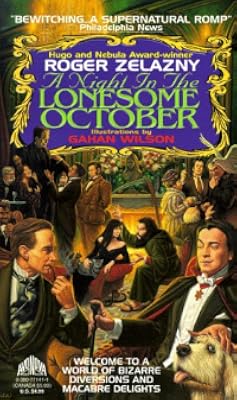
A Night in the Lonesome October
by Roger Zelazny
On This Page
Description
Loyally accompanying a mysterious knife-wielding gentleman named Jack on his midnight rounds through the murky streets of London, good dog Snuff is busy helping his master collect the grisly ingredients needed for an unearthly rite that will take place not long after the death of the moon. But Snuff and his master are not alone. All manner of participants, both human and not, are gathering with their ancient tools and their animal familiars in preparation for the dread night. It is brave, show more devoted Snuff who must calculate the patterns of the Game and keep track of the Players - the witch, the mad monk, the vengeful vicar, the Count who sleeps by day, the Good Doctor and the hulking Experiment Man he fashioned from human body parts, and a wild-card American named Larry Talbot - all the while keeping Things at bay and staying a leap ahead of the Great Detective, who knows quite a bit more than he lets on. Boldly original and wildly entertaining, A Night in the Lonesome October is a darkly sparkling gem, an amalgam of horror, humor, mystery, and fantasy. First published in 1993, it was Zelazny's last book prior to his untimely death. Many consider it the best of the fantasy master's novels. It has inspired many fans to read it every year in October, a chapter a day, and served as inspiration for Neil Gaiman's brilliant story "Only the End of the World Again.". show lessTags
Recommendations












Member Recommendations
WildMaggie Gaiman has acknowledged his debt to Zelanzy. It echoes in Good Omens.
40
PghDragonMan Odd characters caught up in odd happenings as told by master storytellers.

Member Reviews
Reread. First read this the year it came out, and have read it a few times since then. Holds up. Zelazny was so good at achieving a tone and vibe that makes you want to inhabit the world of his novel, and that's true even in this gruesome and macabre version of Earth. That's me, hanging out with Jack the Ripper and the Wolfman, with Frankenstein petting a cat in the background.
I wanted to know why so many people reread this in October. Now I know why!
Ah, what a romp! What a delight! What a homage to everything gothic, to horror fiction, to sensational Victorian fiction… Name a supernatural thing or a cosmic horror thing, it looks like this book has them all. (No ghosts, though.)
Our POV character is Snuff, a very special watchdog. He is badass! I have a strong suspicion that Snuff used to work as a hellhound. Nowadays Snuff fetches master Jack’s wand, makes sure Things they have around the house don’t get out, does his rounds, investigates, makes friends with/enemies of other animal companions. Other animal companions? Yes, the little English village where we are has a very high concentration of people show more and animals that meddle with stuff they really shouldn’t meddle with. They are playing a dangerous game – our whole universe is at stake. Ooops. Come on, can’t you do regular everyday magic instead?
There is so much to love here:
That scene in the graveyard is to die for (ha ha). You’ll know what I mean if you read the book.
There is a Great Detective (and his friend). They are lurking about trying to understand what everyone is up to.
Is there a cat? Of course there is a cat. Her name is Graymalk and she is awesome.
The ending is perfect!
Favourite quotes:
”When I was near enough to catch it with a short lunge I said, ”I trust you are finding your last moments amusing.”
”I took Jack his slippers this evening and lay at his feet before a roaring fire while he smoked his pipe, sipped sherry, and read the newspaper. He read aloud everything involving killings, arsons, mutilations, grave robberies, church desecrations, and unusual thefts. It is very pleasant just being domestic sometimes.”
”’Creature of the Night,’” he said. ”’Living Blasphemy.’ You are safe here. You can even have a peach if you’d like.”
”…a cat may know that which Elder Gods do not.” show less
Ah, what a romp! What a delight! What a homage to everything gothic, to horror fiction, to sensational Victorian fiction… Name a supernatural thing or a cosmic horror thing, it looks like this book has them all. (No ghosts, though.)
Our POV character is Snuff, a very special watchdog. He is badass! I have a strong suspicion that Snuff used to work as a hellhound. Nowadays Snuff fetches master Jack’s wand, makes sure Things they have around the house don’t get out, does his rounds, investigates, makes friends with/enemies of other animal companions. Other animal companions? Yes, the little English village where we are has a very high concentration of people show more and animals that meddle with stuff they really shouldn’t meddle with. They are playing a dangerous game – our whole universe is at stake. Ooops. Come on, can’t you do regular everyday magic instead?
There is so much to love here:
That scene in the graveyard is to die for (ha ha). You’ll know what I mean if you read the book.
There is a Great Detective (and his friend). They are lurking about trying to understand what everyone is up to.
Is there a cat? Of course there is a cat. Her name is Graymalk and she is awesome.
The ending is perfect!
Favourite quotes:
”When I was near enough to catch it with a short lunge I said, ”I trust you are finding your last moments amusing.”
”I took Jack his slippers this evening and lay at his feet before a roaring fire while he smoked his pipe, sipped sherry, and read the newspaper. He read aloud everything involving killings, arsons, mutilations, grave robberies, church desecrations, and unusual thefts. It is very pleasant just being domestic sometimes.”
”’Creature of the Night,’” he said. ”’Living Blasphemy.’ You are safe here. You can even have a peach if you’d like.”
”…a cat may know that which Elder Gods do not.” show less
"Loyally accompanying a mysterious knife-wielding gentleman named Jack on his midnight rounds through the murky streets of London, good dog Snuff is busy helping his master collect the grisly ingredients needed for an unearthly rite that will take place not long after the death of the moon. But Snuff and his master are not alone. All manner of participants, both human and not, are gathering with their ancient tools and their animal familiars in preparation for the dread night. It is brave, devoted Snuff who must calculate the patterns of the Game and keep track of the Players—the witch, the mad monk, the vengeful vicar, the Count who sleeps by day, the Good Doctor and the hulking Experiment Man he fashioned from human body parts, and show more a wild-card American named Larry Talbot—all the while keeping Things at bay and staying a leap ahead of the Great Detective, who knows quite a bit more than he lets on.
Boldly original and wildly entertaining, A Night in the Lonesome October is a darkly sparkling gem, an amalgam of horror, humor, mystery, and fantasy. First published in 1993, it was Zelazny’s last book prior to his untimely death. Many consider it the best of the fantasy master’s novels. It has inspired many fans to read it every year in October, a chapter a day, and served as inspiration for Neil Gaiman’s brilliant story “Only the End of the World Again.” show less
Boldly original and wildly entertaining, A Night in the Lonesome October is a darkly sparkling gem, an amalgam of horror, humor, mystery, and fantasy. First published in 1993, it was Zelazny’s last book prior to his untimely death. Many consider it the best of the fantasy master’s novels. It has inspired many fans to read it every year in October, a chapter a day, and served as inspiration for Neil Gaiman’s brilliant story “Only the End of the World Again.” show less
‘A Night In The Lonesome October‘ was my first Roger Zelazny novel, which is surprising given I've been reading Science fiction since the 1970s Zelazny won six Hugo awards, three Nebula awards and two Locus awards between 1968 and 1986.
I picked up 'A Night In The Lonesome October' because it was a good fit for Halloween Bingo, especially the Halloween square. To my surprise, I fell in love with the book. It's original, engaging and quietly uplifting.
It tells the story of a strange metaphysical struggle for the fate of mankind that occurs each time there is a full moon on Halloween. It’s a conflict that repetition and ritual have turned into a deadly game with rules and traditions that the players must obey or suffer show more consequences.
The game draws monsters and villains from classic horror stories to become players. Each player has an animal as a familiar. At the start of the game, players don’t know which of their fellows is an enemy or an ally.
I liked that the story was told in the form of a chapter for each day in October, building to the final conflict on Halloween.
For me, the story worked as well as it did because it was told entirely from the point of view of Snuff, the dog, familiar to Jack, a man who carries a very large knife when he goes hunting in London’s East End. I liked Snuff. He was calm, rational, as friendly as circumstances would allow and treated players and familiars fairly. He accepted the importance of winning the game for his side and was determined to do his duty, but he didn’t allow that to become an excuse for treating others badly.
I liked that Snuff's main interactions were with the other familiars rather than the players. It gave Snuff more agency, allowed him to develop alliances and even friendships, and kept the famous personalities at arm's-length.
I had fun trying to work out who all the characters were based on. It didn't take me long to decide that the characters included Jack The Ripper, Sherlock Holmes, Victor Frankenstein and Count Dracula but I couldn't name the rest. A friend pointed me at a post in The Lovecraft eZine which offers some interesting suggestions "Fallen Books and Other Subtle Clues in Zelazny’s “A Night in the Lonesome October”, by Dr. Christopher S. Kovacs"
The book was imbued with quiet hope and gentle humour, and I admired the boldness and originality of the story. I think it is one I will come back to in another October and read a chapter each day.
I listened to the 2025 audiobook version, narrated by Matt Godfrey. I was a little surprised that the book was narrated in an American accent (Yes, I know Zelazny was American, but the characters in the novel aren't). I was soon won over by how easy Matt Godfrey was to listen to and how well he managed the large cast of character voices. Click on the YouTube link below to hear a sample.
https://www.youtube.com/watch?v=hII4yppWvbw show less
I picked up 'A Night In The Lonesome October' because it was a good fit for Halloween Bingo, especially the Halloween square. To my surprise, I fell in love with the book. It's original, engaging and quietly uplifting.
It tells the story of a strange metaphysical struggle for the fate of mankind that occurs each time there is a full moon on Halloween. It’s a conflict that repetition and ritual have turned into a deadly game with rules and traditions that the players must obey or suffer show more consequences.
The game draws monsters and villains from classic horror stories to become players. Each player has an animal as a familiar. At the start of the game, players don’t know which of their fellows is an enemy or an ally.
I liked that the story was told in the form of a chapter for each day in October, building to the final conflict on Halloween.
For me, the story worked as well as it did because it was told entirely from the point of view of Snuff, the dog, familiar to Jack, a man who carries a very large knife when he goes hunting in London’s East End. I liked Snuff. He was calm, rational, as friendly as circumstances would allow and treated players and familiars fairly. He accepted the importance of winning the game for his side and was determined to do his duty, but he didn’t allow that to become an excuse for treating others badly.
I liked that Snuff's main interactions were with the other familiars rather than the players. It gave Snuff more agency, allowed him to develop alliances and even friendships, and kept the famous personalities at arm's-length.
I had fun trying to work out who all the characters were based on. It didn't take me long to decide that the characters included Jack The Ripper, Sherlock Holmes, Victor Frankenstein and Count Dracula but I couldn't name the rest. A friend pointed me at a post in The Lovecraft eZine which offers some interesting suggestions "Fallen Books and Other Subtle Clues in Zelazny’s “A Night in the Lonesome October”, by Dr. Christopher S. Kovacs"
The book was imbued with quiet hope and gentle humour, and I admired the boldness and originality of the story. I think it is one I will come back to in another October and read a chapter each day.
I listened to the 2025 audiobook version, narrated by Matt Godfrey. I was a little surprised that the book was narrated in an American accent (Yes, I know Zelazny was American, but the characters in the novel aren't). I was soon won over by how easy Matt Godfrey was to listen to and how well he managed the large cast of character voices. Click on the YouTube link below to hear a sample.
https://www.youtube.com/watch?v=hII4yppWvbw show less
The Game is afoot! This chapter-a-day story is set in a year when there is a full moon on Halloween, and the Door between our world and another dimension can be opened, allowing the Elder Gods to cross over. The Players gather in a remote area near London where, they have calculated, the Door can be found, but who exactly are the Players? Which of them are Openers and which Closers? Will any of them still be alive when the time to Open/Close the Door arrives? And where the heck is that damn Door anyway? This fun story is a paeon to classic horror books and films and is one of my favorite annual Spooktober reads. Note that the first time I read it in 2021 was as a hardback, with the wonderful Gahan Wilson illustrations. Next I read it as show more an ebook, also with Wilson's illustrations, and finally I bought the audiobook, narrated by Matt Godfrey, who did a fantastic job with all the voices. show less
Then came a tale to fit my reading mood ....
Requested this Hallowe'en story on impulse from library loan, perhaps the very day I learned of it, uncertain I would retrieve it once arrived -- or if I did, that I'd take time away from several books underway. Once begun, though, there was no going back.
Zelazny's tale is at once a pastiche of Hallowe'en icons across a variety of traditions (cinema, horror fiction, supernatural folklore & myth) and a genre mashup of detective yarn / whodunnit / sword & sorcery quest. The prose is serious, the tone is arch, and Zelazny's very much taking the reader for a ride. Yet the result is anything but throwaway, more like the pleasure of a good pop lyric and how marvelously it does what you knew it show more would do all along.
The story is best enjoyed as revealed on the page, I'll note no details here. I will state, however, that having turned the final page, I was sufficiently motivated to devote an hour or more researching hinted allusions and to figure the rules. The tale is simple at heart, yet like an elegant game its premise affords a multitude of outcomes, and once in motion it's not clear how the pieces will fall nor who will triumph. Atop all this, it is a tale cleverly told, both in structure and in the elegance of individual lines, so there are layers to be enjoyed.
//
2017: I picked up Zelazny's A Night In The Lonesome October at the same time as Bradbury's The Halloween Tree, wondering which of these two books would best fit my impulse for a Hallowe'en read. Intriguingly, I'd not heard of either title before and then they were mentioned almost together. Though clearly different novels, each was warmly recommended in its own way. I was somewhat surprised Zelazny's impressed me more. An oddly poignant reminder that a text will offer an individual experience to each new reader, no matter how similar or sympathetic the interests or backgrounds those readers may share.
2021: Attempted communal read-aloud with family, and started strong but collective interest fragmented and finished with my Other Reader late. show less
Requested this Hallowe'en story on impulse from library loan, perhaps the very day I learned of it, uncertain I would retrieve it once arrived -- or if I did, that I'd take time away from several books underway. Once begun, though, there was no going back.
Zelazny's tale is at once a pastiche of Hallowe'en icons across a variety of traditions (cinema, horror fiction, supernatural folklore & myth) and a genre mashup of detective yarn / whodunnit / sword & sorcery quest. The prose is serious, the tone is arch, and Zelazny's very much taking the reader for a ride. Yet the result is anything but throwaway, more like the pleasure of a good pop lyric and how marvelously it does what you knew it show more would do all along.
The story is best enjoyed as revealed on the page, I'll note no details here. I will state, however, that having turned the final page, I was sufficiently motivated to devote an hour or more researching hinted allusions and to figure the rules. The tale is simple at heart, yet like an elegant game its premise affords a multitude of outcomes, and once in motion it's not clear how the pieces will fall nor who will triumph. Atop all this, it is a tale cleverly told, both in structure and in the elegance of individual lines, so there are layers to be enjoyed.
//
2017: I picked up Zelazny's A Night In The Lonesome October at the same time as Bradbury's The Halloween Tree, wondering which of these two books would best fit my impulse for a Hallowe'en read. Intriguingly, I'd not heard of either title before and then they were mentioned almost together. Though clearly different novels, each was warmly recommended in its own way. I was somewhat surprised Zelazny's impressed me more. An oddly poignant reminder that a text will offer an individual experience to each new reader, no matter how similar or sympathetic the interests or backgrounds those readers may share.
2021: Attempted communal read-aloud with family, and started strong but collective interest fragmented and finished with my Other Reader late. show less
A fun Halloween read. Nothing too heavy - just the end of humanity if the door holding back the elder gods is opened at the death of the moon on All Hallows Eve! The game is afoot and the fate of the world hangs in the balance! It's up to a dog named Snuff to help his master Jack, (who is good with knives), figure out not only the identities of all the other players, but also which side they are on and also the location of the afore-mentioned metaphysical door.
Whew! That's a lot of stuff to figure out in only one short month! Luckily, Snuff has a talent for math and cartography. He is also good at creating temporary alliances with other familiars who might be able to help him get to the bottom of a myriad of mysteries. He'd better hurry show more though because The Great Detective and his sidekick are also on the case.
This is another great first-person narrative from Zelazny. He was an absolute master of the form and here he doles out the pieces at a perfect pace via the diary entries of Snuff the dog. There is great dialogue, mysterious happenings, clever character allusions, and plenty of that wry Zelazny humor that is his hallmark. A very enjoyable October read. show less
Whew! That's a lot of stuff to figure out in only one short month! Luckily, Snuff has a talent for math and cartography. He is also good at creating temporary alliances with other familiars who might be able to help him get to the bottom of a myriad of mysteries. He'd better hurry show more though because The Great Detective and his sidekick are also on the case.
This is another great first-person narrative from Zelazny. He was an absolute master of the form and here he doles out the pieces at a perfect pace via the diary entries of Snuff the dog. There is great dialogue, mysterious happenings, clever character allusions, and plenty of that wry Zelazny humor that is his hallmark. A very enjoyable October read. show less
Members
- Recently Added By
Published Reviews
ThingScore 88
Part of the enjoyment of A Night in the Lonesome October comes from recognizing obvious characters and puzzling over the identities of the elusive ones. When I wrote about the origins of this novel in Zelazny’s biography, I took the opportunity to identify the characters I was certain about. Then upon re-reading the novel last year, I became determined to identify everyone. When I stumbled show more upon the connection to Virginia Woolf (a writer whose works Zelazny admired), I knew that I had a new essay to write. I also wanted it to be accessible to readers who’d enjoy this kind of thing, and so it appeared in The New York Review of Science Fiction. But the identity game may never end. Only Zelazny knew for certain who was who (or did he?), and a NYRSF reader quickly pointed out a better inspiration for the raven Tekela than what I’d proposed. Some readers may dispute my conclusions and others may not want help unmasking the characters. But for those who do want a Who’s Who in A Night in the Lonesome October, here’s a newly revised and accessible version. And what better place for it than an issue of Lovecraft eZine that is offered in tribute to the novel and the author? show less
added by elenchus
Zelazny chronicles the game's unfolding strategy with a lively, convincing canine eye for detail and a cheerful nod to the vintage movies and books from which he's drawn his cast of characters. There's melodramatic thrill and wry wit in generous proportions, and the dark and comic aspects of the tale complement each other with unusual aptness.
added by Nevov
Lists

Scary Stories for the Season
160 works; 94 members

Favorite Animal Fiction
359 works; 156 members
Nonhuman Protagonists
243 works; 35 members

Top Five Books of 2014
1,064 works; 398 members

Readers Guide to Steampunk
65 works; 1 member

BingoDOG - Animals in Adult Fiction
78 works; 20 members

Books Read in 2020
4,379 works; 124 members

Books Read in 2021
5,361 works; 114 members

Books Read in 2022
5,226 works; 112 members

Witchy Fiction
253 works; 126 members

Overdue Podcast
808 works; 9 members

Reading Glasses Podcast
410 works; 3 members
Best Vampire & Werewolf Fiction
221 works; 146 members

Books Read in 2024
4,727 works; 128 members

Books Read in 2025
4,128 works; 98 members
Author Information

338+ Works 72,917 Members
Roger Zelazny was born in Euclid, Ohio on May 13, 1937. After receiving a B.A. from Case Western Reserve University and a M.A. from Columbia University, he began publishing science fiction stories in 1962. He received six Hugo awards, three Nebula awards including one in 1966 for And Call Me Conrad and 2 Locus awards. He died of kidney failure show more secondary to colorectal cancer on June 14, 1995. (Bowker Author Biography) show less
Some Editions
Awards and Honors
Awards
Series
Belongs to Publisher Series
Work Relationships
Common Knowledge
- Canonical title
- A Night in the Lonesome October
- Original title
- A Night in the Lonesome October
- Original publication date
- 1993-08
- People/Characters
- Snuff (hound, Jack's familiar); Graymalk (cat, Jill's familiar); Master (Jack the Ripper); the Witch (Crazy Jill); the Great Detective (Sherlock Holmes | John Watson); the Count (Dracula) (show all 21); Larry Talbot (The Wolfman); Quicklime (snake, Monk's familiar); Cheeter (squirrel, Druid's familar); Bubo (rat, Doctor's familiar); the Good Doctor (Victor Frankenstein); the Mad Monk (Rastov); Tekela (albino raven, Vicar's familiar); the Clergyman (Vicar Roberts); Morris & MacCab (occultists); Needle (bat, the Count's familiar); the Druid (Owen Glendower); Nightwind (owl, Morris & MacCab's shared familiar); the Monster (Frankenstein's Creature); Lynette (Vicar's stepdaughter); Three Vivisectionists
- Important places
- Dog's Nest
- First words
- I am a watchdog.
- Last words
- (Click to show. Warning: May contain spoilers.)Jack and Jill went down the hill. Gray and I ran after.
- Original language
- English
Classifications
Statistics
- Members
- 1,816
- Popularity
- 12,034
- Reviews
- 111
- Rating
- (4.08)
- Languages
- 6 — English, Estonian, French, German, Hebrew, Ukrainian
- Media
- Paper, Audiobook, Ebook
- ISBNs
- 22
- ASINs
- 16