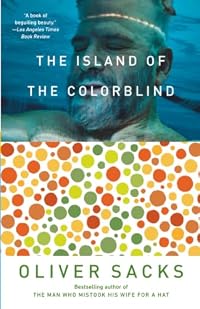
The Island of the Colorblind
by Oliver Sacks
On This Page
Description
Oliver Sacks has always been fascinated by islands--their remoteness, their mystery, above all the unique forms of life they harbor. For him, islands conjure up equally the romance of Melville and Stevenson, the adventure of Magellan and Cook, and the scientific wonder of Darwin and Wallace. Drawn to the tiny Pacific atoll of Pingelap by intriguing reports of an isolated community of islanders born totally color-blind, Sacks finds himself setting up a clinic in a one-room island dispensary, show more where he listens to these achromatopic islanders describe their colorless world in rich terms of pattern and tone, luminance and shadow. And on Guam, where he goes to investigate the puzzling neurodegenerative paralysis endemic there for a century, he becomes, for a brief time, an island neurologist, making house calls with his colleague John Steele, amid crowing cockerels, cycad jungles, and the remains of a colonial culture. The islands reawaken Sacks' lifelong passion for botany--in particular, for the primitive cycad trees, whose existence dates back to the Paleozoic--and the cycads are the starting point for an intensely personal reflection on the meaning of islands, the dissemination of species, the genesis of disease, and the nature of deep geologic time. Out of an unexpected journey, Sacks has woven an unforgettable narrative which immerses us in the romance of island life, and shares his own compelling vision of the complexities of being human. show lessTags
Recommendations











Member Recommendations

Member Reviews
Dr. Sacks travels to pacific islands in this book. it’s really more of travel log whereas other books of his could be described as medical histories which focus on neurological disorders or peculiarities, this one focuses more on the society and geography of the places than the diseases/afflictions he went there to study.
as always, his writing is amiable yet descriptive but the lack of focus in this book kept me from seeing a real point other than the publishing of a memoir of his time in these places. interesting maybe but without much substance. especially since the book is really two books: one about the island of the colorblind (ie a high percentage of the population is achromatopic) and the other about an affliction or disease on show more Guam that mimics Parkinson’s and may be caused somehow by the prolific species of cycads on the island. apparently, this notion has been around since the 1960s but never proven beyond a doubt. Sacks went there to see what he could figure out.
there exists a thin but vital underlying thread of science tribalism and territoriality in the book. Sacks notes how the medical conditions in both parts of the book attract ambitious physician-scientists looking to solve the mystery and make a name for themselves. this is especially present in the latter book on cycads where researchers are seen covering up information sources, skewing and misreporting data, and blackballing heretics from their bailiwick field because, frankly, who’s around to know better? it seems claustrophobic to attempt to practice medicine or research on this remote islands where large, determined personalities can easily dominate by controlling and projecting a carefully crafted outward image. but like i said, this was a significant but nearly ephemeral theme running through Sacks’s narrative- it was not his main purpose to expose this kind of politics in science, he was simply relating the trials and tribulations of doing research in these isolated places and painted an accurate picture.
like any good scholar/journalist, Sacks adds a metric ton of notes to his work to flesh out small points he wants to make and to provide references for his ramblings. i’ve always seen the excessive use of notes (both end- and foot-) as lazy writing. if it’s so very important that you need to take up pages for these notes, why can’t you incorporate it into your narrative and be done with the notes? i always have in my own work and it makes for a much smoother and enjoyable read.
having said that, i think Sacks’s writing is “lazy” only in the sense that he was driven and didn’t much care to make his way as a polished, eloquent author. he wanted to say something and he did - then he would add asides as he thought of them to deepen and enrich the model of events he was building. in other words, i don’t see him using notes as though they are expected as many scholarly writers do; he used them because he was sitting round a campfire telling stories and kept thinking of more interesting things to say. “this happened and then - I ALMOST FORGOT!- this other thing happened, too!” show less
as always, his writing is amiable yet descriptive but the lack of focus in this book kept me from seeing a real point other than the publishing of a memoir of his time in these places. interesting maybe but without much substance. especially since the book is really two books: one about the island of the colorblind (ie a high percentage of the population is achromatopic) and the other about an affliction or disease on show more Guam that mimics Parkinson’s and may be caused somehow by the prolific species of cycads on the island. apparently, this notion has been around since the 1960s but never proven beyond a doubt. Sacks went there to see what he could figure out.
there exists a thin but vital underlying thread of science tribalism and territoriality in the book. Sacks notes how the medical conditions in both parts of the book attract ambitious physician-scientists looking to solve the mystery and make a name for themselves. this is especially present in the latter book on cycads where researchers are seen covering up information sources, skewing and misreporting data, and blackballing heretics from their bailiwick field because, frankly, who’s around to know better? it seems claustrophobic to attempt to practice medicine or research on this remote islands where large, determined personalities can easily dominate by controlling and projecting a carefully crafted outward image. but like i said, this was a significant but nearly ephemeral theme running through Sacks’s narrative- it was not his main purpose to expose this kind of politics in science, he was simply relating the trials and tribulations of doing research in these isolated places and painted an accurate picture.
like any good scholar/journalist, Sacks adds a metric ton of notes to his work to flesh out small points he wants to make and to provide references for his ramblings. i’ve always seen the excessive use of notes (both end- and foot-) as lazy writing. if it’s so very important that you need to take up pages for these notes, why can’t you incorporate it into your narrative and be done with the notes? i always have in my own work and it makes for a much smoother and enjoyable read.
having said that, i think Sacks’s writing is “lazy” only in the sense that he was driven and didn’t much care to make his way as a polished, eloquent author. he wanted to say something and he did - then he would add asides as he thought of them to deepen and enrich the model of events he was building. in other words, i don’t see him using notes as though they are expected as many scholarly writers do; he used them because he was sitting round a campfire telling stories and kept thinking of more interesting things to say. “this happened and then - I ALMOST FORGOT!- this other thing happened, too!” show less
This review applies to the 1996 Random House abridged audio edition, read by the author.
This book contains two accounts of visits to unusual neurological communities on Pacific Islands: the island of Pingalap in Micronesia, and the Pingalapese, who have the highest rate of congenital total colorblindess in the world; and the island of Guam, where some island communities were afflicted by a mysterious neurodegenerative disease called lytigo-bodig.
Both the stories were fascinating, in their accounts of the communities themselves, and the way the diseases had shaped the communities they existed in. As usual, Sacks - part neurologist, part anthropologist, and part story-teller - manages to balance the three roles and pull the reader into show more the lives of people whose experience of the world is very different from the typical but still very warm and human and real.
I did occasionally, especially in the first half (which could be summarised as "old white men bring sunglasses to the light-sensitive natives) get a slight uncomfortable feeling of exoticization and patronization, not toward the illness but toward the island culture itself, but by halfway through the tape the tone had changed enough that I stopped noticing. My only other problem was that the flow was often choppy, and I would have loved more detail and longer accounts, but that can probably be blamed on the abridgement for the audio version.
Overall, and excellent book, and good listening: holds the attention without losing you if you turn your attention elsewhere for a few minutes.
Also, one of these stories has recent developments, since the book was published - google "lytico-bodig" and "sacks" to find out about it (I don't want to give away the new ending!) show less
This book contains two accounts of visits to unusual neurological communities on Pacific Islands: the island of Pingalap in Micronesia, and the Pingalapese, who have the highest rate of congenital total colorblindess in the world; and the island of Guam, where some island communities were afflicted by a mysterious neurodegenerative disease called lytigo-bodig.
Both the stories were fascinating, in their accounts of the communities themselves, and the way the diseases had shaped the communities they existed in. As usual, Sacks - part neurologist, part anthropologist, and part story-teller - manages to balance the three roles and pull the reader into show more the lives of people whose experience of the world is very different from the typical but still very warm and human and real.
I did occasionally, especially in the first half (which could be summarised as "old white men bring sunglasses to the light-sensitive natives) get a slight uncomfortable feeling of exoticization and patronization, not toward the illness but toward the island culture itself, but by halfway through the tape the tone had changed enough that I stopped noticing. My only other problem was that the flow was often choppy, and I would have loved more detail and longer accounts, but that can probably be blamed on the abridgement for the audio version.
Overall, and excellent book, and good listening: holds the attention without losing you if you turn your attention elsewhere for a few minutes.
Also, one of these stories has recent developments, since the book was published - google "lytico-bodig" and "sacks" to find out about it (I don't want to give away the new ending!) show less
One of the most interesting books by Oliver Sacks I've read yet. Sacks travels with a few colleagues to the remote islands of Pingelap and Pohnpei where a large percentage of the population suffered from complete color-blindness. He was curious to study this phenomenon and see how the local culture might have adapted itself to having so many people with a color disability. The later part of the book tackles a different subject, as Sacks goes to Guam, another remote island with a high incidence of a mysterious disease called lytico-bodig. For decades doctors and scientists have been trying to find the cause of this degenerative neurological disease. The strangeness of lytico-bodig was that it seemed to run in families, mostly affected show more people who were native to or had visited the island (very rarely were cases found in other countries) and apparently hid dormant in the body for a long time, symptoms manifesting themselves suddenly years after whatever infecting agent had been encountered. The number of cases peaked in the 1940's and 50's, and after 1961 no more people contracted the disease. All kinds of things have been investigating as possibly causing lytico-bodig, from something toxic concentrated in fish to abnormally high levels of mineral content in water to a virus spread by an animal that has vanished from the island. But all the scientists (Sacks included) kept coming back to the cycad trees: at times the islanders made a special flour out of the seeds, which were highly poisonous but carefully prepared to removed the toxin. Sacks came up with a theory that eating bats which themselves had eaten cycad seeds, could have given people high levels of the toxin (the natives ate so many bats they became extinct on the island). More than just medical speculation though, the final part of the book is also an ode to the cycads, as Sacks admired these ancient plants and was curious about all aspects of their biology. The book contains liberal notes in the back, which are just as interesting as the main text, so I kept a second bookmark in the back to flip to the notes whenever they were indicated.
from the Dogear Diary show less
from the Dogear Diary show less
I enjoyed the first part of the book immensely, as it was about true colorblindness. People see everything in shades of gray. As a scientist who works on vision, it was fascinating to read the way people adapted to their condition and also uplifting to read how Oliver Sacks and his companions (one of which was also achromatic) helped the people on this island. The epidemiology was interesting too. This all began with a storm that killed most of the people on the island…
What kept this from being a 4-star book was that I didn't realize this was only half the book. The second half was on islands where mysterious diseases occurred where people developed dementia, parkinson's like symptoms or symptoms of ALS. While this was intellectually show more interesting, it was terribly depressing and not what I had signed up for. Also there was a large section on native plants. Still, Oliver Sacks is (was) a fantastic writer and has a very keen sense of the humanity of those individuals he talks about. Highly recommended but at least my copy turned out to be different than I thought. I think my edition is actually "The Island of the Colorblind and Cyclad Island". However they seem to be together. show less
What kept this from being a 4-star book was that I didn't realize this was only half the book. The second half was on islands where mysterious diseases occurred where people developed dementia, parkinson's like symptoms or symptoms of ALS. While this was intellectually show more interesting, it was terribly depressing and not what I had signed up for. Also there was a large section on native plants. Still, Oliver Sacks is (was) a fantastic writer and has a very keen sense of the humanity of those individuals he talks about. Highly recommended but at least my copy turned out to be different than I thought. I think my edition is actually "The Island of the Colorblind and Cyclad Island". However they seem to be together. show less
Sacks' fascinating look at colorblindness and other conditions in several Pacific islands. Witty and absorbing, as with all of the Sacks books I've tried.
To have a book cover the topic of genetic issues and illnesses like colorblindness and lytico-bodig was interesting. To find it quotable made it thoroughly enjoyable. I was quite surprised at how much I experienced while reading this book. The author describes his travels in such a way that is both captivating and fascinating, and manages to make the issues more human than scientific or technical. As a reader I found I was learning more about both issues than I ever expected to learn from a book about either.
For people interested in genetics or the culture of a people dealing with genetic issues, this is a book that must be picked up. For others, it is still an enjoyable education. No sleeping in this class.
For people interested in genetics or the culture of a people dealing with genetic issues, this is a book that must be picked up. For others, it is still an enjoyable education. No sleeping in this class.
"Islands were, so to speak, experiments of nature", August 7, 2014
This review is from: The Island of the Colour-blind (Hardcover)
An interesting account of two trips made by the author to the islands of Oceania, where the remoteness of the locations have led to two different illnesses among the locals.
The first section of the book - and to me, by far the most readable - was his visit to Pingelap atoll in Micronesia, where interbreeding of a small population has led to 1 person in 12 being totally colour-blind. Finding out how life 'feels' to such people, along with a fascinating travelogue, made this a wonderful read:
"And in that first long moment, with the children coming out of the forest...and the tropical luxuriance of vegetation in show more all directions - the beauty of the primitive, the human and the natural took hold of me...I had a sense of paradise, of an almost magical reality."
"Little black-and-white piglets darted across our path...we were struck by the fact that the pigs were black and white and wondered, half seriously, if they had been specially bred for, or by, an achromatic population."
In the second section, Sacks visits Guam, where the illness of lytico-bodig (similar to motor neurone disease) was endemic - although the younger generation are no longer affected. Again the travel aspect was fascinating - Sacks' experience of arrival in a US military base seems as bad as any totalitarian state. And the efforts of scientists to crack the reason for the disease (blamed by many on the toxic cycad trees, whose roots were once used as flour) was fairly interesting. But I found the end of the chapter starting to get a bit too scientific for me!
In the third, short chapter, Sacks visits Rota, close to Guam but unspoiled. Here he visits the cycad jungle, similar to the primeval world, and observes that "it seemed as if my senses were actually enlarging, as if a new sense, a time sense, was opening within me, something which might allow me to appreciate millennia or aeons as directly as I had experienced seconds or minutes."
Contains a number of b/w drawings show less
This review is from: The Island of the Colour-blind (Hardcover)
An interesting account of two trips made by the author to the islands of Oceania, where the remoteness of the locations have led to two different illnesses among the locals.
The first section of the book - and to me, by far the most readable - was his visit to Pingelap atoll in Micronesia, where interbreeding of a small population has led to 1 person in 12 being totally colour-blind. Finding out how life 'feels' to such people, along with a fascinating travelogue, made this a wonderful read:
"And in that first long moment, with the children coming out of the forest...and the tropical luxuriance of vegetation in show more all directions - the beauty of the primitive, the human and the natural took hold of me...I had a sense of paradise, of an almost magical reality."
"Little black-and-white piglets darted across our path...we were struck by the fact that the pigs were black and white and wondered, half seriously, if they had been specially bred for, or by, an achromatic population."
In the second section, Sacks visits Guam, where the illness of lytico-bodig (similar to motor neurone disease) was endemic - although the younger generation are no longer affected. Again the travel aspect was fascinating - Sacks' experience of arrival in a US military base seems as bad as any totalitarian state. And the efforts of scientists to crack the reason for the disease (blamed by many on the toxic cycad trees, whose roots were once used as flour) was fairly interesting. But I found the end of the chapter starting to get a bit too scientific for me!
In the third, short chapter, Sacks visits Rota, close to Guam but unspoiled. Here he visits the cycad jungle, similar to the primeval world, and observes that "it seemed as if my senses were actually enlarging, as if a new sense, a time sense, was opening within me, something which might allow me to appreciate millennia or aeons as directly as I had experienced seconds or minutes."
Contains a number of b/w drawings show less
Members
- Recently Added By
Lists

A Rainbow of Books: Colors in the Title
570 works; 24 members
Author Information

66+ Works 43,542 Members
Oliver Sacks was born in London, England on July 9, 1933. He received a medical degree from Queen's College, Oxford University and performed his internship at Middlesex Hospital in London and Mount Zion Hospital in San Francisco. He completed his residency at UCLA. In 1965, he became a clinical neurologist to the Little Sisters of the Poor and show more Beth Abraham Hospital. His work in a Bronx charity hospital led him to write the book Awakenings in 1973. The book inspired a play by Harold Pinter and became a film starring Robert De Niro and Robin Williams. His other works included An Anthropologist on Mars, The Mind's Eye, The Man Who Mistook His Wife for a Hat, Uncle Tungsten, Musicophilia, A Leg to Stand On, On the Move: A Life, and Gratitude. In 2007, he ended his 42-year relationship with the Albert Einstein College of Medicine to accept an interdisciplinary teaching position at Columbia. In 2012, he returned to the New York University School of Medicine as a professor of neurology. He died of cancer on August 30, 2015 at the age of 82. (Bowker Author Biography) show less
Some Editions
Awards and Honors
Series
Belongs to Publisher Series
rororo sachbuch (60560)
Meulenhoff editie (1568)
Work Relationships
Is contained in
Common Knowledge
- Canonical title*
- Het eiland der kleurenblinden
- Original title
- The island of the colour-blind
- Alternate titles*
- Het eiland der kleurenblinden : een boek in twee delen
- Original publication date
- 1996 (Engels) (Engels); 1996 (Nederlands) (Nederlands)
- Important places
- Pingelap Island, Micronesia; Pohnpei, Micronesia; Guam; Rota Island, Northern Mariana Islands
- Dedication
- For Eric
- First words
- Islands have always fascinated me; perhaps they fascinate everyone.
- Last words
- (Click to show. Warning: May contain spoilers.)Ten minutes more and I can no longer see it—it is launched, like a little ship, on its journey on the high seas.
- Publisher's editor
- Frank, Dan
- Original language
- English
*Some information comes from Common Knowledge in other languages. Click "Edit" for more information.
Classifications
- Genres
- Anthropology, General Nonfiction, Science & Nature, Nonfiction, Travel, Biography & Memoir
- DDC/MDS
- 617.75909966 — Applied science & technology Medicine & health Medical Treatment, Surgery, Teeth, Eyes Ophthalmology Disorders of refraction and accommodation, colour vision defects; Optometry
- LCC
- RE921 .S23 — Medicine Ophthalmology Ophthalmology Color vision tests, charts, etc.
- BISAC
Statistics
- Members
- 1,913
- Popularity
- 11,105
- Reviews
- 29
- Rating
- (3.80)
- Languages
- 10 — Dutch, English, French, German, Italian, Polish, Portuguese, Spanish, Swedish, Turkish
- Media
- Paper, Audiobook, Ebook
- ISBNs
- 40
- ASINs
- 11