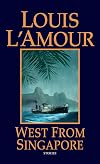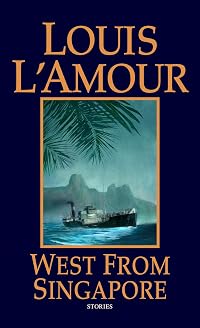
West from Singapore
by Louis L'Amour
On This Page
Description
Fantasy. Fiction. Suspense. Thriller. HTML:He’s a two-fisted American adventurer and veteran of a hundred waterfront brawls. He’s “Ponga Jim” Mayo, and he minds his own business and leaves international intrigue to others. But, as master of his own tramp freighter, trouble seeks him out as he navigates the treacherous East Indian seas from Borneo to Singapore. Never one to back away from danger, Jim straps on his colt automatic and takes the helm of the Semiramis, ready to battle show more pirates and spies, dope peddlers and gunrunners and whoever else dares to challenge his command . . . and God help the man who crosses Jim Mayo. show lessTags
Recommendations





























Member Reviews
Fun collection of pulp fiction set in the S Pacific largely. This was early work in his career and an interesting departure from his more known westerns. The author sailed these areas during these times and drew from that experience, presumably.
This collection features seven of the nine stories Louis L'Amour wrote early in his career featuring the two-fisted merchant seaman-cum-boxer Ponga Jim Mayo (according to this site, the two Ponga Jim Mayo stories not included here are "Voyage to Toblai" and "Wings Over Brazil"); written and set just before or soon after the U.S. entered World War II, Ponga Jim primarily fights Nazi agents and sympathizers, with the occasional run-ins with the Japanese army promulgating the "Greater East Asian Co-Prosperity Sphere," unaffiliated "whoever's paying the most" bounder and pan-Muslim fanatics thrown in for good measure. (Interestingly enough, L'Amour's Wikipedia page reports that he used "Jim Mayo" as his nom de plume for his early Western show more stories.)
At least half of the Ponga Jim stories are as much boxing stories as they are stories of sea adventure, given the loving descriptions of the punch-outs Mayo is involved in; his regular sidekick is a spectacularly unbelievable agent of "British intelligence" named Major William Arnold, who is given to uttering such unlikely American colloquialisms as "darn you!" ("South of Suez," p. 159) and telling Mayo, "'They can't shoot a man that was born to be hung'" instead of "hanged" ("From Here to Banggai," p. 40; this recalled the infamous episode of the game show Hollywood Squares, wherein Paul Lynde held forth on just why Nathan Hale was "hung" -- *ahem*), while his first mate, Slug Brophy -- apparently an American to judge by his speech -- tells Mayo, "'Gosh, Skipper, I hate to think of them Guineas [referencing natives of northern New Guinea] having Miss Sutherland. That girl was a bit of all right'" ("The House of Qasavara,"p. 65), mixing American and English colloquialisms in the same short paragraph.
Still, it would be foolish to read any pulp fiction -- even that written by "America's favorite storyteller" -- for faithfully recorded (or even internally consistent..) dialogue: adventure and action are the thing, and these stories ("East of Gorontalo," "On the Road to Amurang," "From Here to Banggai," "The House of Qasavara," "Well of the Unholy Light," "West From Singapore," and "South of Suez," the longest story here [40 pgs.]) provide reasonable examples thereof; at the least, I found them no more ridiculous or implausible than the average Doc Savage story, and with blessedly fewer ill-thought-out instances of "comic by-play" that tended to drag the Doc Savage stories down, which is not to say that L'Amour wasn't above triteness (Mayo, during a dockside barroom brawl, is described as leaping "with the speed of light" [p. 44]) or last-minute coincidence (the main villain of "The House of Qasavara," named Kull, no less, is described two pages from the end of the story, with no previous mention of it having been made, as "one of Europe's crack amateur heavyweights" [p. 76]), or utterly unbelievable plot elements (the feared pan-Islamist movement of "South of Suez" takes for its muse-cum-standard a young, cosmopolitan Egyptian girl named Zara Hammedan).
Also welcome here is the relative lack of racism endemic to the pulps (and, indeed, to much of the writing of the period), even of the paternalistic "noble savage" variety expressed by Robert E. Howard; a Nazi agent says of one of Mayo's friends, "'The steward is a Chinese and can be discounted'" (in "From Here to Banggai," p. 54), but, hey, he's a Nazi: he's supposed to say things like that. L'Amour also puts some surprisingly thoughtful pearls of political wisdom into the mouths of Mayo ("'A lot of people who don't see beyond the surface think dictatorships are best. They forget their supposed efficiency is because they censor news of mistakes, or shoot them;'" in "West From Singapore," pps. 102-03) or Mayo's old friend and rival, the pilot Ring Wallace ("'When you look for pro-Nazis look in the higher brackets of income, not the lower;'" in "West From Singapore," p. 105).
Another quibble: while L'Amour introduces this collection with a five-paged foreword and introduces each story with a few paragraphs of geographical, historical, or sociological background, he doesn't provide the publication history of these stories; this makes it harder on the collector, historian, or interested reader to chase down copies of the pulps in which they first appeared, or merely have a better grasp of L'Amour's career. show less
At least half of the Ponga Jim stories are as much boxing stories as they are stories of sea adventure, given the loving descriptions of the punch-outs Mayo is involved in; his regular sidekick is a spectacularly unbelievable agent of "British intelligence" named Major William Arnold, who is given to uttering such unlikely American colloquialisms as "darn you!" ("South of Suez," p. 159) and telling Mayo, "'They can't shoot a man that was born to be hung'" instead of "hanged" ("From Here to Banggai," p. 40; this recalled the infamous episode of the game show Hollywood Squares, wherein Paul Lynde held forth on just why Nathan Hale was "hung" -- *ahem*), while his first mate, Slug Brophy -- apparently an American to judge by his speech -- tells Mayo, "'Gosh, Skipper, I hate to think of them Guineas [referencing natives of northern New Guinea] having Miss Sutherland. That girl was a bit of all right'" ("The House of Qasavara,"p. 65), mixing American and English colloquialisms in the same short paragraph.
Still, it would be foolish to read any pulp fiction -- even that written by "America's favorite storyteller" -- for faithfully recorded (or even internally consistent..) dialogue: adventure and action are the thing, and these stories ("East of Gorontalo," "On the Road to Amurang," "From Here to Banggai," "The House of Qasavara," "Well of the Unholy Light," "West From Singapore," and "South of Suez," the longest story here [40 pgs.]) provide reasonable examples thereof; at the least, I found them no more ridiculous or implausible than the average Doc Savage story, and with blessedly fewer ill-thought-out instances of "comic by-play" that tended to drag the Doc Savage stories down, which is not to say that L'Amour wasn't above triteness (Mayo, during a dockside barroom brawl, is described as leaping "with the speed of light" [p. 44]) or last-minute coincidence (the main villain of "The House of Qasavara," named Kull, no less, is described two pages from the end of the story, with no previous mention of it having been made, as "one of Europe's crack amateur heavyweights" [p. 76]), or utterly unbelievable plot elements (the feared pan-Islamist movement of "South of Suez" takes for its muse-cum-standard a young, cosmopolitan Egyptian girl named Zara Hammedan).
Also welcome here is the relative lack of racism endemic to the pulps (and, indeed, to much of the writing of the period), even of the paternalistic "noble savage" variety expressed by Robert E. Howard; a Nazi agent says of one of Mayo's friends, "'The steward is a Chinese and can be discounted'" (in "From Here to Banggai," p. 54), but, hey, he's a Nazi: he's supposed to say things like that. L'Amour also puts some surprisingly thoughtful pearls of political wisdom into the mouths of Mayo ("'A lot of people who don't see beyond the surface think dictatorships are best. They forget their supposed efficiency is because they censor news of mistakes, or shoot them;'" in "West From Singapore," pps. 102-03) or Mayo's old friend and rival, the pilot Ring Wallace ("'When you look for pro-Nazis look in the higher brackets of income, not the lower;'" in "West From Singapore," p. 105).
Another quibble: while L'Amour introduces this collection with a five-paged foreword and introduces each story with a few paragraphs of geographical, historical, or sociological background, he doesn't provide the publication history of these stories; this makes it harder on the collector, historian, or interested reader to chase down copies of the pulps in which they first appeared, or merely have a better grasp of L'Amour's career. show less
Product Description
He's a two-fisted American adventurer and veteran of a hundred waterfront brawls. He's "Ponga Jim" Mayo, and he minds his own business and leaves international intrigue to others. But, as master of his own tramp freighter, trouble seeks him out as he navigates the treacherous East Indian seas from Borneo to Singapore. Never one to back away from danger, Jim straps on his colt automatic and takes the helm of the Semiramis, ready to battle pirates and spies, dope peddlers and gunrunners and whoever else dares to challenge his command...and God help the man who crosses Jim Mayo.
From the Publisher
He's a two-fisted American adventurer and veteran of a hundred waterfront brawls. He's "Ponga Jim" Mayo, and he minds his show more own business and leaves international intrigue to others. But, as master of his own tramp freighter, trouble seeks him out as he navigates the treacherous East Indian seas from Borneo to Singapore. Never one to back away from danger, Jim straps on his colt automatic and takes the helm of the Semiramis, ready to battle pirates and spies, dope peddlers and gunrunners and whoever else dares to challenge his command...and God help the man who crosses Jim Mayo. show less
Ratings
Members
- Recently Added By
Lists

Evan's Wish List
86 works; 2 members
Author Information

871+ Works 100,145 Members
Born in Jamestown, North Dakota on March 22, 1908, Louis L'Amour's adventurous life could have been the subject of one of his novels. Striking out on his own in 1923, at age 15, L'Amour began a peripatetic existence, taking whatever jobs were available, from skinning dead cattle to being a sailor. L'Amour knew early in life that he wanted to be a show more writer, and the experiences of those years serve as background for some of his later fiction. During the 1930s he published short stories and poetry; his career was interrupted by army service in World War II. After the war, L'Amour began writing for western pulp magazines and wrote several books in the Hopalong Cassidy series using the pseudonym Tex Burns. His first novel, Westward the Tide (1950), serves as an example of L'Amour's frontier fiction, for it is an action-packed adventure story containing the themes and motifs that he uses throughout his career. His fascination with history and his belief in the inevitability of manifest destiny are clear. Also present and typical of L'Amour's work are the strong, capable, beautiful heroine who is immediately attracted to the equally capable hero; a clear moral split between good and evil; reflections on the Native Americans, whose land and ways of life are being disrupted; and a happy ending. Although his work is somewhat less violent than that of other western writers, L'Amour's novels all contain their fair share of action, usually in the form of gunfights or fistfights. L'Amour's major contribution to the western genre is his attempt to create, in 40 or more books, the stories of three families whose histories intertwine as the generations advance across the American frontier. The novels of the Irish Chantry, English Sackett, and French Talon families are L'Amour's most ambitious project, and sadly were left unfinished at his death. Although L'Amour did not complete all of the novels, enough of the series exists to demonstrate his vision. L'Amour's strongest attribute is his ability to tell a compelling story; readers do not mind if the story is similar to one they have read before, for in the telling, L'Amour adds enough small twists of plot and detail to make it worth the reader's while. L'Amour fans also enjoy the bits of information he includes about everything from wilderness survival skills to finding the right person to marry. These lessons give readers the sense that they are getting their money's worth, that there is more to a L'Amour novel than sheer escapism. With over 200 million copies of his books in print worldwide, L'Amour must be counted as one of the most influential writers of westerns in this century. He died from lung cancer on June 10, 1988. (Bowker Author Biography) Louis L'Amour, truly America's favorite storyteller, was the first fiction writer ever to receive the Congressional Gold Medal from the United States Congress in honor of his life's work, & was also awarded the Medal of Freedom. There are over 260 million copies of his books in print worldwide. (Publisher Provided) show less
Common Knowledge
- Original publication date
- 1987
- People/Characters
- Pongo Jim Mayo
- Important places
- Pacific Islands; Southeast Asia
- Dedication
- To Arlene Aizer, Stuart Applebaum, Diane Aronswon, Barb Burg, Eileen Damore, Heather Florence, Renee Gelman, Sara Goodman, Linda Grey, Vicky Heredia, Kevin Jones, Stan Last, Yook Louie, Nick Mazzella, Serafina Messina, Michae... (show all)l Morrison, Jim Plumeri, David Ruitenberg, Sandy Su, Beverly Susswein, and Alberto Vitale for support above and beyond the call.
- First words
- Foreword: The stories in this collection and in a previous one, Night Over the Solomons, were written either just before World War II or after it had begun.
The river is deep and the anchorage not very good. - Last words
- (Click to show. Warning: May contain spoilers.)Get us out of this, Mike, and I'll be forever indebted.
Classifications
Statistics
- Members
- 364
- Popularity
- 86,958
- Reviews
- 4
- Rating
- (3.38)
- Languages
- English
- Media
- Paper, Ebook
- ISBNs
- 5
- ASINs
- 3