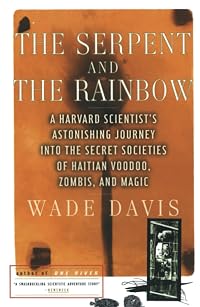
The Serpent and the Rainbow: A Harvard Scientist's Astonishing Journey into the Secret Societies of Haitian Voodoo, Zombis, and Magic
by Wade Davis
On This Page
Description
A scientific investigation and personal adventure story about zombies and the voudoun culture of Haiti by a Harvard scientist. In April 1982, ethnobotanist Wade Davis arrived in Haiti to investigate two documented cases of zombies-people who had reappeared in Haitian society years after they had been officially declared dead and had been buried. Drawn into a netherworld of rituals and celebrations, Davis penetrated the vodoun mystique deeply enough to place zombification in its proper show more context within vodoun culture. In the course of his investigation, Davis came to realize that the story of vodoun is the history of Haiti-from the African origins of its people to the successful Haitian independence movement, down to the present day, where vodoun culture is, in effect, the government of Haiti's countryside. The Serpent and the Rainbow combines anthropological investigation with a remarkable personal adventure to illuminate and finally explain a phenomenon that has long fascinated Americans. show lessTags
Recommendations

















Member Reviews
Wade Davis's renowned investigation into Haitian zombies has the benefit of featuring a hero who is fearless, rugged and insightful. It has the drawback that the hero is also the author, and so his presentation of himself as a latter-day Indiana Jones (an inevitable comparison that comes up in every review ever printed of this book; I will shamefacedly join the queue) is tinged with more than a little self-aggrandisement.
Still, if you can't find a Boswell to write this stuff about you, you might as well do the job yourself. Davis has lived a boy's-own kind of life, and this deep-dive into voodoo and Caribbean secret societies in the mid-1980s was ethnographic fieldwork in the grand old style – hours of poring over dusty books in show more university libraries interspersed with midnight rituals, mind-altering chemicals, and treks through the jungle, all in search of the secret behind zombification. ‘It belongs here in Haiti,’ cry the houngans, bokors, and other assorted sorcerers. ‘It belongs in a museum,’ snarls Wade, who, conceivably, has spent his life trying to make up for the extreme dullness of his name. ‘Wade Davis’ sounds like someone who should be managing a small accounts team in Omaha, not grinding human bonemeal to appease the Ancient Ones.
Nevertheless, it's an enticing objective that does much to give this book its driving narrative force. His findings can be found summarised in various places online, but I won't spoil the surprise here because following him on his quest is well worth the adventure. Suffice to point out that he refers to it as an ‘ethnobotanic’ story – he goes into Haiti with the hypothesis that some plant-based drug is involved, and on the whole he finds his basic assumptions reinforced.
Admirably, Davis makes some very specific claims here, and therefore opens himself up to widespread disagreement. Some botanists of the non-ethno variety have pooh-poohed his results, but they do not give Davis enough credit for his lengthy consideration of what psychedelic researchers call the ‘set and setting’ of Haitian vodou – the mindset and cultural assumptions that people bring to any drug-induced experiences. Still, it's probably fair to say that, if his theories have not yet been comprehensively debunked, that's only because they were never totally bunked in the first place. Personally, I find his explanation, inconclusive though it is, very convincing. Certainly there appear to be no better ideas beyond either ‘zombies don't exist’ or ‘zombies are supernatural’.
Davis's occasional lapses into quasi-mystic lyricism do not do him any favours, however. One minute he'll be reeling off Latin names and calculating datura toxicity on the back of an envelope; the next, he'll come out with stuff like this:
Sometimes with my eyes closed, and the silence broken only by the odd bird, I would hear whispered messages of the land that intuitively I understood, if only for a moment. Eventually I came to respect those moments, for the cycle of logical questions was getting me nowhere.
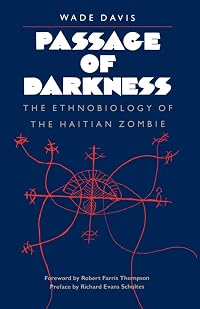
I imagine these passages got up the noses of any academics who were trying to assess the book on its scientific merits. Perhaps aware of this, Davis published a straight academic account of his investigation a few years later, called Passage of Darkness: The Ethnobiology of the Haitian Zombie. If you want just the facts, you might try that instead, but personally, I'd stick with this one. It's great fun, and chock-full of high-octane scholarship and intellectual as well as physical adventure. Fortune and glory, kid. Fortune and glory. show less
Still, if you can't find a Boswell to write this stuff about you, you might as well do the job yourself. Davis has lived a boy's-own kind of life, and this deep-dive into voodoo and Caribbean secret societies in the mid-1980s was ethnographic fieldwork in the grand old style – hours of poring over dusty books in show more university libraries interspersed with midnight rituals, mind-altering chemicals, and treks through the jungle, all in search of the secret behind zombification. ‘It belongs here in Haiti,’ cry the houngans, bokors, and other assorted sorcerers. ‘It belongs in a museum,’ snarls Wade, who, conceivably, has spent his life trying to make up for the extreme dullness of his name. ‘Wade Davis’ sounds like someone who should be managing a small accounts team in Omaha, not grinding human bonemeal to appease the Ancient Ones.
Nevertheless, it's an enticing objective that does much to give this book its driving narrative force. His findings can be found summarised in various places online, but I won't spoil the surprise here because following him on his quest is well worth the adventure. Suffice to point out that he refers to it as an ‘ethnobotanic’ story – he goes into Haiti with the hypothesis that some plant-based drug is involved, and on the whole he finds his basic assumptions reinforced.
Admirably, Davis makes some very specific claims here, and therefore opens himself up to widespread disagreement. Some botanists of the non-ethno variety have pooh-poohed his results, but they do not give Davis enough credit for his lengthy consideration of what psychedelic researchers call the ‘set and setting’ of Haitian vodou – the mindset and cultural assumptions that people bring to any drug-induced experiences. Still, it's probably fair to say that, if his theories have not yet been comprehensively debunked, that's only because they were never totally bunked in the first place. Personally, I find his explanation, inconclusive though it is, very convincing. Certainly there appear to be no better ideas beyond either ‘zombies don't exist’ or ‘zombies are supernatural’.
Davis's occasional lapses into quasi-mystic lyricism do not do him any favours, however. One minute he'll be reeling off Latin names and calculating datura toxicity on the back of an envelope; the next, he'll come out with stuff like this:
Sometimes with my eyes closed, and the silence broken only by the odd bird, I would hear whispered messages of the land that intuitively I understood, if only for a moment. Eventually I came to respect those moments, for the cycle of logical questions was getting me nowhere.
I imagine these passages got up the noses of any academics who were trying to assess the book on its scientific merits. Perhaps aware of this, Davis published a straight academic account of his investigation a few years later, called Passage of Darkness: The Ethnobiology of the Haitian Zombie. If you want just the facts, you might try that instead, but personally, I'd stick with this one. It's great fun, and chock-full of high-octane scholarship and intellectual as well as physical adventure. Fortune and glory, kid. Fortune and glory. show less
Too bad they made this wonderful book into a horror flick. The book is about a Harvard trained ethnobotanist who goes to Haiti to learn about some of the naturally occuring compounds used in the voudoun culture. The hope is that some of the active compounds may provide a safer alternative to general anaesthesia. What I found remarkable about the book was Wade Davis' ability to embrace and respect the voudoun culture (and it is a culture in the full sense of the word) without making western value judgements and assumptions about it. It is only through his understanding of the culture that he is able to learn what he came to find out. I don't want to include any spoilers here about the specific drugs or their effects, but I highly show more recommend this book to anyone who is interested in anthropology and/or biology. show less
A really interesting read -- I thought the discussions about how the effect of the zombi poison manifests as a result of the interaction between its biological action and the societal constructs. Tying it back to the history of Haiti, the slave trade, and the use of poison as a weapon against the slavers was really interesting and well done.
I thought the final third about the structure of the secret societies and their role in the country was less interesting. I would have been more interested in hearing about the biological action of the zombi cucumber, or having Wade go out and track down someone who is currently a zombi. I'd also be interested in hearing about research state-side into the tetrodotoxin compound. We get a little bit of show more that from the researchers working on monkeys, but where do they take it from there? Does it end up being an effective anesthetic? What's the biological mechanism involved? Does it turn off pain receptors or is it merely a paralytic? What about the compounds in Datura? What's the mechanism of action there? What is it like for the zombis? It just seemed like a really interesting botanical mystery that was only partially examined before being abandoned for more information on the Haitian secret societies.
Some things that I didn't care for: I felt like Davis was a little too quick to accept the supernatural powers of the people who were possessed. I feel like if I saw someone pick up a hot coal and put it in their mouth for several minutes my first thought would be "Oh, cool trick-- wonder how they did that". Accepting right away that the power of their altered psychological state allows them to do this doesn't make much sense to me. Similarly when a "god" possessing a human asks for $60 I feel like the appropriate response is incredulity, not blind acceptance.
Other than that a fun and engaging read that paints a beautiful/complex portrait of Haiti. show less
I thought the final third about the structure of the secret societies and their role in the country was less interesting. I would have been more interested in hearing about the biological action of the zombi cucumber, or having Wade go out and track down someone who is currently a zombi. I'd also be interested in hearing about research state-side into the tetrodotoxin compound. We get a little bit of show more that from the researchers working on monkeys, but where do they take it from there? Does it end up being an effective anesthetic? What's the biological mechanism involved? Does it turn off pain receptors or is it merely a paralytic? What about the compounds in Datura? What's the mechanism of action there? What is it like for the zombis? It just seemed like a really interesting botanical mystery that was only partially examined before being abandoned for more information on the Haitian secret societies.
Some things that I didn't care for: I felt like Davis was a little too quick to accept the supernatural powers of the people who were possessed. I feel like if I saw someone pick up a hot coal and put it in their mouth for several minutes my first thought would be "Oh, cool trick-- wonder how they did that". Accepting right away that the power of their altered psychological state allows them to do this doesn't make much sense to me. Similarly when a "god" possessing a human asks for $60 I feel like the appropriate response is incredulity, not blind acceptance.
Other than that a fun and engaging read that paints a beautiful/complex portrait of Haiti. show less
Initially, I was really into this book, and I was impressed by the author’s descriptive talent. One of my favorite passages was a description he wrote early in the book about riding a train.
My interest waxed and waned the further I got into the book. His sections about the history of poisoning and the fear of being buried alive were fascinating. I wasn’t as enamored of the in-depth explanations of the plants he was studying in relation to the zombie poison, but when he got to puffer fish and tetrodotoxin, he piqued my interest again.
As the author moved away from his original goal of show more tracking down poison and antidote—he did accomplish the first part to the satisfaction of his financial backers, but he included no account of whether or not it was used in the way they’d hoped—I started to lose interest in his tangents. The history of Haiti is extremely interesting, and I did like the deviation from his own story to give that background. His explanations of vodoun and its secret societies were a bit more convoluted, and it was hard to tell how much he truly learned. By his own descriptions, it was unclear how much people were really confiding in him, and he often had to pay for the glimpses, bits and pieces he was allowed. I appreciated that he apparently loved the country and seemed respectful of the culture. I liked this description of returning to Haiti after a year away.
A couple of personal issues probably affected my rating, even though they had nothing to do with the quality of the writing. I was disturbed that a man nearing his thirties had a teenage girl as his guide and traveled extensively with her. Maybe that’s cultural bias on my part, but it bothered me.
Also, it was surprising how often he was willing to drink unknown substances and put them on his skin, given that either was a possible delivery system for poison. It struck me as more foolish than brave.
This might deserve a higher rating than I gave it, but I was so ready to be done by the end, I think I’ll stick with 3 stars and still say it’s worth a read. show less
Still, the rhythm of the rails is always seductive, and the passing frames race by like so many childhood fantasies, alive in color and light.
My interest waxed and waned the further I got into the book. His sections about the history of poisoning and the fear of being buried alive were fascinating. I wasn’t as enamored of the in-depth explanations of the plants he was studying in relation to the zombie poison, but when he got to puffer fish and tetrodotoxin, he piqued my interest again.
As the author moved away from his original goal of show more tracking down poison and antidote—he did accomplish the first part to the satisfaction of his financial backers, but he included no account of whether or not it was used in the way they’d hoped—I started to lose interest in his tangents. The history of Haiti is extremely interesting, and I did like the deviation from his own story to give that background. His explanations of vodoun and its secret societies were a bit more convoluted, and it was hard to tell how much he truly learned. By his own descriptions, it was unclear how much people were really confiding in him, and he often had to pay for the glimpses, bits and pieces he was allowed. I appreciated that he apparently loved the country and seemed respectful of the culture. I liked this description of returning to Haiti after a year away.
Still, along with the easy happiness I had come to associate with the country, I was aware of a new and perhaps less superficial sensation—that sense of familiarity and alienation that comes to one who knows a place well, but who can never hope to become a part of it.
A couple of personal issues probably affected my rating, even though they had nothing to do with the quality of the writing. I was disturbed that a man nearing his thirties had a teenage girl as his guide and traveled extensively with her. Maybe that’s cultural bias on my part, but it bothered me.
Also, it was surprising how often he was willing to drink unknown substances and put them on his skin, given that either was a possible delivery system for poison. It struck me as more foolish than brave.
This might deserve a higher rating than I gave it, but I was so ready to be done by the end, I think I’ll stick with 3 stars and still say it’s worth a read. show less
A fascinating account of Mr. Davis' research on a supposed biological compound used to put the human body in a state of stasis indistinguishable from death that turns into an ethnography of the Haitian people, with special emphasis on their Vodun traditions. The author presents a captivating and intimate look at the history and religious traditions of Haiti by getting to know, and subsequently proving himself, to a few practicing sorcerers in order to gain the amazingly vivid look at Vodun religion found in this book. This is simply a book that I don't think I'll ever forget.
I forgot how much I loved this book. It's been at least a decade since the last read. Full of scientific facts, deep history, and beautiful mystical passages. Gives you a world view and draws you into Haiti's soul. I will definitely start looking for more of Mr. Davis's books.
Fascinating account of Davis' journey to Haiti in search of the science behind the mystery and rumours surrounding zombification. Davis is an ethnobotanist with impeccable credentials, and he throws himself headlong into his research. I learned a lot about the history of Haiti. I learned about Voodoo, too, and the interesting rituals and beliefs surrounding this religion. Parts of the book were muddy and circuitous, but so too was the nature of Davis' search.
Members
- Recently Added By
Lists

Best Zombie Books
77 works; 9 members

Weirdo Nonfiction
138 works; 3 members
Author Information

30+ Works 4,695 Members
Wade Davis is Explorer-in-Residence at the National Geographic Society. An ethnographer, photographer, filmmaker, and writer, he is the author of Light at the Edge of the World, One River, the international bestseller The Serpent and the Rainbow, and other books. His articles have appeared in Outside, Cond Nast Traveler, National Geographic, show more Scientific American, and many other publications. show less
Work Relationships
Has the adaptation
Common Knowledge
- Original publication date
- 1985-12-11
- People/Characters
- Wade Davis; Richard Evans Schultes (professor); Nathan S. Kline (Dr.); Rachel Beauvoir; Heinz Lehman (professor); Clairvius Narcisse (show all 38); Francina Illeus; Ti Femme; Lamarque Douyon; Max Beauvoir; Marcel Pierre; Andrés Celestin; Herard Simon; Jacques Belfort; François Duvalier; Marna Anderson; Zora Neale Hurston (mention); Jean-Jacques Leophin; Jean Baptiste; Sebastian Snow; Jay Ausherman; Franz Boas; Henri I, King of Haiti (Henri Christophe); Jean-Jacques Dessalines; Boukman Dutty; Robert Erié; Felicia Felix-Mentor; Jean François; Hector Victor; Bo Holmstedt; Mercilia Illeus; Count Karnice-Karnicki; Michel Laguerre; François Macandal; David Merrick; Angeline Narcisse; Leon Roizin (professor); Hélène Simon
- Important places
- Caribbean Region; French West Indies; Haiti; Hispaniola; West Indies
- Related movies
- The Serpent and the Rainbow (1988 | IMDb)
- Epigraph
- He knew the story of King Da, the incarnation of the Serpent, which is the eternal beginning, never ending, who took his pleasure mystically with a queen who was the Rainbow, patroness of the Waters and of all Bringing For... (show all)th.
—A. CARPENTIER
The Kingdom of This World
Everything is poison, nothing is poison.
—PARACELSUS - Dedication
- To my parents,
to Professor Richard Evans Schultes, who made it possible,
and to John Lennon. - First words
- My first meeting with the man who would send me on my quest for the Haitian zombi poison occurred on a damp miserable winter's day in late February 1974.
- Last words
- (Click to show. Warning: May contain spoilers.)He too was possessed, like the youth straddling the dying bull, or the dancers and the women wallowing in the mud.
- Blurbers
- Crichton, Michael; Schaller, George; Watson, Lyall; Weil, Andrew; Matthiessen, Peter
Classifications
- Genres
- Anthropology, Nonfiction, General Nonfiction, Religion & Spirituality, Biography & Memoir
- DDC/MDS
- 500 — Natural sciences & mathematics Science Natural sciences and mathematics
- LCC
- BL2530 .H3 .D38 — Philosophy, Psychology and Religion Religions. Mythology. Rationalism Religions. Mythology. Rationalism History and principles of religions American
- BISAC
Statistics
- Members
- 1,377
- Popularity
- 17,347
- Reviews
- 17
- Rating
- (3.79)
- Languages
- 7 — Dutch, English, German, Norwegian (Bokmål), Portuguese, Spanish, Swedish
- Media
- Paper, Audiobook, Ebook
- ISBNs
- 18
- ASINs
- 10