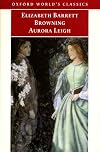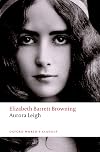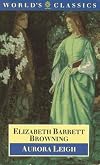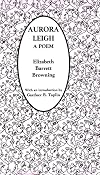
Aurora Leigh
by Elizabeth Barrett Browning
On This Page
Description
A novel in blank verse by Elizabeth Barrett Browning, published in 1857. The first-person narrative, which comprises some 11,000 lines, tells of the heroine's childhood and youth in Italy and England, her self-education in her father's hidden library, and her successful pursuit of a literary career. Initially resisting a marriage proposal by the philanthropist Romney Leigh, Aurora later surrenders her independence and weds her faithful suitor, whose own idealism has also since been tempered show more by experience. Aurora's career, Romney's social theories, and a melodramatic subplot concerni show lessTags
Recommendations













Member Reviews
The story of a woman's Wordsworthian search for her poetic voice. All the while, Browning gives the reader glimpses into 19th century society: gender norms, social concerns, politics, the role of art in society, and the responsibilities of the artist. Browning's language charms even at its less-than pristine moments.
This is a poem in many books (chapters to you and me). Interesting but quite hard going. Here I review book 5.
Introduction
This Book continues the narrative of Aurora’s relationship with her cousin Romney but really only as sideshow for the main event which is a disposition of her literary knowledge and an examination of woman’s place in art. This book is a mixture of these 2 themes and it is really difficult to tell which is the main one.
Romney
In the opening pages she complains that she has failed to “hold and move” Romney, whom she has not seen for 18 months. She decides that fame is not enough-she needs a man. Later she attends a ball and eavesdrops a conversation about Romney and Lady Waldemar between 2 men, a student of show more Germany and an older gentleman. Aurora is disappointed to discover that her cousin has moved on from the peasant girl Marian, whom he was to marry, across the class divide, for reasons of social equality driven by religious belief. He has fallen for Lady Waldemar, whose influence Aurora describes as “this vile woman’s way of trailing garments, shall not trip me up”. Lord Howe rescues her from the strangers and engages Aurora in conversational sparring about art. But being pestered by fans of her writing, promises to escort Aurora out. On the way, they meet Lady Waldemar, who boasting of her new relationship with Romney, taunts Aurora awkwardly. Aurora makes her excuses, leaves the ball early to reflect at home. She resolves to send a congratulatory note to Lady Waldemar and leave the country.
Literature
In this book, Browning makes 110 references to places, constructions and characters both living, dead and mythological. She refers to God 12 times and to the devil twice. 3 mentions each go to the Greeks, Proclus, Wolff (“the kissing Judas”), Mark Gage and Graham. St Lucy, Belmore, Bacchus, Pygmalion and Gottingen get 2 mentions. A further 80 get solitary mentions.
Aurora hopes to write poems that will evoke as nature impels. She says that a poem needs to “humanise”, like the view from a hill needs inhabitants. The poet must give nature a “voice with human meanings” in order to get the message across. She feels she must do more because of “this inferior nature”. Women artists, she complains, are not fairly judged-“Honour us with truth, if not with praise”. Her own attempt at a pastoral failed, she said, because it was just a book of surface pictures, pretty to look at but unmoving and functional. She discusses form in poems and plays and concludes that artists should not be bound by rules but “trust the spirit” and not be led by popularity, praise or hire. show less
Introduction
This Book continues the narrative of Aurora’s relationship with her cousin Romney but really only as sideshow for the main event which is a disposition of her literary knowledge and an examination of woman’s place in art. This book is a mixture of these 2 themes and it is really difficult to tell which is the main one.
Romney
In the opening pages she complains that she has failed to “hold and move” Romney, whom she has not seen for 18 months. She decides that fame is not enough-she needs a man. Later she attends a ball and eavesdrops a conversation about Romney and Lady Waldemar between 2 men, a student of show more Germany and an older gentleman. Aurora is disappointed to discover that her cousin has moved on from the peasant girl Marian, whom he was to marry, across the class divide, for reasons of social equality driven by religious belief. He has fallen for Lady Waldemar, whose influence Aurora describes as “this vile woman’s way of trailing garments, shall not trip me up”. Lord Howe rescues her from the strangers and engages Aurora in conversational sparring about art. But being pestered by fans of her writing, promises to escort Aurora out. On the way, they meet Lady Waldemar, who boasting of her new relationship with Romney, taunts Aurora awkwardly. Aurora makes her excuses, leaves the ball early to reflect at home. She resolves to send a congratulatory note to Lady Waldemar and leave the country.
Literature
In this book, Browning makes 110 references to places, constructions and characters both living, dead and mythological. She refers to God 12 times and to the devil twice. 3 mentions each go to the Greeks, Proclus, Wolff (“the kissing Judas”), Mark Gage and Graham. St Lucy, Belmore, Bacchus, Pygmalion and Gottingen get 2 mentions. A further 80 get solitary mentions.
Aurora hopes to write poems that will evoke as nature impels. She says that a poem needs to “humanise”, like the view from a hill needs inhabitants. The poet must give nature a “voice with human meanings” in order to get the message across. She feels she must do more because of “this inferior nature”. Women artists, she complains, are not fairly judged-“Honour us with truth, if not with praise”. Her own attempt at a pastoral failed, she said, because it was just a book of surface pictures, pretty to look at but unmoving and functional. She discusses form in poems and plays and concludes that artists should not be bound by rules but “trust the spirit” and not be led by popularity, praise or hire. show less
Really enjoyed this, though I didn't get many of the allusions and the flowery language got to be a bit much.
The best part were the sections discoursing on aesthetics. The most boring parts were the conversations and the unreadable parentheses in already-longish bits of dialogue.
Ratings
Members
- Recently Added By
Lists

Narrative verse for pleasure
75 works; 8 members

Victorian Period
113 works; 10 members

In Our Time books
4,934 works; 2 members
Author Information

233+ Works 6,866 Members
Elizabeth Barrett was born in Coxhoe Hall, Durham, England, in 1806. Most of her childhood was spent on her father's estate, reading the classics and writing poetry. An injury to her spine when she was fifteen, the shock of her brother's death by drowning in 1840 and an ogre-like father made her life dark. But she read and wrote, and no little show more volume of verse ever produced a richer return than her Poems of 1844. Robert Browning read the poems, liked them, and came to her rescue like Prince Charming in the fairy story. Elizabeth Barrett and Robert Browning were married on September 12, 1846. Barrett Browning's enduring fame has rested on two works-Poems (1850), containing Sonnets from the Portuguese, and Aurora Leigh (1857). The former is a celebration of woman as man's other half and the latter is a celebration of woman's potential to stand on her own. During the Edwardian and later periods, it was Sonnets from the Portuguese that embodied Barrett Browning. Since the rise of feminism, it has been Aurora Leigh. More recently, a third side of Barrett Browning has been revealed: the incisive critical and political commentator, seen in her letters. Elizabeth Barrett Browning died in Florence, Italy, in 1861. (Bowker Author Biography) show less
Series
Belongs to Publisher Series
Work Relationships
Is contained in
Contains
Is abridged in
Has as a reference guide/companion
Has as a commentary on the text
Has as a student's study guide
Common Knowledge
- Canonical title
- Aurora Leigh
- Original publication date
- 1856; 1860
- Important places
- London, England, UK; United Kingdom; Italy
- First words
- OF WRITING MANY BOOKS there is no end;
And I, who have written much in prose and verse
For others’ uses, will write now for mine,–
Will write my story for my better self,
As when you paint your por... (show all)trait for a friend,
Who keeps it in a drawer and looks at it
Long after he has ceased to love you, just
To hold together what he was and is. - Last words
- (Click to show. Warning: May contain spoilers.)And when
I saw his soul saw,–”Jasper first,” I said,
“And second, sapphire; third, chalcedony;
The rest in order, … last, an amethyst.”
Classifications
Statistics
- Members
- 527
- Popularity
- 57,003
- Reviews
- 4
- Rating
- (3.77)
- Languages
- English, Italian, Spanish
- Media
- Paper, Audiobook, Ebook
- ISBNs
- 31
- ASINs
- 15