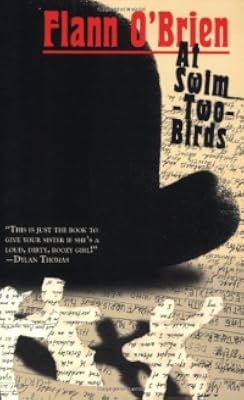
At Swim-Two-Birds
by Flann O'Brien
On This Page
Description
An indolent college student creates a chaotic fictional world in this classic of Irish literature. In this comic masterpiece, our unnamed narrator-a student at University College, Dublin, who spends more time drinking and working on his novel than attending classes-creates a character, a pub owner named Trellis, who himself is devoted mainly to writing and sleeping. Soon Trellis is collaborating with an author of cowboy romances, and from there unspools a brilliantly unpredictable adventure.Tags
Recommendations




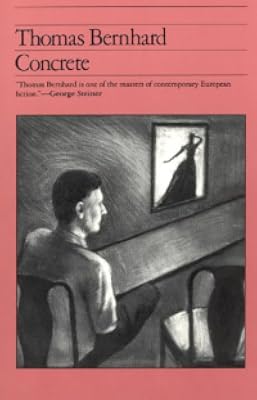

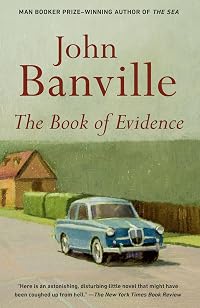
Member Recommendations
CGlanovsky Fictional characters exacting revenge on their creator. Story within a story.
CGlanovsky Books in which the characters interact with their fictitious authors.

Member Reviews
Before this book there was nothing like it. After this book nothing like it could be done again, not as well and not the same way. This book took narrative, plot, character, theme, story, poetry and held them up and subjected them to a long and pitiless examination, then threw them down and subjected them to degradations and tortures not dissimilar to those inflicted on the author, Trellis, holding back from destruction only at the end in a moment of conscience and mercy. O'Brien pierces the drunken pretensions and tedious intellectual self-aggrandisement of the middle-class Dublin drunk but cannot in the end deny his affection for it. A brilliant, daring, anarchic novel of wit and intelligence and linguistic dexterity. There is nothing show more else out there like it at all all. You might even say it's yer only man. show less
Published in 1939, this is a humorous look at the role of an author. It is structured rather like a Matryoshka doll. The unnamed narrator is attending university and spends his time drinking and writing a novel. He creates a character called Trellis, a pub owner, who in turn spends his time drinking and writing. Trellis then writes his novel in collaboration with another fictional writer, and the storyline is that of Trellis’s collaborative creation. During Trellis’s novel, two characters have an already grown child and that child wants to write a novel.
“One beginning and one ending for a book was a thing I did not agree with. A good book may have three openings entirely dissimilar and inter-related only in the prescience of the show more author, or for that matter one hundred times as many endings.”
Hence, it starts with three different openings. It is clever, funny, and brilliantly written. It ventures into the absurd, where the author does battle with his creation. Toward the end, there is a trial where the “author” is suing for being forced to create a character he did not want to create. The trial includes testimony from a fairy and a cow. It also requires a passing knowledge of (or at least an interest in) classic Irish literature in order to fully appreciate the satire. I am sure I did not catch it all. One can read it for the literary references and spend a good amount of time looking them all up, or one can read it for pure entertainment. Flann O’Brien was truly a writer ahead of his time. show less
“One beginning and one ending for a book was a thing I did not agree with. A good book may have three openings entirely dissimilar and inter-related only in the prescience of the show more author, or for that matter one hundred times as many endings.”
Hence, it starts with three different openings. It is clever, funny, and brilliantly written. It ventures into the absurd, where the author does battle with his creation. Toward the end, there is a trial where the “author” is suing for being forced to create a character he did not want to create. The trial includes testimony from a fairy and a cow. It also requires a passing knowledge of (or at least an interest in) classic Irish literature in order to fully appreciate the satire. I am sure I did not catch it all. One can read it for the literary references and spend a good amount of time looking them all up, or one can read it for pure entertainment. Flann O’Brien was truly a writer ahead of his time. show less
At-Swim-Two Birds is simply Flann O’Brien’s novel about an Irish student novelist writing a novel about an unfinished novel. Do you twig? The student’s spare-time literary activity includes spontaneous composition of the story of a lazy novelist who’s misused characters, drawn largely from Irish folk legends, animate and conspire to write their own novel in which their creator is tortured and tried for his abuses. In between the folk legend sections, O’Brien’s young author is browbeaten by his middle-class uncle who criticizes the student for his seeming disinterest in studying.
Metafiction may be a particular taste, as is toiling through O’Brien’s long adaptations of Irish verse and writing styles. I confess I wanted show more give up on this book early on, it was so bewildering. But sticking with O’Brien’s mythical fantasies and stream-of-conscious writing came to feel rewarding. Once I gave up on my inclination to understand every reference to Irish myth or modern Dublin slang term, I was able to absorb that O’Brien created something of epic imagination and wit, even while abandoning all writerly responsibilities toward character and plot. I’ve never been able to slog through the impenetrable language of James Joyce’s Finnegan’s Wake, the style of which O’Brien appears to imitate or parody. Maybe At-Swim is Finnegan’s Wake lite. I know I’ve never before successfully read an Irish novel like this, or finished one feeling as edified. O’Brien’s humor is wicked, and his gifts for description and prose are extraordinary. show less
Metafiction may be a particular taste, as is toiling through O’Brien’s long adaptations of Irish verse and writing styles. I confess I wanted show more give up on this book early on, it was so bewildering. But sticking with O’Brien’s mythical fantasies and stream-of-conscious writing came to feel rewarding. Once I gave up on my inclination to understand every reference to Irish myth or modern Dublin slang term, I was able to absorb that O’Brien created something of epic imagination and wit, even while abandoning all writerly responsibilities toward character and plot. I’ve never been able to slog through the impenetrable language of James Joyce’s Finnegan’s Wake, the style of which O’Brien appears to imitate or parody. Maybe At-Swim is Finnegan’s Wake lite. I know I’ve never before successfully read an Irish novel like this, or finished one feeling as edified. O’Brien’s humor is wicked, and his gifts for description and prose are extraordinary. show less
İrlanda kültürü hakkında alabildiğine komik bir parodi olarak da okunan Ağaca Tüneyen Sweeny, pinti amcasıyla birlikte Dublin’de yaşayan miskin ve derbeder bir üniversite öğrencisinin öyküsünü anlatıyor. Dublin sokaklarında aylaklık eden, fırsat buldukça kafa çeken, ahbaplarıyla felsefi ve edebi konularda sohbet etmeyi seven bu genç, vaktinin çoğunu yatağında okumakla ya da romanını yazmakla geçirir. Yazmakta olduğu romanda, kendisi gibi yatağına düşkün, tuhaf mı tuhaf bir yazar olan başkarakter Trellis de bir roman yazmaktadır. Trellis’in yarattığı ve diğer yazarlardan ödünç aldığı kurgu karakterler zaman içinde kontrolden çıkıp başkaldırarak kötü yazarlığının bedelini show more ona fena ödetirler...
Flann O’Brien’ın çılgın zekâsı ile İrlandalılara özgü hiciv ve espri anlayışının adeta dizginlerinden boşanmışçasına dans ettiği; grotesk, kara mizah, mitoloji ve en saf haliyle saçmalığın baş döndürücü bir şekilde harmanlandığı Ağaca Tüneyen Sweeny, tüm bunların yanı sıra, Joyce’un Ulysses’te yaptığı gibi benzersiz bir Dublin betimlemesi sunuyor.
Hakiki bir mizah duygusuna sahip, gerçek bir yazar.
James Joyce
An indolent college student creates a chaotic fictional world in this classic of Irish literature: "A marvel of imagination, language, and humor" (The New Republic).
In this comic masterpiece, our unnamed narrator—a student at University College, Dublin, who spends more time drinking and working on his novel than attending classes—creates a character, a pub owner named Trellis, who himself is devoted mainly to writing and sleeping. Soon Trellis is collaborating with an author of cowboy romances, and from there unspools a brilliantly unpredictable adventure that James Joyce himself called "a really funny book."
"'Tis the odd joke of modern Irish literature—of the three novelists in its holy trinity, James Joyce, Samuel Beckett and Flann O'Brien, the easiest and most accessible of the lot is O'Brien. . . . Flann O'Brien was too much his own man, Ireland's man, to speak in any but his own tongue." —The Washington Post
"As with Scott Fitzgerald, there is a brilliant ease in [O'Brien's] prose, a poignant grace glimmering off every page." —John Updike
"One of the best books of our century." —Graham Greene
A wildly comic send-up of Irish literature and culture, At Swim-Two-Birds is the story of a young, lazy, and frequently drunk Irish college student who lives with his curmudgeonly uncle in Dublin. When not in bed (where he seems to spend most of his time) or reading he is composing a mischief-filled novel about Dermot Trellis, a second-rate author whose characters ultimately rebel against him and seek vengeance. From drugging him as he sleeps to dropping the ceiling on his head, these figures of Irish myth make Trellis pay dearly for his bad writing. Hilariously funny and inventive, At Swim-Two-Birds has influenced generations of writers, opening up new possibilities for what can be done in fiction. It is a true masterpiece of Irish literature. show less
Flann O’Brien’ın çılgın zekâsı ile İrlandalılara özgü hiciv ve espri anlayışının adeta dizginlerinden boşanmışçasına dans ettiği; grotesk, kara mizah, mitoloji ve en saf haliyle saçmalığın baş döndürücü bir şekilde harmanlandığı Ağaca Tüneyen Sweeny, tüm bunların yanı sıra, Joyce’un Ulysses’te yaptığı gibi benzersiz bir Dublin betimlemesi sunuyor.
Hakiki bir mizah duygusuna sahip, gerçek bir yazar.
James Joyce
An indolent college student creates a chaotic fictional world in this classic of Irish literature: "A marvel of imagination, language, and humor" (The New Republic).
In this comic masterpiece, our unnamed narrator—a student at University College, Dublin, who spends more time drinking and working on his novel than attending classes—creates a character, a pub owner named Trellis, who himself is devoted mainly to writing and sleeping. Soon Trellis is collaborating with an author of cowboy romances, and from there unspools a brilliantly unpredictable adventure that James Joyce himself called "a really funny book."
"'Tis the odd joke of modern Irish literature—of the three novelists in its holy trinity, James Joyce, Samuel Beckett and Flann O'Brien, the easiest and most accessible of the lot is O'Brien. . . . Flann O'Brien was too much his own man, Ireland's man, to speak in any but his own tongue." —The Washington Post
"As with Scott Fitzgerald, there is a brilliant ease in [O'Brien's] prose, a poignant grace glimmering off every page." —John Updike
"One of the best books of our century." —Graham Greene
A wildly comic send-up of Irish literature and culture, At Swim-Two-Birds is the story of a young, lazy, and frequently drunk Irish college student who lives with his curmudgeonly uncle in Dublin. When not in bed (where he seems to spend most of his time) or reading he is composing a mischief-filled novel about Dermot Trellis, a second-rate author whose characters ultimately rebel against him and seek vengeance. From drugging him as he sleeps to dropping the ceiling on his head, these figures of Irish myth make Trellis pay dearly for his bad writing. Hilariously funny and inventive, At Swim-Two-Birds has influenced generations of writers, opening up new possibilities for what can be done in fiction. It is a true masterpiece of Irish literature. show less
Weird, funny, confusing, compelling, frustrating metafiction. The first paragraph includes this:
“One beginning and one ending for a book was a thing I did not agree with. A good book may have three openings entirely dissimilar and inter-related only in the presence of the author, or for that matter one hundred times as many endings.”
Then there are three openings, which become the stories that follow: layered, nested, twisted, as the student-cum-fledgling author blends his life, his characters, and his characters’ characters, interspersed with his thoughts on literary analysis, and some of the fictional characters taking the initiative in directing what happens.
It’s a story about storytelling: a writer’s struggle with words, show more characters, authenticity, originality, and drink.
“A pint of plain is your only man.”
There's a goblin from Irish myth, some cowboys, a dash of sci-fi (aestho-autogamy, because “the process of bringing up children is a tedious anachronism”), a talking cow, a strange debate about pockets that includes “the kangarooality of women”, and a trial as bizarre as anything in Wonderland.
Despite making detailed notes as I read it in two sittings, it’s very hard to describe or explain any further. However, that’s probably a good thing: it’s a unique experience for each reader to construct, deconstruct, and reconstruct.
Image: Image of a pink fish, distorted by being viewed through different glasses of water, by Suzanne Saroff (Source)
“A plot that will be acceptable to all. It combines justice with vengeance.”
I’m not convinced that’s a good metric, nor that this delivers against it.
It concludes by revisiting an earlier discussion:
“Evil is even, truth is an odd number and death is a full stop.”
Profound, pretentious, or meaningless?
It's either cleverer than I am, or not as clever as it's trying to be.
Note: My rating reflects my enjoyment (my failing?). It's not an attempt at an objective evaluation of the book.
See also
I struggled with this novel, but I loved his short story, John Brown's Brother, which I reviewed HERE.
This novel is unique, but elements are reminiscent of other works:
• There’s opaque beauty akin to Tolkien’s The Silmarillion, which I reviewed HERE.
• Other passages are barely coherent. It’s often likened to Joyce’s Ulysses.
• There’s creative wordplay like Carroll’s Jabberwoky.
• The minute attention given to tiny details reminded me of Nicholson Baker’s The Mezzanine, which I reviewed HERE.
• The stories within stories have parallels with Charlie Kaufman’s film, Synechdoche, New York. See imdb HERE.
• Borges described this thus: “I have enumerated many verbal labyrinths, but none so complex as… At Swim-Two-Birds… [which] is not only a labyrinth, [but also] a discussion of the many ways to conceive of the Irish novel and a repertory of exercises in prose and verse which parody all the styles of Ireland.” Personally, I prefer the works of Borges himself. See my main review, HERE.
Quotes
• “His bottom is the stern of a sea-blue schooner, his stomach is its mainsail with a filling of wind. His face is a snowfall on old mountains, the feet are fields.”
• “The further obtrusion of my personal affairs at this stage is unhappily not entirely fortuitous.”
• “The invalid here gathered his senses closely about him as if they were his overcoat to ensure they should not escape before his purpose was accomplished.” show less
“One beginning and one ending for a book was a thing I did not agree with. A good book may have three openings entirely dissimilar and inter-related only in the presence of the author, or for that matter one hundred times as many endings.”
Then there are three openings, which become the stories that follow: layered, nested, twisted, as the student-cum-fledgling author blends his life, his characters, and his characters’ characters, interspersed with his thoughts on literary analysis, and some of the fictional characters taking the initiative in directing what happens.
It’s a story about storytelling: a writer’s struggle with words, show more characters, authenticity, originality, and drink.
“A pint of plain is your only man.”
There's a goblin from Irish myth, some cowboys, a dash of sci-fi (aestho-autogamy, because “the process of bringing up children is a tedious anachronism”), a talking cow, a strange debate about pockets that includes “the kangarooality of women”, and a trial as bizarre as anything in Wonderland.
Despite making detailed notes as I read it in two sittings, it’s very hard to describe or explain any further. However, that’s probably a good thing: it’s a unique experience for each reader to construct, deconstruct, and reconstruct.
Image: Image of a pink fish, distorted by being viewed through different glasses of water, by Suzanne Saroff (Source)
“A plot that will be acceptable to all. It combines justice with vengeance.”
I’m not convinced that’s a good metric, nor that this delivers against it.
It concludes by revisiting an earlier discussion:
“Evil is even, truth is an odd number and death is a full stop.”
Profound, pretentious, or meaningless?
It's either cleverer than I am, or not as clever as it's trying to be.
Note: My rating reflects my enjoyment (my failing?). It's not an attempt at an objective evaluation of the book.
See also
I struggled with this novel, but I loved his short story, John Brown's Brother, which I reviewed HERE.
This novel is unique, but elements are reminiscent of other works:
• There’s opaque beauty akin to Tolkien’s The Silmarillion, which I reviewed HERE.
• Other passages are barely coherent. It’s often likened to Joyce’s Ulysses.
• There’s creative wordplay like Carroll’s Jabberwoky.
• The minute attention given to tiny details reminded me of Nicholson Baker’s The Mezzanine, which I reviewed HERE.
• The stories within stories have parallels with Charlie Kaufman’s film, Synechdoche, New York. See imdb HERE.
• Borges described this thus: “I have enumerated many verbal labyrinths, but none so complex as… At Swim-Two-Birds… [which] is not only a labyrinth, [but also] a discussion of the many ways to conceive of the Irish novel and a repertory of exercises in prose and verse which parody all the styles of Ireland.” Personally, I prefer the works of Borges himself. See my main review, HERE.
Quotes
• “His bottom is the stern of a sea-blue schooner, his stomach is its mainsail with a filling of wind. His face is a snowfall on old mountains, the feet are fields.”
• “The further obtrusion of my personal affairs at this stage is unhappily not entirely fortuitous.”
• “The invalid here gathered his senses closely about him as if they were his overcoat to ensure they should not escape before his purpose was accomplished.” show less
The last book that James Joyce read. He loved it. I have this romantic vision of jimmy holding the manuscript an inch from his eyes, having to relight his candle every page from blowing it out with laughter.
There aren't many righters like Flann. An expert at working within literary strictures and deconstricting them in front of your eyes.
There aren't many righters like Flann. An expert at working within literary strictures and deconstricting them in front of your eyes.
Whew! Double-Whew! Zillion-Whew! I had the vague notion that I'd read everything by Flann O'Brien & then I realized that I hadn't read this one. &, OH SHIT!, it's the most amazing one yet. Rilly. Definitely in my top of my top 10 all-time favorite novels. Utterly hilarious, utterly brilliant, utterly inspired, utterly tangential in the sneakiest most mischievous way. Even the introduction by William H. Gass is fantastic.
The tale? An author (unnamed) who spends much of his time laying in bed writes a story about an author (Trellis) who spends most of his time laying around in bed. Trellis is writing a sordid morality tale in wch it's his intention to make his characters all depraved & their lives miserable. His characters come to life, show more Trellis controls them while he's awake but can't while he's asleep. The characters revolt against the natures they've been given by him & drug Trellis to keep him asleep. Trellis creates a woman character who he rapes, she has a child half in Trellis's 'real' world & half in Trellis's 'fictional' world. The child, Orlick, becomes a writer too & takes revenge on Trellis by writing a tale in wch Trellis suffers enormously.
If the above were all there were to it, "At Swim-Two-Birds" wd be extravagantly beauteous as is - but that's only the outline of its bare, bare bones. O'Brien's brain was on full-force flow when he wrote this. It continually transforms in the most outlandish tall-tale way I've ever come across. Superlatives fail me. Hyperbole poops out.
I love the writing of Philip K. Dick b/c most of his SF has at least 2 major plot ideas where other SF writers wd only have one. O'Brien has 20 or so. He goes off every-wch-way, all fascinating, & manages to tie it together w/o tying it down. One surprise after another, one reference after another tweaked. This is much more conventionally readable than Joyce's "Finnegans Wake" (wch I respect perhaps above all other novels as a work of mammoth intricacy) & came out in the same yr (1939) & DAMNDED IF IT AIN'T ALMOST AS GREAT!! show less
The tale? An author (unnamed) who spends much of his time laying in bed writes a story about an author (Trellis) who spends most of his time laying around in bed. Trellis is writing a sordid morality tale in wch it's his intention to make his characters all depraved & their lives miserable. His characters come to life, show more Trellis controls them while he's awake but can't while he's asleep. The characters revolt against the natures they've been given by him & drug Trellis to keep him asleep. Trellis creates a woman character who he rapes, she has a child half in Trellis's 'real' world & half in Trellis's 'fictional' world. The child, Orlick, becomes a writer too & takes revenge on Trellis by writing a tale in wch Trellis suffers enormously.
If the above were all there were to it, "At Swim-Two-Birds" wd be extravagantly beauteous as is - but that's only the outline of its bare, bare bones. O'Brien's brain was on full-force flow when he wrote this. It continually transforms in the most outlandish tall-tale way I've ever come across. Superlatives fail me. Hyperbole poops out.
I love the writing of Philip K. Dick b/c most of his SF has at least 2 major plot ideas where other SF writers wd only have one. O'Brien has 20 or so. He goes off every-wch-way, all fascinating, & manages to tie it together w/o tying it down. One surprise after another, one reference after another tweaked. This is much more conventionally readable than Joyce's "Finnegans Wake" (wch I respect perhaps above all other novels as a work of mammoth intricacy) & came out in the same yr (1939) & DAMNDED IF IT AIN'T ALMOST AS GREAT!! show less
Members
- Recently Added By
Published Reviews
ThingScore 100
At Swim-Two-Birds has such a strong claim to be one of the founding texts of literary postmodernism. All the markers of that baggy but indispensable cultural category—the deconstruction of narrative, the replacement of nature by culture, an ahistoric sensibility in which tropes and genres from different eras can be mixed and matched promiscuously, the prominence of pastiche, the notion of show more language itself as the real author of the work—are openly declared in At Swim. show less
added by jburlinson
Lists

1001 Books You Must Read Before You Die
1,448 works; 1,137 members

The Guardian's 1000 Novels Everyone Must Read
1,005 works; 552 members

Metafiction
86 works; 23 members

Favourite Books
1,820 works; 316 members
Time Magazine's "All-Time 100"
113 works; 15 members

Irish writers
87 works; 17 members

Larry McCaffery's 20th Century Greatest Hits: 100 English-Language Books
103 works; 12 members

Significant works of postmodern fiction
86 works; 25 members

Best of Irish Literature
37 works; 7 members

Canon de la narrativa universal del siglo XX
254 works; 6 members
Time's All-Time 100 Novels
100 works; 27 members

Anthony Burgess 99 Post War Novels
99 works; 7 members

Tour of Ireland
40 works; 11 members

Experimental Literature
141 works; 19 members

The Guardian's 100 Best Novels Written in English
105 works; 13 members
1,001 BYMRBYD Concensus
723 works; 27 members

Best First Lines
133 works; 8 members

Top 50 Favourite Books
50 works; 2 members

1930s
262 works; 5 members

Revolutions
72 works; 5 members
E's Reader
30 works; 1 member

SHOULD Read Books!
354 works; 9 members

Mooie titels
80 works; 1 member
.
396 works; 1 member

Fiction (Non-Fantasy) by Irish Authors Set in Ireland
87 works; 3 members

Books
85 works; 1 member
Canon de la narrativa universal del s. XX (cicutadry)
499 works; 3 members

Book Club suggestions
20 works; 1 member

Mustich's 1000 Books to Read Before You Die: A Life Changing List
1,001 works; 20 members

Michael Dirda's 100 Best Comic Novels
100 works; 1 member
Author Information

44+ Works 13,446 Members
Writer Brian O'Nolan was born on October 5, 1911. He graduated from University College, Dublin. This gifted Irish writer had three identities: Brian O'Nolan, an Irish civil servant and administrator; Myles Copaleen, columnist for the Irish Times, poet and author of An Beal Bocht (The Poor Mouth: A Bad Story about the Hard Life, 1941), a satire in show more Gaelic on the Gaelic revival; and Flann O'Brien, playwright and avant-garde comic novelist. His masterpiece, At Swim-Two-Birds (1939), went almost unrecognized in its time. This novel, which plays havoc with the conventional novel form, is about a man writing a book about characters in turn writing about him. O'Brien starts off with three separate openings. The Third Policeman (1967), funny but grim, plunges into the world of the dead, though one is not immediately aware that the protagonist is no longer living. He died on April 1, 1966. (Bowker Author Biography) show less
Some Editions
Awards and Honors
Distinctions
Notable Lists
Series
Belongs to Publisher Series
Work Relationships
Is contained in
Common Knowledge
- Canonical title
- At Swim-Two-Birds
- Original title
- At swim-two-birds
- Original publication date
- 1939
- People/Characters
- The Pooka McPhellimy; John Furriskey; Dermot Trellis; Finn Mac Cool; Paul Shanahan; Antony Lamont (show all 8); The Good Fairy; Orlick Trellis
- Important places
- Dublin, Ireland; Ireland
- Related movies
- At Swim-Two-Birds (2011 | IMDb)
- Epigraph
- ἐξίσταται γὰρ πάντ' ἀπ' ἀλλήλων δίχα
- Dedication
- [None]
- First words
- The book you are about to read - if, for the first time, with delight and amazement, and if, for the fourth, with delight and fond remembrance - appeared in the same year (1939( as Finnegans Wake, another very Irish co... (show all)ntrivance. But the beginning of the text (there are several "openings") is pure Samuel Beckett, which, for such a book as this is, seems wholly appropriate, since Murphy had already arrived the year before. -Introduction, William H. Gass
Having placed in my mouth sufficient bread for three minutes' chewing, I withdrew my powers of sensual perception and retired into the privacy of my mind, my eyes and face assuming a vacant and preoccupied expression. I refle... (show all)cted on the subject of my spare-time literary activities One beginning and one ending for a book was a thing I did not agree with. A good book may have three openings entirely dissimilar and inter-related only in the prescience of the author, or for that matter, one hundred times as many ends. -Chapter I - Quotations
- According to its author, Adolf Hitler hated At Swim-Two-Birds so vehemently he started World War II in order to interfere with its sales. "In a grim irony that is not without charm," O'Nolan wrote, "the book survived t... (show all)he war while Hitler did not." -Introduction, William H. Gass
I'm thirsty, he said. I have sevenpence. Therefore I buy a pint.
...
The conclusion of your syllogism, I said lightly, is fallacious, being based on licensed premises.
Licensed premises is right, he replied, spitting... (show all) heavily. I saw that my witticism was unperceived and quietly replaced it in the treasury of my mind.
The passage, however, served to provoke a number of discussions with my friends and acquaintances on the subject of aestho-psycho-eugenics and the general chaos which would result if all authors were disposed to seduce their ... (show all)female characters and bring into being, as a result, offspring of the quasi-illusory type. It was asked why Trellis did not require the expectant mother to make a violent end of herself and the trouble she was causing by the means of drinking a bottle of disinfectant fluid usually to be found in bathrooms. The answer I gave was that the author was paying less and less attention to his literary work and was spending entire days and nights in the unremitting practice of his sleep. This explanation, I am glad to say, gave instant satisfaction and was represented as ingenious by at least one of the inquirers concerned.
When money's tight and is hard to get,
And your horse has also ran,
When all you have is a heap of debt--
A PINT OF PLAIN IS YOUR ONLY MAN. - Last words
- (Click to show. Warning: May contain spoilers.)He went home one evening and drank three cups of tea with three cups of tea in each cup, cut his jugular with a razor three times and scrawled with a dying hand on a picture of his wife good-bye, good-bye, good-bye.
- Blurbers
- Thomas, Dylan; Joyce, James A; Greene, Graham; Updike, John
- Original language
- English
- Canonical DDC/MDS
- 823.912
- Canonical LCC
- PR6029.N56 A934
Classifications
Statistics
- Members
- 3,662
- Popularity
- 4,450
- Reviews
- 74
- Rating
- (3.88)
- Languages
- 17 — Bulgarian, Czech, Danish, Dutch, English, French, German, Italian, Norwegian (Bokmål), Polish, Portuguese, Romanian, Russian, Slovenian, Spanish, Swedish, Turkish
- Media
- Paper, Audiobook, Ebook
- ISBNs
- 54
- UPCs
- 2
- ASINs
- 52