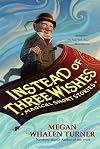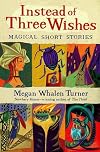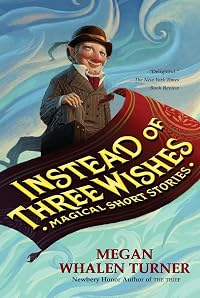
Instead of Three Wishes: Magical Short Stories
by Megan Whalen Turner
On This Page
Description
A collection of seven stories featuring leprechauns, ghosts, time travel, and other extraordinary creatures and experiences.Tags
Recommendations








Member Recommendations

Member Reviews
A perfectly charming set of stories. I am positive I read it before (when? when?), so my enjoyment was a bit dimmed - expecting to be surprised by twists & endings, I kept thinking 'oh - right'. Entirely my fault, because I expect these to hold up to repeated reading.
Turner is such a good writer. This is her first published work, & it's less intricate, less polished than her books, but she still creates entire worlds & full characters with just a few lines. (If I'm reading the dedication page correctly, these were written for her son - and while most are funny and emotionally provocative, one is creepy & disturbing - hard to imagine requesting that to be read as a bedtime story.)
There are a few very early traces of her Thief books, too show more - and since I can't think about that wicked Eugenides without being bathed in a warm glowing warming glow of writerly admiration, it was just an extra delight. show less
Turner is such a good writer. This is her first published work, & it's less intricate, less polished than her books, but she still creates entire worlds & full characters with just a few lines. (If I'm reading the dedication page correctly, these were written for her son - and while most are funny and emotionally provocative, one is creepy & disturbing - hard to imagine requesting that to be read as a bedtime story.)
There are a few very early traces of her Thief books, too show more - and since I can't think about that wicked Eugenides without being bathed in a warm glowing warming glow of writerly admiration, it was just an extra delight. show less
I rarely enjoy collections of short stories, but I quite enjoyed this one. I think The Baker King is the literary grandfather of the Queen's Thief series.
I liked, if not loved, every single story in this short anthology. Granted, there were only eight stories, but for me, it is still quite an achievement as I prefer novels to shorts. Megan Whalen Turner is one of the best story tellers in the YA fantasy genre I've come across and these stories showcase her talents wonderfully. I especially loved "Factory" and "Instead of Three Wishes."
Overall Rating: 3/5
Megan Whalen Turner’s The Queen’s Thief series is, without a doubt, one of the best things I’ve ever read. By the middle of book three, The King of Attolia, I had already decided to add her to my list of favorite authors on goodreads.
However, the best thing about those books is, by far, the characters. Turner has a knack for great, multi-dimensional characters the way Brandon Sanderson has a knack for cool magic systems, or the way Patrick Rothfuss has a knack for pretty words, or the way that Gene Wolfe has a knack for world building. It is her strongest trait by far. Which is not to say that those books don’t have decent world-building, lore, and plots behind them, because they do, but they’re just regular show more good.
I was very excited when I found out that Turner had a short story collection I could read, though now that I’ve read it I realize that her strongest trait, character, is something that typically takes a back seat in short stories so that unique ideas, plots, or styles of writing can take center stage. There’s simply not enough words in a short story to develop strong characters (usually), but the length is perfect for experimentation in other areas.
These stories, unfortunately, are not at all experimental. They’re charming, but woefully predictable, and they all wrap up a little too cleanly for my taste. I would say that the majority of short stories I've read have at least somewhat ambiguous endings, and that's probably for the best. You can get away with stuff you otherwise couldn't, so why not take advantage of that? We really don't like ambiguous endings in western culture, but somehow that type of ending thrives in short stories and that's a big part of why I'm drawn to them.
A Plague of Leprechaun (1/5)
Tourist start flocking to a small town when a leprechaun is sighted. An artist visiting to paint landscapes gets the gold. Quite boring.
Leroy Roachbane (1/5)
Some kid likes to kill roaches to an unhealthy degree. He has to write a report about his black heritage for school, but he lives in Sweden and the school library only has history books about white people. He crashes his bike and has some sort of hallucination about killing roaches for ancient Swedish tribal people or something. What the shit? Seriously, what the shit?
Factory (4/5)
This is a great little story about a sort of dystopian future where people sleep, eat, live, and work for fourteen hours a day in a giant factory. Work is apparently so scarce that there is a selection process to get in, if you can believe it. The main character, John, due to the results of his psych profile, which indicate he's a loner, is assigned to the 'high crane' where he is isolated from most of the other workers. In fact, it takes him so long to climb up and down the ladder to his crane that he very quickly stops climbing down to take his lunch breaks at all, which further isolates him from the rest of the workers.
At first he enjoys his job, doesn't mind being alone at all, and loves reading the books the factory library provides. He hears rumors of how the previous workers in his position have quit after a short time because they saw ghosts. The official story from the factory, however, is that they quit “because they got bored and lonely.”
At first he ignores these rumors, but eventually he meets one of these ghosts and forms a friendship with her. Turns out she's one of the people who lived in a mansion on this plot of land a long time ago, before the factory was built.
They share poetry, she tells him what nature in her time was like (John's people call pigeons 'birds' because 'there's only the one kind' and he's never heard of a squirrel).
They become really close and he comes to realize that he would rather live in her world, a world that never changes, than grow old and leave her, and so he talks to her mother (who is the one who figured out how to ghost-ify the whole family in the first place) and does exactly that, bringing not only himself but a ton of new books and chocolates into his new friend's unchanging world where they can sit and read and eat chocolate together for all eternity.
It's short, sweet, character-driven, and speaks to what is truly important in life (relationships with other people, ideas, contentment, happiness) vs. what really isn't important at all but a lot of people really think is incredibly important (forward progress, manufacturing, profit, money, work work work and more work). It really resonated with me and my own personal world-view and I enjoyed it immensely.
Aunt Charlotte and the NGA Portraits (3/5)
An old woman tells a story from her youth, about how she befriended this older woman during a vacation who was magical. At the end she gets sent into a painting to retrieve a fur coat for said woman and meets several people who are, in actual fact, not real but people from several different paintings. Basically it's her way of explaining why she sees certain painting as friends, and what parts of it you choose to believe are up to you, as aunt Charlotte would say.
Instead of Three Wishes (4/5)
The 'title track' of this collection if you will, this story is yet again a sweet, character-driven story that shows off Turner's strengths.
It all starts when a young woman named Selene helps an elf prince cross the street. He, as elves do, offers her a gift in exchange for her help—three wishes, printed on business cards—which she promptly refuses because he could be a crazy murderer or something, and besides, how often do wishes go so very wrong in stories? She accidentally tells him where she lives in her attempt to escape the situation and receives gift upon gift at her doorstep, all of which she refuses for reasons of practicality and common sense. A mansion she can't afford to live in; a fairy tale prince meant to be her husband who can't read, write, or do anything useful; etc.
Finally, not knowing how to please her, the elf prince disguises himself as a human and takes up lodging in Selene and her mother's house in order to find out what she likes so that he can repay his debt. Turns out a nice lodger was exactly what they wanted, and Selene's delicious baking is exactly what the elf prince wanted. The three of them slowly become friends, and when Selene gets accepted into an exclusive culinary school that she can't afford to go to the elf prince knows exactly what to do. He pays her tuition, and moves Selene's mother into his own house where his mother lives.
What started as a single-minded, almost business-like attempt to repay a debt ends with Selene being able to go to the culinary school of her dreams, and her, her mother, the elf prince and his mother, all becoming good friends. Just like Factory it emphasizes the importance of friendships and other people over material goods. Selene chose to make new friends instead of making three wishes, and she was smarter than most of us for doing so.
The Nightmare (2/5)
Some high-school freshman harasses a woman who throws something at him. Turns out it's a nightmare that he has every night of what the people he saw throughout the day think of him. It turns him into a better, more empathetic individual and at the end of the story he passes it on to someone else, just as the woman did to him.
The Baker King (3/5)
A charming story written like a fairy tale, but a fairy tale that seems...perhaps a little too familiar? Basically a king sends his son off somewhere to learn the ways of life, but dies before he tells anyone where the boy actually is. His ministers manage just fine without a king until an infamous bandit sends word that he'll be taking up the position, whether they like it or not. They realize they can't call upon the army without a royal decree. One minister decides to find a random young man who fits the lost heir's description and tries to convince him that he is, in fact, the king. Turns out the man he picked actually is the lost heir, and knows that he is, but he doesn't want to be king. He pretends as much as he needs to in order to convince everyone that the throne is cursed and will kill anyone who sits on it besides the true heir, which scares away the bandits, and then returns to being a baker's apprentice while the ministers go back to running things. show less
Megan Whalen Turner’s The Queen’s Thief series is, without a doubt, one of the best things I’ve ever read. By the middle of book three, The King of Attolia, I had already decided to add her to my list of favorite authors on goodreads.
However, the best thing about those books is, by far, the characters. Turner has a knack for great, multi-dimensional characters the way Brandon Sanderson has a knack for cool magic systems, or the way Patrick Rothfuss has a knack for pretty words, or the way that Gene Wolfe has a knack for world building. It is her strongest trait by far. Which is not to say that those books don’t have decent world-building, lore, and plots behind them, because they do, but they’re just regular show more good.
I was very excited when I found out that Turner had a short story collection I could read, though now that I’ve read it I realize that her strongest trait, character, is something that typically takes a back seat in short stories so that unique ideas, plots, or styles of writing can take center stage. There’s simply not enough words in a short story to develop strong characters (usually), but the length is perfect for experimentation in other areas.
These stories, unfortunately, are not at all experimental. They’re charming, but woefully predictable, and they all wrap up a little too cleanly for my taste. I would say that the majority of short stories I've read have at least somewhat ambiguous endings, and that's probably for the best. You can get away with stuff you otherwise couldn't, so why not take advantage of that? We really don't like ambiguous endings in western culture, but somehow that type of ending thrives in short stories and that's a big part of why I'm drawn to them.
A Plague of Leprechaun (1/5)
Tourist start flocking to a small town when a leprechaun is sighted. An artist visiting to paint landscapes gets the gold. Quite boring.
Leroy Roachbane (1/5)
Some kid likes to kill roaches to an unhealthy degree. He has to write a report about his black heritage for school, but he lives in Sweden and the school library only has history books about white people. He crashes his bike and has some sort of hallucination about killing roaches for ancient Swedish tribal people or something. What the shit? Seriously, what the shit?
Factory (4/5)
This is a great little story about a sort of dystopian future where people sleep, eat, live, and work for fourteen hours a day in a giant factory. Work is apparently so scarce that there is a selection process to get in, if you can believe it. The main character, John, due to the results of his psych profile, which indicate he's a loner, is assigned to the 'high crane' where he is isolated from most of the other workers. In fact, it takes him so long to climb up and down the ladder to his crane that he very quickly stops climbing down to take his lunch breaks at all, which further isolates him from the rest of the workers.
At first he enjoys his job, doesn't mind being alone at all, and loves reading the books the factory library provides. He hears rumors of how the previous workers in his position have quit after a short time because they saw ghosts. The official story from the factory, however, is that they quit “because they got bored and lonely.”
At first he ignores these rumors, but eventually he meets one of these ghosts and forms a friendship with her. Turns out she's one of the people who lived in a mansion on this plot of land a long time ago, before the factory was built.
They share poetry, she tells him what nature in her time was like (John's people call pigeons 'birds' because 'there's only the one kind' and he's never heard of a squirrel).
They become really close and he comes to realize that he would rather live in her world, a world that never changes, than grow old and leave her, and so he talks to her mother (who is the one who figured out how to ghost-ify the whole family in the first place) and does exactly that, bringing not only himself but a ton of new books and chocolates into his new friend's unchanging world where they can sit and read and eat chocolate together for all eternity.
It's short, sweet, character-driven, and speaks to what is truly important in life (relationships with other people, ideas, contentment, happiness) vs. what really isn't important at all but a lot of people really think is incredibly important (forward progress, manufacturing, profit, money, work work work and more work). It really resonated with me and my own personal world-view and I enjoyed it immensely.
Aunt Charlotte and the NGA Portraits (3/5)
An old woman tells a story from her youth, about how she befriended this older woman during a vacation who was magical. At the end she gets sent into a painting to retrieve a fur coat for said woman and meets several people who are, in actual fact, not real but people from several different paintings. Basically it's her way of explaining why she sees certain painting as friends, and what parts of it you choose to believe are up to you, as aunt Charlotte would say.
Instead of Three Wishes (4/5)
The 'title track' of this collection if you will, this story is yet again a sweet, character-driven story that shows off Turner's strengths.
It all starts when a young woman named Selene helps an elf prince cross the street. He, as elves do, offers her a gift in exchange for her help—three wishes, printed on business cards—which she promptly refuses because he could be a crazy murderer or something, and besides, how often do wishes go so very wrong in stories? She accidentally tells him where she lives in her attempt to escape the situation and receives gift upon gift at her doorstep, all of which she refuses for reasons of practicality and common sense. A mansion she can't afford to live in; a fairy tale prince meant to be her husband who can't read, write, or do anything useful; etc.
Finally, not knowing how to please her, the elf prince disguises himself as a human and takes up lodging in Selene and her mother's house in order to find out what she likes so that he can repay his debt. Turns out a nice lodger was exactly what they wanted, and Selene's delicious baking is exactly what the elf prince wanted. The three of them slowly become friends, and when Selene gets accepted into an exclusive culinary school that she can't afford to go to the elf prince knows exactly what to do. He pays her tuition, and moves Selene's mother into his own house where his mother lives.
What started as a single-minded, almost business-like attempt to repay a debt ends with Selene being able to go to the culinary school of her dreams, and her, her mother, the elf prince and his mother, all becoming good friends. Just like Factory it emphasizes the importance of friendships and other people over material goods. Selene chose to make new friends instead of making three wishes, and she was smarter than most of us for doing so.
The Nightmare (2/5)
Some high-school freshman harasses a woman who throws something at him. Turns out it's a nightmare that he has every night of what the people he saw throughout the day think of him. It turns him into a better, more empathetic individual and at the end of the story he passes it on to someone else, just as the woman did to him.
The Baker King (3/5)
A charming story written like a fairy tale, but a fairy tale that seems...perhaps a little too familiar? Basically a king sends his son off somewhere to learn the ways of life, but dies before he tells anyone where the boy actually is. His ministers manage just fine without a king until an infamous bandit sends word that he'll be taking up the position, whether they like it or not. They realize they can't call upon the army without a royal decree. One minister decides to find a random young man who fits the lost heir's description and tries to convince him that he is, in fact, the king. Turns out the man he picked actually is the lost heir, and knows that he is, but he doesn't want to be king. He pretends as much as he needs to in order to convince everyone that the throne is cursed and will kill anyone who sits on it besides the true heir, which scares away the bandits, and then returns to being a baker's apprentice while the ministers go back to running things. show less
This collection of seven thoughtful, captivating, and sometimes haunting short stories is an excellent addition to any fantasy-lover's collection. Some are funny, others a little sad, but all are wonderful reads.
Good stories, interesting takes. It would be 5 stars if it weren't slightly disappointing compared to the amazing Queen's Thief series. Which had an amazing-er finale volume. Writing this eight months later I can't even recall specifics: just a vague memory of satisfaction.
I guess I should read it several more times, to be certain.
Library copy
I guess I should read it several more times, to be certain.
Library copy
I enjoyed Instead of Three Wishes well enough. They weren't as fabulous as the Eugenides books, but then short stories never have as much depth as full novels, IMHO. I did enjoy most of the stories though, so don't hesitate to pick it up.
I really liked the one about the art museum and the elf prince (can't remember the titles).
I even bought myself a copy to read to my (eventual) students. I'd like to get them more involved in reading and expose them to different genres through the use of short stories and these are perfect.
I really liked the one about the art museum and the elf prince (can't remember the titles).
I even bought myself a copy to read to my (eventual) students. I'd like to get them more involved in reading and expose them to different genres through the use of short stories and these are perfect.
Members
- Recently Added By
Author Information

19+ Works 15,056 Members
Some Editions
Awards and Honors
Common Knowledge
- Original title
- Instead of Three Wishes
- Original publication date
- 1995
- Dedication
- These stories
were written
for Mark Turner - Blurbers
- Wrede, Patricia C.; Alexander, Lloyd
Classifications
- Genres
- Fiction and Literature, Kids, Tween, Fantasy
- DDC/MDS
- 813.54 — Literature & rhetoric American literature in English American fiction in English 1900-1999 1945-1999
- LCC
- PZ7 .T85565 .I — Language and Literature Fiction and juvenile belles lettres Fiction and juvenile belles lettres Juvenile belles lettres
- BISAC
Statistics
- Members
- 415
- Popularity
- 74,984
- Reviews
- 12
- Rating
- (3.75)
- Languages
- English
- Media
- Paper, Ebook
- ISBNs
- 6
- ASINs
- 4