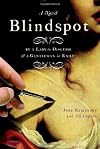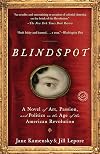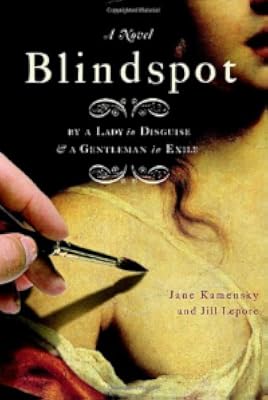
Blindspot
by Jane Kamensky, Jill Lepore
On This Page
Description
Set in boisterous Boston on the eve of the American Revolution, Blindspot is at once fiction and history, mystery and love story, tragedy and farce. Peopled not only with the celebrated Sons of Liberty but also with revolutionary Boston's unsung inhabitants, it tells the story of Scottish painter Stewart Jameson and his spirited apprentice, Fanny Easton, a fallen woman who has disguised herself as a boy, Francis Weston.When Boston's revolutionary leader, Samuel Bradstreet, dies suddenly on show more the day Jameson was to paint his portrait, Bradstreet's slaves are accused of murder. Jameson, Weston, and the brilliant doctor Ignatius Alexander set out to determine the truth. What they discover turns topsy-turvy everything you thought you knew about the Founding Fathers.
. show less
Tags
Recommendations









Member Recommendations
Member Reviews
Summary: Stewart Jameson flees his debts in his native Scotland, and settles himself in colonial Boston. Jameson is a painter, a portraitist, who has an uncanny knack for capturing not only people's faces but their true selves. He advertises for an apprentice, and on his doorstep lands one Francis Weston - neé Fanny Easton - a young woman who has been cast out by her father, one of the luminaries of Boston politics, and has disguised herself as a boy in order to pursue her love of painting. Politics is much on the mind of the town, as Parliment is increasing taxation on goods to the colonies, and there is a growing sentiment in favor of freedom. But the same people cheering for freedom from Britain are not necessarily in favor of show more freedom for all, and when a notable anti-slavery advocate is murdered, tensions come to a head. But can Jameson and Weston see the truth of the situation when they can't clearly see what is happening in their own lives?
Review: I had a ton of fun with this book. It's a total mish-mash of a novel, part historical fiction and part romance and part murder mystery; the tone falls somewhere between picaresque, satire, and epistolary. One thing it never is, though, is self-serious: practically every page is full of wordplay and bad puns and bawdy jokes and riddles. Kamensky & Lepore can tone it down when needed, for the more serious and poignant scenes, but I should have known from the fact that the back cover of the book contains blurbs from Benjamin Franklin, Samuel Johnson, and Henry Fielding, among others, that this book was going to be more than a little tongue-in-cheek. And the excellent thing was, that no matter how difficult the mish-mash of story elements and genres makes this book to describe, they are all woven together well, making this book feel full and rich, if occasionally a little overstuffed. (But, y'know, comfortably so.)
The other great thing about this book was how well it brought 1760s Boston to life. Kamensky and Lepore are both professional historians, so perhaps it's no surprise that they got the details right. But they really captured the tone of the time in Stewart's writings and Fanny's letters, not to mention the newspaper articles, pamplets, legislation, etc. that were sprinkled throughout. And, what's more, they caught the tone of the time yet still kept it readable to a modern audience: pretty impressive. There were a few things that I thought were a little anachronistic: Fanny's personality and decisions, for sure, and also some of the wordplay also struck me as rather modern... but on that latter point, based on the authors' note, I think it's my perception of eighteenth century that's wrong, rather than the book. They also do a really nice job of working with their main theme - of looking so hard at one thing that you completely miss something else - and watching the title play itself out on multiple levels was really fascinating.
Overall, this book was by turns funny, sexy, sad, witty, and thought-provoking. But mostly just a total blast to read. 4.5 out of 5 stars.
Recommendation: Definitely recommended if you like Revolutionary War-era literature, or historical fiction set in that time frame. show less
Review: I had a ton of fun with this book. It's a total mish-mash of a novel, part historical fiction and part romance and part murder mystery; the tone falls somewhere between picaresque, satire, and epistolary. One thing it never is, though, is self-serious: practically every page is full of wordplay and bad puns and bawdy jokes and riddles. Kamensky & Lepore can tone it down when needed, for the more serious and poignant scenes, but I should have known from the fact that the back cover of the book contains blurbs from Benjamin Franklin, Samuel Johnson, and Henry Fielding, among others, that this book was going to be more than a little tongue-in-cheek. And the excellent thing was, that no matter how difficult the mish-mash of story elements and genres makes this book to describe, they are all woven together well, making this book feel full and rich, if occasionally a little overstuffed. (But, y'know, comfortably so.)
The other great thing about this book was how well it brought 1760s Boston to life. Kamensky and Lepore are both professional historians, so perhaps it's no surprise that they got the details right. But they really captured the tone of the time in Stewart's writings and Fanny's letters, not to mention the newspaper articles, pamplets, legislation, etc. that were sprinkled throughout. And, what's more, they caught the tone of the time yet still kept it readable to a modern audience: pretty impressive. There were a few things that I thought were a little anachronistic: Fanny's personality and decisions, for sure, and also some of the wordplay also struck me as rather modern... but on that latter point, based on the authors' note, I think it's my perception of eighteenth century that's wrong, rather than the book. They also do a really nice job of working with their main theme - of looking so hard at one thing that you completely miss something else - and watching the title play itself out on multiple levels was really fascinating.
Overall, this book was by turns funny, sexy, sad, witty, and thought-provoking. But mostly just a total blast to read. 4.5 out of 5 stars.
Recommendation: Definitely recommended if you like Revolutionary War-era literature, or historical fiction set in that time frame. show less
When I heard that two distinguished professors of American history had written a novel for fun, I was a bit worried. First, that's not their thing (fiction). Second, two writers? But I couldn't resist the premise and I wound up loving Blindspot, so much that when my dog woke me up at 3:30 this morning, I picked up the book -- I was already about halfway through -- and read straight through till I finished, around 7:30.
It's got all the elements you want in an intelligent, fun read -- romance and deception, a murder mystery and a rich historical setting. And it's funny! The exclamations of the hero, painter Stewart Jameson, are enough reason to read the book -- but there are more. When I finished the book I had that feeling I used to get show more a lot as a kid but rarely as an adult -- I wish I hadn't read the book yet, so I could read it again for the first time. show less
It's got all the elements you want in an intelligent, fun read -- romance and deception, a murder mystery and a rich historical setting. And it's funny! The exclamations of the hero, painter Stewart Jameson, are enough reason to read the book -- but there are more. When I finished the book I had that feeling I used to get show more a lot as a kid but rarely as an adult -- I wish I hadn't read the book yet, so I could read it again for the first time. show less
Celebrated historians Jane Kamensky (Brandeis) and Jill Lepore (Harvard) have written a novel. Blindspot, published by Doubleday's Spiegel and Grau imprint, is, the authors write, "A revolution - a turn away from our work as historians, that took us back to it. A different kind of history. Only when we read it did we discover: Blindspot was our own declaration of independence." The duo, whose non-fiction works I have read and found much favor with, clearly had great fun writing this book, and of course no one can begrudge them a bit of amusement. Writing fiction can be an enjoyable exercise, and it is clear that they took much delight in the process. But there is much about this book and the way it was written (and by whom), which must show more give any reader, perhaps most of all those of us who take history seriously, reason to reflect.
Its authors maintain that Blindspot is "a twenty-first century novel in eighteenth-century garb." By which I guess they mean it's a book modeled on earlier works, but written explicitly enough that modern readers don't have to read between the lines quite so much as our predecessors did to grasp the bawdy references. The narration alternates between the first-person perspectives of Stewart Jameson, a debt-fleeing Scots portrait painter who's taken refuge in 1760s Boston, and Fanny Easton, a fallen-from-grace girl from the top echelons of Boston's society who, having disguised herself as the boy Francis Weston, takes up as Jameson's alluring and sensible apprentice. Her perspective we get through her letters to a female friend in New York (although as they get more explicit, and thus entirely unsuitable for sending through the mail, we learn that we're reading letterbook copies, most of which are never sent).
Lepore and Kamensky's training and historical sensibilities suit them well in outlining the social contexts of Boston during the years following the end of the French and Indian War through the passage of the first of the revenue acts which would lead to the Revolution. Their depiction of the city and its major figures is generally well-drawn and detailed. Jameson and Easton, eventually joined by Jameson's friend the Anglo-African scholar Ignatius Alexander, find themselves caught up in the web of contradictions that was mid-1760s Boston, embroiled as it was in arguments over tyranny and slavery, taxes and politics, &c. They must solve a murder in order to free an innocent woman from prison, and of course they must fall in love (this is a novel, after all, and the conventions run their course, the fact that Jameson thinks Easton is a boy being of little matter for the first three-quarters of the book).
The novel is at its best when playfully pulling in the conventions of the 18th century's best creations, including some ingenious wordplays and riddle. The language could have been tempered a bit, it being flowery and overwritten (particularly in the beginning) even by the most grandiloquent standards. It is particularly unlike most early American fictional works, which tend to be much less ornate than their English brethren (The Power of Sympathy, The Coquette, Wieland, for example).
What made me twitchy about this book was the authors' surprisingly cavalier attitude toward historical accuracy. As they write in the introduction to their online historical notes (not printed in the book, a galling omission, since it could not possibly have taken many pages to add), Lepore and Kamensky write "We quoted, we borrowed, we took liberties. Above all, we invented." They also changed things around, and that is where their effort foundered with me. The book includes many extracts from the Boston Gazette, a real newspaper. When I started reading I wondered if the authors had taken the extracts directly, or if they'd made them up. So I checked the original newspapers, and found that the novel's snippets were dated on the paper's off-days (it was printed once a week, on days other than the dates found in the book). The snippets weren't real, the dates weren't real, but the paper was. Why not just create a fictional paper and remove the confusion?
The online notes are a must-read, since they are the only place where Lepore and Kamensky announce their self-appointed changes (and mostly superfluous) to the historical chronology. They have a garrison of British troops arrive in Boston in 1764, rather than 1768. They move the governor's residence to Cambridge, and they switch the date of implementation of the Sugar and Currency Acts to 8 October 1764 (they both took effect in September, but neither, let alone both, on 24 September as Lepore and Kamensky maintain). None of these have any material effect on the story, so why make such changes? They turn Samuel Bradstreet (a real person) into a different character inspired by James Otis Jr., and they create a fictional murder trial of slaves by twisting the facts of an earlier trial around to suit their purposes.
Quibbles, some might say, and perhaps that's so. Perhaps I'm letting the facts get in the way of their story. But professional historians, no matter what they're writing, have a responsibility to scholarship and to the historical profession at large. If one wants to write fiction, that's fine, but do so without muddying the historical record by making unwarranted changes to the facts. Create a fictional newspaper, rather than confusing people by being unclear about your sources. Don't use real people's names unless you're going to tell their stories accurately (or, at the very least, plausibly).
Lepore and Kamensky have, in several interviews about their book and in their website, used the phrase "a different kind of truth" to describe Blindspot. Kamensky told the Boston Globe's Samuel Jacobs "I don't think fiction is more true than history, but I don't think the novel is fake. I think it is differently true. It is like asking whether a poem is more true than a wall." I shuddered when I read that, and of course the first thing that came to mind was Samuel Johnson's famous retort to Boswell's about Bishop Berkeley's ideas about the non-reality of matter. Boswell: "I observed, that though we are satisfied his doctrine is not true, it is impossible to refute it. I never shall forget the alacrity with which Johnson answered, striking his foot with mighty force against a large stone, till he rebounded from it, 'I refute it thus.'" I don't recommend Ms. Kamensky try that with the nearest wall, but I suspect the result would be much the same.
I'm sorry, Ms. Kamensky, but your novel is fake. Some lines, some characters, some conventions may be drawn from reality, but what you have created is a story. Not an awful one, mind you, but a fictional story just the same. It is different from history, and yes, it is less true. Indeed, historians create a narrative, but it is their responsibility to do so while staying faithful to the facts they can uncover. This "blurring of fact and fiction," as Gordon Wood called the trend in a 1991 review of another leading historian's dip into the languid waters of storytelling*, deserves our notice, and our vigilance (witness the alarming frequency of the discoveries of fake memoirs). A sentence from Wood's review is impossible to avoid including here: "If we cannot recover the truth about the past with finality and completeness, then must we resort to the techniques of fiction in order to fill in the shadows and embody the ghosts? Are those the alternatives?"
I enjoy historical fiction, very much. And there were elements of Blindspot that were historical fiction at its best. But there were also elements which were historical fiction at its very worst, and overall, I have to say that both history and fiction deserve better treatment than they've received here.
I'll look forward to the next historical works from both Lepore and Kamensky, but I sincerely hope that this will be their last foray into fiction. Their talents are sorely needed on the other side of the fence.
* Wood, Gordon S. "History as Fiction," chapter 7 in The Purpose of the Past. NY: Penguin Press, 2008. Review of Simon Schama's Dead Certainties, first published NYRB, 27 June 1991. As I said in my review of Purpose of the Past, I disagree with some of Wood's comments about Schama's book, but on this point we are in complete agreement.
http://philobiblos.blogspot.com/2009/01/book-review-blindspot.html show less
Its authors maintain that Blindspot is "a twenty-first century novel in eighteenth-century garb." By which I guess they mean it's a book modeled on earlier works, but written explicitly enough that modern readers don't have to read between the lines quite so much as our predecessors did to grasp the bawdy references. The narration alternates between the first-person perspectives of Stewart Jameson, a debt-fleeing Scots portrait painter who's taken refuge in 1760s Boston, and Fanny Easton, a fallen-from-grace girl from the top echelons of Boston's society who, having disguised herself as the boy Francis Weston, takes up as Jameson's alluring and sensible apprentice. Her perspective we get through her letters to a female friend in New York (although as they get more explicit, and thus entirely unsuitable for sending through the mail, we learn that we're reading letterbook copies, most of which are never sent).
Lepore and Kamensky's training and historical sensibilities suit them well in outlining the social contexts of Boston during the years following the end of the French and Indian War through the passage of the first of the revenue acts which would lead to the Revolution. Their depiction of the city and its major figures is generally well-drawn and detailed. Jameson and Easton, eventually joined by Jameson's friend the Anglo-African scholar Ignatius Alexander, find themselves caught up in the web of contradictions that was mid-1760s Boston, embroiled as it was in arguments over tyranny and slavery, taxes and politics, &c. They must solve a murder in order to free an innocent woman from prison, and of course they must fall in love (this is a novel, after all, and the conventions run their course, the fact that Jameson thinks Easton is a boy being of little matter for the first three-quarters of the book).
The novel is at its best when playfully pulling in the conventions of the 18th century's best creations, including some ingenious wordplays and riddle. The language could have been tempered a bit, it being flowery and overwritten (particularly in the beginning) even by the most grandiloquent standards. It is particularly unlike most early American fictional works, which tend to be much less ornate than their English brethren (The Power of Sympathy, The Coquette, Wieland, for example).
What made me twitchy about this book was the authors' surprisingly cavalier attitude toward historical accuracy. As they write in the introduction to their online historical notes (not printed in the book, a galling omission, since it could not possibly have taken many pages to add), Lepore and Kamensky write "We quoted, we borrowed, we took liberties. Above all, we invented." They also changed things around, and that is where their effort foundered with me. The book includes many extracts from the Boston Gazette, a real newspaper. When I started reading I wondered if the authors had taken the extracts directly, or if they'd made them up. So I checked the original newspapers, and found that the novel's snippets were dated on the paper's off-days (it was printed once a week, on days other than the dates found in the book). The snippets weren't real, the dates weren't real, but the paper was. Why not just create a fictional paper and remove the confusion?
The online notes are a must-read, since they are the only place where Lepore and Kamensky announce their self-appointed changes (and mostly superfluous) to the historical chronology. They have a garrison of British troops arrive in Boston in 1764, rather than 1768. They move the governor's residence to Cambridge, and they switch the date of implementation of the Sugar and Currency Acts to 8 October 1764 (they both took effect in September, but neither, let alone both, on 24 September as Lepore and Kamensky maintain). None of these have any material effect on the story, so why make such changes? They turn Samuel Bradstreet (a real person) into a different character inspired by James Otis Jr., and they create a fictional murder trial of slaves by twisting the facts of an earlier trial around to suit their purposes.
Quibbles, some might say, and perhaps that's so. Perhaps I'm letting the facts get in the way of their story. But professional historians, no matter what they're writing, have a responsibility to scholarship and to the historical profession at large. If one wants to write fiction, that's fine, but do so without muddying the historical record by making unwarranted changes to the facts. Create a fictional newspaper, rather than confusing people by being unclear about your sources. Don't use real people's names unless you're going to tell their stories accurately (or, at the very least, plausibly).
Lepore and Kamensky have, in several interviews about their book and in their website, used the phrase "a different kind of truth" to describe Blindspot. Kamensky told the Boston Globe's Samuel Jacobs "I don't think fiction is more true than history, but I don't think the novel is fake. I think it is differently true. It is like asking whether a poem is more true than a wall." I shuddered when I read that, and of course the first thing that came to mind was Samuel Johnson's famous retort to Boswell's about Bishop Berkeley's ideas about the non-reality of matter. Boswell: "I observed, that though we are satisfied his doctrine is not true, it is impossible to refute it. I never shall forget the alacrity with which Johnson answered, striking his foot with mighty force against a large stone, till he rebounded from it, 'I refute it thus.'" I don't recommend Ms. Kamensky try that with the nearest wall, but I suspect the result would be much the same.
I'm sorry, Ms. Kamensky, but your novel is fake. Some lines, some characters, some conventions may be drawn from reality, but what you have created is a story. Not an awful one, mind you, but a fictional story just the same. It is different from history, and yes, it is less true. Indeed, historians create a narrative, but it is their responsibility to do so while staying faithful to the facts they can uncover. This "blurring of fact and fiction," as Gordon Wood called the trend in a 1991 review of another leading historian's dip into the languid waters of storytelling*, deserves our notice, and our vigilance (witness the alarming frequency of the discoveries of fake memoirs). A sentence from Wood's review is impossible to avoid including here: "If we cannot recover the truth about the past with finality and completeness, then must we resort to the techniques of fiction in order to fill in the shadows and embody the ghosts? Are those the alternatives?"
I enjoy historical fiction, very much. And there were elements of Blindspot that were historical fiction at its best. But there were also elements which were historical fiction at its very worst, and overall, I have to say that both history and fiction deserve better treatment than they've received here.
I'll look forward to the next historical works from both Lepore and Kamensky, but I sincerely hope that this will be their last foray into fiction. Their talents are sorely needed on the other side of the fence.
* Wood, Gordon S. "History as Fiction," chapter 7 in The Purpose of the Past. NY: Penguin Press, 2008. Review of Simon Schama's Dead Certainties, first published NYRB, 27 June 1991. As I said in my review of Purpose of the Past, I disagree with some of Wood's comments about Schama's book, but on this point we are in complete agreement.
http://philobiblos.blogspot.com/2009/01/book-review-blindspot.html show less
Henry Fielding has been channeled in this murder mystery and titillating transvestite tale that is rife with political pull and painting practices, and stacked with sniggering slang. The authors have used Fielding’s writing technique he introduced in Tom Jones, wherein the narrator addresses the audience directly while presenting, explaining, or mollifying the sensitive reader to certain material. They have expanded his technique employed in Joseph Andrews (or Shamela for that matter) in which penned letters or handbill texts and news items are blended with the narrative to enrich or to advance the plot.
Here, the narrator is Stewart Jameson, a portrait painter who is prone to punning, rants, and scheming. He has escaped to Boston from show more London to avoid the debt incurred when he sought to free a slave-worthy friend from bondage. The inclusion of his friend, Ignatius Alexander, provides the authors license to explore the slavery issues of 18th Century Massachusetts as well as to offer a bit of technical CSI pioneering.
Jameson encounters and contracts the crossing-dressing Fanny Weston, who eventually reveals herself as Francis Easton, the runaway daughter of a wealthy merchant and politico. She pens the intermittent letters to a childhood chum, all the while functioning as an artist’s apprentice. Their efforts in oils provide the authors a larger palette to explore 18th Century painting techniques.
The duo have been contracted to paint a number of portraits for a men’s social club. One sitter—a vociferous protestor against English governance—dies mysteriously a day after his portrait has been made. His death propels Jameson, Weston, and Alexander into an investigation of the man’s death and launches them into a feverish search for his missing Will. What the trio unearths strips away the pretensions of three prominent families.
This is an ambitious work that intertwines early Colonial culture, art, politics, morals, and philosophy with a lexicon that creates an intimate landscape and enlivens the characters. The novel is accurately authentic enough to please any historian, although the pontificating portions might be off-putting to some modern readers—but that’s the style of 18th Century fiction.
I love alliteration in writing, and the Jameson character provides plenty of expressive epigrams, giggling gibberish, witty ditties, and rhyming retorts. Brava. Bravura. Bully for Blindspot. show less
Here, the narrator is Stewart Jameson, a portrait painter who is prone to punning, rants, and scheming. He has escaped to Boston from show more London to avoid the debt incurred when he sought to free a slave-worthy friend from bondage. The inclusion of his friend, Ignatius Alexander, provides the authors license to explore the slavery issues of 18th Century Massachusetts as well as to offer a bit of technical CSI pioneering.
Jameson encounters and contracts the crossing-dressing Fanny Weston, who eventually reveals herself as Francis Easton, the runaway daughter of a wealthy merchant and politico. She pens the intermittent letters to a childhood chum, all the while functioning as an artist’s apprentice. Their efforts in oils provide the authors a larger palette to explore 18th Century painting techniques.
The duo have been contracted to paint a number of portraits for a men’s social club. One sitter—a vociferous protestor against English governance—dies mysteriously a day after his portrait has been made. His death propels Jameson, Weston, and Alexander into an investigation of the man’s death and launches them into a feverish search for his missing Will. What the trio unearths strips away the pretensions of three prominent families.
This is an ambitious work that intertwines early Colonial culture, art, politics, morals, and philosophy with a lexicon that creates an intimate landscape and enlivens the characters. The novel is accurately authentic enough to please any historian, although the pontificating portions might be off-putting to some modern readers—but that’s the style of 18th Century fiction.
I love alliteration in writing, and the Jameson character provides plenty of expressive epigrams, giggling gibberish, witty ditties, and rhyming retorts. Brava. Bravura. Bully for Blindspot. show less
Blindspot, just released from Spiegel and Grau, is an wonderful piece of historical fiction. Wonderful just isn't enough - it's ribald, witty, charming and oh, so much more.
Jane Kamensky and Jill Lepore are both renowned history professors. They've joined together to produce this novel.
Blindspot tells the tale of young Fanny Easton, a 'fallen' woman from a good family. She has been working in the Manufactory in Boston in 1764, barely surviving. When she spies an advertisement for an artist's apprentice, she sees a slim chance to escape her life of poverty. She disguises herself as a boy and applies to Stewart Jameson as Francis Weston. She does possess artistic ability and is taken on. Unbeknownst to her, Stewart Jameson has fled to the show more colonies from Scotland, where he is wanted for debt evasion. His debt was incurred trying to buy the freedom of his friend, the brilliant, black Dr. Alexander. Boston in 1764 is resisting the heavy hand of England and it's taxes. Slavery is an issue being hotly debated and political unrest is rampant. When a death (or could it be murder) occurs, the three are deeply involved.
Kamensky and Lepore have skillfully woven historical fact with literary license to create an engrossing, clever tale. It is told in alternating viewpoints. Jameson is writing his take on things to "Dear Reader"in his journal, while Fanny (Weston) is writing letters to a childhood friend. I was captured by the language and tone of the book - the puns, plays on words, language used and the social fabric of Boston in 1764. The depth of historical fact woven in adds to an already rich story. Blindspot is a love story as well. Some readers may be offended by some of the sexual scenes, but they are integral to the book.
The authors have created an excellent website for the book as well, providing further insight. Although the book is 500 pages long, it never flagged for me. The storyline was compelling right to the last page. However, I wonder if there will be a sequel? The ending has been left open for one. I hope so!
Fans of Emma Donoghue would enjoy this book. show less
Jane Kamensky and Jill Lepore are both renowned history professors. They've joined together to produce this novel.
Blindspot tells the tale of young Fanny Easton, a 'fallen' woman from a good family. She has been working in the Manufactory in Boston in 1764, barely surviving. When she spies an advertisement for an artist's apprentice, she sees a slim chance to escape her life of poverty. She disguises herself as a boy and applies to Stewart Jameson as Francis Weston. She does possess artistic ability and is taken on. Unbeknownst to her, Stewart Jameson has fled to the show more colonies from Scotland, where he is wanted for debt evasion. His debt was incurred trying to buy the freedom of his friend, the brilliant, black Dr. Alexander. Boston in 1764 is resisting the heavy hand of England and it's taxes. Slavery is an issue being hotly debated and political unrest is rampant. When a death (or could it be murder) occurs, the three are deeply involved.
Kamensky and Lepore have skillfully woven historical fact with literary license to create an engrossing, clever tale. It is told in alternating viewpoints. Jameson is writing his take on things to "Dear Reader"in his journal, while Fanny (Weston) is writing letters to a childhood friend. I was captured by the language and tone of the book - the puns, plays on words, language used and the social fabric of Boston in 1764. The depth of historical fact woven in adds to an already rich story. Blindspot is a love story as well. Some readers may be offended by some of the sexual scenes, but they are integral to the book.
The authors have created an excellent website for the book as well, providing further insight. Although the book is 500 pages long, it never flagged for me. The storyline was compelling right to the last page. However, I wonder if there will be a sequel? The ending has been left open for one. I hope so!
Fans of Emma Donoghue would enjoy this book. show less
For those who enjoy their history lessons told through entertaining fiction the debut novel Blindspot, written by two historians, might be just the ticket. Mixing bawdy ribaldry, historic documents, and the seeds of the independence and abolitionist movements, Blindspot offers a vigorous romp through love, lust and history.
The story begins with the escape from London of Scottish portrait artist Stewart Jamison. “Jamie” is seriously in debt after borrowing money to free his friend, the highly educated Ignatius Alexander, who has been unjustly accused of being a runaway slave. Upon alighting on the shores of Boston Jamison advertises for a painter’s apprentice which is just the opportunity Fanny Easton has been hoping for. Years ago show more she fled her once comfortable life in the upper echelons of Boston’s political circles after betrayals and intrigues fooled her out of her dreams of happiness. She’s fallen a long way down and hopes that by disguising herself as a young man she’ll be able to achieve the freedoms she’s been denied as an independent young woman.
Boston in 1764 is a city in turmoil. Anger against British taxation is brewing, but there is disagreement regarding independence, and among those parties is further disagreement over slavery. Many fail to see the irony of calling for freedom while participating in the slave trade, a vigorous industry for Boston. When vocal abolitionist Samuel Bradstreet is poisoned, Ignatius, Jamie and Fanny become involved in solving the crime in the hopes of saving some innocent lives.
Written in mock 18th century language, chapters alternate between Jamie’s “dear reader” confessions and Fanny’s letters to an old friend. Using their vast historic knowledge authors Jane Kamensky of Brandeis and Jill Lapore of Harvard have infused the story with “interpretations” of real historic news tidbits, as well a verbatim passages from many sources, including diaries, notices, legal records, and sermons. Along with the true-to-life, but fictional, Ignatius, the authors have created several other parallels and have included several real historic individuals such as artist Joshua Reynolds and publisher Benjamin Edes. Even seemingly outrageous episodes are often factual, such as Fanny’s very personal “Beauty Revealed” miniature which is amazingly similar to one such tantalizing painting by the 18th century artist Sarah Goodrich. This self-portrait, and other paintings and historic information can be accessed on the Blindspot website, www.blindspotthenovel.com.
Like Tristam Shandy meeting Fanny Hill the story may be too much for readers of a delicate sensibility, but for those looking for a rollicking, passionate, historic mystery, Blindspot will hit the spot. show less
The story begins with the escape from London of Scottish portrait artist Stewart Jamison. “Jamie” is seriously in debt after borrowing money to free his friend, the highly educated Ignatius Alexander, who has been unjustly accused of being a runaway slave. Upon alighting on the shores of Boston Jamison advertises for a painter’s apprentice which is just the opportunity Fanny Easton has been hoping for. Years ago show more she fled her once comfortable life in the upper echelons of Boston’s political circles after betrayals and intrigues fooled her out of her dreams of happiness. She’s fallen a long way down and hopes that by disguising herself as a young man she’ll be able to achieve the freedoms she’s been denied as an independent young woman.
Boston in 1764 is a city in turmoil. Anger against British taxation is brewing, but there is disagreement regarding independence, and among those parties is further disagreement over slavery. Many fail to see the irony of calling for freedom while participating in the slave trade, a vigorous industry for Boston. When vocal abolitionist Samuel Bradstreet is poisoned, Ignatius, Jamie and Fanny become involved in solving the crime in the hopes of saving some innocent lives.
Written in mock 18th century language, chapters alternate between Jamie’s “dear reader” confessions and Fanny’s letters to an old friend. Using their vast historic knowledge authors Jane Kamensky of Brandeis and Jill Lapore of Harvard have infused the story with “interpretations” of real historic news tidbits, as well a verbatim passages from many sources, including diaries, notices, legal records, and sermons. Along with the true-to-life, but fictional, Ignatius, the authors have created several other parallels and have included several real historic individuals such as artist Joshua Reynolds and publisher Benjamin Edes. Even seemingly outrageous episodes are often factual, such as Fanny’s very personal “Beauty Revealed” miniature which is amazingly similar to one such tantalizing painting by the 18th century artist Sarah Goodrich. This self-portrait, and other paintings and historic information can be accessed on the Blindspot website, www.blindspotthenovel.com.
Like Tristam Shandy meeting Fanny Hill the story may be too much for readers of a delicate sensibility, but for those looking for a rollicking, passionate, historic mystery, Blindspot will hit the spot. show less
Blindspot is a high-energy ride through Boston of 1764, full of Hens (later called Sons of Liberty), painters, fallen women, slave traders, poisoners, murderers, and other exciting characters. The authors, historians and friends, have brought their knowledge of American History to a fast-paced, interesting, and fun read.
I particularly liked how the story unfolds. There are alternating chapters written by Stewart Jameson, a Scottish painter who has fled England ahead of his creditors, and Francis Weston/Frances Easton, a young woman who has fallen from the heights of Bostonian society to work in a Manufactory in the most abject poverty. Jamie’s story is written to us, his Readers, and Francis/Frances’ story is written to her girlhood show more friend Elizabeth. I liked it very much that they weren’t both written to friends, or to the Reader.
I also very much enjoyed the period detail and the feel of the times through the myriad of subplots and characters. They are brought vividly to life by Jamie and Frances in the telling of their stories.
Slavery was a huge part of the story, and you can see the conflicts, prejudices, and financial considerations that later erupted into the Civil War.
I also liked the love story and its ups and downs and resolution.
All in all a very satisfying read. show less
I particularly liked how the story unfolds. There are alternating chapters written by Stewart Jameson, a Scottish painter who has fled England ahead of his creditors, and Francis Weston/Frances Easton, a young woman who has fallen from the heights of Bostonian society to work in a Manufactory in the most abject poverty. Jamie’s story is written to us, his Readers, and Francis/Frances’ story is written to her girlhood show more friend Elizabeth. I liked it very much that they weren’t both written to friends, or to the Reader.
I also very much enjoyed the period detail and the feel of the times through the myriad of subplots and characters. They are brought vividly to life by Jamie and Frances in the telling of their stories.
Slavery was a huge part of the story, and you can see the conflicts, prejudices, and financial considerations that later erupted into the Civil War.
I also liked the love story and its ups and downs and resolution.
All in all a very satisfying read. show less
Members
- Recently Added By
Author Information

9+ Works 976 Members
Jane Kamensky is professor of history at Harvard University and the Pforzheimer Director of the Schlesinger Library at the Radcliffe Institute for Advanced Study. Her many books include The Exchange Artist, a finalist for the George Washington Book Prize.

34+ Works 9,094 Members
Jill Lepore is the David Woods Kemper '41 Professor of American History at Harvard University and a staff writer at The New Yorker. She has written several books including Book of Ages: The Life and Opinions of Jane Franklin, The Whites of Their Eyes: The Tea Party's Revolution and the Battle over American History, The Secret History of Wonder show more Woman, Joe Gould's Teeth, and These Truths: A History of the United States. (Bowker Author Biography) show less
Some Editions
Awards and Honors
Awards
Distinctions
Common Knowledge
- Canonical title
- Blindspot
- Original publication date
- 2008-12-09
- People/Characters
- Stewart Jameson; Francis Weston / Frances Easton; Elizabeth
- Important places
- Boston, Massachusetts, USA
- Important events
- American Revolution (1775 | 1783)
- Dedication
- To Our Husbands
- First words
- From the Edinburgh Evening Courant, April 15, 1764. Escaped. The fifth day this month, from the Sheriff of the City of Edinburgh, one Stewart Jameson, face-painter and libertine, on pain of being confined for debt.
Classifications
Statistics
- Members
- 370
- Popularity
- 84,815
- Reviews
- 27
- Rating
- (3.61)
- Languages
- English
- Media
- Paper, Audiobook, Ebook
- ISBNs
- 10
- ASINs
- 5