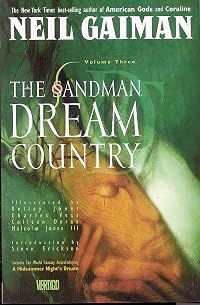
The Sandman: Dream Country
by Neil Gaiman
The Sandman (03 (Issues 17-20)), The Sandman {1989-1996} (Collections and Selections — TPB, issues 17-20)
On This Page
Description
The third book of the Sandman collection is a series of four short comic book stories. In each of these otherwise unrelated stories, Morpheus serves only as a minor character. Here we meet the mother of Morpheus's son, find out what cats dream about, and discover the true origin behind Shakespeare's A Midsummer's Night Dream.Tags
Recommendations

Member Reviews
In this 3rd volume of Gaiman’s “Sandman” series, there are four separate short stories presented, though they all involve dreams and the characters Death or Dream in some way. One was about an author with writer’s block, who acquired the muse Calliope to help him out. One was a cat who told a story trying to get other cats to dream with her to become more powerful than humans. The third was Will Shakespeare and his son Hamnet, travelling and performing for one patron “A Midsummer Night’s Dream”. The last one involved some kind of supernatural creature who cannot die who is lonely and desperately wants to find a way.
I quite liked this one. I don’t always like short stories, but I think I like them better in graphic novel show more format. I like Death portrayed as a woman, as it was on the last story, but the first story was my favourite. Included at the end of the book is Gaiman’s script on how one of the stories (Calliope, my favourite one) should be drawn and formatted. That was interesting to see how he writes his graphic novels (though he specifically explains that not everyone does it the same way). show less
I quite liked this one. I don’t always like short stories, but I think I like them better in graphic novel show more format. I like Death portrayed as a woman, as it was on the last story, but the first story was my favourite. Included at the end of the book is Gaiman’s script on how one of the stories (Calliope, my favourite one) should be drawn and formatted. That was interesting to see how he writes his graphic novels (though he specifically explains that not everyone does it the same way). show less
Aquarius season is all about revelling in the weird vibes, so this strange little interlude in the Sandman narrative is a perfect accompaniment. Contained within its pages, which bridge the gap between the epic events of The Doll’s House and the revelations of Seasons of Mist, are four short dreams that range in tone from perfectly whimsical to downright disturbing. The first tells the story of Calliope, a tale of confinement and rape that I find particularly difficult to stomach for obvious reasons, but which reveals much about the past of the Dream King. Themes of binding, codependency, and the power dynamics between the sexes give this story a thematic richness for all of its disturbing content and imagery, and thankfully show more Gaiman’s Oneiros takes a step towards humanity’s mercy with a judicious use of his power as he helps free his long-ago lover from captivity. “A Dream of a Thousand Cats” is at once a softer tale, but one which once again treads dark themes. What do we know of the dreams of cats, who are creatures of the night and predators made small? The shifted Morpheus reveals their truths in a dream, and sets an erstwhile Siamese on a prophetic quest towards freedom for feline kind. The takeaway here: take care to mind those who are smaller than you, as even the smallest have dreams that may become horrifying realities. The third tale (and my personal favourite of maybe the entire Sandman series) treads familiar territory. Back in time we go to walk the English countryside with Will Shakespeare and his players, as they avoid the summer plague season in London and play the greens instead for a host of faerie - and the Dream King, of course. As “A Midsummer Night’s Dream” plays out in front of the otherworldly court we hear about their plans to leave the mortal realms for good, and Morpheus’ agreement with Shakespeare that results in a play that will keep them from being forgotten down the ages. Well played, master Dreamer, and fitting, as it is in his realm that the magic of the other world can be revisited (if we’re lucky). The fey are also right that the accidental truths in the play are that, and worthwhile, convincing the Puck to remain behind after his brethren have gone from this world and continue his small brand of mischief - a small honesty from an unlikely antihero. The last tale in this collection is maybe the oddest of all - if only because its protagonist is definitely not an expected character to come up in the Sandman story arcs. Elemental Girl is an interesting character, and with her origin story beginning with an unexpected encounter with the sun for Ra and her inability to live a more normal human life, she’s a solid character for Gaiman to tackle. Morpheus is decidedly absent from this tale, but we’re glad for it, because we’re given the opportunity to see more of his elder sister, Death. Being separate from the human world, it is not surprising that Elemental Girl wishes for an end to her suffering or an explanation for how she should survive, and it is through a chat with the passing Death that she is able to see the light (literally) and find solace. Her suicide may be glorified, which can definitely be read as problematic and unsympathetic, but Death (the character not the state of being) is anything but and Urania’s unity with the sun is fitting for her next/last elemental incarnation. And with that this particular set of dreams ends, and the next cycle in Morpheus’ epic stage is set. The Dream Country may have been left, and Morpheus must not remain hidden away in his castle, but what is hidden in the mists of the coming Season? Sweet dreams, until tomorrow night! show less
Dream Country is the third volume in Neil Gaiman's Sandman series, and the first that is devoid of a unifying story arc. Instead, it contains four stories - Calliope, A Dream of a Thousand Cats, A Midsummer Night's Dream, and Facade - only related by their common association with the Endless. Dream himself does not even appear in Facade, which features his older sister Death comforting a distraught failed and retired super-heroine. Though the stories are unrelated to one another, and not really explicitly related to any of the larger story arcs that are contained in several of the other volumes each story, even the story in which he does not appear, provides insight into Dream as a character.
The first story in the volume is Calliope, show more named after the central character, one of the nine muses of Greek mythology. The story is a harsh and brutal one as Calliope is not free, but rather has been captured and in the course of the story is transferred as a possession from one captor to another. Her new owner, the primary antagonist in the story, is an author out of ideas who keeps his beautiful muse imprisoned and repeatedly rapes her (literally) for inspiration. The story of Calliope's imprisonment to satisfy the human hunger for power and riches parallels Dream's own imprisonment at the beginning of Preludes and Nocturnes, and Calliope's call to the weird sisters ties Dream's reality more closely into the Greek mythology that was hinted at in the opening volume of the series (if there are any doubts, Dream's alternate name of Morpheus, used frequently in the books, should dispel them). But the key element to the story is that Dream becomes involved at all - though it is established that he and Calliope had a prior relationship that ended badly, he comes to her aid nonetheless. Further, when Dream secures Calliope's freedom, he does not continue to torment her former captor, but instead shows clemency. In short, the story shows that Dream, despite being a being of endless existence, has been changed by his own captivity and its aftermath, and has become a more merciful being as a result. Despite his forbidding presence as the master of nightmares, Dream is, it seems, a less frightening entity post-capture than he may have been before.
The second story, A Dream of a Thousand Cats is, despite featuring a cute white kitten at its center, the most disturbing of the stories in the volume. Perhaps it is the fact that it features the cute white kitten, and the dreams that even such cute cats may have, that gives the story its impact. The story once again highlights human cruelty to those around us, in this case, human indifference to their pet cat's progeny leads to a dream of revenge that eventually leads to Morpheus, this time in the shape of a massive black cat. Morpheus tells a tale of a world in which cats ruled over humans, and which was eradicated by the dreams of humanity, leading to the realization that if enough cats dreamed the world back to the way it was, they would not longer be pets, but rather masters. This tale gives substance to Dream's other name Oneiros, or "He Who Shapes" which crops up several times in the volume - in Gaiman's world Dreams shape reality. In the end, the cute kitten dreams kitten dreams as his oblivious hosts comment on how cute he looks while having what seems to them to be an innocent hunting dream. But the reader knows the truth, and knowing the truth, the kitten seems not cute, but sinister, a transformation that it seems only Neil Gaiman could pull off.
The third story in the volume is probably the most famous of all the stories in The Sandman, the World Fantasy Award winning A Midsummer Night's Dream in which Shakespeare repays his end of a deal he made with Dream by presenting the performance of the first of two plays commissioned by the Sandman for an audience of creatures from the faerie realm. Though much heralded as the only comic book to win a World Fantasy Award (for short fiction in 1991), I am somewhat lukewarm about the story. Though important for establishing Dream as a character allied with, or at least conversant with the creatures of faerie such as Puck, Titania, and Oberon, and interestingly self-referential as creatures from the fairy realm watch human actors portraying themselves in a story that is like, but not completely true to reality, the story seems fairly predictable and pedestrian compared with the more original flights of fancy that make up the other stories in the series. Because of this circular quality, the entire story has dream-like elements behind dream-like elements that fold in on one another. As an English writer, it seems inevitable that Gaiman would have to include at least one Shakespeare homage in his work, but even though he brings out the inherent wildness and danger that was traditionally associated with characters of the faerie-realm that Shakespeare expunged from his version, the constraints of Shakespeare's vision serve to also constrain Gaiman. Though it is still a strong story, it is not, in my opinion, anywhere close to being the best of the Sandman stories.
The final story in the volume is Facade, and is a story in which Dream does not even appear. The prime character in the story is a lonely, scared, and desperate retired super-heroine (who fans of more obscure DC super-heroes will recognize as "Element Girl") living alone on a tiny stipend, whose only human contact is apparently a rare phone call from her agency contact who makes sure her pension checks are sent to her. She is unexpectedly called by an old friend and asked to meet for lunch, and it soon becomes clear that our retired protagonist, who goes by the name "Rainie", is not scared because she fears for her safety, but fears she will never be able to have human contact again due to the grotesque side effects of the transformation that changed her from a regular human into a super-powered being. This story element almost off-handedly calls into question the light-hearted nature of most super-hero comics by showing the terrible price that many of the costumed crusaders would pay for their prowess, and how they can lose their own humanity in the process. Soon she is visited by Death, who happened to be passing by, and the true terror of Rainie's existence comes to light - that she cannot even seem to seek the solace of death to escape an existence that has become repugnant to her. And in this exchange with Death, we learn something about Death, and about Dream at the same time: Death is merciful, even when she does not have to be, in a way that probably would not even occur to Dream unless someone suggested it to him. After all, in Calliope, Dream had to be asked to release Ric Madoc from the terrible curse he had laid upon him, and even releasing him from it proved to be no solace. This continues the theme set up in Preludes and Nocturnes and which continues to run through the series: Dream is terrible, and Death simply is.
The final section of this volume is the script for Calliope. As Gaiman explains, when he was starting out, he didn't know how to write a script for a comic book, and had to ask how it was done, eventually posing the question to comics legend Alan Moore. In what seems to be a measure of thankfulness, Gaiman includes the script to Calliope as an example for others so that they can see one way that it can be done. Gaiman is careful to note that this is not the only way to present a script for a comic book, nor is it the only way he has written scripts. It is, as he says, merely the way that Calliope was scripted. It is fairly interesting, with a handful of notes from Gaiman (that are almost illegible at times), and Kelley Jones, who was the artist who drew the issue. Since the reader will have already read the issue, there's nothing really new here, but it is a somewhat interesting look at how comics are put together.
Although Dream Country does not contain a single story arc, the individual stories are a much needed pause in the action of the series, allowing for some interesting character development. As a member of the Endless, time essentially has no meaning for Dream, and thus the stories can (and do) jump around to where it is most convenient to provide a clear view on Dream's character. But time does have meaning for the reader, and providing this interlude for the reader to get a stronger grip on exactly who Dream and Death are and a better picture of how they fit into the larger world seems almost necessary. Making this brief pause in the larger story work is the fact that each of these individual smaller stories are quite good on their own, which adds up to a strong volume that should leave the reader both satisfied by the material within it and looking forward with anticipation to the next installment in the series.
This review has also been posted to my blog Dreaming About Other Worlds. show less
The first story in the volume is Calliope, show more named after the central character, one of the nine muses of Greek mythology. The story is a harsh and brutal one as Calliope is not free, but rather has been captured and in the course of the story is transferred as a possession from one captor to another. Her new owner, the primary antagonist in the story, is an author out of ideas who keeps his beautiful muse imprisoned and repeatedly rapes her (literally) for inspiration. The story of Calliope's imprisonment to satisfy the human hunger for power and riches parallels Dream's own imprisonment at the beginning of Preludes and Nocturnes, and Calliope's call to the weird sisters ties Dream's reality more closely into the Greek mythology that was hinted at in the opening volume of the series (if there are any doubts, Dream's alternate name of Morpheus, used frequently in the books, should dispel them). But the key element to the story is that Dream becomes involved at all - though it is established that he and Calliope had a prior relationship that ended badly, he comes to her aid nonetheless. Further, when Dream secures Calliope's freedom, he does not continue to torment her former captor, but instead shows clemency. In short, the story shows that Dream, despite being a being of endless existence, has been changed by his own captivity and its aftermath, and has become a more merciful being as a result. Despite his forbidding presence as the master of nightmares, Dream is, it seems, a less frightening entity post-capture than he may have been before.
The second story, A Dream of a Thousand Cats is, despite featuring a cute white kitten at its center, the most disturbing of the stories in the volume. Perhaps it is the fact that it features the cute white kitten, and the dreams that even such cute cats may have, that gives the story its impact. The story once again highlights human cruelty to those around us, in this case, human indifference to their pet cat's progeny leads to a dream of revenge that eventually leads to Morpheus, this time in the shape of a massive black cat. Morpheus tells a tale of a world in which cats ruled over humans, and which was eradicated by the dreams of humanity, leading to the realization that if enough cats dreamed the world back to the way it was, they would not longer be pets, but rather masters. This tale gives substance to Dream's other name Oneiros, or "He Who Shapes" which crops up several times in the volume - in Gaiman's world Dreams shape reality. In the end, the cute kitten dreams kitten dreams as his oblivious hosts comment on how cute he looks while having what seems to them to be an innocent hunting dream. But the reader knows the truth, and knowing the truth, the kitten seems not cute, but sinister, a transformation that it seems only Neil Gaiman could pull off.
The third story in the volume is probably the most famous of all the stories in The Sandman, the World Fantasy Award winning A Midsummer Night's Dream in which Shakespeare repays his end of a deal he made with Dream by presenting the performance of the first of two plays commissioned by the Sandman for an audience of creatures from the faerie realm. Though much heralded as the only comic book to win a World Fantasy Award (for short fiction in 1991), I am somewhat lukewarm about the story. Though important for establishing Dream as a character allied with, or at least conversant with the creatures of faerie such as Puck, Titania, and Oberon, and interestingly self-referential as creatures from the fairy realm watch human actors portraying themselves in a story that is like, but not completely true to reality, the story seems fairly predictable and pedestrian compared with the more original flights of fancy that make up the other stories in the series. Because of this circular quality, the entire story has dream-like elements behind dream-like elements that fold in on one another. As an English writer, it seems inevitable that Gaiman would have to include at least one Shakespeare homage in his work, but even though he brings out the inherent wildness and danger that was traditionally associated with characters of the faerie-realm that Shakespeare expunged from his version, the constraints of Shakespeare's vision serve to also constrain Gaiman. Though it is still a strong story, it is not, in my opinion, anywhere close to being the best of the Sandman stories.
The final story in the volume is Facade, and is a story in which Dream does not even appear. The prime character in the story is a lonely, scared, and desperate retired super-heroine (who fans of more obscure DC super-heroes will recognize as "Element Girl") living alone on a tiny stipend, whose only human contact is apparently a rare phone call from her agency contact who makes sure her pension checks are sent to her. She is unexpectedly called by an old friend and asked to meet for lunch, and it soon becomes clear that our retired protagonist, who goes by the name "Rainie", is not scared because she fears for her safety, but fears she will never be able to have human contact again due to the grotesque side effects of the transformation that changed her from a regular human into a super-powered being. This story element almost off-handedly calls into question the light-hearted nature of most super-hero comics by showing the terrible price that many of the costumed crusaders would pay for their prowess, and how they can lose their own humanity in the process. Soon she is visited by Death, who happened to be passing by, and the true terror of Rainie's existence comes to light - that she cannot even seem to seek the solace of death to escape an existence that has become repugnant to her. And in this exchange with Death, we learn something about Death, and about Dream at the same time: Death is merciful, even when she does not have to be, in a way that probably would not even occur to Dream unless someone suggested it to him. After all, in Calliope, Dream had to be asked to release Ric Madoc from the terrible curse he had laid upon him, and even releasing him from it proved to be no solace. This continues the theme set up in Preludes and Nocturnes and which continues to run through the series: Dream is terrible, and Death simply is.
The final section of this volume is the script for Calliope. As Gaiman explains, when he was starting out, he didn't know how to write a script for a comic book, and had to ask how it was done, eventually posing the question to comics legend Alan Moore. In what seems to be a measure of thankfulness, Gaiman includes the script to Calliope as an example for others so that they can see one way that it can be done. Gaiman is careful to note that this is not the only way to present a script for a comic book, nor is it the only way he has written scripts. It is, as he says, merely the way that Calliope was scripted. It is fairly interesting, with a handful of notes from Gaiman (that are almost illegible at times), and Kelley Jones, who was the artist who drew the issue. Since the reader will have already read the issue, there's nothing really new here, but it is a somewhat interesting look at how comics are put together.
Although Dream Country does not contain a single story arc, the individual stories are a much needed pause in the action of the series, allowing for some interesting character development. As a member of the Endless, time essentially has no meaning for Dream, and thus the stories can (and do) jump around to where it is most convenient to provide a clear view on Dream's character. But time does have meaning for the reader, and providing this interlude for the reader to get a stronger grip on exactly who Dream and Death are and a better picture of how they fit into the larger world seems almost necessary. Making this brief pause in the larger story work is the fact that each of these individual smaller stories are quite good on their own, which adds up to a strong volume that should leave the reader both satisfied by the material within it and looking forward with anticipation to the next installment in the series.
This review has also been posted to my blog Dreaming About Other Worlds. show less
Volume 3 of the acclaimed 'Sandman' series but stand-alone. This edition also contains the original script for the first of its four stories, 'Calliope', which might be of interest to students of illustration.
If we are to be honest, Neil Gaiman is engaged in a project to bring 'Tales from the Crypt' up the literary and artistic food chain. There is no doubt that he succeeds admirably in his task, aided by a series of excellent illustrators, but the stories, with the exception of his re-thinking of the origins of Shakespeare's 'Midsummer Night's Dream', are not complex - poetic and suggestive perhaps but not complex.
The first story. the 'Calliope', tells of a writer's abuse of an incarnated muse, an exploitation that has its sexual side show more and which brilliantly makes a creative reader feel besmirched by his own potential for evil in following his artistic ambition. Gaiman and illustrator Kelley Jones' skill lies in making a captured Greek mythological figure into the type of sex-trafficked woman and the artist into little more than a sleazy punter or pimp - a reversal of romantic views of the artist and her muse that is truly horrific.
The second, 'A Dream of a Thousand Cats' is a 'take' on another type of dream, not that of ambition but of dream as magical transformer of reality. This is a theme that we know from 'The Matrix' but here it is expressed as the remaking of reality and their history by humans and cats in turn and intentionally leaves us with a sense of unease. It might also be read as a commentary on the potential power of religious faith, born out of suffering, to change the world although the unease remains just that, unease - there is no real evidence here that faith changes anything but the faithful or that the faithful have anything more to look forward to than homeless wandering and more pain.
The award winning Shakespearian tale is magical at two levels. It is English-magical in referring back to the Old Religion and the ancient countryside in a way that should have earned it a place at the recent 'Dark Monarch' Exhibition by the Tate on magic and modernity in English art. But it also revisits the issue of the price paid by the artist in his obsessive disregard for a greater personal creation than his play and his bargain with the Dark Lord of the the dream world for inspiration, a bargain as cruel in its way as that of the writer in 'Calliope'.
Gaiman is different from all his contemporaries in questioning here and occasionally elsewhere whether the imagination and magic are sufficient cause to abandon the world. The conclusion appears to be that he and other imaginative people can do no other but that they should be under no illusion that what they do is somehow inevitably better or nobler than the lives of ordinary mortals.
This seems to be an attitude very different from that of the bulk of the English School of imaginative and magical writers, of which Alan Moore is exemplar, where the world of faery, alchemy, imagination and magic seem to be presented as an alternate reality truer than our mundane world. It strikes me as no surprise that Gaiman would find himself not only living happily in America but seemingly welcoming its modernity in later works. There is an ambiguity in Gaiman that might just, when history judges him, tip him into the very top rank of authors.
The final story,'Facade', as if to confirm this thesis, is, by contrast very modern and very American, with a nod to the 'superhero' tradition that never really embedded itself in Gaiman's homeland. In this case, we may have an Egyptian mythological back story and visual references to the Mummy tradition but the core story is one of mysterious government agencies and advanced bodily transmutation in which science rather than magic is dominant. This is the world of 'Superman' if seen through a very dark lens. Ra's magic is as scientific in its way as the speculations of Stoker's main protagonist against 'The Mummy' in the 'Jewel of the Seven Stars' nearly a hundred years before.
Taken together, the four stories are variations on the theme of dreaming a myth - of the incorporation of myth into reality, of the use of myth to change reality, of the creative interplay, with its dangers, of myth and reality and of science as a dream or myth in its own right. The Dark Lord of the dream world appears in two of them - where myth and legend are most obviously in sight. The other two have American settings and owe their style to the American comic book tradition. As in 'American Gods', Gaiman is merging European mythic and American popular cultural traditions with not a little genius.
It is probably no accident that Gaiman uses a quotation in a letter from the quintessential English writer of the supernatural, magic and the Old Religion, Arthur Machen, to the American James Branch Cabell in 1918 as one of his two introductory quotations. He also quotes separately that all writers are liars. The two quotations set the mood - an artist-writer hybridising two great traditions of magic and modernity but not believing that anything he creates represents anything bigger than a human imaginative creation. Pragmatic, sceptical, Gaiman uses but is not part of the English mystical-magical tradition.
Yet, at the end of the day, while the style is brilliant and the themes intriguing, the attempt to go beyond the comic book shows the weakness of the genre. In general, high quality books are far better than the films that they derive from - we think of Moravia's treatment by no less Directors than Bertolucci and Godard. On the other hand, films made from comic books and second-rate pulp fiction tend to be superior to their sources.
There is an intellectual hierarchy here whether we like it or not, albeit with exceptions on all sides. This graphic novel is far greater than most graphic material and it deserves re-reading but you sense that it is a stepping stone to the prize rather than the prize itself and has lost something by trying to do more than graphic novels can do. Still, it has to be in any respectable collection and Gaiman certainly gets the best out of his illustrators. You will not regret owning it. show less
If we are to be honest, Neil Gaiman is engaged in a project to bring 'Tales from the Crypt' up the literary and artistic food chain. There is no doubt that he succeeds admirably in his task, aided by a series of excellent illustrators, but the stories, with the exception of his re-thinking of the origins of Shakespeare's 'Midsummer Night's Dream', are not complex - poetic and suggestive perhaps but not complex.
The first story. the 'Calliope', tells of a writer's abuse of an incarnated muse, an exploitation that has its sexual side show more and which brilliantly makes a creative reader feel besmirched by his own potential for evil in following his artistic ambition. Gaiman and illustrator Kelley Jones' skill lies in making a captured Greek mythological figure into the type of sex-trafficked woman and the artist into little more than a sleazy punter or pimp - a reversal of romantic views of the artist and her muse that is truly horrific.
The second, 'A Dream of a Thousand Cats' is a 'take' on another type of dream, not that of ambition but of dream as magical transformer of reality. This is a theme that we know from 'The Matrix' but here it is expressed as the remaking of reality and their history by humans and cats in turn and intentionally leaves us with a sense of unease. It might also be read as a commentary on the potential power of religious faith, born out of suffering, to change the world although the unease remains just that, unease - there is no real evidence here that faith changes anything but the faithful or that the faithful have anything more to look forward to than homeless wandering and more pain.
The award winning Shakespearian tale is magical at two levels. It is English-magical in referring back to the Old Religion and the ancient countryside in a way that should have earned it a place at the recent 'Dark Monarch' Exhibition by the Tate on magic and modernity in English art. But it also revisits the issue of the price paid by the artist in his obsessive disregard for a greater personal creation than his play and his bargain with the Dark Lord of the the dream world for inspiration, a bargain as cruel in its way as that of the writer in 'Calliope'.
Gaiman is different from all his contemporaries in questioning here and occasionally elsewhere whether the imagination and magic are sufficient cause to abandon the world. The conclusion appears to be that he and other imaginative people can do no other but that they should be under no illusion that what they do is somehow inevitably better or nobler than the lives of ordinary mortals.
This seems to be an attitude very different from that of the bulk of the English School of imaginative and magical writers, of which Alan Moore is exemplar, where the world of faery, alchemy, imagination and magic seem to be presented as an alternate reality truer than our mundane world. It strikes me as no surprise that Gaiman would find himself not only living happily in America but seemingly welcoming its modernity in later works. There is an ambiguity in Gaiman that might just, when history judges him, tip him into the very top rank of authors.
The final story,'Facade', as if to confirm this thesis, is, by contrast very modern and very American, with a nod to the 'superhero' tradition that never really embedded itself in Gaiman's homeland. In this case, we may have an Egyptian mythological back story and visual references to the Mummy tradition but the core story is one of mysterious government agencies and advanced bodily transmutation in which science rather than magic is dominant. This is the world of 'Superman' if seen through a very dark lens. Ra's magic is as scientific in its way as the speculations of Stoker's main protagonist against 'The Mummy' in the 'Jewel of the Seven Stars' nearly a hundred years before.
Taken together, the four stories are variations on the theme of dreaming a myth - of the incorporation of myth into reality, of the use of myth to change reality, of the creative interplay, with its dangers, of myth and reality and of science as a dream or myth in its own right. The Dark Lord of the dream world appears in two of them - where myth and legend are most obviously in sight. The other two have American settings and owe their style to the American comic book tradition. As in 'American Gods', Gaiman is merging European mythic and American popular cultural traditions with not a little genius.
It is probably no accident that Gaiman uses a quotation in a letter from the quintessential English writer of the supernatural, magic and the Old Religion, Arthur Machen, to the American James Branch Cabell in 1918 as one of his two introductory quotations. He also quotes separately that all writers are liars. The two quotations set the mood - an artist-writer hybridising two great traditions of magic and modernity but not believing that anything he creates represents anything bigger than a human imaginative creation. Pragmatic, sceptical, Gaiman uses but is not part of the English mystical-magical tradition.
Yet, at the end of the day, while the style is brilliant and the themes intriguing, the attempt to go beyond the comic book shows the weakness of the genre. In general, high quality books are far better than the films that they derive from - we think of Moravia's treatment by no less Directors than Bertolucci and Godard. On the other hand, films made from comic books and second-rate pulp fiction tend to be superior to their sources.
There is an intellectual hierarchy here whether we like it or not, albeit with exceptions on all sides. This graphic novel is far greater than most graphic material and it deserves re-reading but you sense that it is a stepping stone to the prize rather than the prize itself and has lost something by trying to do more than graphic novels can do. Still, it has to be in any respectable collection and Gaiman certainly gets the best out of his illustrators. You will not regret owning it. show less
Unlike the previous books of Sandman, this one doesn't follow the same plot-line in all of its issues, but rather each issue has its own story. And the dream lord wasn't exactly a main character in them, but he did make an appearance here and there.
1- Calliope:
Rating: 5 Golden Stars
This story is probably my favorite of all four stand-alones. Calliope follows the story of a writer who, after writing an incredibly successful first novel, couldn't come up with anything else to match it, and his publishers were at his throat. So he seeks another author's help and guess what? His secret is that he has freaking CALLIOPE in his basement!!!
So basically all he had to do to get inspiration was to RAPE poor Calliope.
I found that detail gruesome, I show more HATED that author but at the same time I loved his story and how he progressed.
And then Calliope was like ya know what? Let me call the three-faced goddess real quick. And they get word to Morpheus who is by the way Calliope's old husband.
And THEN the horrible author gets the horrible fate he deserves.
It was so fun to go through this, I felt for poor Calliope, I wanted to shoot the author, I was so happy when Morpheus showed up, it was just glorious.
2-A Dream of a Thousand Cats:
Rating: 5 Stars
Cats are everywhere around us, we either have them in our homes our in our neighborhood or in out schools or where we work. And honestly, I have wondered many times as I watched my cats sleep, what were they dreaming?
A Dream of a Thousand Cats tells us exactly that. The dreams of cats.
And it is exactly what one may think cats would dream of; World domination !
I really loved going through this one, especially because it was told exclusively from cats' points of view.
3-A Midsummer Night’s Dream:
Rating: 4 Stars
In this issue, we are reunited with a character that has made an appearance earlier in the series, who is William Shakespeare, who was asked by the Dream lord to write two plays for him.
He follows up on his promise and writes him the first play, while the Dream Lord brings him an audience to perform in front.
Said audience was a thing of dreams and nightmares tangled up together, and I really liked that.
Though it was quite confusing at some parts, it was fun to go through.
4-Façade:
Rating: 5 Stars
In this story Gaiman featured one of my absolute favorite Egyptian gods which is Raa!
I honestly didn't expect that he would make such an appearance, but it was such a delightful surprise!
The main character in this story was transformed into a meta-human by Raa himself but she wasn't exactly pleased by it so she only wished for one thing but she couldn't deliver it; death.
Though Morpheus doesn't make an appearance in this book, his sister Death does, and I really liked her appearance.
In general this was such an interesting set of stories, and I really enjoyed going through it! show less
1- Calliope:
Rating: 5 Golden Stars
This story is probably my favorite of all four stand-alones. Calliope follows the story of a writer who, after writing an incredibly successful first novel, couldn't come up with anything else to match it, and his publishers were at his throat. So he seeks another author's help and guess what? His secret is that he has freaking CALLIOPE in his basement!!!
So basically all he had to do to get inspiration was to RAPE poor Calliope.
I found that detail gruesome, I show more HATED that author but at the same time I loved his story and how he progressed.
And then Calliope was like ya know what? Let me call the three-faced goddess real quick. And they get word to Morpheus who is by the way Calliope's old husband.
And THEN the horrible author gets the horrible fate he deserves.
It was so fun to go through this, I felt for poor Calliope, I wanted to shoot the author, I was so happy when Morpheus showed up, it was just glorious.
2-A Dream of a Thousand Cats:
Rating: 5 Stars
Cats are everywhere around us, we either have them in our homes our in our neighborhood or in out schools or where we work. And honestly, I have wondered many times as I watched my cats sleep, what were they dreaming?
A Dream of a Thousand Cats tells us exactly that. The dreams of cats.
And it is exactly what one may think cats would dream of; World domination !
I really loved going through this one, especially because it was told exclusively from cats' points of view.
3-A Midsummer Night’s Dream:
Rating: 4 Stars
In this issue, we are reunited with a character that has made an appearance earlier in the series, who is William Shakespeare, who was asked by the Dream lord to write two plays for him.
He follows up on his promise and writes him the first play, while the Dream Lord brings him an audience to perform in front.
Said audience was a thing of dreams and nightmares tangled up together, and I really liked that.
Though it was quite confusing at some parts, it was fun to go through.
4-Façade:
Rating: 5 Stars
In this story Gaiman featured one of my absolute favorite Egyptian gods which is Raa!
I honestly didn't expect that he would make such an appearance, but it was such a delightful surprise!
The main character in this story was transformed into a meta-human by Raa himself but she wasn't exactly pleased by it so she only wished for one thing but she couldn't deliver it; death.
Though Morpheus doesn't make an appearance in this book, his sister Death does, and I really liked her appearance.
In general this was such an interesting set of stories, and I really enjoyed going through it! show less
4.5/5 stars
The Sandman: Volume 3 - Dream Country (written by Neil Gaiman, illustrated by Kelley Jones (17-18, Charles Vess (19), and Colleen Doran (20))
Dream Country is a bit tricky to review as it's less of an arc and more of a collection of one-shots - though all of the one-shots are great. There's no storyline to follow here, no characters to track. Instead, this volume is more akin to a short story collection, where each issue has to be looked at as a complete story - and it's a lot of fun. Dream Country is the volume where it becomes apparent just how varied The Sandman can be.
First up is "Caliope," one of those stories with a great idea that's a bit difficult to read. The idea of a writer capturing a muse is a great one, but show more having to see the awful things done to Caliope doesn't make for a very fun read. Still, it falls into that common Sandman trope of Morpheus coming by to give a bad person their just desserts and that remains as satisfying as ever. Plus, Kelley Jones' artwork is gorgeous. "Caliope" is one of those stories that probably worked when it was first published but hasn't aged so well.
Second is "A Dream of a Thousand Cats," the first of many Sandman issues that could be considered classic. Here, a cat tells the tale of when she met the cat Dream and all that she learned from him. It's a delightful little tale with some more gorgeous artwork from Kelley Jones. It's interesting reading this directly after the previous issue and seeing how this series can so deftly go from a dark story about a writer capturing Caliope to a story about cats wanting to dream a world where they are the dominant species. It's a testament to the malleability of the world Gaiman has created that these issues can work back-to-back like this at all.
Up third is "A Midsummer Night's Dream," my personal favorite issue of the volume. Here, William Shakespeare and his troupe of actors perform A Midsummer Night's Dream for a rather unusual audience - the fae that inspired the very play. In a collection of one-shots that are all about the power of stories, this particular story might be the one that best touches on that theme. Plus, it's paired with the gorgeous artwork of Charles Vess, who creates paintings on each page that perfect capture the majesty of the fae. If you only read a single issue of The Sandman, I'd argue this is the one to read.
Lastly, there's "Façade," the odd story out. Dream doesn't appear in this one at all, rather it's his sister, Death, who visits the story's main character, Urania, in a moment of darkness. It's an interesting premise - Urania is basically a superhero who hates the loss of her normal life. She desperately wants to return to a life of normalcy, but she is unable to. It's this desire for death that we track throughout the comic. The highlight, of course, is the conversation between Urania and Death. It's a weird story, though, accompanied by some suitably surreal art from Colleen Doran, but it's an enjoyable one nonetheless.
All in all, Dream Country is a weird installment in The Sandman series, but it's also one of my favorites. It's nice, after an arc as heavy as The Doll's House, to take a moment and explore some of the other corners of Gaiman's world. Each of the stories are super interesting and well worth a read on their own. The artwork for each issue fits perfectly with the story being told and it all coalesces into what might be my favorite of the first three volumes of The Sandman. show less
The Sandman: Volume 3 - Dream Country (written by Neil Gaiman, illustrated by Kelley Jones (17-18, Charles Vess (19), and Colleen Doran (20))
Dream Country is a bit tricky to review as it's less of an arc and more of a collection of one-shots - though all of the one-shots are great. There's no storyline to follow here, no characters to track. Instead, this volume is more akin to a short story collection, where each issue has to be looked at as a complete story - and it's a lot of fun. Dream Country is the volume where it becomes apparent just how varied The Sandman can be.
First up is "Caliope," one of those stories with a great idea that's a bit difficult to read. The idea of a writer capturing a muse is a great one, but show more having to see the awful things done to Caliope doesn't make for a very fun read. Still, it falls into that common Sandman trope of Morpheus coming by to give a bad person their just desserts and that remains as satisfying as ever. Plus, Kelley Jones' artwork is gorgeous. "Caliope" is one of those stories that probably worked when it was first published but hasn't aged so well.
Second is "A Dream of a Thousand Cats," the first of many Sandman issues that could be considered classic. Here, a cat tells the tale of when she met the cat Dream and all that she learned from him. It's a delightful little tale with some more gorgeous artwork from Kelley Jones. It's interesting reading this directly after the previous issue and seeing how this series can so deftly go from a dark story about a writer capturing Caliope to a story about cats wanting to dream a world where they are the dominant species. It's a testament to the malleability of the world Gaiman has created that these issues can work back-to-back like this at all.
Up third is "A Midsummer Night's Dream," my personal favorite issue of the volume. Here, William Shakespeare and his troupe of actors perform A Midsummer Night's Dream for a rather unusual audience - the fae that inspired the very play. In a collection of one-shots that are all about the power of stories, this particular story might be the one that best touches on that theme. Plus, it's paired with the gorgeous artwork of Charles Vess, who creates paintings on each page that perfect capture the majesty of the fae. If you only read a single issue of The Sandman, I'd argue this is the one to read.
Lastly, there's "Façade," the odd story out. Dream doesn't appear in this one at all, rather it's his sister, Death, who visits the story's main character, Urania, in a moment of darkness. It's an interesting premise - Urania is basically a superhero who hates the loss of her normal life. She desperately wants to return to a life of normalcy, but she is unable to. It's this desire for death that we track throughout the comic. The highlight, of course, is the conversation between Urania and Death. It's a weird story, though, accompanied by some suitably surreal art from Colleen Doran, but it's an enjoyable one nonetheless.
All in all, Dream Country is a weird installment in The Sandman series, but it's also one of my favorites. It's nice, after an arc as heavy as The Doll's House, to take a moment and explore some of the other corners of Gaiman's world. Each of the stories are super interesting and well worth a read on their own. The artwork for each issue fits perfectly with the story being told and it all coalesces into what might be my favorite of the first three volumes of The Sandman. show less
Re-read, 3/3/20:
All of these stories are wonderful, but I think I preferred the monk and the fox story best this time. A close second is Midsummer Night's Dream. For all the right reasons. :)
Original review:
This is a fairly short volume, but each story is tight and delightful. This is where I remember the Sandman comics coming into its own, and Morpheus himself hardly had any role in them. It's all about stories. Stories about stories. Of course, I can make the same argument about the entire run of the series, but like I said, this is where it comes into its own.
A kidnapped muse gets freed by her old lover. A cat's dreaming of a new and free world. What the Fae court really felt about [b:A Midsummer Night's Dream|1622|A Midsummer show more Night's Dream|William Shakespeare|https://i.gr-assets.com/images/S/compressed.photo.goodreads.com/books/1327874534l/1622._SY75_.jpg|894834]. A world of masks.
None of these short descriptions really do any of it justice. Dream gets revenge on an artist that rapes Calliope for his success, and the revenge is so damn sweet it bears repeating a thousand times. You want ideas? I'll give you ideas... muahahaha... :) The cat's dream was of overturning the rule of man, while remembering that cats once DID rule man, but man dreamt of a new world with more of it's kind and changed the nature of reality. Can't cats bring themselves to reverse reality in the same way? It brings a whole new spin on the adage, "To herd cats."
But it was the story about the Shakespearian production that takes the cake. Dream invites the entire Fae court to watch Will and his entire cast of players in a private production of the famous play, becoming a dream within a dream within a dream in a real sense, and because Puck, well, shenanigans ensue. There was sadness and longing, and it was nearly, but not quite, 4th walled. I think this one was my favourite.
The mythbuilding is truly great stuff. :) show less
All of these stories are wonderful, but I think I preferred the monk and the fox story best this time. A close second is Midsummer Night's Dream. For all the right reasons. :)
Original review:
This is a fairly short volume, but each story is tight and delightful. This is where I remember the Sandman comics coming into its own, and Morpheus himself hardly had any role in them. It's all about stories. Stories about stories. Of course, I can make the same argument about the entire run of the series, but like I said, this is where it comes into its own.
A kidnapped muse gets freed by her old lover. A cat's dreaming of a new and free world. What the Fae court really felt about [b:A Midsummer Night's Dream|1622|A Midsummer show more Night's Dream|William Shakespeare|https://i.gr-assets.com/images/S/compressed.photo.goodreads.com/books/1327874534l/1622._SY75_.jpg|894834]. A world of masks.
None of these short descriptions really do any of it justice. Dream gets revenge on an artist that rapes Calliope for his success, and the revenge is so damn sweet it bears repeating a thousand times. You want ideas? I'll give you ideas... muahahaha... :) The cat's dream was of overturning the rule of man, while remembering that cats once DID rule man, but man dreamt of a new world with more of it's kind and changed the nature of reality. Can't cats bring themselves to reverse reality in the same way? It brings a whole new spin on the adage, "To herd cats."
But it was the story about the Shakespearian production that takes the cake. Dream invites the entire Fae court to watch Will and his entire cast of players in a private production of the famous play, becoming a dream within a dream within a dream in a real sense, and because Puck, well, shenanigans ensue. There was sadness and longing, and it was nearly, but not quite, 4th walled. I think this one was my favourite.
The mythbuilding is truly great stuff. :) show less
Members
- Recently Added By
Lists

1001 Books You Must Read Before You Die
1,448 works; 1,136 members

NPRs your picks: top 100 Sci-Fi/Fantasy books
297 works; 80 members

Slipstream or Interstitial Fiction
160 works; 19 members

READ in 2023
244 works; 1 member

Best Pern Books
79 works; 11 members

Magic Realism
371 works; 52 members

Best books I read in 2013
152 works; 3 members

Books I've Read More Than Once
602 works; 49 members

Speculative Fiction to Read
706 works; 32 members

To Read - Horror
137 works; 14 members

Books Read in 2012
816 works; 34 members

Books Read in 2016
4,666 works; 199 members

Books Read in 2022
5,226 works; 115 members

Overdue Podcast
808 works; 9 members

Books Read in 2024
4,727 works; 128 members
Talk Discussions
Past Discussions
The Sandman Vol 3: Dream Country in Sandman (April 2013)
Author Information

Neil Gaiman was born in Portchester, England on November 10, 1960. He worked as a journalist and freelance writer for a time, before deciding to try his hand at comic books. Some of his work has appeared in publications such as Time Out, The Sunday Times, Punch, and The Observer. His first comic endeavor was the graphic novel series The Sandman. show more The series has won every major industry award including nine Will Eisner Comic Industry Awards, three Harvey Awards, and the 1991 World Fantasy Award for best short story, making it the first comic ever to win a literary award. He writes both children and adult books. His adult books include The Ocean at the End of the Lane, which won a British National Book Awards, and the Locus Award for Best Fantasy Novel for 2014; Stardust, which won the Mythopoeic Award as best novel for adults in 1999; American Gods, which won the Hugo, Nebula, Bram Stoker, SFX, and Locus awards; Anansi Boys; Trigger Warning: Short Fictions and Disturbances; and The View from the Cheap Seats: Selected Nonfiction, which is a New York Times Bestseller. His children's books include The Day I Swapped My Dad for Two Goldfish; Coraline, which won the Elizabeth Burr/Worzalla, the BSFA, the Hugo, the Nebula, and the Bram Stoker awards; The Wolves in the Walls; Odd and the Frost Giants; The Graveyard Book, which won the Newbery Award in 2009 and The Sandman: Overture which won the 2016 Hugo Awards Best Graphic Story. (Bowker Author Biography) show less
All Editions
Awards and Honors
Awards
Series

The Sandman
11 works (03 (Issues 17-20))

The Sandman {1989-1996}
76 works (Collections and Selections — TPB, issues 17-20)
Belongs to Publisher Series
Work Relationships
Is contained in
Contains
Has the adaptation
Has as a reference guide/companion
Has as a supplement
Common Knowledge
- Canonical title
- The Sandman: Dream Country
- Alternate titles
- The Sandman Vol. 03: Dream Country; The Sandman Library
- Original publication date
- 1991-09-10
- People/Characters
- Bevis; Richard Burbage; Calliope; Henry Condell; Death of the Endless; Dream (Morpheus) (show all 20); Element Girl (Urania "Rainie" Blackwell); Will Kemp; The Three Witches; Nash; Kim Newman; Oberon (King of the Fairies); Peaseblossom; Puck; Ra; Titania (Queen of the Fairies); Hamnet Shakespeare; William Shakespeare; Skarrow; Wendel
- Important places
- London, England, UK; Mount Helicon, Boeotia, Greece; The Dreaming; South Downs, Sussex, England, UK
- Epigraph
- "I do not know whether you know all that is to be known concerning small mirrors: but of this, silence."
Arthur Machen, in a letter to James Branch Cabell. 17 Feb. 1918
"Writers are liars."
Erasmus Fry, in conversation, 6 May 1986 - First words
- May, 1986. So what is it? It smells quite disgusting.
- Quotations
- When the last living thing dies, my job will be finished. I'll put the chairs on the tables, turn out the lights, and lock the universe behind me when I leave.
- Last words
- (Click to show. Warning: May contain spoilers.)Be seeing you...
- Publisher's editor
- Berger, Karen; Hill, Michael Charles; Kahan, Bob
- Original language
- English
Classifications
- Genres
- Graphic Novels & Comics, Horror, Fiction and Literature
- DDC/MDS
- 741.5973 — Arts & recreation Drawing & decorative arts Drawing Comic books, graphic novels, fotonovelas, cartoons, caricatures, comic strips History, geographic treatment, biography North American United States (General)
- LCC
- PN6728 .S26 .G35 — Language and Literature Literature (General) Literature (General) Collections of general literature Comic books, strips, etc.
- BISAC
Statistics
- Members
- 7,680
- Popularity
- 1,488
- Reviews
- 130
- Rating
- (4.23)
- Languages
- 13 — Chinese, Czech, English, Finnish, French, German, Hungarian, Italian, Polish, Romanian, Spanish, Turkish, Portuguese (Portugal)
- Media
- Paper, Ebook
- ISBNs
- 41
- ASINs
- 19