On This Page
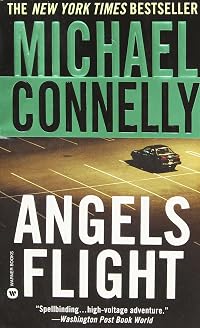
Description
An activist attorney is killed in a cute little L.A. trolley called Angels Flight, far from Harry Bosch's Hollywood turf. But the case is so explosive, and the dead man's enemies inside the L.A.P.D. are so numerous, that it falls to Harry to solve it. Now the streets are superheating. Harry's year old Vegas marriage is unraveling. And the hunt for a killer is leading Harry to another high-profile L.A. murder case, one where every cop had a motive. The question is, did any have the guts?Tags
Recommendations
Member Recommendations
kraaivrouw One of my faves of the Harry Bosch series - same sorts of characters, different environments.
Member Reviews
I'm on a Harry Bosch jag this year, and loving it. Not every entry in the series is up to snuff, but none of them are irredeemable. [Angels Flight] is one of the best entries - one of my favorite recurring characters, Eleanor Wish, features prominently, as Harry's marriage short marriage breaks down. Harry is investigating the murder of an attorney who has made a practice out of excoriating the Los Angeles Police Department. And the murder has its roots in a large civil rights case against some LAPD detectives - so, the usual suspects here carry a gun and a badge. Harry, always loyal only to the victim, burns through the case, leaving a wake ash and debris.
Interestingly, the more of these I read, I understand that Connelly and the show more television show writers put all of the plots and characters into a mixer and turned it on high. The result is that you can read these books and watch the television show without ruining either experience.
5 bones!!!!!
Highly recommended show less
Interestingly, the more of these I read, I understand that Connelly and the show more television show writers put all of the plots and characters into a mixer and turned it on high. The result is that you can read these books and watch the television show without ruining either experience.
5 bones!!!!!
Highly recommended show less
According to my records, I read this in December of 2019, but I left no review, and now that I've (technically) reread it, I can't imagine why. It's a barn-burner, full of Bosch's deep skepticism and suspicion of his own police force, full of seamy stories and liars and losses, Harry's included. There might have been a time I wasn't prepared to dive back into this series, but it sat well with me now.
Harry is called in to a murder of a prominent defense attorney and gadfly of the police, not the honorable kind but definitely an effective one from his own perspective. Suing the City of Los Angeles is a lucrative business. Of course, suspicion falls on the cops themselves, and the city tries to keep the lid on potential riots.
But there show more are a lot of moving parts here, a lot of people with agendas and secrets. By the end of the story, we know who they are, or were. I'm sure we will meet those still alive down the road. show less
Harry is called in to a murder of a prominent defense attorney and gadfly of the police, not the honorable kind but definitely an effective one from his own perspective. Suing the City of Los Angeles is a lucrative business. Of course, suspicion falls on the cops themselves, and the city tries to keep the lid on potential riots.
But there show more are a lot of moving parts here, a lot of people with agendas and secrets. By the end of the story, we know who they are, or were. I'm sure we will meet those still alive down the road. show less
I'm a big fan of Detective Bosch and this mystery in the series delivers a serious punch. With the haunting of the 1992 riots, Bosch is put on a case with tones of racism and police brutality, a delicate line to toe since the murderer is most likely an officer.
This story was interesting from a political, procedural and social perspective and the multitude of layers kept me on my seat. I did not see the end coming and while the last pages seem to end abruptly, I think this is one of the better Bosch stories.
This story was interesting from a political, procedural and social perspective and the multitude of layers kept me on my seat. I did not see the end coming and while the last pages seem to end abruptly, I think this is one of the better Bosch stories.
When Harry Bosch is sent out to investigate the death of accomplished lawyer Howard Elias he could never have anticipated the political minefield he is about to step into. At its heart this is a story of police corruption and the length that some senior officers will go to further their career, and in the process turn a blind eye to the stinking underbelly of so called law enforcement in the city of Los Angeles. The novel is written at a time when the mishandled case of one retired football player, OJ Simpson, and the beating of Rodney King are still fresh in the minds of so many Americans...."Everyone was oblivious to the seething hatred and anger that churned in other parts of the city- beneath the surface like an undiscovered fault show more line waiting to open up and swallow all above."..... Yet against all of that, one grizzled detective, is prepared to take a noble stand against evil and wrong doing where ever that may occur.
I adore the writings of Michael Connelly and his depiction of life, its hardships and cruelties through the eyes of one honest and incorruptible policeman the great antihero Harry Bosch. I sympathize with his pain, and his longing for some inner peace, his search for a partner, a soulmate someone to share his anguish and mop his fevered brow...It is the style of writing and Connelly's ability to get under the skin of Bosch, laying him open to an eager reader, that makes for some wonderful thoughtful observations...."The rich kept you waiting so that you could feel free to admire all that they had."..."Happy is the man who finds refuge in himself."...."He believed in the one shot. He didn't know if he'd had his yet- it wasn't the kind of thing you knew and understood until you looked back over your life as an old man."...."It's about hope, Detective she continued. Most of the people in the minority communities of Los Angeles have no power, have no money, have no voice. They subsist on hope for these things. And Howard Elias was hope for many of them".....
Everyone in this book is perfect from the strong storyline to the well drawn and very believable characters, from the sad and deeply troubled ex cop Frankie Sheehan to the political ambitions of Deputy Chief Irvin Irving. I rarely ever read a book by Michael Connelly that is not worthy of at least a 5 star review and this is no exception. Highly Recommended. show less
I adore the writings of Michael Connelly and his depiction of life, its hardships and cruelties through the eyes of one honest and incorruptible policeman the great antihero Harry Bosch. I sympathize with his pain, and his longing for some inner peace, his search for a partner, a soulmate someone to share his anguish and mop his fevered brow...It is the style of writing and Connelly's ability to get under the skin of Bosch, laying him open to an eager reader, that makes for some wonderful thoughtful observations...."The rich kept you waiting so that you could feel free to admire all that they had."..."Happy is the man who finds refuge in himself."...."He believed in the one shot. He didn't know if he'd had his yet- it wasn't the kind of thing you knew and understood until you looked back over your life as an old man."...."It's about hope, Detective she continued. Most of the people in the minority communities of Los Angeles have no power, have no money, have no voice. They subsist on hope for these things. And Howard Elias was hope for many of them".....
Everyone in this book is perfect from the strong storyline to the well drawn and very believable characters, from the sad and deeply troubled ex cop Frankie Sheehan to the political ambitions of Deputy Chief Irvin Irving. I rarely ever read a book by Michael Connelly that is not worthy of at least a 5 star review and this is no exception. Highly Recommended. show less
With this sixth novel in the Harry Bosch series I have come to envision Michael Connelly as my number one go-to author when I am in the mood for some crime/thriller fiction, and I’m now quite ready to explore his writings beyond this more famous series, because I’m certain that I will find myself equally enthralled by the brilliant combination of narrative skills and engaging storytelling that is the author’s trademark. And there is a great deal of Connelly works to explore, indeed…
Angels Flight is the best Bosch novel I’ve read so far, showing a confident mastery of pace and characterization whose growth I have witnessed throughout the previous books I read, and also incorporating several social and moral themes that feel show more completely actual even now, more than twenty years after the book’s first publication. The title refers to what I’ve learned is a famous Los Angeles landmark, a cable car system connecting a lower area of the city with one of its hills: when Bosch is called on the scene to investigate a double murder, he discovers that one of the victims is Howard Elias, an African-American attorney well-known for his numerous lawsuits against police brutality. Elias was due to start shortly on the proceedings against the detectives who caused grievous injuries to the suspect in a kidnapping and homicide: the man was later declared not guilty once the real perpetrator was apprehended, and is now suing the city for the barbarous way the interrogation was carried out.
The investigation is therefore fraught with many social and political pitfalls, not least the growing suspicion that Elias might have been killed by a police officer, which is causing mounting unrest and the concern that riots might explode once more in a city that has not forgotten the Rodney King case from a few years before. Bosch and his team - the old-time partner Jerry Edgar and the newest acquisition Kizmin Rider - must be very careful in the way they move, both because the media eyes are on them and also because they have to navigate the dangerous waters of public relations and departmental policy, which manage to place some irksome fetters on Bosch’s methods in his unrelenting search for truth. Moreover, Bosch is dealing with personal problems, since his year-old marriage seems to be already over and he’s facing the very real possibility of finding himself alone again after gaining a measure of happiness and stability with Eleanor: the Harry Bosch we see here is at his emotional weakest, once again having to experience the heavy sense of loss that has been a constant theme in his life - this unexpected vulnerability has the effect of making him appear more human, which adds some quite welcome softness to a character that so far has been depicted as harshly inexorable in his quest for justice.
Having met these stories first through their televised version, I am once again delighted in discovering that the two mediums are quite different in the way the facts are told, showing marked differences both in the final outcome and in other details, which results in my always being surprised at how events turn out in the books: my reading experience is never compromised - for want of a better word - by the knowledge gained through the TV show, and I’ve come to envision the two versions of this series as complementary and enhancing each other. A great combination indeed.
Back to Angels Flight, there is a pervading sense of uneasiness running throughout the book, partly due to the tense situation created by Elias’ murder, but also coming from the constantly shifting suspicion that jumps from one subject to another as the investigation progresses in fits and starts, encountering a good number of false leads and willful misdirections. Bosch and his team have to deal not only with the usual difficulties inherent in a murder investigation, but also with politics and with the institutional optics which require a solution that will keep the brewing troubles under control, rather than finding the real perpetrator of the crime, and that’s something that goes against Bosch’s personal inclinations. In the end it all boils down to a contest between opposing drives, the resolution bringing no catharsis at all because it becomes quite clear that there are no winners and losers in such a situation - everyone loses here, the concept of justice being the greatest victim. This conflict is embodied by the constant clash between Bosch and Chief Irving, the political face of the police department: unlike his screen version, Irving is far less tolerant of Bosch’s insubordination and unconventional tactics, being even more concerned with public perception here than he looks in the tv show. I found the willpower matches between the two of them quite fascinating, because the author is able to convey both characters’ emotions through the heated exchanges where the unsaid carries the same weight, if not more, of what is openly expressed: it’s fascinating to see how they represent the two faces of the same coin, and how they ultimately balance each other out in pursuing what they believe to be the best for their city.
On top of the engrossing events at its core, Angels Flight portrays some painful social conflicts that are still unresolved now, twenty years after the novel was written, and therefore it feels just as actual as the fictional facts it describes: where it’s somewhat depressing to acknowledge that after more than two decades things have not changed much - if at all - on the other hand this story is imbued with a sense of reality that strengthens its narrative impact and turns it into a far more powerful novel than might have been originally intended. show less
Angels Flight is the best Bosch novel I’ve read so far, showing a confident mastery of pace and characterization whose growth I have witnessed throughout the previous books I read, and also incorporating several social and moral themes that feel show more completely actual even now, more than twenty years after the book’s first publication. The title refers to what I’ve learned is a famous Los Angeles landmark, a cable car system connecting a lower area of the city with one of its hills: when Bosch is called on the scene to investigate a double murder, he discovers that one of the victims is Howard Elias, an African-American attorney well-known for his numerous lawsuits against police brutality. Elias was due to start shortly on the proceedings against the detectives who caused grievous injuries to the suspect in a kidnapping and homicide: the man was later declared not guilty once the real perpetrator was apprehended, and is now suing the city for the barbarous way the interrogation was carried out.
The investigation is therefore fraught with many social and political pitfalls, not least the growing suspicion that Elias might have been killed by a police officer, which is causing mounting unrest and the concern that riots might explode once more in a city that has not forgotten the Rodney King case from a few years before. Bosch and his team - the old-time partner Jerry Edgar and the newest acquisition Kizmin Rider - must be very careful in the way they move, both because the media eyes are on them and also because they have to navigate the dangerous waters of public relations and departmental policy, which manage to place some irksome fetters on Bosch’s methods in his unrelenting search for truth. Moreover, Bosch is dealing with personal problems, since his year-old marriage seems to be already over and he’s facing the very real possibility of finding himself alone again after gaining a measure of happiness and stability with Eleanor: the Harry Bosch we see here is at his emotional weakest, once again having to experience the heavy sense of loss that has been a constant theme in his life - this unexpected vulnerability has the effect of making him appear more human, which adds some quite welcome softness to a character that so far has been depicted as harshly inexorable in his quest for justice.
Having met these stories first through their televised version, I am once again delighted in discovering that the two mediums are quite different in the way the facts are told, showing marked differences both in the final outcome and in other details, which results in my always being surprised at how events turn out in the books: my reading experience is never compromised - for want of a better word - by the knowledge gained through the TV show, and I’ve come to envision the two versions of this series as complementary and enhancing each other. A great combination indeed.
Back to Angels Flight, there is a pervading sense of uneasiness running throughout the book, partly due to the tense situation created by Elias’ murder, but also coming from the constantly shifting suspicion that jumps from one subject to another as the investigation progresses in fits and starts, encountering a good number of false leads and willful misdirections. Bosch and his team have to deal not only with the usual difficulties inherent in a murder investigation, but also with politics and with the institutional optics which require a solution that will keep the brewing troubles under control, rather than finding the real perpetrator of the crime, and that’s something that goes against Bosch’s personal inclinations. In the end it all boils down to a contest between opposing drives, the resolution bringing no catharsis at all because it becomes quite clear that there are no winners and losers in such a situation - everyone loses here, the concept of justice being the greatest victim. This conflict is embodied by the constant clash between Bosch and Chief Irving, the political face of the police department: unlike his screen version, Irving is far less tolerant of Bosch’s insubordination and unconventional tactics, being even more concerned with public perception here than he looks in the tv show. I found the willpower matches between the two of them quite fascinating, because the author is able to convey both characters’ emotions through the heated exchanges where the unsaid carries the same weight, if not more, of what is openly expressed: it’s fascinating to see how they represent the two faces of the same coin, and how they ultimately balance each other out in pursuing what they believe to be the best for their city.
On top of the engrossing events at its core, Angels Flight portrays some painful social conflicts that are still unresolved now, twenty years after the novel was written, and therefore it feels just as actual as the fictional facts it describes: where it’s somewhat depressing to acknowledge that after more than two decades things have not changed much - if at all - on the other hand this story is imbued with a sense of reality that strengthens its narrative impact and turns it into a far more powerful novel than might have been originally intended. show less
June Group Read on LibraryThing
An activist attorney is killed in a cute little L.A. trolley called "Angels Flight", far from Harry Bosch's Hollywood turf. But the case is so explosive -- and the dead man's enemies inside the L.A.P.D. are so numerous -- that it falls to Harry to solve it. Now the streets are superheating. Harry's year-old Vegas marriage is unraveling. And the hunt for a killer is leading Harry to another high-profile L.A. murder case, one where every cop had a motive. The question is, did any have the guts?
A ringing phone early in the morning started the case for Detective Harry Bosch. Harry was awake and pacing his floor, so he actually looked forward to a new case. He had been trying in the darkness to will the phone show more to ring. However, the voice on the other end wasn’t even close to the voice he had hoped for and actually wanted to hear. He felt desolate once again; but the voice of Deputy Chief Irving was yet another shock; Chief Irving was not in Harry's departments area, and not even in their district, but he was going to pull Harry into a case that would change many lives in a violent and permanent way.
"Angels Flight" wasn't a band of Heavenly beings with harps; it was a combination of two trolley cars which ran from top to bottom of one of the steep inclines of Los Angelas. The motor that ran the cars was at the top and operated by a very human driver. The two cars would pass each other in the center. It made "Angels Flight" a well visited tourist attraction. It also was a good way for workers to move quickly and easily from one part of the city to the another. That night, with Harry and his partners, Kiz Ryder and Jerry Edgar arriving in the wee early hours of the morning. the area was filled to overflowing with cops. Harry wondered why they had been called in and why were so many needed – but it wasn't long before he found out.
The race was soon on to forestall any rioting. Harry had the entire services of the Internal Affairs Division facing him. Detective Chastain and Harry were sworn enemies; He didn't like Harry and Harry certainly didn't like him so how on earth was they expected to actually work together? They quickly learned that neither of them had a choice. They also learned something that no cop EVER wants to learn or even contemplate...there was the very real possibility of a rogue cop out there. I mere seconds the investigation took a sinister turn. To further complicate things; a large number of the LAPD had good reason to want the dead victim...dead, Harry knew of absolutely no-one that he could trust... no-one. he was on his own and he would do this his way and find the killer, hopefully before anyone else became a victim.
This was another brilliantly written addition to this series! Harry Bosch is sometimes a bit unlikeable...a bit off the wall in in thinking...but still a fabulous character. This one, like most Bosch books, was intense. The different varied layers of the story all blended to create one absolutely spellbinding, and thrilling story. The finale was absolutely stunning and not what I was expecting. I like to be right, but I always like to be surprised also. I can't believe there is anyone out there that reads Mystery and Suspense that HAS NEVER read a Harry Bosch novel...in case there is...without hesitation I would highly recommend this one or any of the others in the series. show less
An activist attorney is killed in a cute little L.A. trolley called "Angels Flight", far from Harry Bosch's Hollywood turf. But the case is so explosive -- and the dead man's enemies inside the L.A.P.D. are so numerous -- that it falls to Harry to solve it. Now the streets are superheating. Harry's year-old Vegas marriage is unraveling. And the hunt for a killer is leading Harry to another high-profile L.A. murder case, one where every cop had a motive. The question is, did any have the guts?
A ringing phone early in the morning started the case for Detective Harry Bosch. Harry was awake and pacing his floor, so he actually looked forward to a new case. He had been trying in the darkness to will the phone show more to ring. However, the voice on the other end wasn’t even close to the voice he had hoped for and actually wanted to hear. He felt desolate once again; but the voice of Deputy Chief Irving was yet another shock; Chief Irving was not in Harry's departments area, and not even in their district, but he was going to pull Harry into a case that would change many lives in a violent and permanent way.
"Angels Flight" wasn't a band of Heavenly beings with harps; it was a combination of two trolley cars which ran from top to bottom of one of the steep inclines of Los Angelas. The motor that ran the cars was at the top and operated by a very human driver. The two cars would pass each other in the center. It made "Angels Flight" a well visited tourist attraction. It also was a good way for workers to move quickly and easily from one part of the city to the another. That night, with Harry and his partners, Kiz Ryder and Jerry Edgar arriving in the wee early hours of the morning. the area was filled to overflowing with cops. Harry wondered why they had been called in and why were so many needed – but it wasn't long before he found out.
The race was soon on to forestall any rioting. Harry had the entire services of the Internal Affairs Division facing him. Detective Chastain and Harry were sworn enemies; He didn't like Harry and Harry certainly didn't like him so how on earth was they expected to actually work together? They quickly learned that neither of them had a choice. They also learned something that no cop EVER wants to learn or even contemplate...there was the very real possibility of a rogue cop out there. I mere seconds the investigation took a sinister turn. To further complicate things; a large number of the LAPD had good reason to want the dead victim...dead, Harry knew of absolutely no-one that he could trust... no-one. he was on his own and he would do this his way and find the killer, hopefully before anyone else became a victim.
This was another brilliantly written addition to this series! Harry Bosch is sometimes a bit unlikeable...a bit off the wall in in thinking...but still a fabulous character. This one, like most Bosch books, was intense. The different varied layers of the story all blended to create one absolutely spellbinding, and thrilling story. The finale was absolutely stunning and not what I was expecting. I like to be right, but I always like to be surprised also. I can't believe there is anyone out there that reads Mystery and Suspense that HAS NEVER read a Harry Bosch novel...in case there is...without hesitation I would highly recommend this one or any of the others in the series. show less
Because of its emotional and powerful confrontation of the racial tensions in LA, this is one of the most powerful stories in the series. It was a profoundly uncomfortable read. The narrator's repressed anger at the fallout of the LA race riots of '92 is palpable, but so his the guilt. The book clearly displays that racism isn't a binary trait; it's a continuum. And being white in America means that you are racist to some degree and fall somewhere on that continuum. In LA, where fear and resentment on both sides became even more pronounced after Rodney King, the racial divide seems even starker. Harry Bosch, though less racist than some of the furious and bigoted police officers he associates with, has his own limitations. He starts out show more feeling positive that he is totally unbiased. After all, his two working partners are black. How could he be racist? And yet he immediately assumes that a black man he encounters is lying about police brutality. He is judgemental of lawyers who "play the race card," but views the issue from only one perspective. Most despicably to me, he first refuses to let his partners be used as camera fodder, then uses them himself--and yet doesn't see this as a serious betrayal. As the story continues, he is forced to confront his own biases, and in turn, forced me to confront my own. I still feel uncomfortable with what I see as racial resentment colouring the narrator's point of view. Yes, perhaps Connelly tried to add humanity through Kiz and Edgar, but overall, I felt that he characterized the African-American community as a vicious and unintelligent mob, ready to devolve into senseless violence at the least provocation. I think a read of this book needs to be paired with a read of a book written from the perspective of a person of color. I read it at the same time as Little Scarlet, which confronts the race riots of '65, and this helped to bring into stark contrast the biases of both the narrative and the characters. Overall, I see the story as powerful and valuable because both its acknowledged and unacknowledged racism forces the reader into a confrontation of his or her unconscious prejudices. show less
Members
- Recently Added By
Lists

Best Crime Fiction
262 works; 39 members

Top Cops (Detectives in Fiction)
86 works; 24 members

Crime and Mysteries to Read
746 works; 31 members

A Novel Cure
742 works; 23 members

Books Read in 2010
631 works; 10 members

Jarett's Books
86 works; 1 member

Books Read in 2018
4,360 works; 110 members

Books - Connolly, Michael: Bosch
44 works; 1 member
Author Information

160+ Works 154,697 Members
Michael Connelly was born in Philadelphia, Pennsylvania on July 21, 1956. He graduated from the University of Florida in 1980 where he majored in journalism and minored in creative writing. After graduation, he worked at newspapers in Daytona Beach and Fort Lauderdale, Florida, specializing in the crime beat. In 1986, he interviewed survivors of a show more plane crash with two other reporters and the magazine story subsequently written on the crash was on the short list for the Pulitzer Prize for feature writing. This story led to a job as a crime reporter for the Los Angeles Times. After three years there, he began writing his first novel. His first novel, The Black Echo, was published in 1992 and won the Edgar Award for best first novel. He is the author of the Harry Bosch series, the Jack McEvoy series, and the Mickey Haller series. He has won numerous awards including the Anthony Award, Macavity Award, Shamus Award, Dilys Award, Nero Award, Barry Award, Ridley Award, Maltese Falcon Award (Japan), .38 Caliber Award (France), Grand Prix Award (France), Premio Bancarella Award (Italy), and the Pepe Carvalho Award (Spain). (Bowker Author Biography) show less
Some Editions
Awards and Honors
Awards
Distinctions
Series


Belongs to Publisher Series
Work Relationships
Is contained in
The Black Echo / The Poet / Trunk Music / Angels Flight / The Closers / The Lincoln Lawyer by Michael Connelly
The Black Echo / The Concrete Blonde / Angels Flight / City of Bones / Lost Light / The Wrong Side of Goodbye / The Late Show by Michael Connelly
The Black Echo / The Concrete Blonde / Angels Flight / City of Bones / Lost Light / Two Kinds of Truth / The Late Show by Michael Connelly
The Black Echo / The Black Ice / The Concrete Blonde / The Last Coyote / The Poet / Trunk Music / Blood Work / Angels Flight / Void Moon / A Darkness More Than Night / City of Bones / Lost Light / The Narrows / The Closers / The Lincoln Lawyer / Echo Park / The Overlook / The Brass Verdict / Nine Dragons / The Reversal by Michael Connelly
Has as a reference guide/companion
Common Knowledge
- Canonical title
- Angels Flight
- Original publication date
- 1999
- People/Characters
- Hieronymus 'Harry' Bosch; Jerry Edgar; Kizmin 'Kiz' Rider; Grace 'Bullets' Billets; Irvin Irving; Eleanor D. Wish (show all 33); Frankie Sheehan; John 'Sustain' Chastain; John Garwood; Catalina Perez; Howard 'Eli' Elias; Millie Elias; Martin Luther Elias; Michael Harris; Peete Eldridge; Sally Tam; Tom O'Rourke; Raymond Fuentes; Loomis Baker; Preston Tuggins (Reverend); Janis Longwiser; Carla 'I'mthinkin' Entrenkin; Joe Dellacroce; Stacey Kincaid; Sam Kincaid; Katherine Kincaid; Mistress Regina (Virginia Lampley); Gilbert Spencer; Roy Lindell; Jenkins 'Jenks' Pelfry; Margie Sheehan; Harvey Button; Tom Chainey
- Important places
- Los Angeles, California, USA
- Dedication
- This book is dedicated to
McCaleb Jane Connelly
This is for
McCaleb Fane Connelly
From Warner Books paperback edition. - First words
- The word sounded alien in his mouth, as if spoken by someone else.
- Last words
- (Click to show. Warning: May contain spoilers.)Bosch knew he could never allow himself to forget it.
Classifications
Statistics
- Members
- 4,630
- Popularity
- 3,148
- Reviews
- 98
- Rating
- (3.92)
- Languages
- 13 — Danish, Dutch, English, Finnish, French, German, Grebo, Italian, Norwegian (Bokmål), Portuguese, Spanish, Swedish, Turkish
- Media
- Paper, Audiobook, Ebook
- ISBNs
- 97
- UPCs
- 2
- ASINs
- 28