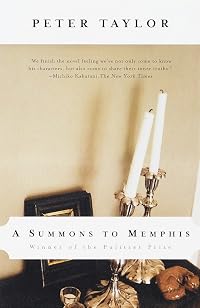
A Summons to Memphis
by Peter Taylor
On This Page
Description
When Phillip Carver is asked by his sisters to help avert their widower father's impending marriage to a younger women, he is forced to confront his domineering siblings, a controlling patriarch, and a flood of memories from his deeply troubled past.Tags
Recommendations


























Member Recommendations

Member Reviews
A very strange thing happened while reading this book. I took it on a trip to New York, and upon returning home, I forgot about it completely and started reading something else. A few weeks later, I started thinking about Stone Mountain (Georgia) and recalling a scene set there that I had read in a novel. It took me a few seconds to remember which book. Once I did, I struggled to try to remember how the book ended. I even checked LibraryThing to see if I had written a review, which I do for every book I finish. There was none. I found the book in one of my several computer bags and started reading where I left off. Despite the passage of time, the story was still quite clear in my head. Perhaps this is the difference between a work of show more "serious fiction" and the types of novel I usually read. In those novels, mostly mysteries, there are events galore, but they tend to run together and be forgotten. They are contrived to create a puzzle that can be solved. Real life isn't like that, and neither is A Summons to Memphis.
The story moves slowly-at least the part taking place in the present. A son, Philip Carver, living in New York as a collector and seller of antiquarian books, is called back to Memphis by his two older, spinster sisters who are trying to prevent their 81-year old father from remarrying. But neither that trip nor subsequent ones goes as planned. The novel defies your expectations about plot, and you realize it is a book, like so many great Southern novels, about history and family and place-all magnified and distorted through the son's resentment of his father for uprooting the family from Nashville to Memphis, then later stopping his plans to marry the girl he met on Stone Mountain. As the son's relationship with his father evolves through the present-day scenes in the novel, the real story of forgetting and forgiving that is the book's center is told.
If a great book requires great events or a cast of thousands, this is not a great book. But if a great book is judged on its telling details about a small number of characters, details that ring true even if those fictional lives are far from our own, then perhaps A Summons to Memphis is a great book. It is these small details that linger with us, such as Philip Carver's dismissal of his friend Alex Mercer's idea near the end of the book, or of Alex's own close relationship with Philip's father, begun in childhood, but extending through the years when Philip was living in New York. So many great books hinge on the honest portrayal of the relationship between and among family and friends. In this quiet, reflective novel, Peter Taylor has shone a light into the lives, pent-up frustrations, and (I think) the ultimate failure of this family to ever honestly come to grips with its feelings about one another. Each has lived his or her life in a way to send messages to the others about their feelings and resentments but has never managed to speak about them openly. In the end, everyone gets what they deserve, and only the portion of happiness they have allowed themselves to have.
As I wrote this review and reflected more on what lingered and what it all meant, I added a half star to my LibraryThing review (making it 4 ½ stars). This is a book that demands the reader give it a little more thought and consideration than it at first appears to require. I suspect its implications will continue to linger with me. show less
The story moves slowly-at least the part taking place in the present. A son, Philip Carver, living in New York as a collector and seller of antiquarian books, is called back to Memphis by his two older, spinster sisters who are trying to prevent their 81-year old father from remarrying. But neither that trip nor subsequent ones goes as planned. The novel defies your expectations about plot, and you realize it is a book, like so many great Southern novels, about history and family and place-all magnified and distorted through the son's resentment of his father for uprooting the family from Nashville to Memphis, then later stopping his plans to marry the girl he met on Stone Mountain. As the son's relationship with his father evolves through the present-day scenes in the novel, the real story of forgetting and forgiving that is the book's center is told.
If a great book requires great events or a cast of thousands, this is not a great book. But if a great book is judged on its telling details about a small number of characters, details that ring true even if those fictional lives are far from our own, then perhaps A Summons to Memphis is a great book. It is these small details that linger with us, such as Philip Carver's dismissal of his friend Alex Mercer's idea near the end of the book, or of Alex's own close relationship with Philip's father, begun in childhood, but extending through the years when Philip was living in New York. So many great books hinge on the honest portrayal of the relationship between and among family and friends. In this quiet, reflective novel, Peter Taylor has shone a light into the lives, pent-up frustrations, and (I think) the ultimate failure of this family to ever honestly come to grips with its feelings about one another. Each has lived his or her life in a way to send messages to the others about their feelings and resentments but has never managed to speak about them openly. In the end, everyone gets what they deserve, and only the portion of happiness they have allowed themselves to have.
As I wrote this review and reflected more on what lingered and what it all meant, I added a half star to my LibraryThing review (making it 4 ½ stars). This is a book that demands the reader give it a little more thought and consideration than it at first appears to require. I suspect its implications will continue to linger with me. show less
Ostensibly, A Summons to Memphis is about an adult son being called home by his older sisters to prevent the marriage of his eighty-one year old widower father. The pace for the book, particularly the beginning, is a slow one, reminding one of a soft Southern drawl, and it is essential that the reader is paying attention to all the subtle nuances of meaning laid between what the narrator says and where the truth actually lies.
The circumstances of his father’s old-age rebellion against the control of the sisters, causes Phillip, our narrator, to re-examine his life, the character of his father, and the impact of his fathers decisions upon the family at large. As he begins to see the prevention of the marriage as an act of revenge by show more the sisters, he begins to reconstruct the origin of the complicated relationship all these children share with their sometimes overbearing and always self-consumed father.
Initially, it is hard to muster much sympathy for Phillip, this fully grown man who seems to operate from such a cold center, but as the book progresses, we begin to see him more clearly and how he has been shaped by the events of his life: the original abrupt move to Memphis from Nashville, the separation from his first and perhaps only love, the usurping of his place in his father’s life by his own best friend, Alex Mercer. Along with his own revelations, we begin to see the sisters more clearly as well, the sacrifices they have made for a father, who possessed more than loved them, and their need to prevent the disruption of this relationship by the admission of any new dynamic, let along a new wife.
I seems to me that Taylor’s interest here is family connections and how individuals inside the circle are affected by one another. In bending to their father’s will, the mother and the children are shaped and reshaped into some lesser version of who they were or who they could have been. The older brother, Georgie, is so anxious to escape that he joins the armed forces and puts himself in the midst of a conflict from which he never returns. Phillip’s relationship with his father, with Alex, and with his live-in girlfriend, Holly, are all affected by Phillip’s early experiences and his changing perceptions of who his father is.
The saddest part of this, for me, wasthe fact that Phillip never shares any of his feelings with anyone in his life. He pretends to feel as Holly does about the father situation, he never discusses anything of import with the sisters, he holds Alex at an arm’s length and drops him completely after the death of his father, and he never sits down and tells his father how he feels. He buries all his feelings as deeply as he can, even giving up his claim to have once loved someone, in the end.
When I initially finished the book, I was wondering whether I believed it merited a Pulitzer. After a little reflection, I decided it was one of those books that seems to have a simple story, that could never be said to be plot driven, and that appears to only scratch the surface of its characters, but when you keep thinking about it, you realize you are peeling the layers away, like the skin of an onion, and there is a great deal of substance underneath. show less
The circumstances of his father’s old-age rebellion against the control of the sisters, causes Phillip, our narrator, to re-examine his life, the character of his father, and the impact of his fathers decisions upon the family at large. As he begins to see the prevention of the marriage as an act of revenge by show more the sisters, he begins to reconstruct the origin of the complicated relationship all these children share with their sometimes overbearing and always self-consumed father.
Initially, it is hard to muster much sympathy for Phillip, this fully grown man who seems to operate from such a cold center, but as the book progresses, we begin to see him more clearly and how he has been shaped by the events of his life: the original abrupt move to Memphis from Nashville, the separation from his first and perhaps only love, the usurping of his place in his father’s life by his own best friend, Alex Mercer. Along with his own revelations, we begin to see the sisters more clearly as well, the sacrifices they have made for a father, who possessed more than loved them, and their need to prevent the disruption of this relationship by the admission of any new dynamic, let along a new wife.
I seems to me that Taylor’s interest here is family connections and how individuals inside the circle are affected by one another. In bending to their father’s will, the mother and the children are shaped and reshaped into some lesser version of who they were or who they could have been. The older brother, Georgie, is so anxious to escape that he joins the armed forces and puts himself in the midst of a conflict from which he never returns. Phillip’s relationship with his father, with Alex, and with his live-in girlfriend, Holly, are all affected by Phillip’s early experiences and his changing perceptions of who his father is.
The saddest part of this, for me, was
When I initially finished the book, I was wondering whether I believed it merited a Pulitzer. After a little reflection, I decided it was one of those books that seems to have a simple story, that could never be said to be plot driven, and that appears to only scratch the surface of its characters, but when you keep thinking about it, you realize you are peeling the layers away, like the skin of an onion, and there is a great deal of substance underneath. show less
Peter Taylor is highly regarded for his short stories, and has won both a PEN/Faulkner and a PEN/Malamud award for those, as well as a Pulitzer for this particular novel. While I appreciated this story of a man's reflections on his family life, I did not love it. I found the style rambling, repetitive and a tad navel-gazey. There is a nifty little tale of revenge embedded in all that, but it is not the narrator's focus, and it could have been told to better effect on its own merits in a short story, I feel. Phillip Carver is a middle-aged man, called back to Memphis from his separate existence in New York City by his two older sisters, to deal with the issue of their father's intent to re-marry. The relationships of youth, his sisters' show more and his own, as well as their mother's personality shift and extended invalidism are examined at length, always in context of their father's long-ago betrayal by a business associate, and the "new start" in Memphis that defined all their lives from that point forward. While there is no overt bitterness toward Dad for uprooting the family from their native Nashville or his tendency to direct and control their lives, each of Carver, Sr's children took their own way out of his sphere of influence, until the day came when the tables could finally be turned. My problem with all the reflection and introspection is that it doesn't seem to lead anywhere---Phillip doesn't really learn anything useful about himself, and he isn't any more interesting or likeable at the end than he was at the beginning. (His habit of always referring to his sisters as "middle-aged", or "stout" in the narration, and of subtly belittling their manner of dress and their social lives for the reader's benefit really got irritating.) I suspect a bit of autobiography in this novel, and its presentation does not endear me to the author. show less
3.5***
Philip Carver has escaped his controlling father and now lives in New York with his much younger Jewish girlfriend. But when he gets a surprise phone call from his older sister, followed only minutes later by a call from his second sister, and then from an old family friend, he knows he has been summoned to Memphis to help deal with the “disaster.” A mere two years after his mother’s death, his 80-something father has plans to remarry and his adult children have no intention of letting him do so.
George Carver has always been the head of his family, and while he was gentlemanly and generous with his children he also thwarted any potential romantic relationship they might have. It began when he moves his family to Memphis from show more Nashville after he has been financially ruined and socially humiliated by a long-term friend and colleague. He ensures that his sons and daughters also break off all ties with Nashville. In Memphis, the family seems to find the new start they needed. They are members of the best country club, the girls join the Junior League, they live in a lovely home – they are just like any other wealthy and well-born Memphis family.
The children love and respect their father, but they rebel in quiet ways to distance themselves and find independence. Now, some thirty years after their move, the middle-aged sisters will get their revenge by controlling their widower father, and prohibiting any kind of romance in his life as he once ended their own hopes of romance.
Taylor gives us a work that explores the complex relationships within one family – the wrongs done to one another, resentment built over decades, petty reprisals, and subtle revenge. I usually enjoy character-based novels. I loved Marilynne Robinson’s Housekeeping and Paul Harding’s Tinkers, and this work reminds me of those. But this is a very slow read, and I’m struggling with what to write because I’m not really sure how to react to these characters. The last twenty or so pages are poignant and lovely, and I finally felt some connection to Philip and his father and sisters. show less
Philip Carver has escaped his controlling father and now lives in New York with his much younger Jewish girlfriend. But when he gets a surprise phone call from his older sister, followed only minutes later by a call from his second sister, and then from an old family friend, he knows he has been summoned to Memphis to help deal with the “disaster.” A mere two years after his mother’s death, his 80-something father has plans to remarry and his adult children have no intention of letting him do so.
George Carver has always been the head of his family, and while he was gentlemanly and generous with his children he also thwarted any potential romantic relationship they might have. It began when he moves his family to Memphis from show more Nashville after he has been financially ruined and socially humiliated by a long-term friend and colleague. He ensures that his sons and daughters also break off all ties with Nashville. In Memphis, the family seems to find the new start they needed. They are members of the best country club, the girls join the Junior League, they live in a lovely home – they are just like any other wealthy and well-born Memphis family.
The children love and respect their father, but they rebel in quiet ways to distance themselves and find independence. Now, some thirty years after their move, the middle-aged sisters will get their revenge by controlling their widower father, and prohibiting any kind of romance in his life as he once ended their own hopes of romance.
Taylor gives us a work that explores the complex relationships within one family – the wrongs done to one another, resentment built over decades, petty reprisals, and subtle revenge. I usually enjoy character-based novels. I loved Marilynne Robinson’s Housekeeping and Paul Harding’s Tinkers, and this work reminds me of those. But this is a very slow read, and I’m struggling with what to write because I’m not really sure how to react to these characters. The last twenty or so pages are poignant and lovely, and I finally felt some connection to Philip and his father and sisters. show less
Set in mid-Twentieth Century Tennessee, A Summons to Memphis is a delightful novel of manners that teaches the importance of going beyond forgetting, beyond even forgiving, and trying to actually understand our parents. Wonderful.
It's been too long since I've read anything by Peter Taylor, which I guess is why reading A Summons To Memphis was such a pleasurable reading experience. Taylor's words just flow from page to page and his writing is very similar to William Maxwell. His work is so much different from other “Southern writers” in that his characters are primarily upper middle class from the upper, as opposed to the deep south, living in the middle decades of the twentieth century.
Phillip Carver, the narrator of the story, is a bachelor working at a publishing house in Manhattan who learns from his two older sisters in Memphis that their father, 81 and a widower, is planning to remarry and thus, putting at risk the children’s inheritance. But the show more relationship and subsequent falling out of Carver’s father and his former partner, Lewis Shackleford, is just as interesting as the main plot. The family was forced to move from Nashville to Memphis during the depression because of the falling out between the two, and this presents another interesting aspect of the story - the difference between the two cultures of Nashville and Memphis and their inhabitants. There’s just a whole lot depicted within the 209 pages. A Summons is definitely one of the best books I’ve read this year.
Too bad, but I think Taylor has fell out of the public consciousness. I’d love to see the NYRoB do a reissue of his work, especially something like In The Miro District. show less
Phillip Carver, the narrator of the story, is a bachelor working at a publishing house in Manhattan who learns from his two older sisters in Memphis that their father, 81 and a widower, is planning to remarry and thus, putting at risk the children’s inheritance. But the show more relationship and subsequent falling out of Carver’s father and his former partner, Lewis Shackleford, is just as interesting as the main plot. The family was forced to move from Nashville to Memphis during the depression because of the falling out between the two, and this presents another interesting aspect of the story - the difference between the two cultures of Nashville and Memphis and their inhabitants. There’s just a whole lot depicted within the 209 pages. A Summons is definitely one of the best books I’ve read this year.
Too bad, but I think Taylor has fell out of the public consciousness. I’d love to see the NYRoB do a reissue of his work, especially something like In The Miro District. show less
The premise of this short Pulitzer Prize winning novel sounded appealing - a grown up son is summoned back to Memphis by his two spinster sisters to stop his widowed father is planning to get married to a younger (read gold digger) woman. So far, so me - I love a well executed family drama. However, Pulitzer Prize or not, I found this novel to be really lacking, and can't for the life of me figure out why it was considered prize-worthy.
It's a short novel (just over 200 pages), yet it was over two-thirds of the way into the story before our narrator got anywhere near the plane to bring him back to Memphis (and then it took him quite a few pages to even get off the damn plane once it landed). I could easily forgive that if Taylor was busy show more building wonderful characters, but I cared even less about the characters when I finally (with relief) shut the cover for the last time than I did at the beginning. More to the point, I was annoyed that I was wasting precious hours of my life being abjectly bored by them. He spent most of the book going around and around a loop telling us about his spinster sisters and his father like some painful literary Groundhog Day, and that's exactly what it was - telling. .
2.5 stars - utterly snooze-inducing narration with one dimensional characters. Did Taylor have a secret family member on the Pulitzer panel that year? show less
It's a short novel (just over 200 pages), yet it was over two-thirds of the way into the story before our narrator got anywhere near the plane to bring him back to Memphis (and then it took him quite a few pages to even get off the damn plane once it landed). I could easily forgive that if Taylor was busy show more building wonderful characters, but I cared even less about the characters when I finally (with relief) shut the cover for the last time than I did at the beginning. More to the point, I was annoyed that I was wasting precious hours of my life being abjectly bored by them. He spent most of the book going around and around a loop telling us about his spinster sisters and his father like some painful literary Groundhog Day, and that's exactly what it was - telling. .
2.5 stars - utterly snooze-inducing narration with one dimensional characters. Did Taylor have a secret family member on the Pulitzer panel that year? show less
Members
- Recently Added By
Lists

Pulitzer Prize Winners for Fiction
102 works; 54 members
Southern Fiction
212 works; 52 members

Novels from The Guardian's Great American Novelist Tournament
148 works; 24 members

20th Century Literature
1,161 works; 54 members
National Book Award Finalists - Fiction
377 works; 12 members
TML 200 Best Books 1950-1999
202 works; 10 members

Books Read in 2016
4,666 works; 199 members

Books With Place Names in the Title
215 works; 10 members

The Atlantic's The Great American Novel
136 works; 12 members

The Modern Library (The Two Hundred Best Novels....
202 works; 1 member
Author Information

21+ Works 2,469 Members
Awards and Honors
Awards
Distinctions
Common Knowledge
- Canonical title*
- Ritorno a Memphis
- Original title
- A Summons to Memphis
- Original publication date
- 1986
- People/Characters
- George Carver; Josephine Carver
- Important places
- Memphis, Tennessee, USA; Nashville, Tennessee, USA; Tennessee, USA
- Dedication
- For Eleanor, Katie and Ross
With love - First words
- The courtship and remarriage of an old widower is always made more difficult when middle-aged children are involved - especially when they are unmarried daughters.
- Last words
- (Click to show. Warning: May contain spoilers.)How else, I ask myself, can one think of the end of two such serenely free spirits as Holly Kaplan and I?
*Some information comes from Common Knowledge in other languages. Click "Edit" for more information.
Classifications
Statistics
- Members
- 1,115
- Popularity
- 22,698
- Reviews
- 29
- Rating
- (3.43)
- Languages
- 5 — Dutch, English, French, Italian, Spanish
- Media
- Paper, Audiobook, Ebook
- ISBNs
- 17
- ASINs
- 12