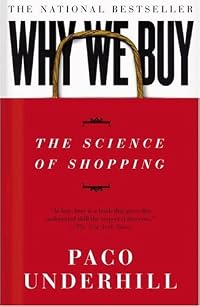
Why We Buy: The Science of Shopping
by Paco Underhill
On This Page
Description
Guide to ever-evolving consumer culture, offering advice on how to keep current customers and attract new ones.Tags
Recommendations






















Member Recommendations
mercure If you want to read a theory about WHY people shop, rather than the shopkeeper's perspective on how to squeeze more money out of you, Miller's book is far more interesting.

Member Reviews
In Why We Buy (which should more accurately be titled How We Buy, since there is almost nothing on the the yawning abyss of soul-crushing emptiness inside that impels us Beyond Bed and Bath with credit cards aloft) takes us on the journey of Paco the Erstwhile Anthropologist, who spins his ethnographic credentials into a lucrative consulting business telling Target where it should locate its Ladies' Unmentionables. Sample tip from Dr. Paco to retailers: Your shoppers only have two hands! Make sure that shopping baskets are always available to them -- throughout the store -- so that Impulse Shopping can take place once two items are already selected! Also, if your grocery store has a Starbucks, make sure your carts have cupholders!
I show more valued this book because it enabled me to more intelligently thwart the merchandisers' attempt to seduce me with their colorful, touchable, and well-fonted product. Get thee behind me, merchandisers! I also think it sounds like too much fun to be one of the researchers at this firm, spying -- um, gathering data on unsuspecting shoppers as they are jostled from behind in the handbag section and as they squat to retrieve their herbal remedies. Like Papua New Guinea, but air-conditioned! show less
I show more valued this book because it enabled me to more intelligently thwart the merchandisers' attempt to seduce me with their colorful, touchable, and well-fonted product. Get thee behind me, merchandisers! I also think it sounds like too much fun to be one of the researchers at this firm, spying -- um, gathering data on unsuspecting shoppers as they are jostled from behind in the handbag section and as they squat to retrieve their herbal remedies. Like Papua New Guinea, but air-conditioned! show less
I had to read part of _Why We Buy_ for a class (and apply the lessons to libraries), but then I became obsessed and read the whole thing. The chapters on internet shopping are already pretty outdated, but otherwise it's GREAT. Paco Underhill has consulted everyone from Wal-Mart to Starbucks and McDonald's. He's the reason we feel compelled to buy in a lot of places. I could go on forever, but he's basically a genius and I learned a lot (both about how companies try to trick us and how to make the browsing experience more pleasant and fruitful for library users).
I enjoyed Paco Underhill’s Call of the Mall so much I decided to go back to his previous book, Why We Buy. It's in many ways even better than its sequel, as Underhill's insights are fresh and perhaps more liberally salted through his chatty, enjoyable prose.
You're not likely to come away from this book with any life-altering revelations, but you will experience any number of 'a-ha!' moments as you start to realize, along with Underhill, how seemingly insignificant matters such as aisle width, shelf height and signage affect the way we interact with shops and stores.
Underhill's seat-of-the-pants anthropological approach is refreshing and practical. I'd highly recommend this book if you run your own store or other business, but most show more readers should find it diverting and fun. show less
You're not likely to come away from this book with any life-altering revelations, but you will experience any number of 'a-ha!' moments as you start to realize, along with Underhill, how seemingly insignificant matters such as aisle width, shelf height and signage affect the way we interact with shops and stores.
Underhill's seat-of-the-pants anthropological approach is refreshing and practical. I'd highly recommend this book if you run your own store or other business, but most show more readers should find it diverting and fun. show less
Paco Underhill walks into a bar...
With levels of wealth rising in many places on our planet, more and more people have more money then they would actually need. Women now have more independent roles, even if they are not head of a household.
So what are they doing with that new found freedom? They hold pilgrimmages to malls and shopping streets from Sao Paulo to Tokyo.
Unfortunately, this book does not really analyse the deeper causes of this curious behaviour. Rather, it looks at how shopkeepers can extract more money from these people's (and your) wallets and credit cards.
As the CEO of Envirosell, Paco Underhill has studied people's behaviour in shops, banks, malls, and cinemas around the globe. In this book he chats about his company show more (you can easily skip the first 40 pages), and the most important issues shopkeepers need to keep in mind, all peppered with many, mostly American, examples.
It all starts with making stuff easy to grab for the human physique, which changes during our lifetime. Plus people want a pleasurable experience, hence no intimidating queues, but clean and attractive (ladies) loos. Managers at head offices, of which he is quite critical, should keep the relation between the three major factors of shop design (design of premises and where and how merchandise is showcased, the merchandise itself, and staff - both number of staff and procedures) in balance.
Mr. Underhill digs a little deeper in the chapter The Sensual Shopper. For much merchandise, the possibility to hold and touch an article will greatly influence the buying decision. show less
With levels of wealth rising in many places on our planet, more and more people have more money then they would actually need. Women now have more independent roles, even if they are not head of a household.
So what are they doing with that new found freedom? They hold pilgrimmages to malls and shopping streets from Sao Paulo to Tokyo.
Unfortunately, this book does not really analyse the deeper causes of this curious behaviour. Rather, it looks at how shopkeepers can extract more money from these people's (and your) wallets and credit cards.
As the CEO of Envirosell, Paco Underhill has studied people's behaviour in shops, banks, malls, and cinemas around the globe. In this book he chats about his company show more (you can easily skip the first 40 pages), and the most important issues shopkeepers need to keep in mind, all peppered with many, mostly American, examples.
It all starts with making stuff easy to grab for the human physique, which changes during our lifetime. Plus people want a pleasurable experience, hence no intimidating queues, but clean and attractive (ladies) loos. Managers at head offices, of which he is quite critical, should keep the relation between the three major factors of shop design (design of premises and where and how merchandise is showcased, the merchandise itself, and staff - both number of staff and procedures) in balance.
Mr. Underhill digs a little deeper in the chapter The Sensual Shopper. For much merchandise, the possibility to hold and touch an article will greatly influence the buying decision. show less
This is great for anyone in marketing, anyone who owns a store, and anyone who has ever even been in a store. Paco Underhill takes the anthropology of shopping to a whole new level. Some of the ideas are trite and common sense, but many of them challenge the way we think about stores and marketing.
http://lifelongdewey.wordpress.com/2012/02/06/658-why-we-buy-by-paco-underhill/
http://lifelongdewey.wordpress.com/2012/02/06/658-why-we-buy-by-paco-underhill/
Interesting and insightful with some good tips for people setting up an interactive environment like a shop or a library. It seemed more like an ad for his services and/or his other books but it was a good introduction to the principles behind his business.
Very interesting. I would like to read a whole book of just descriptions of what people do in stores.
However, it's also a bit disturbing; you feel like even the author is a little creeped out by the extent to which people can be manipulated into buying things.
However, it's also a bit disturbing; you feel like even the author is a little creeped out by the extent to which people can be manipulated into buying things.
Members
- Recently Added By
Lists

My List
302 works; 1 member
Author Information

4+ Works 2,116 Members
Paco Underhill is an environmental psychologist and founder of a market research and consulting company called Envirosell. His books include Why We Buy : The Science of Shopping, Call of the Mall: The Geography of Shopping, and What Women Want. (Bowker Author Biography)
Work Relationships
Has as a study
Common Knowledge
- Canonical title
- Why We Buy: The Science of Shopping
- Blurbers
- Popcorn, Faith
Classifications
Statistics
- Members
- 1,619
- Popularity
- 13,880
- Reviews
- 24
- Rating
- (3.73)
- Languages
- 11 — Czech, Dutch, English, Estonian, French, German, Portuguese, Russian, Spanish, Swedish, Turkish
- Media
- Paper, Audiobook, Ebook
- ISBNs
- 34
- ASINs
- 6