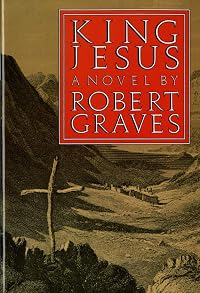
King Jesus
by Robert Graves 
On This Page
Description
"Both the knowledge of a scholar and the imagination of a poet are brought to bear upon Jesus as child, boy, and man.... A bold speculative adventure" ( Harold Brighouse, Manchester Guardian ). In Robert Graves's unique retelling, Jesus is very much a mortal and the grandson of King Herod the Great. When his father runs afoul of the king's temper and is executed, Jesus is raised in the house of Joseph the Carpenter. The kingdom he is heir to, in this version of the story, is very much a show more terrestrial one: the Kingdom of Judah. Graves tells of Jesus's rise as a philosopher, scriptural scholar, and charismatic speaker in sharp detail, as well as his arrest and downfall as a victim of pitiless Roman politics. Bringing together his unparalleled narrative skill and in-depth expertise in historical scholarship, renowned classicist and historical novelist Robert Graves brings the story of Jesus Christ to life in a strikingly unorthodox way, making this one of the most hotly contested novels Graves ever wrote-and possibly one of the most controversial ever written. It provides a fascinating new twist to a well-known story, one that fans of this historical period are sure to love. "This is not reading for the easily shocked; it definitely presents Jesus as a sage and a [poet], if not divine. It moves, as does all Mr. Graves' writing, at a brilliant fast pace, and with a tremendous style." - Kirkus Reviews show lessTags
Recommendations





















Member Recommendations
CGlanovsky Both books attempt address the life and death of Jesus from an objective perspective, showing how it might have been viewed by contemporaries not predisposed to believe the full religious account
CGlanovsky Historical fictions framing the life of Jesus within the ancient Mediterranean/Middle-Eastern syncretist milieu
Member Reviews
An interesting book, which paints a possible picture of the "true" story behind Jesus Christ. Interesting, but not riveting. In fact rather tedious in places. It took me a long time to get through it, because it is a mixture of story and erudite analysis and explanation. I would have enjoyed the book much more as pure story. The erudite parts would have been better reserved for a different book aimed at academia.
Published in 1946, undoubtedly raised hackles on some who would want a more conventional view of J.C. This book is Grave's own reconstruction of Jesus' life which he creates through rationality and serious belief. Grave's detailed knowledge of how the Roman Empire worked and where King Herod fit into the picture lends real credibility to the details which add plausibility to many of his hypotheses. RMB, CSBS
I was fascinated enough by the story to somehow get through this tome. (I'm not very good at understanding philosophy and theology.) Loved the plausibility of this version of the life of Jesus.
King Jesus is a retelling of the Jesus story without the supernatural elements of the virgin birth, miracles, and resurrection. The fictional author of the story is Agabus the Decapolitan who is writing after the first Jewish-Roman war. During his childhood, Agabus saw Jesus at the blessing of the children. Now as an old man, he wishes to faithfully record the life of Jesus before the Gentile Christians erase certain facts from their scripture versions in order to convince the Romans that the Chrestians (as they are called) have nothing to do with Jewish nationalism. It doesn't make sense to say caution spoilers, the story does ends in crucifixion, but the why is another matter. As in the I Claudius novels, the Herod family play a very show more important part in the plot of the novel, as do Augustus and Livia.
Grave's version will make more sense if the reader reads the Historical Commentary first, although it is the last chapter of the book. In that chapter,Graves introduces his concept of iconotropy, the deliberate misinterpretation of a culture's icons and stories for political purposes. Without that knowledge, some of the book will not make any sense. show less
Grave's version will make more sense if the reader reads the Historical Commentary first, although it is the last chapter of the book. In that chapter,Graves introduces his concept of iconotropy, the deliberate misinterpretation of a culture's icons and stories for political purposes. Without that knowledge, some of the book will not make any sense. show less
I fail to be convinced by his interpretation of various Biblical passages as revisionist explications of the icons of previous religions.
A compelling and constroverial alternate telling of the New Testament story. Ever wonder where Pantera the band got heir name? Read this...
Much like Paul Park's The Gospel of Corax, Graves pretty much disregards the gospels. Unlike Park's novel, this one presents a noble, transcendent leader whom - unfortunately - no one understands.
Like other works by Graves, this one was way over my head.
Like other works by Graves, this one was way over my head.
Members
- Recently Added By
Lists

Best historical fiction set in the ancient world
126 works; 40 members

Harold Bloom - The Western Canon: D. The Chaotic Age
833 works; 24 members
Author Information

259+ Works 40,616 Members
Robert Graves (also known as Robert Ranke Graves) was born in 1895 in London and served in World War I. Goodbye to All That: an Autobiography (1929), was published at age thirty three, and gave a gritty portrait of his experiences in the trenches. Graves edited out much of the stark reality of the book when he revised it in 1957. Although his most show more popular works, I, Claudius (1934) and its sequel, Claudius the God and His Wife Messalina (1935), were produced for television by the BBC in 1976 and seen in America on Masterpiece Theater, he was also famous as a poet, producing more than 50 volumes of poetry. Graves was awarded the 1934 James Tait Black Memorial Prize for both I, Claudius and Claudius the God. Also a distinguished academic, Graves was a professor of English in Cairo, Egypt, in 1926, a poetry professor at Oxford in the 1960s, and a visiting lecturer at universities in England and the U.S. He wrote translations of Greek and Latin works, literary criticism, and nonfiction works on many other topics, including mythology and poetry. He lived most of his life in Majorca, Spain, and died after a protracted illness in 1985. (Bowker Author Biography) show less
Robert Graves has a Legacy Library. Legacy libraries are the personal libraries of famous readers, entered by LibraryThing members from the Legacy Libraries group.
Series
Belongs to Publisher Series
Work Relationships
Is contained in
Common Knowledge
- Canonical title
- King Jesus
- Original publication date
- 1946
- Important places
- Israel
- Blurbers
- Brighouse, Harold
- Original language
- English
Classifications
Statistics
- Members
- 762
- Popularity
- 36,845
- Reviews
- 13
- Rating
- (3.88)
- Languages
- 10 — Danish, Dutch, English, French, Hungarian, Italian, Polish, Portuguese, Spanish, Swedish
- Media
- Paper, Ebook
- ISBNs
- 35
- ASINs
- 17