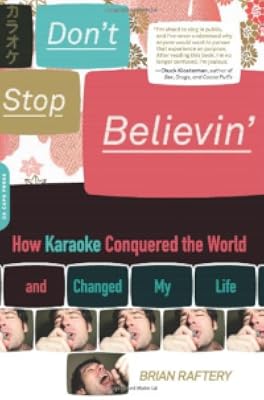
Don't Stop Believin': How Karaoke Conquered the World and Changed My Life
by Brian Raftery
On This Page
Description
Armed with a keen eye and a terrible singing voice, writer Brian Raftery sets out across the globe, tracing karaoke's evolution from cult fad to multi-million dollar phenomenon. In Japan, he meets Daisuke Inoue, the godfather of karaoke; in Thailand, he follows a group of Americans hoping to win the Karaoke World Championships; and in New York City, he hangs out backstage with the world's longest-running heavy-metal karaoke band. Along the way, Raftery chronicles his own time as an show more obsessivekaraoke fan, recalling a life's worth of noisy relationships and poor song choices, and analyzing the karaoke-bar merits of such artists as Prince, Bob Dylan and Fugazi. Part cultural history, part memoir,Don't Stop Believin': How Karaoke Conquered the World and Changed My Life is a hilarious and densely reported look at the liberating effects of a good sing-along. show lessTags
Recommendations








Member Reviews
Brian Raftery is a karaoke connoisseur. Oh, I know -- if you're not a karaoke aficionado, this may seem to you a little bit like bragging that Colt 45 is your favorite aperitif. But Raftery is so enthusiastic about his hobby, and so effectively conveys its charms, that by the end of this book, you won't be rolling your eyes anymore.
Raftery not only offers a complete history of karaoke, but also a damn near brilliant deconstruction of what makes a good karaoke tune. Among other things, the audience shouldn't have heard it one million times before; it should be varied in tempo, mood, and style; and it shouldn't be too earnest, like "Moondance." For the above reasons, Bob Dylan's "Like a Rolling Stone" is the worst karaoke song ever, and show more Bobby Brown's "On Our Own" is one of the best. (Night Ranger's "Sister Christian" is apparently the exception that proves the rule.) And as though we needed them, Don't Stop Believin' gives us even more reasons to hate Don Henley, surely making Raftery eligible for some sort of public service award.
Raftery also has an excellent touch with the autobiographical material interspersed throughout, never coming across as solipsistic, or even self-involved -- not an easy task, as anyone who's read a book by John Seabrook or Elizabeth Wurzel can attest. And adding to the fun, he's a damn funny writer. I laughed out loud a few times (and this was on the 7 train to Queens, where no one dares to laugh). He also can turn a phrase like no one's business. Representative sample: "Even a subprime boy band like 98 Degrees could sell 4 million copies of an album, and those guys were little more than overgroomed remoras picking the detritus from Lou Pearlman's great white underbelly."
Hell, if after finishing this book, you're not dying to go to the nearest karaoke bar and belt out The Backstreet Boys "I Want It That Way," I promise I'll give you a good laugh by coming to your living room to give you my rousing rendition of Johnny Cash's "Ring of Fire." (I actually did this one the other day, through the magic of Time Warner Cable's Oh! On Demand Karaoke. My husband went stomping out of the room in disgust, and I can't say I blame him. But I can hardly blame Brian Raftery for that.)
(I got a hold of a bound galley, and if you're reading this, Brian, there are just two teeny copy editing errors that I beg you -- nay, implore you -- to fix for the first printing, if possible. The first one: it's "Nurse Rached," not "Nurse Rachet." The second one: it's "Dexys Midnight Runners," not "Dexy's." Sorry, but I am a bit fussy about that kind of thing.) show less
Raftery not only offers a complete history of karaoke, but also a damn near brilliant deconstruction of what makes a good karaoke tune. Among other things, the audience shouldn't have heard it one million times before; it should be varied in tempo, mood, and style; and it shouldn't be too earnest, like "Moondance." For the above reasons, Bob Dylan's "Like a Rolling Stone" is the worst karaoke song ever, and show more Bobby Brown's "On Our Own" is one of the best. (Night Ranger's "Sister Christian" is apparently the exception that proves the rule.) And as though we needed them, Don't Stop Believin' gives us even more reasons to hate Don Henley, surely making Raftery eligible for some sort of public service award.
Raftery also has an excellent touch with the autobiographical material interspersed throughout, never coming across as solipsistic, or even self-involved -- not an easy task, as anyone who's read a book by John Seabrook or Elizabeth Wurzel can attest. And adding to the fun, he's a damn funny writer. I laughed out loud a few times (and this was on the 7 train to Queens, where no one dares to laugh). He also can turn a phrase like no one's business. Representative sample: "Even a subprime boy band like 98 Degrees could sell 4 million copies of an album, and those guys were little more than overgroomed remoras picking the detritus from Lou Pearlman's great white underbelly."
Hell, if after finishing this book, you're not dying to go to the nearest karaoke bar and belt out The Backstreet Boys "I Want It That Way," I promise I'll give you a good laugh by coming to your living room to give you my rousing rendition of Johnny Cash's "Ring of Fire." (I actually did this one the other day, through the magic of Time Warner Cable's Oh! On Demand Karaoke. My husband went stomping out of the room in disgust, and I can't say I blame him. But I can hardly blame Brian Raftery for that.)
(I got a hold of a bound galley, and if you're reading this, Brian, there are just two teeny copy editing errors that I beg you -- nay, implore you -- to fix for the first printing, if possible. The first one: it's "Nurse Rached," not "Nurse Rachet." The second one: it's "Dexys Midnight Runners," not "Dexy's." Sorry, but I am a bit fussy about that kind of thing.) show less
I must admit I have never tried karaoke. I'm not even sure what prompted me to buy this book except that it was on sale and looked like fun. I'm glad, however, that I did pick it up. I found it to be entertaining, informative, and well-written, at times touching, at times hilarious. While I am not a karaoke fan, I certainly have a deep attachment to popular music and can appreciate the passion that others bring to this entertainment form. I found much of the historical information and glimpses into the karaoke industry to be fascinating. I recommend this book to anyone who is interested in karaoke or just wants to read a fun and informative memoir.
A really enjoyable read; the perfect blend of memoir and cultural history.
"With the exception of live music itself, karaoke may be the most direct form of music appreciation that exists" (p. 75)
Which is not to say that I'll be getting up on stage any time soon.
"With the exception of live music itself, karaoke may be the most direct form of music appreciation that exists" (p. 75)
Which is not to say that I'll be getting up on stage any time soon.
I am not really into karaoke (my experience tends to be at family functions with horrible backing tracks accompanying various footage of the Philippines), but do love me some SingStar. Either way, this book intrigued me and I love cultural studies, so I got it.
So great! I really enjoyed the history behind karaoke, how the author was into it, the evolution of the phenomenon and how technology affects it, and, especially, its appeal.
This book seals its four star rating because the author has a go at the "baby boomers' self-mythologizing" which is a peeve of mine. I loathe the canonization of 60s culture.
Anyway, good book. I definitely recommend it.
So great! I really enjoyed the history behind karaoke, how the author was into it, the evolution of the phenomenon and how technology affects it, and, especially, its appeal.
This book seals its four star rating because the author has a go at the "baby boomers' self-mythologizing" which is a peeve of mine. I loathe the canonization of 60s culture.
Anyway, good book. I definitely recommend it.
Ratings
Members
- Recently Added By
Author Information
5 Works 222 Members
Common Knowledge
- Original publication date
- 2008-12-09
- People/Characters
- Mike Kuhle
- Dedication
- To my Nana Mac, who always hated Mel Tormé.
- First words
- It's okay with me if you hate karaoke. But ask yourself: Do you really want to be like Don Henley?
- Last words
- (Click to show. Warning: May contain spoilers.)I took her hand and went inside. There was no reason for me to keep singing by myself.
- Publisher's editor
- Schafer, Ben
- Blurbers
- Klosterman, Chuck; Jacobs, A.J.
Classifications
- Genres
- Music, Nonfiction, Biography & Memoir, History
- DDC/MDS
- 782.42164 — Arts & recreation Music Vocal music Secular forms of vocal music Songs General principles and musical forms Traditions of secular songs {genres} Western popular songs
- LCC
- ML3918 .K36 .R35 — Music Literature on music Literature on music Philosophical and societal aspects of music. Physics Social and political aspects of music
- BISAC
Statistics
- Members
- 31
- Popularity
- 861,551
- Reviews
- 4
- Rating
- (3.65)
- Languages
- English
- Media
- Paper, Ebook
- ISBNs
- 2
- ASINs
- 2