
On This Page
Description
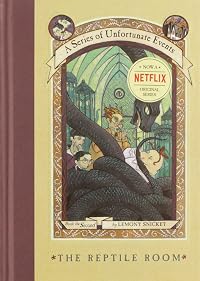
After narrowly escaping the menacing clutches of the dastardly Count Olaf, the three Baudelaire orphans are taken in by a kindly herpetologist with whom they live happily for an all-too-brief time.Tags
Recommendations







Member Reviews
""If you are interested in stories with happy endings, you would be better off reading some other book."" So cautions Snicket, the exceedingly well-mannered narrator of the mock-gothic novels, A Series of Unfortunate Events, featuring the misadventures of 14-year-old Violet, 12-year-old Klaus and infant Sunny Baudelaire. After escaping the clutches of the evil Count Olaf, the children once again find themselves facing death, mystery, and reptiles (!) in Snicket's The Reptile Room. Seriously, things look unfortunate once again for our trio.
Things look hopefully at first for the Baudelaires. They are getting closer and closer to a great future after learning about their parents death. They have a new guardian in their lives, Uncle Monty show more - who is a kind and loving herpetologist (which means: studier of snakes and reptiles) who instantly takes the children into his care with love and devotion . However, he still seems naive just like every other adult in this series (cough* cough* MR. POE). Then there's Count Olaf who is still trying to take the kids fortune.
But have no fear, dear reader, for the children once again use their talents to outsmart Count Olaf once again!
The Reptile Room is a brilliant follow up to The Bad Beginning. All three children use their respective skills and interests to their advantage time and again throughout the series, and I love their ingenuity, their intellect, and their love for one another. I also love that Handler (writing as Snicket) clearly defines what is good and what is evil. Count Olaf is honestly, in my opinion, one of the most repulsive forms of evil that exists: he is greedy murderer who plays with deceptions and lies. Contrast this will the intellects of our heroes and their familial love for one another, and the message of these books become very clear.
I'm a fan. And I'm ashamed I'm just not reading this series. show less
Things look hopefully at first for the Baudelaires. They are getting closer and closer to a great future after learning about their parents death. They have a new guardian in their lives, Uncle Monty show more - who is a kind and loving herpetologist (which means: studier of snakes and reptiles) who instantly takes the children into his care with love and devotion . However, he still seems naive just like every other adult in this series (cough* cough* MR. POE). Then there's Count Olaf who is still trying to take the kids fortune.
But have no fear, dear reader, for the children once again use their talents to outsmart Count Olaf once again!
The Reptile Room is a brilliant follow up to The Bad Beginning. All three children use their respective skills and interests to their advantage time and again throughout the series, and I love their ingenuity, their intellect, and their love for one another. I also love that Handler (writing as Snicket) clearly defines what is good and what is evil. Count Olaf is honestly, in my opinion, one of the most repulsive forms of evil that exists: he is greedy murderer who plays with deceptions and lies. Contrast this will the intellects of our heroes and their familial love for one another, and the message of these books become very clear.
I'm a fan. And I'm ashamed I'm just not reading this series. show less
The series hits its stride in its second entry, as the children move in with a relative and learn that their problems with Count Olaf are far from over. The first book introduced the characters and the unique style of the series, and its plot was a grim entrapment story that revealed a great evilness in Olaf. Certainly enjoyable, but a bit narrow in scope, which happens when a story has to focus so much on set up. With the pieces in place, the story in The Reptile Room establishes a pattern that will be elaborated and then upended in future books.
Violet, Klaus, and Sunny move in with their Uncle Monty, and he is amazing. He loves his nieces and nephew, and lets them explore his herpetological collection in the Reptile Room and takes show more them to fun movies. He feeds them coconut cake. He introduces them to the Incredibly Deadly Viper, a sweet and harmless snake that Uncle Monty discovered and named with a misnomer. Unfortunately, while the man is kind and intelligent, he is too naive. His assistant disappeared recently, and when Count Olaf arrives in a laughable disguise as the replacement, Stephano, Uncle Monty falls for his trick. The children try to tell him, but Olaf stops them with threats and distractions. When Monty finally begins to suspect him, he thinks that Olaf is a herpetological spy trying to mooch off his expertise. They make plans to leave Stephano and head off on a journey alone, but before they leave, Olaf murders Uncle Monty.
He forces the Baudelaires to come with him, to complete the journey they were going to take with Monty, where he plans on killing them and securing their fortune. However, Mr. Poe accidentally runs into their car as they are leaving, and they tell him about Monty. They try to show Mr. Poe that Stephano is actually Count Olaf, but he refuses to see past the disguise. However, he does force Olaf to take everyone back to the house, to call a doctor for Monty Montgomery. This gives the children a small window of opportunity, in which they must prove to Mr. Poe that Stephano is a fraud, the doctor that arrives is not what he seems, and that Monty was not killed by a snake but was murdered in a way that blamed snakes.
Using their wits and special skills, the children reveal Stephano to be a fraud, with evidence compelling enough to even convince Mr. Poe. Snicket ensures the story doesn't end a happy note, in spite of their victory, because Count Olaf escapes and the children have to say quick farewells to their snake friends.
Summarizing these events briefly, the book sounds a touch horrible, but the writing style is so absurdly funny, with a playful use of language, an emphasis on doom and destruction that becomes ridiculous in its extremity, and the over the top villainy and incompetent adults. Violet, Klaus, and Sunny shine in their ingenuity, and Olaf's plot is cleverly diabolical, even if his disguise is not. The book is a fast read, entertaining, and quite different from most of the choices in the children's book department. The pattern of the first half of the series begins here: the Baudelaires go to a new guardian, Olaf finds them, the guardian falls for his disguise but the children do not, Olaf puts someone in mortal peril, and the children must rely on themselves to thwart him. It's a funny sequence, and it begins here. show less
Violet, Klaus, and Sunny move in with their Uncle Monty, and he is amazing. He loves his nieces and nephew, and lets them explore his herpetological collection in the Reptile Room and takes show more them to fun movies. He feeds them coconut cake. He introduces them to the Incredibly Deadly Viper, a sweet and harmless snake that Uncle Monty discovered and named with a misnomer. Unfortunately, while the man is kind and intelligent, he is too naive. His assistant disappeared recently, and when Count Olaf arrives in a laughable disguise as the replacement, Stephano, Uncle Monty falls for his trick. The children try to tell him, but Olaf stops them with threats and distractions. When Monty finally begins to suspect him, he thinks that Olaf is a herpetological spy trying to mooch off his expertise. They make plans to leave Stephano and head off on a journey alone, but before they leave, Olaf murders Uncle Monty.
He forces the Baudelaires to come with him, to complete the journey they were going to take with Monty, where he plans on killing them and securing their fortune. However, Mr. Poe accidentally runs into their car as they are leaving, and they tell him about Monty. They try to show Mr. Poe that Stephano is actually Count Olaf, but he refuses to see past the disguise. However, he does force Olaf to take everyone back to the house, to call a doctor for Monty Montgomery. This gives the children a small window of opportunity, in which they must prove to Mr. Poe that Stephano is a fraud, the doctor that arrives is not what he seems, and that Monty was not killed by a snake but was murdered in a way that blamed snakes.
Using their wits and special skills, the children reveal Stephano to be a fraud, with evidence compelling enough to even convince Mr. Poe. Snicket ensures the story doesn't end a happy note, in spite of their victory, because Count Olaf escapes and the children have to say quick farewells to their snake friends.
Summarizing these events briefly, the book sounds a touch horrible, but the writing style is so absurdly funny, with a playful use of language, an emphasis on doom and destruction that becomes ridiculous in its extremity, and the over the top villainy and incompetent adults. Violet, Klaus, and Sunny shine in their ingenuity, and Olaf's plot is cleverly diabolical, even if his disguise is not. The book is a fast read, entertaining, and quite different from most of the choices in the children's book department. The pattern of the first half of the series begins here: the Baudelaires go to a new guardian, Olaf finds them, the guardian falls for his disguise but the children do not, Olaf puts someone in mortal peril, and the children must rely on themselves to thwart him. It's a funny sequence, and it begins here. show less
This is chapter two of the terrible misfortunes of the Baudelaire orphans, and it picks right up where The Bad Beginning left off. The Baudelaires are sent to live with another "relation" of sorts, Dr. Montgomery Montgomery. He is a renowned herpetologist and a very kind man. The children feel safe with him almost instantly... but just as quickly, that security evaporates when Count Olaf again appears on the scene.
Snicket maintains the humor of the first book as well as the more serious side notes. I love his description of losing a loved one like missing a step on a staircase that you knew was there. It's a very simple image, but profound.
After awhile, the constant explanation of big words can be somewhat annoying, not because I feel show more like I'm being talked down to (I don't), but because it's overused. But I will say there were some funny ones, like Sunny saying "Ackroid!" and meaning "Roger!" It makes me wonder what other literary allusions are hidden in there.
I've seen the movie and so I knew pretty much what was coming. I'm looking forward to reaching book four, when I won't know any of the events to come. I think the first few books have suffered a bit in my estimation because I haven't come to them unknowing. Too much hype can have the opposite effect of its intent. So perhaps I should tell you that you will hate this book, and please don't read it, because it's perfectly awful? :-P show less
Snicket maintains the humor of the first book as well as the more serious side notes. I love his description of losing a loved one like missing a step on a staircase that you knew was there. It's a very simple image, but profound.
After awhile, the constant explanation of big words can be somewhat annoying, not because I feel show more like I'm being talked down to (I don't), but because it's overused. But I will say there were some funny ones, like Sunny saying "Ackroid!" and meaning "Roger!" It makes me wonder what other literary allusions are hidden in there.
I've seen the movie and so I knew pretty much what was coming. I'm looking forward to reaching book four, when I won't know any of the events to come. I think the first few books have suffered a bit in my estimation because I haven't come to them unknowing. Too much hype can have the opposite effect of its intent. So perhaps I should tell you that you will hate this book, and please don't read it, because it's perfectly awful? :-P show less
To finish one book in an afternoon might be unfortunate. To finish a second one smacks of carelessness. Concern for the fates of the Baudelaire children, despite reassurances from the author that there is nothing good to be expected, compels one, however, and this time they are almost happy, for a while, until the reliably dreadful Count Olaf arrives to make sure the events continue unfortunate.
The audio version of this book is worth a listen, if for no other reason than to hear Tim Curry repeat the word "ever" -- which in his lovely accent, with various inflections, most often sounds more like "evah" -- for what I can assume is an entire page in the original text. And also this song by The Gothic Archies, which you can just listen to here.
In addition, either version of the book contains gems like these:
“When somebody is a little bit wrong - say, when a waiter puts nonfat milk in your espresso macchiato, instead of lowfat milk - it is often quite easy to explain to them how and why they are wrong. But if somebody is surprisingly wrong - say, when a waiter bites your nose instead of taking your order - you can often be so show more surprised that you are unable to say anything at all. Paralyzed by how wrong the waiter is, your mouth would hang slightly open and your eyes would blink over and over, but you would be unable to say a word.”
"When you were very small, perhaps someone read to you the insipid story — the word insipid here means not worth reading to someone — of the Boy Who Cried Wolf. A very dull boy, you may remember, cried Wolf! when there was no wolf, and the gullible villagers ran to rescue him only to find the whole thing was a joke. Then he cried Wolf! when it wasn't a joke, and the villagers didn't come running, and the boy was eaten and the story, thank goodness, was over. The story's moral, of course, ought to be Never live somewhere where wolves are running around loose, but whoever read you the story probably told you that the moral was not to lie. This is an absurd moral, for you and I both know that sometimes not only is it good to lie, it is necessary to lie. For example, it was perfectly appropriate, after Violet left the Reptile Room, for Sunny to crawl over to the cage that held the Incredibly Deadly Viper, unlatch the cage, and begin screaming as loudly as she could even though nothing was really wrong. There is another story concerning wolves that somebody has probably read to you, which is just as absurd. I am talking about Little Red Riding Hood, an extremely unpleasant little girl who, like the Boy Who Cried Wolf, insisted on intruding on the territory of dangerous animals. You will recall that the wolf, after being treated very rudely by Little Red Riding Hood, ate the little girl's grandmother and put on her clothing as a disguise. It is this aspect of the story that is the most ridiculous, because one would think that even a girl as dim-witted as Little Red Riding hood could tell in an instant the difference between her grandmother and a wolf dressed in a nightgown and fuzzy slippers. If you know somebody very well, like your grandmother or your baby sister, you will know when they are real and when they are fake. This is why as Sunny began to scream, Violet and Klaus could tell immediately tell that her scream was absolutely fake."
"There are two basic types of panicking: standing still and not saying a word, and leaping all over the place babbling anything that comes into your head. Mr. Poe was the leaping-and-babbling kind. Klaus and Sunny had never seen the banker move so quickly or talk in such a high pitched voice. 'Goodness!' he cried. 'Golly! Good God! Blessed Allah! Zeus and Hera! Mary and Joseph! Nathaniel Hawthorne! Don't touch her! Grab her! Move closer! Run away! Don't move! Kill the snake! Leave it alone! Give it some food! Don't let it bite her! Lure the snake away! Here, snakey! Here, snakey snakey!'"
“How did you do that?” Mr. Poe asked. “Nice girls shouldn’t know how to do such things.”
“My sister is a nice girl,” Klaus said, “and she knows how to do all sorts of things.”
Amen. show less
In addition, either version of the book contains gems like these:
“When somebody is a little bit wrong - say, when a waiter puts nonfat milk in your espresso macchiato, instead of lowfat milk - it is often quite easy to explain to them how and why they are wrong. But if somebody is surprisingly wrong - say, when a waiter bites your nose instead of taking your order - you can often be so show more surprised that you are unable to say anything at all. Paralyzed by how wrong the waiter is, your mouth would hang slightly open and your eyes would blink over and over, but you would be unable to say a word.”
"When you were very small, perhaps someone read to you the insipid story — the word insipid here means not worth reading to someone — of the Boy Who Cried Wolf. A very dull boy, you may remember, cried Wolf! when there was no wolf, and the gullible villagers ran to rescue him only to find the whole thing was a joke. Then he cried Wolf! when it wasn't a joke, and the villagers didn't come running, and the boy was eaten and the story, thank goodness, was over. The story's moral, of course, ought to be Never live somewhere where wolves are running around loose, but whoever read you the story probably told you that the moral was not to lie. This is an absurd moral, for you and I both know that sometimes not only is it good to lie, it is necessary to lie. For example, it was perfectly appropriate, after Violet left the Reptile Room, for Sunny to crawl over to the cage that held the Incredibly Deadly Viper, unlatch the cage, and begin screaming as loudly as she could even though nothing was really wrong. There is another story concerning wolves that somebody has probably read to you, which is just as absurd. I am talking about Little Red Riding Hood, an extremely unpleasant little girl who, like the Boy Who Cried Wolf, insisted on intruding on the territory of dangerous animals. You will recall that the wolf, after being treated very rudely by Little Red Riding Hood, ate the little girl's grandmother and put on her clothing as a disguise. It is this aspect of the story that is the most ridiculous, because one would think that even a girl as dim-witted as Little Red Riding hood could tell in an instant the difference between her grandmother and a wolf dressed in a nightgown and fuzzy slippers. If you know somebody very well, like your grandmother or your baby sister, you will know when they are real and when they are fake. This is why as Sunny began to scream, Violet and Klaus could tell immediately tell that her scream was absolutely fake."
"There are two basic types of panicking: standing still and not saying a word, and leaping all over the place babbling anything that comes into your head. Mr. Poe was the leaping-and-babbling kind. Klaus and Sunny had never seen the banker move so quickly or talk in such a high pitched voice. 'Goodness!' he cried. 'Golly! Good God! Blessed Allah! Zeus and Hera! Mary and Joseph! Nathaniel Hawthorne! Don't touch her! Grab her! Move closer! Run away! Don't move! Kill the snake! Leave it alone! Give it some food! Don't let it bite her! Lure the snake away! Here, snakey! Here, snakey snakey!'"
“How did you do that?” Mr. Poe asked. “Nice girls shouldn’t know how to do such things.”
“My sister is a nice girl,” Klaus said, “and she knows how to do all sorts of things.”
Amen. show less
Oh, I love Lemony Snicket. I love the Baudelaire orphans, I loved Uncle Monty and I might even love Count Olaf (a bit, from time to time, because he's part of these stories).
It is a sad, depressing, senseless, upsetting story about the bad things that can unfortunately happen in this world, meaning: It is the most enjoyable and entertaining book I've read in some time, making me burst with laughters or calmly grin on the explanation of all those "difficult words", then again cause me to hold my breath or shiver slightly.
In this volume, I was particularily fond of the Incredibly Deadly Viper.
It is a sad, depressing, senseless, upsetting story about the bad things that can unfortunately happen in this world, meaning: It is the most enjoyable and entertaining book I've read in some time, making me burst with laughters or calmly grin on the explanation of all those "difficult words", then again cause me to hold my breath or shiver slightly.
In this volume, I was particularily fond of the Incredibly Deadly Viper.
Another fabulous addition to one of my favourite childhood series!
I read these way back in the day (you know, when Jim Carrey was Count Olaf) but I figured as an adult I should pick this series up again for the fun of it! And, oh boy, am I not disappointed! While I am not the target audience, I still get a big kick from these books and have a good laugh too! If I ever have a kid, these books are a MUST READ because they are hilarious and awfully cruel all at the same time. No wonder I have such a brutal, sarcastic sense of humour - I grew up on these books!
This book didn't strike me like the first one, but it's just as good, goofy and entertaining. I love Montegomery Montegomery and it's a real shame we didn't get more time in the book show more with him. He was so kooky and crazy that I wanted just a few more chapters before he meets his match. We all knew that this series wasn't going to end happily in this book (look at the title, folks) but I wanted to cherish the hilarious scenarios for a little bit longer before Count Olaf/Stephano arrives on the scene.
I do wonder why the banker is in charge of the children. They have SO many relatives and a random banker gets to take care of them. Not even a lawyer... wouldn't a lawyer make more sense? It's child logic though, so I'm not going to let that ruin the story for me.
One big positive for this book is that the characters seem to grow. We see our Baudelaire children in a happy, family friendly setting and feel comforted. They get along, feel like they have a Father figure and want to go on adventures. Seeing another side of them was a real treat and I just know that these guys will continue to evolve ('cause... you know... I already read the series). I also really enjoy all of the terminology and slang that is explained in this book. I kept chuckling along the way as the reader was introduced to amusing sayings that have been plastered in literature for years.
Overall, this series is absolutely charming. I still love them to this day and I will see it through to the end! I have the next two books sitting on my shelf and it will be a challenge to find the rest...
Until next time, Count Olaf...
P.S. I still imagine Jim Carrey as Count Olaf. I do love me some Neil Patrick Harris, but Jim Carrey was my childhood Olaf.
Four out of five stars. show less
I read these way back in the day (you know, when Jim Carrey was Count Olaf) but I figured as an adult I should pick this series up again for the fun of it! And, oh boy, am I not disappointed! While I am not the target audience, I still get a big kick from these books and have a good laugh too! If I ever have a kid, these books are a MUST READ because they are hilarious and awfully cruel all at the same time. No wonder I have such a brutal, sarcastic sense of humour - I grew up on these books!
This book didn't strike me like the first one, but it's just as good, goofy and entertaining. I love Montegomery Montegomery and it's a real shame we didn't get more time in the book show more with him. He was so kooky and crazy that I wanted just a few more chapters before he meets his match. We all knew that this series wasn't going to end happily in this book (look at the title, folks) but I wanted to cherish the hilarious scenarios for a little bit longer before Count Olaf/Stephano arrives on the scene.
I do wonder why the banker is in charge of the children. They have SO many relatives and a random banker gets to take care of them. Not even a lawyer... wouldn't a lawyer make more sense? It's child logic though, so I'm not going to let that ruin the story for me.
One big positive for this book is that the characters seem to grow. We see our Baudelaire children in a happy, family friendly setting and feel comforted. They get along, feel like they have a Father figure and want to go on adventures. Seeing another side of them was a real treat and I just know that these guys will continue to evolve ('cause... you know... I already read the series). I also really enjoy all of the terminology and slang that is explained in this book. I kept chuckling along the way as the reader was introduced to amusing sayings that have been plastered in literature for years.
Overall, this series is absolutely charming. I still love them to this day and I will see it through to the end! I have the next two books sitting on my shelf and it will be a challenge to find the rest...
Until next time, Count Olaf...
P.S. I still imagine Jim Carrey as Count Olaf. I do love me some Neil Patrick Harris, but Jim Carrey was my childhood Olaf.
Four out of five stars. show less
Members
- Recently Added By
Lists

Read the book and saw the movie
1,170 works; 195 members

NPRs Ultimate Backseat Bookshelf: 100 Must-Reads for kids 9-14
222 works; 30 members

Most Popular Young Adult Lit on LT
100 works; 4 members

Best Satire
188 works; 29 members

Books You Couldn't Finish
202 works; 29 members

Books Read in 2015
3,299 works; 126 members
Books Read in 2016
4,666 works; 199 members

Stories Featuring Reptiles
22 works; 5 members

Animals in the Title
498 works; 11 members

Unread books
1,063 works; 87 members

Books About Murder
313 works; 7 members

Books Read in 2007
326 works; 8 members

SYES Library Wishlist
1,080 works; 4 members

Guilty Pleasures
223 works; 86 members
Author Information

159+ Works 210,025 Members
Lemony Snicket is the pen name of Daniel Handler, who was born on February 28, 1970. As Lemony Snicket, he is the author of and appears as a character in the children's book series A Series of Unfortunate Events. He has also written or contributed to other works using this pen name including Baby in the Manger, The Lump of Coal, The Composer Is show more Dead, and Where Did You See Her Last?. Under his real name, Handler is the author of several books for adults including The Basic Eight, Watch Your Mouth, and Adverbs. (Bowker Author Biography) show less
All Editions
Some Editions
Awards and Honors
Awards
Series

Work Relationships
Is contained in
Has the adaptation
Common Knowledge
- Canonical title
- The Reptile Room
- Original title
- The Reptile Room
- Original publication date
- 1999-09-30
- People/Characters
- Violet Baudelaire; Klaus Baudelaire; Sunny Baudelaire; Count Olaf; Montgomery Montgomery; Incredibly Deadly Viper (show all 11); Mr. Poe; Stephano; Gustav Sebald; Bruce [in A Series of Unfortunate Events]; Polly Poe (mentioned)
- Important places
- Lousy Lane; Peru
- Related movies
- Lemony Snicket's A Series of Unfortunate Events (2004 | IMDb); A Series of Unfortunate Events (2017 | IMDb)
- Dedication
- For Beatrice -- My love for you shall live forever. You, however, did not.
- First words
- The stretch of road that leads out of the city, past Hazy Harbor and into the town of Tedia, is perhaps the most unpleasant in the world.
- Last words
- (Click to show. Warning: May contain spoilers.)They stood together in the moonlight, and kept waving, even when Bruce shut the doors of the van, even as the van drove past the snake-shaped hedges and down the driveway to Lousy Lane, and even when it turned a corner and disappeared into the dark.
- Canonical DDC/MDS
- [Fic]--dc21
- Canonical LCC
- PZ7.S6795Re
Classifications
- Genres
- Kids, Fiction and Literature, Children's Books
- DDC/MDS
- 813.54 — Literature & rhetoric American literature in English American fiction in English 1900-1999 1945-1999
- LCC
- PZ7 .S6795 .R — Language and Literature Fiction and juvenile belles lettres Fiction and juvenile belles lettres Juvenile belles lettres
- BISAC
Statistics
- Members
- 17,916
- Popularity
- 355
- Reviews
- 206
- Rating
- (3.75)
- Languages
- 26 — Chinese, Czech, Danish, Dutch, English, Estonian, Finnish, French, German, Greek, Hungarian, Italian, Norwegian (Bokmål), Norwegian, Farsi/Persian, Polish, Russian, Croatian, Slovak, Slovenian, Spanish, Swedish, Thai, Turkish, Welsh, Portuguese (Brazil)
- Media
- Paper, Audiobook, Ebook
- ISBNs
- 109
- ASINs
- 39