
Down these Dark Spaceways
by Mike Resnick (Editor)
Skolian Empire Chronological Order ("The City of Cries" 2205)
On This Page
Description
Six stories written by authors who take you to distant planets and dangerous futures where crime flourishes and is fought.Tags
Recommendations
















Member Reviews
This is a collection of science fiction detective novellas, intended to be more or less in the Raymond Chandler or Dashiell Hammett tradition. There are a total of six stories:
"Guardian Angel" by Mike Resnick: I've read some novels of Resnick's that I believe were set in the same universe as this one, quite some time ago, and I mostly remember enjoying them. This story really didn't do much for me, though. It wasn't bad, but it never engaged me very much, and was utterly and immediately forgettable.
"In the Quake Zone" by David Gerrold: This is an interesting one. Ostensibly it's about hunting for a killer, but it's really much more about the experience of being young and gay in 1960s Los Angeles, brought to you by some really weird time show more travel stuff. Said time travel stuff doesn't make any actual sense, but, honestly, I don't think it's really even trying to, and I was mostly okay with that. That aside, I'd say this one is mostly good, with an imaginative premise and interesting characterization, but it suffers a bit from being overlong, and from some difficulty balancing social commentary and plot. Plus I had very mixed feelings about the ending.
"The City of Cries" by Catherine Asaro: A very straightforward story about a search for a missing person. Not an incredibly intricate or memorable plot, but enjoyable enough. I liked a lot of the worldbuilding details, too, but the way the society depicted here just takes some familiar social structures and flips the gender roles feels really simplistic and not terribly well thought out.
"Camouflage" by Robert Reed: I liked this one. It's weird, but in a good way. The setting -- a mysterious and unbelievably massive spaceship populated by a variety of species -- is strange and interesting, and the whole thing has the feeling of a small glimpse into a complex and alien world. Which doesn't actually sound like a great setting for a mystery story, that being the kind of thing where it's usually better if you feel like you know what the rules are, but I think it works fairly well.
"The Big Downtown" by Jack McDevitt: This one was readable enough, I guess, but the mystery wasn't especially interesting, and it gets wrapped up ridiculously fast at the end. And after the last couple of stories, the wordbuilding for this one was disappointing. It's supposedly far enough in the future that people are off doing archeology on alien planets, but the setting feels exactly like the present, just with very slightly more advanced technology.
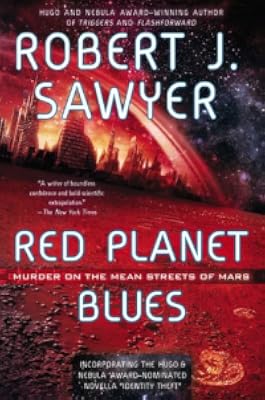
"Identity Theft" by Robert J. Sawyer: I was looking forward to this one because, based on a very quick glance at the dust jacket summaries, it looked like it was going to feature the same detective as Sawyer's Red Planet Blues, which I enjoyed. It turns out I was right about that, but not exactly in the way I was hoping for: it's actually an earlier version of the first ten or so chapters of the novel. And while I liked Red Planet Blues, I don't think I liked it quite enough to want to read the beginning of it twice, so I ended up skipping this one. show less
"Guardian Angel" by Mike Resnick: I've read some novels of Resnick's that I believe were set in the same universe as this one, quite some time ago, and I mostly remember enjoying them. This story really didn't do much for me, though. It wasn't bad, but it never engaged me very much, and was utterly and immediately forgettable.
"In the Quake Zone" by David Gerrold: This is an interesting one. Ostensibly it's about hunting for a killer, but it's really much more about the experience of being young and gay in 1960s Los Angeles, brought to you by some really weird time show more travel stuff. Said time travel stuff doesn't make any actual sense, but, honestly, I don't think it's really even trying to, and I was mostly okay with that. That aside, I'd say this one is mostly good, with an imaginative premise and interesting characterization, but it suffers a bit from being overlong, and from some difficulty balancing social commentary and plot. Plus I had very mixed feelings about the ending.
"The City of Cries" by Catherine Asaro: A very straightforward story about a search for a missing person. Not an incredibly intricate or memorable plot, but enjoyable enough. I liked a lot of the worldbuilding details, too, but the way the society depicted here just takes some familiar social structures and flips the gender roles feels really simplistic and not terribly well thought out.
"Camouflage" by Robert Reed: I liked this one. It's weird, but in a good way. The setting -- a mysterious and unbelievably massive spaceship populated by a variety of species -- is strange and interesting, and the whole thing has the feeling of a small glimpse into a complex and alien world. Which doesn't actually sound like a great setting for a mystery story, that being the kind of thing where it's usually better if you feel like you know what the rules are, but I think it works fairly well.
"The Big Downtown" by Jack McDevitt: This one was readable enough, I guess, but the mystery wasn't especially interesting, and it gets wrapped up ridiculously fast at the end. And after the last couple of stories, the wordbuilding for this one was disappointing. It's supposedly far enough in the future that people are off doing archeology on alien planets, but the setting feels exactly like the present, just with very slightly more advanced technology.
"Identity Theft" by Robert J. Sawyer: I was looking forward to this one because, based on a very quick glance at the dust jacket summaries, it looked like it was going to feature the same detective as Sawyer's Red Planet Blues, which I enjoyed. It turns out I was right about that, but not exactly in the way I was hoping for: it's actually an earlier version of the first ten or so chapters of the novel. And while I liked Red Planet Blues, I don't think I liked it quite enough to want to read the beginning of it twice, so I ended up skipping this one. show less
The jacket blurb indicates that things have changed – that they (yes, that ephemeras “they”) said mystery couldn’t blend with science fiction. The point is that most science fiction mysteries are merely “Sam Spade took his blaster out of his holster” type approaches. Okay, that’s (kind of) the first thing wrong with this book – done incorrectly (which a lot of it is) – all genre blends with science fiction are just a case of take one genre, add science fiction props, mix briskly. And this collection does almost nothing to change that. The stories are fine, but they still seem to just be adapting the mystery (in this case – per the editor’s request – “Chandler-esque tales”) to science fiction by just adding show more the trappings. “Guardian Angel” by editor Resnick suffers the most from this. “The City of Cries” does the same thing, this time adapting it to a Space Opera. “The Big Downtown” by Jack McDeviit comes close. It is very well written and I enjoyed the story. But in the back of my head I couldn’t keep from asking, “Is there any real reason why this has to be science fiction? What does that add?” And I think that should be the point of any collection of Chandler-esque type science fiction.
The stories are nicely written, but the book is not really worth picking up – except for one story. David Gerrold’s “In the Quake Zone” does it right. Really does it right. This story of time traveling event adjustors (my term –not his) cannot exist, cannot drive forward without the science fiction aspect. There are plenty of ideas, plenty of mind-twists, and plenty of old-time detective action. Many of the stories here are longer (80 – 100 pages), and Gerrold’s made me wish it was even longer. (In fact, the ending seemed to rush to conclusion – as if a little more time would have made a better, more complete story.) So, if you are willing to take on a book for one story, (or if you want to take it on to read well written stories – and there’s nothing wrong with that) then this is worth the time. show less
The stories are nicely written, but the book is not really worth picking up – except for one story. David Gerrold’s “In the Quake Zone” does it right. Really does it right. This story of time traveling event adjustors (my term –not his) cannot exist, cannot drive forward without the science fiction aspect. There are plenty of ideas, plenty of mind-twists, and plenty of old-time detective action. Many of the stories here are longer (80 – 100 pages), and Gerrold’s made me wish it was even longer. (In fact, the ending seemed to rush to conclusion – as if a little more time would have made a better, more complete story.) So, if you are willing to take on a book for one story, (or if you want to take it on to read well written stories – and there’s nothing wrong with that) then this is worth the time. show less
The thing I liked best about this anthology was how it showed the multiple facets of hard-boiled detectives. Some of them are smart-alecky ne'er-do-wells. Some of them have deep secrets. And some of them have very noir lives. The thing I liked least was that at least thee of the stories (Asaro, Reed and McDevitt's) take place in previously existing worlds, and, since I hadn't read any Asaro or McDevitt, I felt vaguely like I was missing background. In fact, the solution I came up with for the McDevitt mystery wouldn't have occurred to me if I'd read other stories in the series. I agree with the first reviewer that Gerrold's story makes this anthology worth picking up. I also liked the Reed story, one of the best I've read in his great show more ship series. The Asaro and McDevitt were intriguing enough to make me want to read more of their stories. The Resnick and the Sawyer were fun. show less
Ratings
Members
- Recently Added By
Lists

Science Fiction Short Story Collections
9 works; 2 members
Author Information

Mike Resnick was born on March 5, 1942. He sold his first article in 1957, his first short story in 1959, and his first book in 1962. He attended the University of Chicago from1959 through 1961. Resnick began writing stories under various pseudonyms and churned out more than 200 novels, 300 short stories and 2,000 articles, from1964 through1976. show more He edited 7 different tabloid newspapers and a pair of men's magazines, as well. Beginning with Shaggy B.E.M. Stories in 1988, Resnick has also become an anthology editor, and was nominated for a Best Editor Hugo in 1994 and 1995. His list of anthologies in print and in press totals more than 20. Since 1989, he has won four Hugo Awards, a Nebula Award, and has been nominated for 19 Hugos, eight Nebulas, a Clarke (British), and five Seiun-shos (Japanese). He has also won 10 Homer Awards, an Alexander Award, a Golden Pagoda Award, the Seiun Award (Japanese), a Hayakawa SF Award (Japanese), a Locus Award, an Ignotus Award (Spanish), a Futura Award (Croatian), the Tour Eiffel Award (French), the Prix Ozone (French), two Sfinks Awards and a Fantastyka Award (both Polish), and has topped the S. F. Chronicle Poll six times and the Asimov's Readers Poll twice. (Bowker Author Biography) show less
All Editions
Series

Belongs to Publisher Series
Science Fiction Book Club (1166121)
Work Relationships
Classifications
Statistics
- Members
- 145
- Popularity
- 224,837
- Reviews
- 3
- Rating
- (3.71)
- Languages
- English
- Media
- Paper
- ISBNs
- 1


