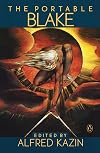
The Portable Blake
by William Blake
On This Page
Description
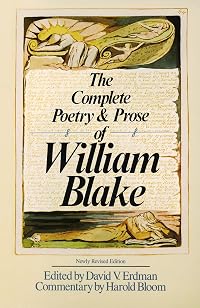
A collection of the most notable writings of William Blake.Tags
Recommendations














Member Reviews
A strange collection of the works of William Black along with some biographical sketches and reflections upon his character from people who knew him. I picked up this volume because I have an intense affection for Blake from a few poems I read when I was younger and wanted a broader view of his oeuvre. Turns out I didn't know much about the man or his work.
I had thought him exclusively a poet but he did engravings, drawings, paintings, prose and was a prolific letter writer as well as general scribbler (a whole section was for his marginalia). I call the collection odd because few of the collections are complete. There were selected letters, excerpts from larger work and other things that just confused me as I was not familiar with the show more whole.
The marginalia especially was bizarre, because there was only his comments but not the passage he was commenting upon which left little context. I was also unaware of his religious obsession, vision, mysticism and petty vendettas against people who didn't share his artistic sensibilities.
The result of reading this book is that I don't really care for Blake's work much. Obviously, I still have my pet poems, but most of his work didn't capture my fascination. And he was also apparently a weirdo who thought he spoke regularly with such persons as Jesus, Milton and Shakespeare.
Favorite Poems: Song [2]; Song [7]; Night; On Another's Sorrow; The Clod and the Pebble; The Tyger; The Garden of Love; London; Infant Sorrow [1]; A Poison Tree; A Little Girl Lost; To Tirzah; [I fear'd the fury of my wind]; To My Mirtle; [Her whole Life is an Epigram]; Auguries of Innocence show less
I had thought him exclusively a poet but he did engravings, drawings, paintings, prose and was a prolific letter writer as well as general scribbler (a whole section was for his marginalia). I call the collection odd because few of the collections are complete. There were selected letters, excerpts from larger work and other things that just confused me as I was not familiar with the show more whole.
The marginalia especially was bizarre, because there was only his comments but not the passage he was commenting upon which left little context. I was also unaware of his religious obsession, vision, mysticism and petty vendettas against people who didn't share his artistic sensibilities.
The result of reading this book is that I don't really care for Blake's work much. Obviously, I still have my pet poems, but most of his work didn't capture my fascination. And he was also apparently a weirdo who thought he spoke regularly with such persons as Jesus, Milton and Shakespeare.
Favorite Poems: Song [2]; Song [7]; Night; On Another's Sorrow; The Clod and the Pebble; The Tyger; The Garden of Love; London; Infant Sorrow [1]; A Poison Tree; A Little Girl Lost; To Tirzah; [I fear'd the fury of my wind]; To My Mirtle; [Her whole Life is an Epigram]; Auguries of Innocence show less
Early on I thought Blake easily passed the test for a poet that is worth an entire book. That being, not only was I taken with the famous poems, but ones I'd never heard of before such as "Soft Snow." Blake really does have a unique voice with rich rewards for the reader at times and such a complicated world-view peeking even through such familiar poems as "The Lamb" in Songs of Innocence and "London," "A Poison Tree" and "Tyger! Tyger!" in Songs of Experience. In "Tyger" he asks how God could make the lamb and yet the tiger, I thought Blake was just as paradoxical in his own creations. The introduction by Alfred Kazin makes Blake sound like a paradox--even mad. Kazin described Blake as a "libertarian" who supported revolution and hated show more any restraints upon liberty and loathed dogma. Yet he was also deeply anti-reason, a man who'd rant against any who'd try to prove the Earth isn't flat, let alone the likes of Newton. His vision of the world is sui generis and that meant at times I felt disoriented reading his poetry, as if I was missing reference points only he recognized--even the very thorough introduction didn't always help. Some poems were just too deeply weird. See, for instance, "The Mental Travelled."
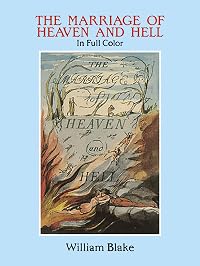
I hit a wall with The Prophetic Books, including his purported masterpiece "The Marriage of Heaven and Hell." I find the later Blake the most impenetrable writer I've read save James Joyce. Even C.S. Lewis, in the preface to The Great Divorce inspired by the poem, said he wasn't sure what Blake meant. Reading this I think it was only because Blake was so anti-social that he didn't found his own religion. And really, a man that rants not just against Bacon, Newton and Locke but Homer, Virgil and Shakespeare? We can't be friends. show less
I hit a wall with The Prophetic Books, including his purported masterpiece "The Marriage of Heaven and Hell." I find the later Blake the most impenetrable writer I've read save James Joyce. Even C.S. Lewis, in the preface to The Great Divorce inspired by the poem, said he wasn't sure what Blake meant. Reading this I think it was only because Blake was so anti-social that he didn't found his own religion. And really, a man that rants not just against Bacon, Newton and Locke but Homer, Virgil and Shakespeare? We can't be friends. show less
This book is really interesting. Blake must have been quite a character when he was alive. Hmm. Anyway, along with his poetry and selections from his "Prophetic Books," it also contains a short biography and some other interesting tidbits of information.
Like all loved poetry, one never really finishes reading it.
From 'The Marriage of Heaven and Hell'
'The Prophets Isaiah and Ezekiel dined with me, and I asked them how they dared so roundly to assert that God spoke to them; and whether they did not think at the time that they would be misunderstood, & so be the cause of imposition.
'Isaiah answer'd: 'I saw no God, nor heard any, in a finite organical perception; but my senses discover'd the infinite in everything, and as I was then perswaded, & remain confirm'd, that the voice of honest indignation is the voice of God, I cared not for consequences, but wrote.'
'Then I asked: 'Does firm perswasion that a thing is so, make it so?'
'He replied: 'All poets believe that it does, & in ages of imagination this firm perswasion removed mountains; but many show more are not capable of a firm perswasion of any thing.'' (Kindle ebook locations 2809-19)
From 'There is No Natural Religion' [Religion as defined by Deism]
'The bounded is loathed by its possessor. The same dull round, even of a universe, would soon become a mill with complicated wheels...
'If any could desire what he is incapable of possessing, despair must be his eternal lot.
'The desire of Man being Infinite, the possession is Infinite & himself Infinite.
'He who sees the Infinite in all things, sees God. He who sees the Ratio [rationality and naturalism] only, sees himself only.
'Therefore God becomes as we are, that we may be as he is.' (Kindle ebook locations 978-987)
From the 1946 Introduction by Alfred Kazin:
'... Blake has perplexed his readers even more than he has delighted them. The reason lies in his refusal to concede a distance between what is real and what is ideal.... Blake is difficult not because he invented symbols of his own; he created his symbols to show that the existence of any natural object and the value man's mind places on it were one and the same. He was fighting the acceptance of reality in the light of science as much as he was fighting the suppression of human nature by ethical dogmas. He fought on two fronts, and shifted his arms from one to the other without letting us know - more exactly, he did not let himself know. He created for himself a personality, in life and in art, that was the image of the thing he sought.
'Like all the great enlighteners of the eighteenth century, Blake is againt the ancien regime, in all its manifestations - autocracy, feudalism, superstition. Though he loathed the destructive reason of the Deists, he sometimes praised it in the fight against 'holy mystery.' He was fighting for free thought.' (Kindle ereader locations 395-404) show less
'The Prophets Isaiah and Ezekiel dined with me, and I asked them how they dared so roundly to assert that God spoke to them; and whether they did not think at the time that they would be misunderstood, & so be the cause of imposition.
'Isaiah answer'd: 'I saw no God, nor heard any, in a finite organical perception; but my senses discover'd the infinite in everything, and as I was then perswaded, & remain confirm'd, that the voice of honest indignation is the voice of God, I cared not for consequences, but wrote.'
'Then I asked: 'Does firm perswasion that a thing is so, make it so?'
'He replied: 'All poets believe that it does, & in ages of imagination this firm perswasion removed mountains; but many show more are not capable of a firm perswasion of any thing.'' (Kindle ebook locations 2809-19)
From 'There is No Natural Religion' [Religion as defined by Deism]
'The bounded is loathed by its possessor. The same dull round, even of a universe, would soon become a mill with complicated wheels...
'If any could desire what he is incapable of possessing, despair must be his eternal lot.
'The desire of Man being Infinite, the possession is Infinite & himself Infinite.
'He who sees the Infinite in all things, sees God. He who sees the Ratio [rationality and naturalism] only, sees himself only.
'Therefore God becomes as we are, that we may be as he is.' (Kindle ebook locations 978-987)
From the 1946 Introduction by Alfred Kazin:
'... Blake has perplexed his readers even more than he has delighted them. The reason lies in his refusal to concede a distance between what is real and what is ideal.... Blake is difficult not because he invented symbols of his own; he created his symbols to show that the existence of any natural object and the value man's mind places on it were one and the same. He was fighting the acceptance of reality in the light of science as much as he was fighting the suppression of human nature by ethical dogmas. He fought on two fronts, and shifted his arms from one to the other without letting us know - more exactly, he did not let himself know. He created for himself a personality, in life and in art, that was the image of the thing he sought.
'Like all the great enlighteners of the eighteenth century, Blake is againt the ancien regime, in all its manifestations - autocracy, feudalism, superstition. Though he loathed the destructive reason of the Deists, he sometimes praised it in the fight against 'holy mystery.' He was fighting for free thought.' (Kindle ereader locations 395-404) show less
Ratings
Members
- Recently Added By
Lists

Trinity College Booklist (1951): Class Ten, English Literature
358 works; 5 members
Author Information

501+ Works 20,199 Members
William Blake's poems, prophecies, and engravings represent his strong vision and voice for rebellion against orthodoxy and all forms of repression. Born in London in November 1757; his father, a hosier of limited means, could do little for the boy's education. However, when the young Blake's talent for design became apparent, his wise father sent show more him to drawing school at the age of 10. In 1771 Blake was apprenticed to an engraver. Blake went on to develop his own technique, a method he claimed that came to him in a vision of his deceased younger brother. In this, as in so many other areas of his life, Blake was an iconoclast; his blend of printing and engraving gave his works a unique and striking illumination. Blake joined with other young men in support of the Revolutions in France and America. He also lived his own revolt against established rules of conduct, even in his own home. One of his first acts after marrying his lifetime companion, Catherine Boucher, was to teach her to read and write, rare for a woman at that time. Blake's writings were increasingly styled after the Hebrew prophets. His engravings and poetry give form and substance to the conflicts and passions of the elemental human heart, made real as actual characters in his later work. Although he was ignored by the British literary community through most of his life, interest and study of his work has never waned. Blake's creativity and original thinking mark him as one of the earliest Romantic poets, best known for his Songs of Innocence (1789) and Songs of Experience (1794) and The Tiger. Blake died in London in 1827. (Bowker Author Biography) show less
All Editions
Awards and Honors
Notable Lists
Series
Belongs to Publisher Series
Common Knowledge
- Canonical title
- The Portable Blake
- Original title
- The Portable Blake
- Original publication date
- 1946
- People/Characters
- William Blake
- First words
- Introduction: In 1827 there died, undoubtedly unknown to each other, two plebeian Europeans of supreme originality: Ludwig van Beethoven and William Blake.
- Last words
- (Click to show. Warning: May contain spoilers.)I question not my Corporeal or Vegetative Eye any more than I would Question a Window concerning a Sight. I look thro' it & not with it.
- Original language
- English UK
Classifications
Statistics
- Members
- 744
- Popularity
- 37,849
- Reviews
- 5
- Rating
- (3.88)
- Languages
- English
- Media
- Paper, Ebook
- ISBNs
- 6
- ASINs
- 15