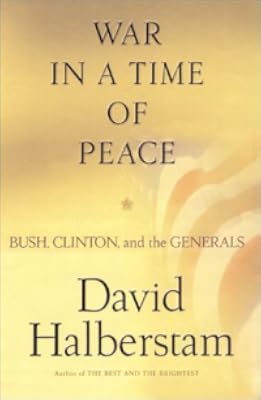
War in a Time of Peace: Bush, Clinton, and the Generals
by David Halberstam
On This Page
Description
"More than twenty-five years ago Halberstam told the riveting story of the men who conceived and executed the Vietnam War. Today the author has written another chronicle of Washington politics, this time exploring the complex dynamics of foreign policy in post-Cold War America." "Halberstam evokes the internecine conflicts, the untrammeled egos, and the struggles for dominance among the key figures in the White House, the State Department, and the military. He shows how the decisions of men show more who served in the Vietnam War - such as General Colin Powell and presidential advisers Richard Holbrooke and Anthony Lake - and those who did not have shaped American politics and policy makers (perhaps most notably, President Clinton's placing, for the first time in fifty years, domestic issues over foreign policy)."--Jacket. show lessTags
Recommendations














Member Reviews
David Halberstam produces here a useful historical document, as an experienced journalist who undertook many primary source interviews to get some sense of the conflicts between the military and the political leadership over policy and power that took place under Bush I and Clinton (I).
The narrative is dominated by the crisis in Yugoslavia. This helped to define the new liberal internationalism that emerged in subsequent years (although Halberstam was not to know this). The book might be seen an ur-source for evaluating the seeds of the mess we are now in.
Completed just before 9/11, the book is remarkable for not mentioning the Middle East, bar one passing reference to the Peace Process, and relations with Russia are only considered show more indirectly. Fortunately, the collapse of the Soviet Union was not a matter for the generals as imminent war.
This all gives a slightly skewed picture but only if we do not understand what Halberstam is doing here. He is not writing a history of foreign policy or of national defence but only one about a dialectic - that between military realism and political short-termism and ideology.
Evaluating the lessons of this book might result in a very long and detailed essay so I will only pull out some themes and let the reader explore them himself based on the facts that Halberstam lays out in his book. You can judge whether his (and my) interpretations are correct on those facts.
I rather trust Halberstam within the limited territory he is exploring. He usefully understands the historic pull of past wars on American politics and on military thinking and he is an 'insider' insofar as an intellectual journalist can be one in a relatively free society.
The first theme is the importance of a President who actually understands the world he is dealing with. George H. Bush comes across as sophisticated, surrounded by people of judgement and experience. Clinton horrifies somewhat as clever and shallow, vacillating, almost 'feminine'.
Nor is Clinton's team particularly impressive. I do not think that Halberstam is showing any partisan bias (unusually for American political writing). They really are unable to cohere around clear macro-analyses and decisive effective planning with some notion of consequences.
I refuse to draw easy conclusions about the competence of Hillary Clinton who may soon be leader of the largest military empire the world has ever seen. She now has significant experience and she is not her husband but the historic conduct of Democrat foreign policy might reasonably worry us.
The second theme is the conservatism of the military. One leading figure is quoted as saying that the Democrats want a small military and to use it everywhere and the Republicans a large army and never use it all. This is borne out by the book (though things change with Bush II's neo-cons).
Surprisingly, one comes to the conclusion that, all things being equal, the US military and the Republicans to whom they tend are America's Peace Party and the Democrats, in opposition to traditional European 'Leftism', are the War Party.
Self-evidently, the American military were still in super-war mode, against the threat of a major world war, and adjusted only slowly to the collapse of the Soviet military threat. They also had no illusions about the massive costs of ground war operations (and remain cautious today).
The Gulf War under Bush certainly restored the American military's sense of what was possible against a second rank traditional state power but it told the military nothing about the costs of mountainous guerrilla war or managing failed states
Former Yugoslavia and Somalia taught them what the later Iraq War was to teach them. Destroying a formal state power is one thing and, if you are prepared to accept the body count, possible but reconstruction and policing are another thing. George C. Marshall was very much an army man.
To win is not to hold or settle. Body bags where the public cannot see their essential interest in the game (after all, America needed Pearl Harbour to undertake its mission against the rise of national socialism) implied a repetition of Vietnam's undermining of trust in the system.
Could liberal internationalism have gone ape around the world if 9/11 had not happened? We doubt it. And the strike against Iraq (unconnected to 9/11) mirrors the decision to go for Germany first instead of Japan after 1941 because of decisions already made elsewhere.
What strikes one here is that, until George W. Bush decided to invade a country on spurious grounds, the military and political establishment were both consistently nervous of taking any armed actions but for different reasons. How that changed is the story of the last third of the book.
For the military it was the justifiable fear of the costs of failure and concern at the inability of the civilians to come up with any plan for consequences (which was to prove fatal in Iraq). For civilians it was fear of domestic electoral consequences and simple ignorance of strategy.
What triggered interventionist strategies was ideological sentiment - mostly Democrat excitability about humanitarian issues in countries they scarcely understood. They certainly had no serious plan about what to do if the aggressor was beaten. It was "Something must be done!"
The blundering around in Clinton's first term is embarrassing - whether it be Somalia, Haiti or Bosnia. The sensible Vance-Owen proposals were sidelined by political half wits only to be returned to in essence and in a weaker version after much misery later.
Allies play scarcely any rule in the deliberations except as dead weights on action (early Clinton) or agents provocateurs (later Clinton). Speaking as a Brit, the US has often been manipulable by foreign powers from the British Empire through to Israel. This period was no exception.
By the second term we are moving into legacy time, that point where a narcissistic President starts to think about how he will be seen by history and realises that he is going to be seen as a middle ranker unless he solves some big question.
The Middle East Peace Process was the obvious solution but that all falls apart on the stunning obduracy of Yasser Arafat so the crisis in Yugoslavia emerges as the constant sore that is high risk but also high reward if something can be done - yet it is not the President who really drives this.
Where Halberstam is particularly good is on the personal dynamics that are the essence of the American State at the highest level - who is up, who is down, who is respected and who is not, what personal histories dictated what ideological presupposition.
We see the emergence or rather convergence of activist liberal internationalists genuinely concerned about the condition of the peoples of former Yugoslavia but also activists for the use of US power to order the world (a theme to be taken up by the neo-cons with more aggression later).
There are State Department officials and policy wonks but these are buttressed by two new forces - Wesley Clark as SACEUR and the arrival in London of the 'hawk' Tony Blair who seems to have had a ready-made model of global military intervention to hand.
The story of Wes Clark is most instructive for two reasons. He was clearly hated by the US military establishment but his role as SACEUR allowed him to push the envelope in using military resources to pursue a war that they saw no reason for. The second reason was air power.
The eternal conflict within the US military over the value and role of air power was not quite resolved by the Gulf War but it was arguable now that a state could be brought low simply with aggressive targeting by a new stock of precision-guided weaponry.
The radicals wanted to show that air power alone was sufficient to bring a tyrant to heel. Wes Clark (an army man) drove this tactic as far as he could against Milosevic despite European doubts and divisions in NATO and Pentagon attempts to deny him any ground support resources.
In fact, it worked but not in the simple way that liberal intellectuals have presented to the world since. It worked because the US was actually backing gangsters as bad as Milosevic in the KLA (just as it had earlier backed the quasi-fascists of Tudjman's Croatia) and the Serb people revolted.
As Halberstam points out, the Serb internal revolt was enabled because Yugoslavia precisely was not the total dictatorship of myth - Former Yugoslavia was a hybrid of single party secret police control and relative intellectual and civil society freedom. Milosevic pushed the people too far.
At the same time, Serbia lost its negotiating position because Russia, economically-dependent on the West under the corrupt Yeltsin, simply and overtly withdrew support from its old ally. This was from weakness and another seed of the future - Putin would reverse this within a few years.
Air power 'worked' but it could not be said to have done so without cost. The US was never tested with a ground invasion (the US military clearly did everything it could not to allow SACEUR that option) and the humanitarian mission was actually as much in support of gangsters as victims.
What Halberstam does not write about is the medium term and long term consequences of the flaccidity of a Clinton looking for a legacy, whose wife clearly has inherited that legacy not as short term fix but as an ideology - which may makes her as dangerous as her rival, more so perhaps.
The discovery of air power under conditions where the old superpower Russia could be treated with contempt and China was still rising but without skin in the game - and monomaniacs like Tony Blair could offer unstinting support - created a new mentality of 'possibility'.
It was not the humanitarian Democrats who took things to the next stage (although Al Gore is likely to have been a strong interventionist) but Bush II with a determined model of using humanitarian rhetoric to take out states that challenged US authority to set the global agenda.
Well, we know how that turned out - but equally interesting is the trajectory of non-US liberal internationalists into an ideology that abandoned over a century of Leftist aversion to the use of war and the effect of the Yugoslav warlets on a revived and aggressive NATO.
The first created Left claques for criminal operations against Iraq but also for an acceptance that military forces could legitimately be used to enforce Western liberal standards. Blair led the US by the nose after the apparently successful Sierra Leone campaign and then was led by the nose.
The second used the humanitarian model as cover for the expansion of liberal values by what had been hitherto an essentially defensive alliance, turning it into a force for potential aggression against anything that might prove a threat in the future - Russia being the most obvious.
The realist 'sphere of influence' understanding that reached its high point at Yalta gave priority to global peace over human rights. The collapse of the Soviet Union allowed liberals to switch the emphasis from global peace and the nation state to human rights (inherent in the Atlantic Charter).
Despite the Cold War, the superpowers maintained a sort of balance in which spheres of influence and ideas were contested short of direct military conflict until one of them collapsed. At that point, the beaten power could have been respected or treated as defeated - the West chose the latter.
Such triumphalism might have worked if the world carried on along the same trajectory but Russia revived with reason to be distrustful and not grateful, China watched how the US behaved and learned lessons and Political Islam and failed states started to grind down the American Empire.
Rights sound noble especially to intellectual leader writers in the West, easily seduced by ideas, but it meant that NATO started to move into every political vacuum presented to it, backed up by trade promises that could not be safely fulfilled, especially in relation to free movement of labour.
It then participated in the slow degradation of the European West's borderlands by interventions that pushed it right up to the borders of Russia itself and destabilised regimes such as Libya's that were brutal but which also acted as defensive lines against migration, terror and organised crime.
None of this could be known by the actors in Halberstam's book, completed in 2001 as contemporary history, but the crisis of our time cannot just be put down to the exploitation of new powers by George W. Bush and the Cheney Gang - that is all too easy.
It comes ultimately down to the narcissism and foreign policy ignorance of his predecessor whose weakness included an inability to engage with his foreign policy staffs and listen with care and respect to his military - and to allow men like Blair and Clark to drive the agenda.
The competent one, George H. Bush, turned out to be the one who could not win an election because, understandably, the American people are and should be most concerned with domestic prosperity and the theatre that is American politics. Democracy is problematic for empire.
We are coming up to another decisive election in a few months and there is an unusual intensity in this one regarding foreign policy. The foreign policy estasblishment that has locked itself into power since Kosovo is clearly terrified of a Trump who asks too many difficult questions.
The question is whether Hillary is better than her husband - that is a question for Americans to answer but insofar as her time at State was a continuation of the last days of her husband's rule under a more moderate, apparently competent and sensible Democrat President, doubts are normal.
As for Halberstam's book, it remains worth reading even if he could have done with a bit of sub-editing at times in the first third where he repeats himself a bit. His analyses are always plausible. His insight into the micro-politics of American statecraft genuinely enlightening.
It is worth reading the very short post-9/11 introduction after rather than before the rest of the book. Its tone is at variance with the main text and it reminds us that Americans really were shocked into counter-aggression by the Islamist aggression - and confused by what had happened.
But, finally, what really strikes me about his text is that it is part of a non-reflexive culture that finds it very difficult to ask more fundamental questions about its own imperial conduct - what does the nation actually want and do its people have much informed say in that decision? show less
The narrative is dominated by the crisis in Yugoslavia. This helped to define the new liberal internationalism that emerged in subsequent years (although Halberstam was not to know this). The book might be seen an ur-source for evaluating the seeds of the mess we are now in.
Completed just before 9/11, the book is remarkable for not mentioning the Middle East, bar one passing reference to the Peace Process, and relations with Russia are only considered show more indirectly. Fortunately, the collapse of the Soviet Union was not a matter for the generals as imminent war.
This all gives a slightly skewed picture but only if we do not understand what Halberstam is doing here. He is not writing a history of foreign policy or of national defence but only one about a dialectic - that between military realism and political short-termism and ideology.
Evaluating the lessons of this book might result in a very long and detailed essay so I will only pull out some themes and let the reader explore them himself based on the facts that Halberstam lays out in his book. You can judge whether his (and my) interpretations are correct on those facts.
I rather trust Halberstam within the limited territory he is exploring. He usefully understands the historic pull of past wars on American politics and on military thinking and he is an 'insider' insofar as an intellectual journalist can be one in a relatively free society.
The first theme is the importance of a President who actually understands the world he is dealing with. George H. Bush comes across as sophisticated, surrounded by people of judgement and experience. Clinton horrifies somewhat as clever and shallow, vacillating, almost 'feminine'.
Nor is Clinton's team particularly impressive. I do not think that Halberstam is showing any partisan bias (unusually for American political writing). They really are unable to cohere around clear macro-analyses and decisive effective planning with some notion of consequences.
I refuse to draw easy conclusions about the competence of Hillary Clinton who may soon be leader of the largest military empire the world has ever seen. She now has significant experience and she is not her husband but the historic conduct of Democrat foreign policy might reasonably worry us.
The second theme is the conservatism of the military. One leading figure is quoted as saying that the Democrats want a small military and to use it everywhere and the Republicans a large army and never use it all. This is borne out by the book (though things change with Bush II's neo-cons).
Surprisingly, one comes to the conclusion that, all things being equal, the US military and the Republicans to whom they tend are America's Peace Party and the Democrats, in opposition to traditional European 'Leftism', are the War Party.
Self-evidently, the American military were still in super-war mode, against the threat of a major world war, and adjusted only slowly to the collapse of the Soviet military threat. They also had no illusions about the massive costs of ground war operations (and remain cautious today).
The Gulf War under Bush certainly restored the American military's sense of what was possible against a second rank traditional state power but it told the military nothing about the costs of mountainous guerrilla war or managing failed states
Former Yugoslavia and Somalia taught them what the later Iraq War was to teach them. Destroying a formal state power is one thing and, if you are prepared to accept the body count, possible but reconstruction and policing are another thing. George C. Marshall was very much an army man.
To win is not to hold or settle. Body bags where the public cannot see their essential interest in the game (after all, America needed Pearl Harbour to undertake its mission against the rise of national socialism) implied a repetition of Vietnam's undermining of trust in the system.
Could liberal internationalism have gone ape around the world if 9/11 had not happened? We doubt it. And the strike against Iraq (unconnected to 9/11) mirrors the decision to go for Germany first instead of Japan after 1941 because of decisions already made elsewhere.
What strikes one here is that, until George W. Bush decided to invade a country on spurious grounds, the military and political establishment were both consistently nervous of taking any armed actions but for different reasons. How that changed is the story of the last third of the book.
For the military it was the justifiable fear of the costs of failure and concern at the inability of the civilians to come up with any plan for consequences (which was to prove fatal in Iraq). For civilians it was fear of domestic electoral consequences and simple ignorance of strategy.
What triggered interventionist strategies was ideological sentiment - mostly Democrat excitability about humanitarian issues in countries they scarcely understood. They certainly had no serious plan about what to do if the aggressor was beaten. It was "Something must be done!"
The blundering around in Clinton's first term is embarrassing - whether it be Somalia, Haiti or Bosnia. The sensible Vance-Owen proposals were sidelined by political half wits only to be returned to in essence and in a weaker version after much misery later.
Allies play scarcely any rule in the deliberations except as dead weights on action (early Clinton) or agents provocateurs (later Clinton). Speaking as a Brit, the US has often been manipulable by foreign powers from the British Empire through to Israel. This period was no exception.
By the second term we are moving into legacy time, that point where a narcissistic President starts to think about how he will be seen by history and realises that he is going to be seen as a middle ranker unless he solves some big question.
The Middle East Peace Process was the obvious solution but that all falls apart on the stunning obduracy of Yasser Arafat so the crisis in Yugoslavia emerges as the constant sore that is high risk but also high reward if something can be done - yet it is not the President who really drives this.
Where Halberstam is particularly good is on the personal dynamics that are the essence of the American State at the highest level - who is up, who is down, who is respected and who is not, what personal histories dictated what ideological presupposition.
We see the emergence or rather convergence of activist liberal internationalists genuinely concerned about the condition of the peoples of former Yugoslavia but also activists for the use of US power to order the world (a theme to be taken up by the neo-cons with more aggression later).
There are State Department officials and policy wonks but these are buttressed by two new forces - Wesley Clark as SACEUR and the arrival in London of the 'hawk' Tony Blair who seems to have had a ready-made model of global military intervention to hand.
The story of Wes Clark is most instructive for two reasons. He was clearly hated by the US military establishment but his role as SACEUR allowed him to push the envelope in using military resources to pursue a war that they saw no reason for. The second reason was air power.
The eternal conflict within the US military over the value and role of air power was not quite resolved by the Gulf War but it was arguable now that a state could be brought low simply with aggressive targeting by a new stock of precision-guided weaponry.
The radicals wanted to show that air power alone was sufficient to bring a tyrant to heel. Wes Clark (an army man) drove this tactic as far as he could against Milosevic despite European doubts and divisions in NATO and Pentagon attempts to deny him any ground support resources.
In fact, it worked but not in the simple way that liberal intellectuals have presented to the world since. It worked because the US was actually backing gangsters as bad as Milosevic in the KLA (just as it had earlier backed the quasi-fascists of Tudjman's Croatia) and the Serb people revolted.
As Halberstam points out, the Serb internal revolt was enabled because Yugoslavia precisely was not the total dictatorship of myth - Former Yugoslavia was a hybrid of single party secret police control and relative intellectual and civil society freedom. Milosevic pushed the people too far.
At the same time, Serbia lost its negotiating position because Russia, economically-dependent on the West under the corrupt Yeltsin, simply and overtly withdrew support from its old ally. This was from weakness and another seed of the future - Putin would reverse this within a few years.
Air power 'worked' but it could not be said to have done so without cost. The US was never tested with a ground invasion (the US military clearly did everything it could not to allow SACEUR that option) and the humanitarian mission was actually as much in support of gangsters as victims.
What Halberstam does not write about is the medium term and long term consequences of the flaccidity of a Clinton looking for a legacy, whose wife clearly has inherited that legacy not as short term fix but as an ideology - which may makes her as dangerous as her rival, more so perhaps.
The discovery of air power under conditions where the old superpower Russia could be treated with contempt and China was still rising but without skin in the game - and monomaniacs like Tony Blair could offer unstinting support - created a new mentality of 'possibility'.
It was not the humanitarian Democrats who took things to the next stage (although Al Gore is likely to have been a strong interventionist) but Bush II with a determined model of using humanitarian rhetoric to take out states that challenged US authority to set the global agenda.
Well, we know how that turned out - but equally interesting is the trajectory of non-US liberal internationalists into an ideology that abandoned over a century of Leftist aversion to the use of war and the effect of the Yugoslav warlets on a revived and aggressive NATO.
The first created Left claques for criminal operations against Iraq but also for an acceptance that military forces could legitimately be used to enforce Western liberal standards. Blair led the US by the nose after the apparently successful Sierra Leone campaign and then was led by the nose.
The second used the humanitarian model as cover for the expansion of liberal values by what had been hitherto an essentially defensive alliance, turning it into a force for potential aggression against anything that might prove a threat in the future - Russia being the most obvious.
The realist 'sphere of influence' understanding that reached its high point at Yalta gave priority to global peace over human rights. The collapse of the Soviet Union allowed liberals to switch the emphasis from global peace and the nation state to human rights (inherent in the Atlantic Charter).
Despite the Cold War, the superpowers maintained a sort of balance in which spheres of influence and ideas were contested short of direct military conflict until one of them collapsed. At that point, the beaten power could have been respected or treated as defeated - the West chose the latter.
Such triumphalism might have worked if the world carried on along the same trajectory but Russia revived with reason to be distrustful and not grateful, China watched how the US behaved and learned lessons and Political Islam and failed states started to grind down the American Empire.
Rights sound noble especially to intellectual leader writers in the West, easily seduced by ideas, but it meant that NATO started to move into every political vacuum presented to it, backed up by trade promises that could not be safely fulfilled, especially in relation to free movement of labour.
It then participated in the slow degradation of the European West's borderlands by interventions that pushed it right up to the borders of Russia itself and destabilised regimes such as Libya's that were brutal but which also acted as defensive lines against migration, terror and organised crime.
None of this could be known by the actors in Halberstam's book, completed in 2001 as contemporary history, but the crisis of our time cannot just be put down to the exploitation of new powers by George W. Bush and the Cheney Gang - that is all too easy.
It comes ultimately down to the narcissism and foreign policy ignorance of his predecessor whose weakness included an inability to engage with his foreign policy staffs and listen with care and respect to his military - and to allow men like Blair and Clark to drive the agenda.
The competent one, George H. Bush, turned out to be the one who could not win an election because, understandably, the American people are and should be most concerned with domestic prosperity and the theatre that is American politics. Democracy is problematic for empire.
We are coming up to another decisive election in a few months and there is an unusual intensity in this one regarding foreign policy. The foreign policy estasblishment that has locked itself into power since Kosovo is clearly terrified of a Trump who asks too many difficult questions.
The question is whether Hillary is better than her husband - that is a question for Americans to answer but insofar as her time at State was a continuation of the last days of her husband's rule under a more moderate, apparently competent and sensible Democrat President, doubts are normal.
As for Halberstam's book, it remains worth reading even if he could have done with a bit of sub-editing at times in the first third where he repeats himself a bit. His analyses are always plausible. His insight into the micro-politics of American statecraft genuinely enlightening.
It is worth reading the very short post-9/11 introduction after rather than before the rest of the book. Its tone is at variance with the main text and it reminds us that Americans really were shocked into counter-aggression by the Islamist aggression - and confused by what had happened.
But, finally, what really strikes me about his text is that it is part of a non-reflexive culture that finds it very difficult to ask more fundamental questions about its own imperial conduct - what does the nation actually want and do its people have much informed say in that decision? show less
Summary: A history of the post-Cold War conflicts of the first Bush and the Clinton administrations, with extensive coverage of the Balkan conflicts in the former Yugoslavia.
David Halberstam wrote one of the first major accounts of how the United States became bogged down in the Vietnam War in The Best and the Brightest, studying the various persons involved in U.S. decision-making. There, Halberstam offered at once a meticulous and riveting account of the succession of events and decisions that both led into the war, and led to the concealing of the full implications of those decisions from the American public.
Halberstam accomplished a similar feat in this work, nominated for a Pulitzer in 2002. He takes us through the succession of show more events from fall of Communist rule, the brilliantly executed Gulf War, a triumph of American technology, and the simmering "teacup" wars in Somalia and the Balkans, the human rights implications of which could not be ignored by one administration tired of war, and another administration preferring to focus on domestic issues.
Halberstam gives us an account thick with all the personalities -- the presidents, the policy makers, the military leaders. We meet Larry Eagleburger, on the ground as Yugoslavia breaks up into its ethnic components, watching the rise of Milosevic and warning of the trouble to come with an administration fighting to meet an unexpectedly tough electoral challenge from Bill Clinton. There is a new administration, not particularly interested in foreign policy with a competent bureaucrat but not visionary Warren Christopher, the aloof Tony Lake, Richard Holbrooke, facing the diplomatic challenge of a lifetime.
The abject failure of leadership in Somalia leaves the Clinton administration all the more reticent to assert itself in the Balkans, hoping for European leadership instead. Meanwhile the situation degenerates into genocide in Bosnia. We see a military conflicted with the memories of Vietnam, and the accomplishments of its forces in the Gulf War, and its rapidly improving aerial technology. Around them are hawks like Al Gore and Madeleine Albright, deeply disturbed by the human rights violations, while others from Christopher to Clinton struggle to define an American interests, and Colin Powell from another Vietnam. Eventually, the use of American airpower brought Milosevic to Dayton and Holbrooke's shining hour negotiating the Dayton Peace accords.
Halberstam's account does not paint a favorable picture of Clinton. He identifies a key concern of the military--a president who will remain loyal to them and give them what they need to do what he has asked of them as commander-in-chief. Perhaps nowhere is this so evident as the case of General Wes Clark, who brilliantly led the subsequent conflict against Milosevic and the Serbs in Kosovo, working with European allies, and cajoling a cautious president into sufficient use of their air and ground forces to give a growing Kosovar resistance a chance. For his successes, he was shunted aside by Defense Secretary Cohen, who never liked him.
The book also raises questions, particularly in its closing epilogue, written after 9/11, of the changes in American society from a resilient and resolute one of the post Depression years to an indulgent society, glutted on entertainment, accustomed to wars without casualties that are over in a matter of weeks. Little did Halberstam envision at the time the conflicts going on two decades in both Afghanistan and Iraq for which the conflicts of the Nineties were just rehearsals. What Halberstam understood is the growing consensus in political circles that these wars are fine as long as the American people could continue to live on an untroubled peacetime footing, apart from the occasionally troubling news of another soldier from one's local community lost in a distant part of the world in a conflict no one really understood. He also recognizes the short-sightedness of planners who did not see the threat from terrorist in their obsession with great, or even regional power conflicts.
Writing close to the events gave Halberstam access to all the key players. Clinton was one of the few he did not personally interview. Yet closeness to the events did not obscure for Halberstam the big issues. No administration has the luxury to ignore foreign policy--it will seek you out. Political pragmatism without overarching principle will lead to betrayal of loyalties and America's best interests.
Like every decade, the decisions of the Nineties shaped those that followed. Halberstam gives us a rich and readable account of this important period when some of today's leaders were coming of age. show less
David Halberstam wrote one of the first major accounts of how the United States became bogged down in the Vietnam War in The Best and the Brightest, studying the various persons involved in U.S. decision-making. There, Halberstam offered at once a meticulous and riveting account of the succession of events and decisions that both led into the war, and led to the concealing of the full implications of those decisions from the American public.
Halberstam accomplished a similar feat in this work, nominated for a Pulitzer in 2002. He takes us through the succession of show more events from fall of Communist rule, the brilliantly executed Gulf War, a triumph of American technology, and the simmering "teacup" wars in Somalia and the Balkans, the human rights implications of which could not be ignored by one administration tired of war, and another administration preferring to focus on domestic issues.
Halberstam gives us an account thick with all the personalities -- the presidents, the policy makers, the military leaders. We meet Larry Eagleburger, on the ground as Yugoslavia breaks up into its ethnic components, watching the rise of Milosevic and warning of the trouble to come with an administration fighting to meet an unexpectedly tough electoral challenge from Bill Clinton. There is a new administration, not particularly interested in foreign policy with a competent bureaucrat but not visionary Warren Christopher, the aloof Tony Lake, Richard Holbrooke, facing the diplomatic challenge of a lifetime.
The abject failure of leadership in Somalia leaves the Clinton administration all the more reticent to assert itself in the Balkans, hoping for European leadership instead. Meanwhile the situation degenerates into genocide in Bosnia. We see a military conflicted with the memories of Vietnam, and the accomplishments of its forces in the Gulf War, and its rapidly improving aerial technology. Around them are hawks like Al Gore and Madeleine Albright, deeply disturbed by the human rights violations, while others from Christopher to Clinton struggle to define an American interests, and Colin Powell from another Vietnam. Eventually, the use of American airpower brought Milosevic to Dayton and Holbrooke's shining hour negotiating the Dayton Peace accords.
Halberstam's account does not paint a favorable picture of Clinton. He identifies a key concern of the military--a president who will remain loyal to them and give them what they need to do what he has asked of them as commander-in-chief. Perhaps nowhere is this so evident as the case of General Wes Clark, who brilliantly led the subsequent conflict against Milosevic and the Serbs in Kosovo, working with European allies, and cajoling a cautious president into sufficient use of their air and ground forces to give a growing Kosovar resistance a chance. For his successes, he was shunted aside by Defense Secretary Cohen, who never liked him.
The book also raises questions, particularly in its closing epilogue, written after 9/11, of the changes in American society from a resilient and resolute one of the post Depression years to an indulgent society, glutted on entertainment, accustomed to wars without casualties that are over in a matter of weeks. Little did Halberstam envision at the time the conflicts going on two decades in both Afghanistan and Iraq for which the conflicts of the Nineties were just rehearsals. What Halberstam understood is the growing consensus in political circles that these wars are fine as long as the American people could continue to live on an untroubled peacetime footing, apart from the occasionally troubling news of another soldier from one's local community lost in a distant part of the world in a conflict no one really understood. He also recognizes the short-sightedness of planners who did not see the threat from terrorist in their obsession with great, or even regional power conflicts.
Writing close to the events gave Halberstam access to all the key players. Clinton was one of the few he did not personally interview. Yet closeness to the events did not obscure for Halberstam the big issues. No administration has the luxury to ignore foreign policy--it will seek you out. Political pragmatism without overarching principle will lead to betrayal of loyalties and America's best interests.
Like every decade, the decisions of the Nineties shaped those that followed. Halberstam gives us a rich and readable account of this important period when some of today's leaders were coming of age. show less
Careful and detailed reporting of the Bush/Clinton post-cold-war politics. Great to fill in the gaps in one's understanding of the early 19080s-2001. Halberstam uses an extremely wide range of sources; and he has a wonderful ability to piece together a sea of facts into a very readable narrative. Great history book.
This work makes me nostalgic for the days when America existed and the country could choose to fight a war or no, it was strong, and projected itself as a force to improve the world. It all seems so long ago now. Halberstam is at his best describing the Bush and Clinton optimistic years when America was the world's sole superpower. Optimistically, America was at the top of its game, and prophetically elsewhere, before his tragic death in a car crash in 2007, Halberstam predicted how America had changed. America's youth will be competing against people from the world who resemble their grandparents (http://blogsmithconsulting.blogspot.com/2010/07/david-halberstam-global-economy-and.html), dynamic, resourceful, hard-working, and highly show more motivated. The challenge to America's youth is the crux of the security issue in the 21st century.
War then is a book commemorating that nostalgic and all too brief secure period in the '90s when the U.S. appeared as the world's sole superpower. In this edition, Halberstam added an Epilogue as a post-911 reflection. As he concluded the original version of his book he cautioned that Rumsfield's "missile shield" (p. 494) would not be an effective security barrier, a Maginot Line of our own making. In light of 9/11 then he proved to be prophetic. The Epilogue is an effectively written summary of America's dilemma in the post-911 fight. We are most vulnerable to the strongest points of terrorists and we are ill-equipped to quickly respond to the challenge. Halberstam nonetheless remained optimistic that America would eventually and convincingly respond to the threat of terrorism.
Combat warfare over time is re-invented and the 90s were a critical time that can be easily overlooked in the history of warfare since the period is relatively undistinguished as opposed to earlier crucial periods of world history. As expressed by the preeminent military historian, John Keegan, "There are certain dates in the history of warfare that mark real turning points. November 20, 1917, is one, when at Cambrai the tank showed that the traditional dominance of infantry, cavalry, and artillery on the battlefield had been overthrown. November 11, 1940, is another, when the sinking of the Italian fleet at Taranta demonstrated that the aircraft carrier and its aircraft had abolished the age-old supremacy of the battleship. Now there is a new turning point to fix on the calender, June 3, 1999, when the capitulation of President Milosevic proved that a war can be won by air power alone" (Keegan as quoted in War, Halberstam, p. 478).
Another takeaway of the work is the complex interplay of forces between the Pentagon and civilian leadership. Particularly with Clinton, a non-military man, the first baby boomer president, and Halberstam illuminatingly reveals Clinton's lack of interest in foreign affairs generally and his lack of leadership and resolve in military affairs.
One of the most revealing passages is Halberstam's discussion of General Jack Sheehan of the Marines (pp. 412-413) and his possible nomination as Joint Chiefs of Staff. For an administration lacking military commitment and support, such as Clinton's, Sheehan proved to be problematic. "Sheehan, it was judged, would be the hardest of the senior men to control, and in a dispute over strategy, the most likely to resign in protest. That was the nightmare. This formidable, exceptionally impressive marine, who agreed with the Clinton administration's theory of what we should be doing in foreign policy, might go public if it was unwilling to make the necessary commitment. Sheehan would not get the chairman's job" (p. 413).
This is a startling passage in light of the Stanley McChrystal resignation (cf. http://www.huffingtonpost.com/2010/06/28/stanley-mcchrystal-retiri_n_628463.html.... This resignation is most often compared to Truman's sacking of MacArthur for insubordination. Perhaps not. This resignation is more akin to an uncontrollable Sheehan who can not be managed or spun, yet, he was eminently qualified for the position, and who moreover is telegraphing grave concerns about Obama's regime. If Clinton lacked support for the military, and he was rightly perceived as such, the internationalist, pro-Islamic, and quixotic Obama is something beyond a Clinton. Questions about Obama's past and lack of documentation have troubled military personnel more than anyone else. Witness the numerous challenges to Obama's documentation that question his commitment to American national security. The military has questioned Obama's tenacity (Cf. https://www.nytimes.com/2009/10/30/opinion/30brooks.html?_r=3), Major General Carroll D. Childers agreed to be a plaintiff against Obama on the grounds that he was ineligible to qualify for the Office of the Presidency, and thus occupies the office illegally. 1st LT. Scott Easterling, Al Rowley, CDR, USN, (Retired), Charles E. Jones, Brigadier General US Air Force, Retired, Colonel Harry Riley Former Division Chief National Security Agency, Major James L. Cannon, SSGT. Brian A. Keith, Sgt. Mathew Michael Edwards, Lt Col. Chuck Miller, among others, have all brought public and legal actions against the regime. The military may be indicating with these actions their grave reservations about Obama.
During the Obama regime we are involved in two foreign wars and yet the public seems barely aware or conscious of the ongoing costs and security concerns as expressed, in the only ways available to them, by the American military.
Bosnia: How the war started, by Andy Wilcoxson, Cf. http://www.slobodan-milosevic.org/bosnia-started.htm
14 December 2010:
Richard Holbrooke dies: Veteran U.S. diplomat brokered Dayton peace accords
Cf. http://www.washingtonpost.com/wp-dyn/content/article/2010/12/13/AR2010121305198.... show less
War then is a book commemorating that nostalgic and all too brief secure period in the '90s when the U.S. appeared as the world's sole superpower. In this edition, Halberstam added an Epilogue as a post-911 reflection. As he concluded the original version of his book he cautioned that Rumsfield's "missile shield" (p. 494) would not be an effective security barrier, a Maginot Line of our own making. In light of 9/11 then he proved to be prophetic. The Epilogue is an effectively written summary of America's dilemma in the post-911 fight. We are most vulnerable to the strongest points of terrorists and we are ill-equipped to quickly respond to the challenge. Halberstam nonetheless remained optimistic that America would eventually and convincingly respond to the threat of terrorism.
Combat warfare over time is re-invented and the 90s were a critical time that can be easily overlooked in the history of warfare since the period is relatively undistinguished as opposed to earlier crucial periods of world history. As expressed by the preeminent military historian, John Keegan, "There are certain dates in the history of warfare that mark real turning points. November 20, 1917, is one, when at Cambrai the tank showed that the traditional dominance of infantry, cavalry, and artillery on the battlefield had been overthrown. November 11, 1940, is another, when the sinking of the Italian fleet at Taranta demonstrated that the aircraft carrier and its aircraft had abolished the age-old supremacy of the battleship. Now there is a new turning point to fix on the calender, June 3, 1999, when the capitulation of President Milosevic proved that a war can be won by air power alone" (Keegan as quoted in War, Halberstam, p. 478).
Another takeaway of the work is the complex interplay of forces between the Pentagon and civilian leadership. Particularly with Clinton, a non-military man, the first baby boomer president, and Halberstam illuminatingly reveals Clinton's lack of interest in foreign affairs generally and his lack of leadership and resolve in military affairs.
One of the most revealing passages is Halberstam's discussion of General Jack Sheehan of the Marines (pp. 412-413) and his possible nomination as Joint Chiefs of Staff. For an administration lacking military commitment and support, such as Clinton's, Sheehan proved to be problematic. "Sheehan, it was judged, would be the hardest of the senior men to control, and in a dispute over strategy, the most likely to resign in protest. That was the nightmare. This formidable, exceptionally impressive marine, who agreed with the Clinton administration's theory of what we should be doing in foreign policy, might go public if it was unwilling to make the necessary commitment. Sheehan would not get the chairman's job" (p. 413).
This is a startling passage in light of the Stanley McChrystal resignation (cf. http://www.huffingtonpost.com/2010/06/28/stanley-mcchrystal-retiri_n_628463.html.... This resignation is most often compared to Truman's sacking of MacArthur for insubordination. Perhaps not. This resignation is more akin to an uncontrollable Sheehan who can not be managed or spun, yet, he was eminently qualified for the position, and who moreover is telegraphing grave concerns about Obama's regime. If Clinton lacked support for the military, and he was rightly perceived as such, the internationalist, pro-Islamic, and quixotic Obama is something beyond a Clinton. Questions about Obama's past and lack of documentation have troubled military personnel more than anyone else. Witness the numerous challenges to Obama's documentation that question his commitment to American national security. The military has questioned Obama's tenacity (Cf. https://www.nytimes.com/2009/10/30/opinion/30brooks.html?_r=3), Major General Carroll D. Childers agreed to be a plaintiff against Obama on the grounds that he was ineligible to qualify for the Office of the Presidency, and thus occupies the office illegally. 1st LT. Scott Easterling, Al Rowley, CDR, USN, (Retired), Charles E. Jones, Brigadier General US Air Force, Retired, Colonel Harry Riley Former Division Chief National Security Agency, Major James L. Cannon, SSGT. Brian A. Keith, Sgt. Mathew Michael Edwards, Lt Col. Chuck Miller, among others, have all brought public and legal actions against the regime. The military may be indicating with these actions their grave reservations about Obama.
During the Obama regime we are involved in two foreign wars and yet the public seems barely aware or conscious of the ongoing costs and security concerns as expressed, in the only ways available to them, by the American military.
Bosnia: How the war started, by Andy Wilcoxson, Cf. http://www.slobodan-milosevic.org/bosnia-started.htm
14 December 2010:
Richard Holbrooke dies: Veteran U.S. diplomat brokered Dayton peace accords
Cf. http://www.washingtonpost.com/wp-dyn/content/article/2010/12/13/AR2010121305198.... show less
A good history of modern American history and attitudes to international affairs in the United States.
Very depressing...again where was the press
Ratings
Members
- Recently Added By
Author Information

43+ Works 16,099 Members
David Halberstam was born on April 10, 1934 in New York City and later attended Harvard University. After graduating in 1955, Halberstam worked at a small daily newspaper until he attained a position at the Nashville Tennessean. Halberstam has written over 20 books including The Children, a written account of his coverage of the Civil Rights show more Movement; The Best and Brightest, which was a bestseller; and The Game and October, 1964, both detailing his fascination of sports. Halberstam also won a Pulitzer Prize for his reports on the Vietnam War while working for the New York Times. He was killed in a car crash on April 23, 2007 at the age of 73. (Bowker Author Biography) show less
Awards and Honors
Awards
Distinctions
Common Knowledge
- Original title
- War in a Time of Peace
- Original publication date
- 2001
- People/Characters
- George H. W. Bush (POTUS 41); Bill Clinton (POTUS 42); Al Gore; Colin Powell (General); Richard Holbrooke (presidential advisor); Anthony Lake (presidential advisor)
- Important places
- Washington, D.C., USA
Classifications
- Genres
- History, Nonfiction, Politics and Government, General Nonfiction
- DDC/MDS
- 327.73 — Society, government, & culture Political science International Relations: Spies North America United States
- LCC
- E881 .H34 — History of the United States United States Later twentieth century, 1961-2000 George H.W. Bush's administration, 1989-1993
- BISAC
Statistics
- Members
- 826
- Popularity
- 33,538
- Reviews
- 6
- Rating
- (3.89)
- Languages
- English, Serbian, Turkish
- Media
- Paper, Audiobook, Ebook
- ISBNs
- 15
- ASINs
- 7