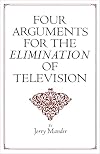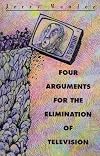
Four Arguments for the Elimination of Television
by Jerry Mander
On This Page
Description
A total departure from previous writing about television, this book is the first ever to advocate that the medium is not reformable. Its problems are inherent in the technology itself and are so dangerous—to personal health and sanity, to the environment, and to democratic processes—that TV ought to be eliminated forever.Weaving personal experiences through meticulous research, the author ranges widely over aspects of television that have rarely been examined and never before joined show more together, allowing an entirely new, frightening image to emerge. The idea that all technologies are "neutral," benign instruments that can be used well or badly, is thrown open to profound doubt. Speaking of TV reform is, in the words of the author, "as absurd as speaking of the reform of a technology such as guns."
. show less
Tags
Recommendations






















Member Reviews
There are books that are outdated yet still relevant; Four Arguments for the Elimination of Television, however, isn't one of them. The author can't be blamed for a book about technology becoming outdated after 35 years, but by founding a significant part of his argument on the then-present state of television technology, it is for no better reason than his own shortsightedness that his book is now irrelevant. Add to this a curious mixture of pseudoscience and anti-scientific sentiment (except where science seems to confirm the author's theory, of course), a touch of emotive hyperbole (television = political autocracy); and some particularly fine examples of both erroneous reasoning and intellectual dishonesty, and you have a book that show more not only misleads but annoys as well.
I really do try to keep my reviews balanced, but I have very little to add to the 'positive' side of the scales here. If I were to summarise my thoughts in one point, it would be that one gets the impression that the argument is very much a product of the conclusion. I don't doubt the sincerity of the author's belief, but the validity of the argument is questionable to say the least. show less
I really do try to keep my reviews balanced, but I have very little to add to the 'positive' side of the scales here. If I were to summarise my thoughts in one point, it would be that one gets the impression that the argument is very much a product of the conclusion. I don't doubt the sincerity of the author's belief, but the validity of the argument is questionable to say the least. show less
As I've written elsewhere, probably in the Cognitive Dissidents Group, I put off reading this for 30 yrs. It came out in 1978 & I'd already stopped watching TV in 1969 or 1970 - one of the best decisions I ever made in my life, if I do say! Of course, saying that I "stopped watching TV" is, sadly, not as true as I'd like it to be given that there's usually a TV on in whatever laundromat I go to, in the bars I go to, etc.. There was even talk for a while of putting TVs on buses here in Pittsburgh. THANK GOODNESS THEY DIDN'T DO THAT!!
ANYWAY, I probably didn't read it when it came out b/c I'd already stopped watching TV long since & figured that I already knew most of Mander's arguments - having made them myself. AND I was right. Much of show more what Mander writes is what I'd already observed too.. BUT he articulates it so well, so thoroughly, that I'd recommend this bk to everyone as much as possible (w/o being a proselytizer, ie). I even loved this as much as I loved "The Politics of Heroin in Southeast Asia"! & that's saying alot!
During the mnths that I've been intermittently reading this, I've quoted from it extensively on various Cognitive Dissidents posts:
The 4th & 5th messages to the "Robopaths" topic:
http://www.goodreads.com/topic/show/19326-robopaths
The 5th, 6th, & 7th messages to the "Propaganda" topic:
http://www.goodreads.com/topic/show/178790-propaganda
PLUS, I'm working toward making a movie called "Robopaths" that I've been selecting Mander quotes for.
B/c of the space limitations of this review, I'll confine myself to just quoting 2 ending paragraphs here:
"Television technology is inherently antidemocratic. Because of its cost, the limited kind of information it can disseminate, the way it transforms the people who use it, and the fact that a few speak while millions absorb, television is suitable for use only by the most powerful corporate interests in the country. They inevitably use it to redesign human minds into a channeled, artificial, commercial form, that nicely fits the commercial environment. Television freewayizes, suburbanizes, and commoditizes human beings, who are then easier to control. Meanwhile, those who control television consolidate their power." - p349
"We believe ourselves to be living in a democracy because from time to time we get to vote on candidates for public office. Yet our vote for congressperson or president means very little in the light of our lack of power over technological inventions that affect the nature of our existence more than any individual leader has ever done. Without our gaining control over technology, all notions of democracy are a farce. If we cannot even think of abandoning a technology, or thinking of it, affect the ban, then we are trapped in a state of passivity and impotence hardly to be distinguished from living under a dictatorship. What is confusing is that our dictator is not a person. Though a handful of people most certainly benefit from and harness to their purposes these pervasive technologies, the true dictators are the technologies themselves." - p352 show less
ANYWAY, I probably didn't read it when it came out b/c I'd already stopped watching TV long since & figured that I already knew most of Mander's arguments - having made them myself. AND I was right. Much of show more what Mander writes is what I'd already observed too.. BUT he articulates it so well, so thoroughly, that I'd recommend this bk to everyone as much as possible (w/o being a proselytizer, ie). I even loved this as much as I loved "The Politics of Heroin in Southeast Asia"! & that's saying alot!
During the mnths that I've been intermittently reading this, I've quoted from it extensively on various Cognitive Dissidents posts:
The 4th & 5th messages to the "Robopaths" topic:
http://www.goodreads.com/topic/show/19326-robopaths
The 5th, 6th, & 7th messages to the "Propaganda" topic:
http://www.goodreads.com/topic/show/178790-propaganda
PLUS, I'm working toward making a movie called "Robopaths" that I've been selecting Mander quotes for.
B/c of the space limitations of this review, I'll confine myself to just quoting 2 ending paragraphs here:
"Television technology is inherently antidemocratic. Because of its cost, the limited kind of information it can disseminate, the way it transforms the people who use it, and the fact that a few speak while millions absorb, television is suitable for use only by the most powerful corporate interests in the country. They inevitably use it to redesign human minds into a channeled, artificial, commercial form, that nicely fits the commercial environment. Television freewayizes, suburbanizes, and commoditizes human beings, who are then easier to control. Meanwhile, those who control television consolidate their power." - p349
"We believe ourselves to be living in a democracy because from time to time we get to vote on candidates for public office. Yet our vote for congressperson or president means very little in the light of our lack of power over technological inventions that affect the nature of our existence more than any individual leader has ever done. Without our gaining control over technology, all notions of democracy are a farce. If we cannot even think of abandoning a technology, or thinking of it, affect the ban, then we are trapped in a state of passivity and impotence hardly to be distinguished from living under a dictatorship. What is confusing is that our dictator is not a person. Though a handful of people most certainly benefit from and harness to their purposes these pervasive technologies, the true dictators are the technologies themselves." - p352 show less
When I think of my favorite books, this book instantly comes to mind. It covers the main reasons why television is the main problem in our society and why it's elimination is essential to our survival. It is from the 90s so it deserves a revisit to see if things are still holding true, but this book resonated so well with me when I read it. It felt like the author was expressing the idea more thoughtfully than I could with my own words and reinforcing my ideas with new ideas. I highly recommend this book!
Edit to add... This book was published in 1978!
Edit to add... This book was published in 1978!
This book supplied a grounded set of reasons for my avoidance of television which had previously been based in gut feeling and some personal observations. Mander marshals the results of scientific studies along with his own observations to make his case.
A most insightful and brilliant perspective on television, media and human consciousness. You'll never look at television the same after reading this book.
4 BUENAS RAZONES PARA ELIMINAR LA TELEVISIÓN
Este es el primer libro que plantea abiertamente la imposibilidad de transformar, reformar siquiera, el medio de comunicación de masas que ha revolucionado nuestra vida cotidiana: la televisión.
Para Jerry Mander los daños corporales y mentales que la televisión produce, los peligros de control social que encierra y el tipo de realidad que nos impone son efectos propios de sus características como tecnología y son tan peligrosos que debería ser eliminada para siempre. La televisión es tan poco “reformable” como lo son las armas atómicas en manos de cualquier ejército.
Los aciertos de Mander en su análisis del papel central de la televisión en la aceleración del consumo y de show more su dependencia del mercado se deben a su consideración de la tecnología como ideología. Ésta no cambia a pesar de las sofisticadas innovaciones digitales o la seducción de la interactividad. Sobre la base de una amplia experiencia personal y profesional, y una cuidadosa investigación de los diversos aspectos del medio, el autor combina el análisis de los efectos cotidianos de la televisión con las advertencias acerca de los efectos dañinos que pueden ocasionarnos el abuso de la luz artificial, la manipulación de las imágenes y el siempre temido control de las conciencias.
El resultado es un libro de denuncia, único en su género. show less
Este es el primer libro que plantea abiertamente la imposibilidad de transformar, reformar siquiera, el medio de comunicación de masas que ha revolucionado nuestra vida cotidiana: la televisión.
Para Jerry Mander los daños corporales y mentales que la televisión produce, los peligros de control social que encierra y el tipo de realidad que nos impone son efectos propios de sus características como tecnología y son tan peligrosos que debería ser eliminada para siempre. La televisión es tan poco “reformable” como lo son las armas atómicas en manos de cualquier ejército.
Los aciertos de Mander en su análisis del papel central de la televisión en la aceleración del consumo y de show more su dependencia del mercado se deben a su consideración de la tecnología como ideología. Ésta no cambia a pesar de las sofisticadas innovaciones digitales o la seducción de la interactividad. Sobre la base de una amplia experiencia personal y profesional, y una cuidadosa investigación de los diversos aspectos del medio, el autor combina el análisis de los efectos cotidianos de la televisión con las advertencias acerca de los efectos dañinos que pueden ocasionarnos el abuso de la luz artificial, la manipulación de las imágenes y el siempre temido control de las conciencias.
El resultado es un libro de denuncia, único en su género. show less
Jan 18, 2018 (Edited)Spanish
Ratings
Members
- Recently Added By
Lists

Shaykh Hamza's Book Recommendations
439 works; 3 members

Books With the Most Memorable Titles
478 works; 158 members
Talk Discussions
Past Discussions
Four Arguments for the Elimination of Television - Jerry Mander in Book talk (April 2024)
Author Information

11+ Works 2,193 Members
A former celebrated advertising executive, Jerry Mander is founder and distinguished fellow of the International Forum on Globalization. The New York Times called him "The Patriarch of the Anti-Globalization movement." Other popular books of his include In the Absence of the Sacred, and The Case Against the Global Economy (with Edward Goldsmith).
Common Knowledge
- Canonical title
- Four Arguments for the Elimination of Television
- Original title
- Four Arguments for the Elimination of Television
- Original publication date
- 1978
- Dedication
- This book is dedicated to my parents, Eva Mander and Harry Mander
- First words
- If this book has any basis in "authority," it lies in the fifteen years I worked as a public relations and advertising executive.
- Last words
- (Click to show. Warning: May contain spoilers.)It is obvious, however, that the first step is for all of us to purge from our minds the idea that just because television exists, we cannot get rid of it. Thank you.
- Blurbers
- Montagu, Ashley; Callenbach, Ernest; Dowd, Douglas F.
Classifications
- Genres
- Sociology, Nonfiction, General Nonfiction, Technology
- DDC/MDS
- 301.161 — Society, Government, and Culture Social sciences, sociology & anthropology Sociology and anthropology Formerly: Social psychology Mass Media Studies, Media Criticism
- LCC
- HE8700.8 .M35 — Social sciences Transportation and communications Transportation and communications Telecommunication industry. Telegraph
- BISAC
Statistics
- Members
- 800
- Popularity
- 34,508
- Reviews
- 6
- Rating
- (3.82)
- Languages
- 6 — Danish, English, Portuguese, Croatian, Spanish, Swedish
- Media
- Paper, Ebook
- ISBNs
- 12
- ASINs
- 4