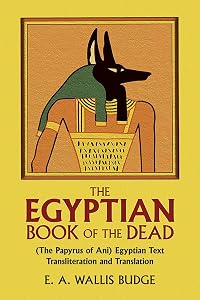
The Egyptian Book of the Dead
by E. A. Wallis Budge
On This Page
Description
The Book of the Dead is the title now commonly given to the great collection of funerary texts which the ancient Egyptian scribes composed for the benefit of the dead. These consist of spells and incantations, hymns and litanies, magical formulae and names, words of power and prayers, and they are found cut or painted on walls of pyramids and tombs, and painted on coffins and sarcophagi and rolls of papyri. This book is the treatise and analysis of The Book of the Dead, (also known as Spells show more of Coming and Forth by Day), by Egyptologist E. A. Wallis Budge. show less
Tags
Recommendations











Member Recommendations

ngoomie More recent and accurate translation
Member Reviews
In the film, "Stargate," Daniel Jackson said, "Someone must have been using Budge. I don't know why they still print it." He was, of course, referring to Budge's Dictionaries of Ancient Egyptian, but the same might be said for his translation of Ani's "Book of the Dead."
In his time, Budge was an important Egyptologist, and no one can deny that he advanced the study of Ancient Egypt significantly. But his time was 100 years ago, and enormous strides have been made in the study of the Ancient Egyptian language. If you're interested in seeing the current state of the art, then I suggest that you get a copy of Gardiner's translation. It is based on the Budge's unsurpassed photographs of Papyrus Ani; however, today, Gardiner's grammar of show more Ancient Egyptian is what almost all modern, English-speaking Egyptologists use, together with Faulkner's Dictionary of Middle Egyptian.
Why do I have this book? Easy. Once upon a time, before I studied Ancient Egyptian (which happened before Stargate was released), I thought Budge was the only game in town. I keep it around to remind me that there was once a time when we didn't know what we do now, and in memory of the man who helped create and maintain the British Museum's splendid collection. show less
In his time, Budge was an important Egyptologist, and no one can deny that he advanced the study of Ancient Egypt significantly. But his time was 100 years ago, and enormous strides have been made in the study of the Ancient Egyptian language. If you're interested in seeing the current state of the art, then I suggest that you get a copy of Gardiner's translation. It is based on the Budge's unsurpassed photographs of Papyrus Ani; however, today, Gardiner's grammar of show more Ancient Egyptian is what almost all modern, English-speaking Egyptologists use, together with Faulkner's Dictionary of Middle Egyptian.
Why do I have this book? Easy. Once upon a time, before I studied Ancient Egyptian (which happened before Stargate was released), I thought Budge was the only game in town. I keep it around to remind me that there was once a time when we didn't know what we do now, and in memory of the man who helped create and maintain the British Museum's splendid collection. show less
I've been wanting to read the so called 'Book of the Dead' for quite some time and was pleased with this copy. For my personal use/study I wanted to make sure I didn't get a translation/volume that was aimed at the crowd believing this collection of funerary texts has power. Simply put I wanted a historical approach/translation.
Budge does a good job at translating the text, the old school thee's, and thou's take some getting used to for me at least, but honestly given the time period and the origin it grew on me and fit. The illustrations are excellent throughout.
It's key to understanding Ancient Egyptian Mythology and their outlook on life/death and I am glad I read it. It was best digested in chapters, almost like a daily show more devotional. Read a chapter or 2 and meditate/cogitate on what the text was saying to those that believed it. In larger portions it could be fairly dry. show less
Budge does a good job at translating the text, the old school thee's, and thou's take some getting used to for me at least, but honestly given the time period and the origin it grew on me and fit. The illustrations are excellent throughout.
It's key to understanding Ancient Egyptian Mythology and their outlook on life/death and I am glad I read it. It was best digested in chapters, almost like a daily show more devotional. Read a chapter or 2 and meditate/cogitate on what the text was saying to those that believed it. In larger portions it could be fairly dry. show less
This was intended for Egyptologists. It is not for people who are simply interested in Egypt and Egyptian Myth and Religion. He has also fallen out of favor with modern Egyptologists because his translations are not sufficiently specific to the time period of these books.
Very difficult to grasp at first as it isn't necessarily linear. Don't expect great secrets of life out of it like the Bible or Stargate or something. Still a phenomenal read and insightful into an amazing culture.
This is the classic text of the extensive Papyrus of Ani with an introduction by its acquirer (1888), the Egyptologist E. Wallis Budge. Budge first published the papyrus as a facsimile in 1890 with further publications leading to the most well known popular 1967 Dover Publications version.
It is, of course, not the only variant of what was called by Lepsius 'The Book of the Dead', It is not a book at all but a very variable set of funerary texts that relate to the ritual and beliefs of Egyptians concerning their afterlife. However the Papyrus of Ani is the finest surviving and fullest example.
It is, of course, not the only variant of what was called by Lepsius 'The Book of the Dead', It is not a book at all but a very variable set of funerary texts that relate to the ritual and beliefs of Egyptians concerning their afterlife. However the Papyrus of Ani is the finest surviving and fullest example.
An abridged and illustrated edition of Budge's classic translation, now considered a bit out of date. The plates are very nicely done, if some are a bit small, and most of the footnotes from the original edition have been cut for clarity. Nicely done, but could've used some more or the original material and made some of the detail pictures a little larger and placed closer to the translated text.
Classic translation of famous Ancient Egyptian text written to accompany a deceased on his journey to the other world in the Ancient Egyptian religion. Budge has been discounted by modern scholars as being outdated, but I like the interlinear text where the English is just below the hieroglyphs.
Members
- Recently Added By
Lists

Pagan E-O-L doula
15 works; 1 member

Books About Non-Abrahamic Religions
98 works; 2 members

el
1,139 works; 1 member

Egypt
5 works; 1 member
Author Information

231+ Works 10,073 Members
E.A. Wallis Budge, 1857 - 1934 Budge was the Curator of Egyptian and Assyrian Antiquities at the British Museum from 1894 to 1924. He was also a Sometime Scholar of Christ's College, a scholar at the University of Cambridge, Tyrwhitt, and a Hebrew Scholar. He collected a large number of Coptic, Greek, Arabic, Syriac, Ethiopian, and Egyptian Papyri show more manuscripts. He was involved in numerous archaeology digs in Egypt, Mesopotamia and the Sudan. Budge is known for translating the Egyptian Book of the Dead, which is also known as The Papyrus of Ani. He also analyzed many of the practices of Egyptian religion, language and ritual. His written works consisted of translated texts and hieroglyphs and a complete dictionary of hieroglyphs. Budge's published works covered areas of Egyptian culture ranging from Egyptian religion, Egyptian mythology and magical practices. He was knighted in 1920. E.A. Wallis Budge died on November 23, 1934 in London, England. (Bowker Author Biography) show less
All Editions
Some Editions
Awards and Honors
Series
Belongs to Publisher Series
Work Relationships
Is abridged in
Common Knowledge
- Canonical title
- The Egyptian Book of the Dead
- Original title
- rw nw prt m hrw; Per-t em hru; Book of Coming Forth by Day; The Book of the Dead
- Alternate titles
- The Egyptian Book of the Dead (cover, spine) (cover, spine); The Book of the Dead: The Papyrus of Ani; The Book of the Dead: The Papyrus of Ani in the British Museum; The Egyptian Text with Interlinear Transliteration and Translation, a Running Translation, Introduction, Etc.
- Original publication date
- c. 1240 B.C.; 1895 (Budge's translation) (Budge's translation)
- People/Characters
- Osiris; Anubis; Amun-Ra; Thoth; Hathor; Maati (show all 8); Anpu; Hunefer
- Important places
- Africa; Egypt; Thebes, Egypt; Ancient Egypt
- First words
- The Papyrus of Ani, which was acquired by the Trustees of the British Museum in the year 1888, is the largest, the most perfect, the best preserved, and the best illuminated of all the papyri which date from the second half o... (show all)f the XVIIIth dynasty (about ʙ.ᴄ. 1500 to 1400).
--Preface
Introduction:
The history of the great body of religious compositions which form the Book of the Dead of the ancient Egyptians may conveniently be divided into four periods, which are represented by four versions:—
Adoration of Rā when riseth he in horizon eastern of heaven.
Body text - Last words
- (Click to show. Warning: May contain spoilers.)I have come to thee, my heart is right, my breast is without deceit, grant thou that I may be among the living, that I may sail down and that I may sail up among thy followers.
- Original language
- British English
- Disambiguation notice
- There is no single ancient Egyptian work called The Book of the Dead. Instead, there were collections of "spells" (about 200 altogether) written on papyrus and buried with the deceased to help on the journey to the next life.... (show all)
No single papyrus contains all the spells. Thanks to many reprints, the most common translation available is by E. A. Wallis Budge; published in 1898. Since then, many other funerary papyri have been translated (and it's also be noted that some of Budge's translation was just plain wrong). Subsequent translations by Thomas George Allen (1968) and Raymond Faulkner (1972, sometimes attributed to Carol Andrews or Eva von Dassow the editors) are much more up-to-date and contain better supplemental material. The different translations should not be combined.
Classifications
- Genres
- Religion & Spirituality, Nonfiction, History, General Nonfiction
- DDC/MDS
- 299.31 — Religion Other religions Shintoism/Taoism/Other Mythologies Of North African Origin Ancient Egyptian
- LCC
- PJ1555 .A3 — Language and Literature Oriental languages and literatures Oriental philology and literature Egyptology Literature. Inscriptions
- BISAC
Statistics
- Members
- 3,114
- Popularity
- 5,643
- Reviews
- 14
- Rating
- (3.63)
- Languages
- 7 — Chinese, Egyptian, English, Portuguese, Russian, Spanish, Swedish
- Media
- Paper, Audiobook, Ebook
- ISBNs
- 93
- UPCs
- 1
- ASINs
- 44