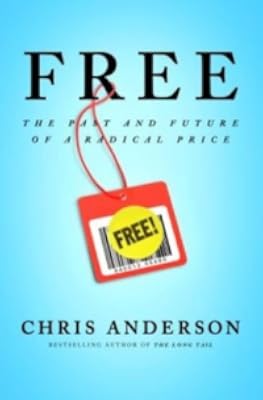
Free: The Future of a Radical Price
by Chris Anderson
On This Page
Description
Author Chris Anderson makes the compelling case that in many instances, businesses can profit more from giving things away than they can by charging for them. Traditional economics operates under fundamental assumptions of scarcity--there's only so much oil, iron, and gold in the world. But the online economy is built upon three cornerstones: processing power, hard drive storage, and bandwidth--and the costs of all these elements are trending toward zero at an incredible rate. Never in the show more course of human history have the primary inputs to an industrial economy fallen in price so fast and for so long. This is the engine behind the new Free, the one that goes beyond a marketing gimmick or a cross-subsidy. Anderson explores this radical idea for the new economy, and demonstrates how this revolutionary price can be harnessed for the benefit of both consumers and business alike.--From publisher description. show lessTags
Recommendations
Member Recommendations
Member Reviews
Disclaimer: I won a free copy of this book from Goodreads First Reads.
Free is a pretty comprehensive overview of the free business model. Anderson first outlines the history of free, the economic and psychological reasons behind free, the reason that free can exist in today's digital world, and the ways it differs from so-called "20th century free."
Anderson's points are well made, complete, and interesting to read. However, I do believe that he ignores and/or understates the full implications of free.
He briefly touches on the point that free is not possible without abundance, and that abundance usually comes with a cost. In chapter 15 Anderson uses Athens and Sparta as examples of two civilizations of abundance, mentioning in passing show more that they were "[s]upported by massive populations of slaves".
Abundance never comes without a cost, whether it be environmental or social, and abundance never comes without cheap or free labor. American abundance would not have come about without slavery, and today abundance would not be possible without so-called wage slavery. Simply put, if people did not have to work in order to eat and house themselves, most probably wouldn't, and with good reason.
Anderson also seems to think that "waste," (which he always uses in scare quotes) which humans are trained to think of as a bad thing, as a byproduct of abundance is not inherently bad. Waste is why billions of plastic bottles and plastic bags (among countless other disposable things) are thrown away and wind up poisoning our environment and oceans. Waste comes from mountaintop extraction, which brings us cheap coal-powered electricity, and leads to loss of ecosystems, polluted waterways and displaced communities. Waste comes from the wars overseas that keep people in the US knee deep in oil. I don't know how anybody can put such blinders on and say that waste is okay because it gives us free information online.
That nothing comes without a cost is an idea that Anderson tries to debunk, but I can hardly agree with that statement. Industrial pollutants are created in abundance because of the semiconductor industry. While transistors may be made of "sand" (Silicon), Anderson clearly has no idea that Silicon processing uses among the most toxic chemicals ever invented. Silane gas, arsenic gas, hydrofluoric acid, to name just three. The overabundance of cheap electronic gadgets and computers leads to computer waste that is discarded overseas and leads to health problems (and death) in third world countries. The information that I can easily access online for free would not exist without these costs. Just because I am not paying them does not mean they don't exist.
Anderson also seems to believe that technology will eventually solve all of our problems, and that there is no limit to human ingenuity. I find this position to be naive and ignorant of what really drives abundance, which is global capitalism. Perhaps problems will be solved, but only for those with enough money to pay for it.
For example, Anderson holds high hopes that biofuels could be used as a source of free electricity. Aside from the fact that biofuels take away land for food production to make cheap electricity for the rich, growing enough corn to satisfy 100% of the electricity demand in the United States would consume 37% of all of the landmass of the United States. Obviously this is not the last bit realistic.
In summary, I find this book to be somewhat sensationalist without being realistic. While I can't deny that the Internet provides vast resources of information for, as far as my wallet is concerned, little to no cost, I simply can't deny that it comes without any cost whatsoever. Anderson paints a very myopic picture of the wonders of free technology without looking at the larger implications (or completely ignores that they exist). show less
Free is a pretty comprehensive overview of the free business model. Anderson first outlines the history of free, the economic and psychological reasons behind free, the reason that free can exist in today's digital world, and the ways it differs from so-called "20th century free."
Anderson's points are well made, complete, and interesting to read. However, I do believe that he ignores and/or understates the full implications of free.
He briefly touches on the point that free is not possible without abundance, and that abundance usually comes with a cost. In chapter 15 Anderson uses Athens and Sparta as examples of two civilizations of abundance, mentioning in passing show more that they were "[s]upported by massive populations of slaves".
Abundance never comes without a cost, whether it be environmental or social, and abundance never comes without cheap or free labor. American abundance would not have come about without slavery, and today abundance would not be possible without so-called wage slavery. Simply put, if people did not have to work in order to eat and house themselves, most probably wouldn't, and with good reason.
Anderson also seems to think that "waste," (which he always uses in scare quotes) which humans are trained to think of as a bad thing, as a byproduct of abundance is not inherently bad. Waste is why billions of plastic bottles and plastic bags (among countless other disposable things) are thrown away and wind up poisoning our environment and oceans. Waste comes from mountaintop extraction, which brings us cheap coal-powered electricity, and leads to loss of ecosystems, polluted waterways and displaced communities. Waste comes from the wars overseas that keep people in the US knee deep in oil. I don't know how anybody can put such blinders on and say that waste is okay because it gives us free information online.
That nothing comes without a cost is an idea that Anderson tries to debunk, but I can hardly agree with that statement. Industrial pollutants are created in abundance because of the semiconductor industry. While transistors may be made of "sand" (Silicon), Anderson clearly has no idea that Silicon processing uses among the most toxic chemicals ever invented. Silane gas, arsenic gas, hydrofluoric acid, to name just three. The overabundance of cheap electronic gadgets and computers leads to computer waste that is discarded overseas and leads to health problems (and death) in third world countries. The information that I can easily access online for free would not exist without these costs. Just because I am not paying them does not mean they don't exist.
Anderson also seems to believe that technology will eventually solve all of our problems, and that there is no limit to human ingenuity. I find this position to be naive and ignorant of what really drives abundance, which is global capitalism. Perhaps problems will be solved, but only for those with enough money to pay for it.
For example, Anderson holds high hopes that biofuels could be used as a source of free electricity. Aside from the fact that biofuels take away land for food production to make cheap electricity for the rich, growing enough corn to satisfy 100% of the electricity demand in the United States would consume 37% of all of the landmass of the United States. Obviously this is not the last bit realistic.
In summary, I find this book to be somewhat sensationalist without being realistic. While I can't deny that the Internet provides vast resources of information for, as far as my wallet is concerned, little to no cost, I simply can't deny that it comes without any cost whatsoever. Anderson paints a very myopic picture of the wonders of free technology without looking at the larger implications (or completely ignores that they exist). show less
I feel we may be decades away from truly realizing the economic changes caused by digitization changes the way music other media as well as software, games, etc. are distributed and marketed. Even though this book is a decade old, I feel it is still insightful how Anderson from his vantage as Editor-in-Chief of Wired magazine, a position he took in 2001, sees the history and landscape. Obviously billions are being made on free (Google, etc.) and billions lost (newspapers, artists and record labels). Anderson explores the disruption, paths forward, and the psychology of the consumer confronted with these new realities.
As a matter of fact, it is that this book has held up so well when commenting on fast-changing technology largely why I show more ratted it so highly. One thread is about how science fiction has considered such "post-scarcity" economics philosophically:
This goes along well with how I am considering my current re-viewing of the first couple seasons of Star Trek. show less
As a matter of fact, it is that this book has held up so well when commenting on fast-changing technology largely why I show more ratted it so highly. One thread is about how science fiction has considered such "post-scarcity" economics philosophically:
Science fiction is what writer Clive Thompson calls “the last bastion of philosophical writing.” It’s a sort of simulation, Thompson says, where we change some of the basic rules and then learn more about ourselves. “How would love change if we lived to be five hundred? If you could travel back in time to reverse decisions, would you? What if you could confront, talk to, or kill God?”
This goes along well with how I am considering my current re-viewing of the first couple seasons of Star Trek. show less
I'm a tad split on my opinion of Chris Anderson and his works. He's a terrific cheerleader for the tech industry and how it can improve our daily lives, but his thesis here (as in the Long Tail) over-stretches and over-simplifies. For every valid point, there's a glaring omission; for every insight there's a woeful misstep.
Still though, worth it for me for its references to the music industry and a well-structured argument as to why my generation and younger have difficulty, shall we say, in paying for anything online.
Still though, worth it for me for its references to the music industry and a well-structured argument as to why my generation and younger have difficulty, shall we say, in paying for anything online.
The price was right!
haha, just kidding. I'd have paid for this book, even though I did get it for free (gratis, not libre).
It's quite an interesting look at the nature of digital economies (and is not too technical/complicated for a dummy like me to follow).
If you're not looking into the mass-production of items in the digital world, or you're not a small business owner heading out into the internet realm, and you're not a geek-head who likes to know stuff about the economics of the internet... you might not really find any "use" out of this information.
I must fall in the last category 'cause I liked learning this stuff, even though it's completely useless knowledge since I don't own a business, don't pirate or buy pirated items, and show more don't spend much time on the internet other than to write some book reviews. show less
haha, just kidding. I'd have paid for this book, even though I did get it for free (gratis, not libre).
It's quite an interesting look at the nature of digital economies (and is not too technical/complicated for a dummy like me to follow).
If you're not looking into the mass-production of items in the digital world, or you're not a small business owner heading out into the internet realm, and you're not a geek-head who likes to know stuff about the economics of the internet... you might not really find any "use" out of this information.
I must fall in the last category 'cause I liked learning this stuff, even though it's completely useless knowledge since I don't own a business, don't pirate or buy pirated items, and show more don't spend much time on the internet other than to write some book reviews. show less
I borrowed this book from the library (my place of work) purely on the reputation of its author, Chris Anderson.
"Reputation" and "Attention", Anderson argues, are the two most important non-monetary currencies on the web, entities that can, with the right strategies, be monetized in support of a sustainable business model.
So the simple act of me selecting this particular book to borrow (from a trolley of about 50 new books) is evidence already of the veracity of his thesis, more so because that reputation is a product of my encounters with the author's ideas via citations from other web blogs, articles and posts. I came to have a copy of Free in my hand purely on stuff I read for free on the internet (usually about concepts raised in show more his earlier book, The Long Tail).
True, I have not personally paid for this copy I am adding to Library Thing, but Anderson made a sale to the local library. And the author's continuing free presence on the web will ensure he maintains that reputation and attention, ensuring that libraries around the world will buy his next book as well. So, at the very least, I can see the principles of Free being enacted in the very act of my choice of reading matter.
I approached this book with the expectation that this would be a exposition and critique of all things Free (yep - Free is a noun, sure sign this is a book for neophytes), particularly the illuminating and entertaining early chapters that discussed the etymology and history of all things free.
But, as one reads on, it becomes clear that Anderson is writing for the web entrepreneur. He is spruiking an idea to the business side of things: you can embrace Free, this is how Google does it, this is how online games do it, you can do it too, even if your not one of the big boys. It's an infectiously optimistic how-to guide, cunningly disguised with some stimulating research and conjecture normally reserved for more scholarly texts.
And, unlike similar books confident about our digital future, such as Print is Dead, Free does not disdain its critics with anti-Luddite diatribes (as entertaining as this was to read at the time!). Anderson makes it clear that not all Free strategies will work for all enterprises. There are risks, there is the problem of monopolisation by existing companies such as Google. But the message seems to be - this trend is with us, try your best to adapt to it. You might even thrive with it. You cannot go back.
However, any book about free and the internet must seriously address the issue of piracy. Anderson does not provide evidence to support his claim that piracy generates more audience dollars than it forgoes.
Regardless of how unlicensed copying is working for those performing artists in China and Brazil that Anderson discusses, the fact remains there is an awful lot of illegally copied material out there. Which, of course, means there is a lot of traditional Intellectual Property owners who remain yet to be convinced that the future is bright for all things free on the web.
While traditional newspapers and their paid journalists still exist, the free web will have a source of content. to feed off. File sharers are still posting copied CDs on the web. But what happens when all this content from traditional media sources begins to dry up and the web can no longer leech from the old world media? The challenge for Free in the future will be to make money from self-contained digital domain. Bloggers will no longer be able to give themselves credibility by linking to those sources - they will have to stand on their own two feet.
This is where polemics such as Andrew Keen's The Cult of the Amateur give us pause. Do we really want to have to wade through mountains of pop up ads and amateur inanity to get the substance? Do we really know what this future will look like? Can the Google monopoly be broken? The answer, for the moment, seems to lie in a blend of sources and models - traditional business, government funded entities (such as the ABC in Australia), resources like Wikipedia and full-blown charging online entities.
A question - Library Thing is free. How do they pay their way? show less
"Reputation" and "Attention", Anderson argues, are the two most important non-monetary currencies on the web, entities that can, with the right strategies, be monetized in support of a sustainable business model.
So the simple act of me selecting this particular book to borrow (from a trolley of about 50 new books) is evidence already of the veracity of his thesis, more so because that reputation is a product of my encounters with the author's ideas via citations from other web blogs, articles and posts. I came to have a copy of Free in my hand purely on stuff I read for free on the internet (usually about concepts raised in show more his earlier book, The Long Tail).
True, I have not personally paid for this copy I am adding to Library Thing, but Anderson made a sale to the local library. And the author's continuing free presence on the web will ensure he maintains that reputation and attention, ensuring that libraries around the world will buy his next book as well. So, at the very least, I can see the principles of Free being enacted in the very act of my choice of reading matter.
I approached this book with the expectation that this would be a exposition and critique of all things Free (yep - Free is a noun, sure sign this is a book for neophytes), particularly the illuminating and entertaining early chapters that discussed the etymology and history of all things free.
But, as one reads on, it becomes clear that Anderson is writing for the web entrepreneur. He is spruiking an idea to the business side of things: you can embrace Free, this is how Google does it, this is how online games do it, you can do it too, even if your not one of the big boys. It's an infectiously optimistic how-to guide, cunningly disguised with some stimulating research and conjecture normally reserved for more scholarly texts.
And, unlike similar books confident about our digital future, such as Print is Dead, Free does not disdain its critics with anti-Luddite diatribes (as entertaining as this was to read at the time!). Anderson makes it clear that not all Free strategies will work for all enterprises. There are risks, there is the problem of monopolisation by existing companies such as Google. But the message seems to be - this trend is with us, try your best to adapt to it. You might even thrive with it. You cannot go back.
However, any book about free and the internet must seriously address the issue of piracy. Anderson does not provide evidence to support his claim that piracy generates more audience dollars than it forgoes.
Regardless of how unlicensed copying is working for those performing artists in China and Brazil that Anderson discusses, the fact remains there is an awful lot of illegally copied material out there. Which, of course, means there is a lot of traditional Intellectual Property owners who remain yet to be convinced that the future is bright for all things free on the web.
While traditional newspapers and their paid journalists still exist, the free web will have a source of content. to feed off. File sharers are still posting copied CDs on the web. But what happens when all this content from traditional media sources begins to dry up and the web can no longer leech from the old world media? The challenge for Free in the future will be to make money from self-contained digital domain. Bloggers will no longer be able to give themselves credibility by linking to those sources - they will have to stand on their own two feet.
This is where polemics such as Andrew Keen's The Cult of the Amateur give us pause. Do we really want to have to wade through mountains of pop up ads and amateur inanity to get the substance? Do we really know what this future will look like? Can the Google monopoly be broken? The answer, for the moment, seems to lie in a blend of sources and models - traditional business, government funded entities (such as the ABC in Australia), resources like Wikipedia and full-blown charging online entities.
A question - Library Thing is free. How do they pay their way? show less
Uma complementação do livro anterior (The Long Tail) do mesmo autor. Recomendo com louvor. Pode parecer datado e conter tudo que uma pessoa "antenada" já sabe, mas a forma estruturada que o livro trata o assunto e os exemplos ajudar a organizar o pensamentos colocar as coisas nas devidas caixinhas. Aí podemos entender como o facebook ganha dinheiro e como o twitter não ganha.
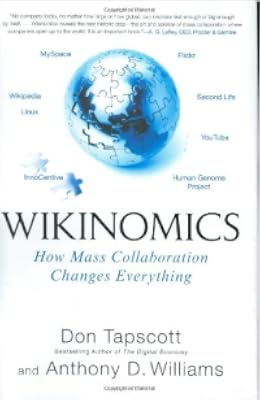
Wired magazine editor in chief Chris Anderson follows the success of his earlier book, "The Long Tail" (about mining what might otherwise be seen as marginal endeavors to create great successes), with this exploration of how we can benefit in many ways--including economically--by giving things away. It's a great complement to Tapscott and Williams' "Wikinomics: How Mass Collaboration Changes Everything" in that it is a paean to the power of collaboration in our onsite-online world. Anderson's puckish sense of humor, furthermore, keeps what is in essence a treatise on Internet/Web 2.0 economics engaging and entertaining; his comments about another writer's half-hearted attempt to experiment with "Free" (pp. 232-233), for example, capture show more the spirit of his work as he dissects the work of that other writer (Steven Poole), then offers a parenthetical aside ("Rather than being a failed Free business model, it's no business model at all...sorry, Poole!"). He also puts his (and his publisher's) money where his mouth is: "Free" appeared briefly as a free download on the Internet, and a free abridged audiobook version remains available at http://hyperionbooks.com/free/. The printed (not-free) book begins with "Free 101: A Short Course on a Most Misunderstood Word," helps provide background often missing from thoughts about familiar phrases including Stewart Brand's "information wants to be free" (Chapter 6), and ends with pithy rebuttals to 14 thoughts commonly proposed by those who maintain that Free is not a workable economic model. His conclusion is both reassuring and grounded in common sense: Free does not mean that there is no room for profit; "...Free is not enough; It also has to be matched with Paid" (p. 240)--an idea far less radical than we otherwise might have expected to find among Free's numerous proponents. show less
Members
- Recently Added By
Published Reviews
ThingScore 50
There's plenty in our world that lives outside of the marketplace: it's a rare family that uses spot-auctions to determine the dinner menu or where to go for holidays.
added by aethercowboy
Anderson capitalizes Free into a concept whose meaning sometimes crumples under his sweeping pronouncements.
added by Shortride
Chris Anderson's Free Sparks Debate
added by Tomhartley
Lists

Hachette Book Group
152 works; 6 members
Author Information

73+ Works 5,585 Members
Chris Anderson is editor in chief of Wired magazine. He was U.S. business editor at The Economist
Awards and Honors
Distinctions
Common Knowledge
- Canonical title
- Free: The Future of a Radical Price
- Alternate titles
- Free: How Today's Smartest Businesses Profit by Giving Something for Nothing
- Dedication
- To Anne
- First words
- In November 2008, the Surviving members of the original monty python team, stunned by the extent of digital piracy of their videos, issued a very stern announcement on YouTube:
For 3 years you YouTubers have been rippi... (show all)ng us off, taking tens of thousands of our videos and putting them on YouTube. (Prologue)
There's no getting around it: Gelatin come from flesh and bones. (Chapter 1) - Last words
- (Click to show. Warning: May contain spoilers.)Knowing how the value of a customer changes over time can help you figure out what the right time for free is, and when it's no longer necessary.
Classifications
Statistics
- Members
- 1,216
- Popularity
- 20,373
- Reviews
- 55
- Rating
- (3.66)
- Languages
- 13 — Danish, Dutch, English, Finnish, French, German, Hungarian, Italian, Japanese, Polish, Portuguese, Spanish, Swedish
- Media
- Paper, Audiobook, Ebook
- ISBNs
- 29
- ASINs
- 16