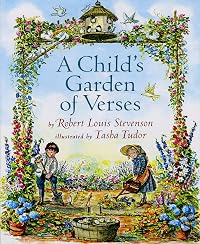
A Child's Garden of Verses
by Robert Louis Stevenson
On This Page
Description
A collection of poems evoking the world and feelings of childhood.Tags
Recommendations






Member Recommendations



Member Reviews
Stevenson can not simply sit quietly on a shelf. His works beg to be lifted and opened for new worlds to discover. As a child, he was lonely and ill and many of the poems in this collection for children exude that sense of isolation.
I'm sure everyone has their favorites, but mine was always THE LAMPLIGHTER. At my school in Melbourne, we would have a midday break of tea and biscuits, and my teacher would recite the beginning of this poem. It was Stevenson's ode to a world quickly changing, as electricity replaced gaslamps in the late 19th century.
My tea is nearly ready and the sun has left the sky
I'm sure everyone has their favorites, but mine was always THE LAMPLIGHTER. At my school in Melbourne, we would have a midday break of tea and biscuits, and my teacher would recite the beginning of this poem. It was Stevenson's ode to a world quickly changing, as electricity replaced gaslamps in the late 19th century.
My tea is nearly ready and the sun has left the sky
I'm glad I waited to review this one. I picked it up to read to my son, and his attention wandered, and he was just not up for it, and I was like "no wonder, Robert Louis Stevenson, your whole book is obviously aimed at Victorian grown-ups and their nostalgia for things like climbing trees and visiting the farm that baby Emmett hasn't even experienced yet." But my mum kept telling me how much I loved this book when I was small, and we kept reading, and over nights Stevenson worked his weirding way on both of us: Emmett (as I fancy it--let's face it, he can't even talk yet) feeling himself into the poems through the big, splashy, soft-focus fairy-pictures with their blues and greens and weird perspectives and distant horizons (and the show more fact is, if he doesn't know yet from farms or trees or penny-cannons, there are a lot of things here that are already part of his everyday: blocks, the rain, the moon, his little shadow, bedtime. And if the prescriptive intent behind all the "nursie" and fairyland and "ships at sea" stuff can get a little cloying--English childhood is an English garden, practice for when English children will leave to conquer and catalogue and administrate the earth!--it is certainly not that Stevenson was an overt imperialist, merely a man of his times. And the ships speak to me too, and remind me to be vigilant to the ways in which children open the door for their parents to embrace conservatism via halcyon-days sentimentality. And in fact, the overt prescriptiveness can be charming: in 2015 we are already more than primed for a statement of creed like "kids love blocks," it has moved from cliché to archetype and needs the merest oblique mention to activate our frames around it. In 1885? The sentimentalization of children as a whole was a relatively new thing; and Stevenson's way of talking about blocks as though no one has ever talked about blocks before in the history of childhood has a courtly formality: "What are you able to build with your blocks?" his opening gambit in the elaboration of the highly moral thesis "blocks are a tool of the imagination." Like, every time I get to the poem about the enigmatic rider I have to remind myself that he's not a headless horseman (although this does, of course, postdate Ichabod Crane); today he would have to be to get the kids to put down the ipad and listen, and the HH has become in fact a stock character, familiar/lovable/entirely unremarkable/not even scary. The fact that a mere headful horseguy riding by night can conjure up a world of mystery feels so fresh and sincere and simple, like drinking cold water, and if I didn't manage to avoid the curmudgeonly ipad grumbling entirely in this review, I will just say that horseman–ipad–starry night sky, it's all equally as new to my boy.
And the ultimate point here is that now the soft trundling doggerel of it is the only book he has that actually puts him to sleep and doesn't stir up the blood like Go Dog Go! and suchlike, and when you read to him from A Child's Garden he cuddles up and looks at the pictures and drifts away and he is happy. show less
And the ultimate point here is that now the soft trundling doggerel of it is the only book he has that actually puts him to sleep and doesn't stir up the blood like Go Dog Go! and suchlike, and when you read to him from A Child's Garden he cuddles up and looks at the pictures and drifts away and he is happy. show less
I remember owning an abridged version of this book as a child. I later located a copy of the complete version in a library to read. I just re-read the complete version. The poems are age appropriate for children, but I suspect many of them are a bit dated for today's children. Still many of the poems stand the test of time. The edition I read was from 1905 with illustrations by Jessie Willcox Smith. These are watercolor plates chosen to illustration some of the poems. Most poems are accompanied by line drawings as well.
Summary:
A Child’s Garden of Verses is a book comprised of many different short children’s poems about childhood. In this book there are sixty-six different poems that children all around the world can relate to. Many of the poems are about nature, the world and fantasy play. All written by Robert Louis Stevenson, he retells the stories of his childhood in poem form. There are poems about seasons, imaginary characters, traveling, boats, planes, bedtime, animals, nature, family, etc.
Comments (opinions/arguments):
I find this book to be very wonderful and useful because it’s simple and beautifully illustrated. Although it’s simple, the poems have a lot of depth, meaning and relation to childhood. I really like that the author wrote show more a wide variety of poems, ones that could be realistic and ones that are imaginary. I think this book could be really fun for children who are learning about poems because it offers poems that are very short and simple, as well as ones that are longer and more complicated. I think this book could serve as a good guide for children learning to write their own poems. I also like that all the poems are about different aspects of childhood and that they’re grouped together in different chapters. The wide variety of poems about nature, family, travel, imagination and childhood are great for children to learn about the world around them. I think this books central message is to help children become more familiar with poem styles of writing and to encourage children to use their creativity and imagination. show less
A Child’s Garden of Verses is a book comprised of many different short children’s poems about childhood. In this book there are sixty-six different poems that children all around the world can relate to. Many of the poems are about nature, the world and fantasy play. All written by Robert Louis Stevenson, he retells the stories of his childhood in poem form. There are poems about seasons, imaginary characters, traveling, boats, planes, bedtime, animals, nature, family, etc.
Comments (opinions/arguments):
I find this book to be very wonderful and useful because it’s simple and beautifully illustrated. Although it’s simple, the poems have a lot of depth, meaning and relation to childhood. I really like that the author wrote show more a wide variety of poems, ones that could be realistic and ones that are imaginary. I think this book could be really fun for children who are learning about poems because it offers poems that are very short and simple, as well as ones that are longer and more complicated. I think this book could serve as a good guide for children learning to write their own poems. I also like that all the poems are about different aspects of childhood and that they’re grouped together in different chapters. The wide variety of poems about nature, family, travel, imagination and childhood are great for children to learn about the world around them. I think this books central message is to help children become more familiar with poem styles of writing and to encourage children to use their creativity and imagination. show less
While trying to get some semblance of order for my books, I found this rare gem. Copyrighted in 1900, the paper is older and semi glossy; the illustrations are simple and lovely. My copy is in poor condition, but none of the pages are missing.
It was incredibly delightful to spend time savoring each delightful poem. While simply written, each sentence paints a lush portrait of serenity and reminds the reader of a childhood of dreams and time spent exploring through the imagination. Many of the missives contain images of night and sleeping.
Here is one of my favorites:
North-West Passage
When the bright lamp is carried in,
The sunless ours again begin;
O'er all without, in field and lane,
The haunted night returns again.
Now we behold the show more embers flee
About the firelit hearth; and see
Our faces painted as we pass,
Like pictures, on the window-glass.
Must we go to bed indeed? Well then,
Let us arise and go like men,
And face with an undaunted tread
The long black passage up to bed.
Farewell, O brother, sister, sire!
O pleasant party round the fire!
The songs you sing, the tales you tell,
Till far to-morrow, fare ye well! show less
It was incredibly delightful to spend time savoring each delightful poem. While simply written, each sentence paints a lush portrait of serenity and reminds the reader of a childhood of dreams and time spent exploring through the imagination. Many of the missives contain images of night and sleeping.
Here is one of my favorites:
North-West Passage
When the bright lamp is carried in,
The sunless ours again begin;
O'er all without, in field and lane,
The haunted night returns again.
Now we behold the show more embers flee
About the firelit hearth; and see
Our faces painted as we pass,
Like pictures, on the window-glass.
Must we go to bed indeed? Well then,
Let us arise and go like men,
And face with an undaunted tread
The long black passage up to bed.
Farewell, O brother, sister, sire!
O pleasant party round the fire!
The songs you sing, the tales you tell,
Till far to-morrow, fare ye well! show less
My edition different cover, with an assortment of classic illustrations chosen by Cooper Edens.
My review from the Children's Books discussion for Poetry month:
Emphasizes the sentimental and the nostalgic. That may be appropriate, and a good way to sell the book to the ppl with the money... but I'm not sure if it helps today's children appreciate the timelessness of the verses.
I would have loved any edition of this when my children were tiny. Reading it now, I feel as if I deprived my kids!
Even nursing infants could appreciate the sounds, the rhythm, rhyme, and alliteration of the poems as read aloud. It won't be long before some of the lines stick in their heads... even if they don't understand them.
And toddlers can enjoy many of the show more concepts... and preschoolers more... and some of the poems are worth a teen student's time. Owning whichever edition of this you prefer is like owning a big book of Mother Goose rhymes, and another big book, or collection, of famous fairy tales... it's almost a must!
Many of the poems have been reprinted in other collections, including the Nat'l Geog. we read upthread. But many are new to me, too. show less
My review from the Children's Books discussion for Poetry month:
Emphasizes the sentimental and the nostalgic. That may be appropriate, and a good way to sell the book to the ppl with the money... but I'm not sure if it helps today's children appreciate the timelessness of the verses.
I would have loved any edition of this when my children were tiny. Reading it now, I feel as if I deprived my kids!
Even nursing infants could appreciate the sounds, the rhythm, rhyme, and alliteration of the poems as read aloud. It won't be long before some of the lines stick in their heads... even if they don't understand them.
And toddlers can enjoy many of the show more concepts... and preschoolers more... and some of the poems are worth a teen student's time. Owning whichever edition of this you prefer is like owning a big book of Mother Goose rhymes, and another big book, or collection, of famous fairy tales... it's almost a must!
Many of the poems have been reprinted in other collections, including the Nat'l Geog. we read upthread. But many are new to me, too. show less
Here is a delightful look at childhood, written by master poet and storyteller Robert Louis Stevenson. In this collection of sixty-six poems, Stevenson recalls the joys of his childhood, from sailing boats down a river, to waiting for the lamplighter, to sailing off to foreign lands in his imagination.
Members
- Recently Added By
Published Reviews
Joni Lucas (Children's Literature)
Stevenson's poems and stories are American classics. Poems about rain, foreign lands, travel, windy nights, shadows, swings, cows, the moon and other fanciful things and places fill up this beautifully illustrated book of poems that would make a great gift for new parents. Tasha Tudor's watercolor illustrations help convey the historical flavor of Stevenson's show more work and conjure up images of simpler times for children. 1999 (orig. 1981), Simon and Schuster Books for Young Readers, $18.00. Ages All. show less
Stevenson's poems and stories are American classics. Poems about rain, foreign lands, travel, windy nights, shadows, swings, cows, the moon and other fanciful things and places fill up this beautifully illustrated book of poems that would make a great gift for new parents. Tasha Tudor's watercolor illustrations help convey the historical flavor of Stevenson's show more work and conjure up images of simpler times for children. 1999 (orig. 1981), Simon and Schuster Books for Young Readers, $18.00. Ages All. show less
added by kthomp25
Lists

Favorite Childhood Books
1,646 works; 518 members
1001 Children's Books You Must Read Before You Grow Up
774 works; 101 members

Brilliant poetry collections for kids
51 works; 18 members

Childhood Favorites
427 works; 24 members

1,000 Good Books of John Senior
36 works; 6 members

Sonlight Books
1,487 works; 25 members
Honey For a Child's Heart
1,152 works; 25 members

Brightly Beaming Curriculum Books
281 works; 8 members
Ambleside Books
459 works; 18 members

Publisher's Weekly Bestsellers Prior to 1895 in Chronological Order
95 works; 6 members

CCE 1000 Good Books List
1,033 works; 12 members

Bennett's 30 Great Books Every Preschooler Should Meet
30 works; 3 members

Folio Society
831 works; 53 members

Necessary & Exquisite
30 works; 4 members

Out of Copyright
244 works; 14 members

Under The Chinaberry Tree
194 works; 1 member

Book Titles Mentioned In Newberry Medal And Honor Books
884 works; 3 members

HMS: Make Your Child a Lover of Books, Ages 3-5
14 works; 2 members

Books We Loved As Children
603 works; 252 members

EGBERTINA'S List of childhood books worthy of merit or unspeakable delight
155 works; 6 members

Poetry Collections
79 works; 6 members
Works in the game of Authors
44 works; 2 members

Mustich's 1000 Books to Read Before You Die: A Life Changing List
1,001 works; 19 members

Before Austen Comes Aesop
318 works; 9 members

Poetry Corner
187 works; 15 members

Stealth- and Posthumously- Edited Books
15 works; 1 member
Talk Discussions
Past Discussions
Book covers, A Child's Garden of Verses in Tattered but still lovely (December 2016)
Author Information

2,802+ Works 139,408 Members
Novelist, poet, and essayist Robert Louis Stevenson was born in Edinburgh, Scotland. A sickly child, Stevenson was an invalid for part of his childhood and remained in ill health throughout his life. He began studying engineering at Edinburgh University but soon switched to law. His true inclination, however, was for writing. For several years show more after completing his studies, Stevenson traveled on the Continent, gathering ideas for his writing. His Inland Voyage (1878) and Travels with a Donkey (1878) describe some of his experiences there. A variety of essays and short stories followed, most of which were published in magazines. It was with the publication of Treasure Island in 1883, however, that Stevenson achieved wide recognition and fame. This was followed by his most successful adventure story, Kidnapped, which appeared in 1886. With stories such as Treasure Island and Kidnapped, Stevenson revived Daniel Defoe's novel of romantic adventure, adding to it psychological analysis. While these stories and others, such as David Balfour and The Master of Ballantrae (1889), are stories of adventure, they are at the same time fine studies of character. The Master of Ballantrae, in particular, is a study of evil character, and this study is taken even further in The Strange Case of Dr. Jekyll and Mr. Hyde (1886). In 1887 Stevenson and his wife, Fanny, went to the United States, first to the health spas of Saranac Lake, New York, and then on to the West Coast. From there they set out for the South Seas in 1889. Except for one trip to Sidney, Australia, Stevenson spent the remainder of his life on the island of Samoa with his devoted wife and stepson. While there he wrote The Wrecker (1892), Island Nights Entertainments (1893), and Catriona (1893), a sequel to Kidnapped. He also worked on St. Ives and The Weir of Hermiston, which many consider to be his masterpiece. He died suddenly of apoplexy, leaving both of these works unfinished. Both were published posthumously; St. Ives was completed by Sir Arthur Quiller-Couch, and The Weir of Hermiston was published unfinished. Stevenson was buried on Samoa, an island he had come to love very much. Although Stevenson's novels are perhaps more accomplished, his short stories are also vivid and memorable. All show his power of invention, his command of the macabre and the eerie, and the psychological depth of his characterization. (Bowker Author Biography) show less
Some Editions
Awards and Honors
Notable Lists
Series
Belongs to Publisher Series
Work Relationships
Is contained in
Has the adaptation
Common Knowledge
- Canonical title
- A Child's Garden of Verses
- Original title
- A Child's Garden of Verses
- Original publication date
- 1885
- Dedication
- To Alison Cunningham, from her boy.
- First words
- In winter I get up at night and dress by yellow candle-light.
(Little Golden Books edition)
A birdie with a yellow bill
Hopped upon the window sill,
Cocked his shining eye and said,
"Ain't you 'shamed, you sleepy-head!"
(Thomas Kinkade edition)
Bring the comb and play upon it!
Marching, here we come! - Quotations
- It is very nice to think
The world is full of meat and drink
With little children saying grace
In every Christian knd of place. - Last words
- (Click to show. Warning: May contain spoilers.)For, long ago, the truth to say, he has grown up and gone away, and it is but a child of air that lingers in the garden there.
(Click to show. Warning: May contain spoilers.)(Little Golden Books edition)
By at the gallop he goes, and then
By he comes back at the gallop again.
(Click to show. Warning: May contain spoilers.)(Thomas Kinkade edition)
Thank the Lord because he is good.
His love continues forever.
--I Chronicles, 16:34 - Original language
- English
Classifications
Statistics
- Members
- 9,530
- Popularity
- 1,089
- Reviews
- 101
- Rating
- (4.18)
- Languages
- 11 — Catalan, English, French, German, Italian, Latin, Norwegian, Russian, Spanish, Swedish, Vietnamese
- Media
- Paper, Audiobook, Ebook
- ISBNs
- 273
- UPCs
- 8
- ASINs
- 347