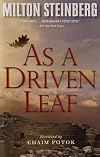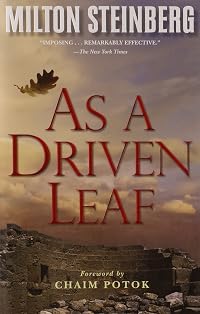
As a Driven Leaf
by Milton Steinberg
On This Page
Description
"A magnificent work of fiction brings the age of the Talmud to life and explores the times of Elisha ben Abuya, whose struggle to live in two worlds destroyed his chances to live in either. Now with a new forward by Rabbi David J. Wolpe"--Tags
Recommendations















Member Reviews
I first read this novel before I studied Talmud, so I didn't realize it was based on actual Jewish texts. I was fascinated by Steinberg's descriptions of life in Roman Palestine, especially how the Jews lived, since there wasn't any other Jewish historical fiction from this time period. I wasn't so happy with the ending, never quite understanding why Elisha had to completely reject his religion when he couldn't reconcile it with Hellenism.
Later, when I studied the Gemara where his story appeared, I was even less happy. The Talmud is quite clear that Elisha ascends to Paradise with Rabbi Akiva and their 2 younger colleagues, and that all except Akiva are traumatized by the experience, Elisha so much that he becomes an apostate. Yet show more Steinberg leaves this crucial scene out of "As a Driven Leaf" so we never understand what set Elisha on his difficult path. show less
Later, when I studied the Gemara where his story appeared, I was even less happy. The Talmud is quite clear that Elisha ascends to Paradise with Rabbi Akiva and their 2 younger colleagues, and that all except Akiva are traumatized by the experience, Elisha so much that he becomes an apostate. Yet show more Steinberg leaves this crucial scene out of "As a Driven Leaf" so we never understand what set Elisha on his difficult path. show less
This is "inspired by a true story," as Hollywood would put it. It is not "based on a true story." That is, aside from a few names and a very few key facts, this bears little resemblance to the actual life of Elisha ben Abuyah, otherwise known as Acher, or to the era of history in which it takes place. (The author grants much of this in the afterword, which you might want to read first.)
Once you get past that, it's interesting enough.
I shall now digress.
I think a lot of us—and by "us," I mean people who were raised Orthodox Jewish and have gone on to question that system—are fascinated by Acher. I certainly am. I wrote my own version of his story a few years back; I will cheerfully admit it was not a very good retelling, but it was show more probably the only class assignment I've ever turned in that dealt with Judaism in any significant way. Acher is pretty much the only classic role model we have; the one member of the Sanhedrin whose influence was strong enough that he couldn't be redacted from the Talmud entirely—who, indeed, continued to teach even after going over to the Dark Side (my favorite detail, and one Steinberg leaves out, as it doesn't fit his narrative)—but who nevertheless left the fold.
Combine that with the facts that we're given very few details about his life, and that those few we have occasionally contradict one another, and it becomes tempting to project one's own issues and agendas onto Acher, making him the poster sage for one's own pet cause. In my better moments, I try to avoid that. It's enough to know that somebody who otherwise qualified as one of the greatest rabbis in history came to a different conclusion than the rest of the pack; that he provides proof that not everybody who opts out of the system does so out of ignorance.
Getting back to the book... in Steinberg's version of the story, there are two major causes for Elisha straying from the path: rational difficulties of proving God's existence, and a lack of nurturing women in his life. His version expunges anything that might be construed as supernatural or non-rational; the four sages "entering the garden" gets redefined as their attempting to collaborate on something like Maimonides' Guide for the Perplexed. Ultimately, Steinberg suggests, we can't really know what's true or not; better not to worry about such things and just live happily; and if only Acher had had a wife better suited to him, he just might have been able to manage it.
I'm not thrilled by these choices, especially the last one.
With all of that said, it's still an interesting book in its own right, and worth the four stars I'm giving it. show less
Once you get past that, it's interesting enough.
I shall now digress.
I think a lot of us—and by "us," I mean people who were raised Orthodox Jewish and have gone on to question that system—are fascinated by Acher. I certainly am. I wrote my own version of his story a few years back; I will cheerfully admit it was not a very good retelling, but it was show more probably the only class assignment I've ever turned in that dealt with Judaism in any significant way. Acher is pretty much the only classic role model we have; the one member of the Sanhedrin whose influence was strong enough that he couldn't be redacted from the Talmud entirely—who, indeed, continued to teach even after going over to the Dark Side (my favorite detail, and one Steinberg leaves out, as it doesn't fit his narrative)—but who nevertheless left the fold.
Combine that with the facts that we're given very few details about his life, and that those few we have occasionally contradict one another, and it becomes tempting to project one's own issues and agendas onto Acher, making him the poster sage for one's own pet cause. In my better moments, I try to avoid that. It's enough to know that somebody who otherwise qualified as one of the greatest rabbis in history came to a different conclusion than the rest of the pack; that he provides proof that not everybody who opts out of the system does so out of ignorance.
Getting back to the book... in Steinberg's version of the story, there are two major causes for Elisha straying from the path: rational difficulties of proving God's existence, and a lack of nurturing women in his life. His version expunges anything that might be construed as supernatural or non-rational; the four sages "entering the garden" gets redefined as their attempting to collaborate on something like Maimonides' Guide for the Perplexed. Ultimately, Steinberg suggests, we can't really know what's true or not; better not to worry about such things and just live happily; and if only Acher had had a wife better suited to him, he just might have been able to manage it.
I'm not thrilled by these choices, especially the last one.
With all of that said, it's still an interesting book in its own right, and worth the four stars I'm giving it. show less
A marvelous tale of historical fiction. The book is about Elisha ben Avuyah, the only Talmudic sage to abandon Judaism and become a heretic. Because of the suffering of innocents, Elisha no longer can bring himself to base his beliefs in tradition. He leaves Palestine for Antioch and for the life of a scholar, in search of a faith based on reason rather than assumption. It ends rather depressingly but is a very good book, nonetheless. Recommended.
Experiments in Reading
Experiments in Reading
What is faith? How do you know the truth of what you believe in? What if you have doubts? How do you find the truth? And, at what costs? These are some of the spiraling questions you will deal with when reading about Elisha.
You love Elisha, and so you follow him through the trials in which he engages. This book answered a lot of my own questions about the faith versus reason "conversation" with which most of us are still struggling.
You love Elisha, and so you follow him through the trials in which he engages. This book answered a lot of my own questions about the faith versus reason "conversation" with which most of us are still struggling.
Started out very slow, but picked up and was an interesting way to learn about 1st century Jewish schools of thought and history.
This is historical fiction of the life of Elisha ben Avuyah. An interesting but difficult read, I found it getting intollerably pedantic towards the end. The author tends to belabor his point.
This is a historical-fiction account of the rabbinic community immediately after the destruction of the Second Temple. It takes the rabbis from the Talmud and puts them to life to offer a "midrash" of how the Tannaitic period brought about the Mishnah.
Members
- Recently Added By
Lists

Book Riot's 100 must-read works of Jewish Fiction
100 works; 8 members

Judaism & Israel
104 works; 2 members

JBC's Classic Jewish Literature
5 works; 1 member
Author Information

13+ Works 1,631 Members
Some Editions
Awards and Honors
Common Knowledge
- Original publication date
- 1939
- People/Characters
- Elisha ben Abuyah
- Epigraph
- Wherefore hidest Thou Thy face...
Wilt Thou harass a driven leaf?
--Job XIII: 24-25 - Dedication
- To Edith, In tribute to her love, in gratitude for her collaboration.
- First words
- The sages of the Sanhedrin sat in a sweeping half-circle, motionless like some conclave of graven images.
- Last words
- (Click to show. Warning: May contain spoilers.)And he wept not alone for his master, but for himself as well, for a woman who rarely smiled, for sweet children who slept near by, for a people crushed and persecuted, for all the sons of men, their aches of the body and soul, and their dreams that die.
- Blurbers
- Kazin, Alfred; Poling, Daniel A.
Classifications
- Genres
- Fiction and Literature, General Fiction, Historical Fiction
- DDC/MDS
- 813.54 — Literature & rhetoric American literature in English American fiction in English 1900-1999 1945-1999
- LCC
- PS3537 .T32343 .A9 — Language and Literature American literature American literature Individual authors 1900-1960
- BISAC
Statistics
- Members
- 651
- Popularity
- 44,295
- Reviews
- 9
- Rating
- (4.23)
- Languages
- English, Russian, Spanish
- Media
- Paper, Audiobook, Ebook
- ISBNs
- 8
- ASINs
- 9