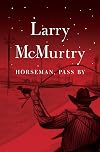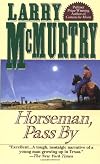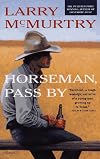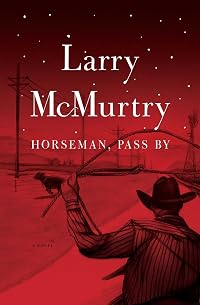
Horseman, Pass By
by Larry McMurtry
On This Page
Description
Horseman, Pass By is a post-World War II classic first published in 1961 and later made into a feature film. Cattleman Homer Bannon is a walking advertisement for traditional, old-frontier morals-in contrast to his stepson, Hud. Homer's grandson Lonnie is torn between emotions for his father and grandfather as he struggles to define his own identity.Tags
Recommendations







Member Reviews
McMurtry’s debut novel was a sensation when published in 1961. Here was a contemporary Western showing the conflict between the then current generation with the values of the Old West still prevalent at the time. The novel was made into the movie Hud, starring Paul Newman in the titular role.
McMurtry’s novel, however, is narrated by young Lonnie Bannon, grandson of an old-time cattleman, Homer Bannon. Hud is the son of Homer’s second wife, and he is in constant conflict with the old man about how the ranch operates. When a plague hits the herd, decisions no rancher wants to make are forced upon the Bannons. Lonnie is caught in the middle; torn between his love and admiration of his grandfather and the old man’s principles, and show more his fascination with the exciting, unscrupulous and dangerous, step-uncle, Hud.
Boy, but McMurtry can write a scene! I could feel the grit, taste the cold drinks, hear the bellow of cattle, and smell the dung at the rodeo arena. (It probably helped that I had just attended a rodeo in real life.) His characters come alive on the page. They are not particularly likeable, but the reader gets to know them through their actions and reactions. Each one, even those appearing for the briefest of scenes, is fully fleshed out. show less
McMurtry’s novel, however, is narrated by young Lonnie Bannon, grandson of an old-time cattleman, Homer Bannon. Hud is the son of Homer’s second wife, and he is in constant conflict with the old man about how the ranch operates. When a plague hits the herd, decisions no rancher wants to make are forced upon the Bannons. Lonnie is caught in the middle; torn between his love and admiration of his grandfather and the old man’s principles, and show more his fascination with the exciting, unscrupulous and dangerous, step-uncle, Hud.
Boy, but McMurtry can write a scene! I could feel the grit, taste the cold drinks, hear the bellow of cattle, and smell the dung at the rodeo arena. (It probably helped that I had just attended a rodeo in real life.) His characters come alive on the page. They are not particularly likeable, but the reader gets to know them through their actions and reactions. Each one, even those appearing for the briefest of scenes, is fully fleshed out. show less
Horseman, Pass By is the title of Larry McMurtry's debut novel [1961], set in the dry barren flatland of West Texas. It is also part of the epitaph I saw above William Butler Yeats tombstone in my ancestral homeland in Sligo, Ireland. Both are elegiac summations of lost times and vanished lives. I learned soon enough reading this world-weary novel that it is the first volume of what is now known as The Thalia Trilogy, Thalia being the small town that centers the three novels. I also realized one chapter in that my novel was also the movie with Paul Newman in the title role, Hud. (The third part of the trilogy is also the Oscar winning The Last Picture Show.) I cannot discuss the plot very well because in doing so, I would be revealing show more the spoilers that encompass most of the story. Let's just say it is narrated by one teenager, Lonnie, as he recounts the hardscrabble lives around him, his life on his grandfather's ranch, and the abundant toxic masculinity surrounding this small-town Texas of the 1950's. The story is beautifully written. Let me leave you with this, a dancehall during the week of the rodeo: "...and on the dance floor the dancers hugged and swirled in the blue darkness and the smoke. The only ones who weren't having a good time were a few lonesome-looking cowboys at the bar....the jukebox flared up and played hillbilly dance music the rest of the time I stayed. It played old songs by Hank Williams and Ernest Tubb and Kitty Wells, and it was cold, cold hearts in the darkness with dancers bumping into each other and going to dance some more....It was no more work and no more lonesome and all the honky-tonk angels living it up." show less
Horseman, Pass By is the first Western novel written by the recently deceased American writer Larry McMurtry. It was published when he was just 25 in 1961. This modern western portrays life on a cattle ranch from the perspective of young narrator Lonnie Bannon. Set in post-World War II Texas (1954), the Bannon ranch is owned by Lonnie's grandfather, Homer Bannon. Homer's ruthless stepson, Hud, stands as the primary antagonist of the novel, who desires to inherit the ranch from Homer by any means. The novel inspired the film Hud, starring Paul Newman as the title character.
This novel helped to elevate the western from it's pulp status to one of literature. Horseman, Pass By is about many things: toxic masculinity (in the character of show more Hud), the influence of modernity on an old way of life and making a living, and it's a warm yet melancholy coming of age tale. Lonnie, our 17 year old teenage narrator - grows up quick on the ranch between Hud's cruelty and his grandfather's old-school ways yet he longs to escape his situation, to escape the small town Thalia. His grandfather Homer is portrayed as an aging, stubborn rancher who is attached to his way of life and does not want to let go of his ranch, despite Hud's forceful insistence and his sickly cattle. Hud - is a womanizer, a drunk, and the threat to Homer's way of life. He is our villian - who is consumed by greed and lust. At the end of the novel we are supposed to view Homer - in one pivotal scene - as if he too was just one of the sickly cattle on the ranch. And it is suggested that it is the humane thing to out him of his misery. Homer's way of life is strong-and can only be killed violently - so it is a fitting end that he meets.
Horseman, Pass By is a beautiful, violent, melancholy, atmospheric novel. It's a tough, nostalgic narrative of a young man growing up in Texas.
It's pure poetry. Larry McMurtry was a master of his craft. show less
This novel helped to elevate the western from it's pulp status to one of literature. Horseman, Pass By is about many things: toxic masculinity (in the character of show more Hud), the influence of modernity on an old way of life and making a living, and it's a warm yet melancholy coming of age tale. Lonnie, our 17 year old teenage narrator - grows up quick on the ranch between Hud's cruelty and his grandfather's old-school ways yet he longs to escape his situation, to escape the small town Thalia. His grandfather Homer is portrayed as an aging, stubborn rancher who is attached to his way of life and does not want to let go of his ranch, despite Hud's forceful insistence and his sickly cattle. Hud - is a womanizer, a drunk, and the threat to Homer's way of life. He is our villian - who is consumed by greed and lust. At the end of the novel we are supposed to view Homer - in one pivotal scene - as if he too was just one of the sickly cattle on the ranch. And it is suggested that it is the humane thing to out him of his misery. Homer's way of life is strong-and can only be killed violently - so it is a fitting end that he meets.
Horseman, Pass By is a beautiful, violent, melancholy, atmospheric novel. It's a tough, nostalgic narrative of a young man growing up in Texas.
It's pure poetry. Larry McMurtry was a master of his craft. show less
Larry McMurtry's first novel is a rather remarkable slice of Texas life in the relatively modern era. HORSEMAN, PASS BY was made into a popular movie, HUD. But the novel is darker than the film, which nudged one character's moral character slightly toward the sympathetic and shoved another character into an entirely different race. Paul Newman, at the height of his coolness and fame when HUD was filmed, played the title character with menace, anger, and plenty of moral turpitude. But he also played him cool, with a radiant charm that almost succeeded in overcoming the darkness at Hud's heart. It is unlikely that Newman would have ever taken the role of Hud had it been certain to follow precisely in the book's depiction. It's just as show more unlikely that the film itself would have been made had it been a requirement not to water it down. In the movie, Hud is an anti-hero, and Newman in the role became the pinup boy for such types. In HORSEMAN, PASS BY, Hud is more than an anti-hero. He is largely despicable. At one point in the book, he commits an act so outrageous and horrifying that it is hard to imagine how anyone ever thought of making a movie with Paul Newman out of the book. But the rest of the book is reflected rather well in the film, and there is the same taste of loneliness, isolation, and desperation in both, a reflection of the harsh life in the North Texas ranchlands. Hud's father Homer faces obstacles every day in running his cattle ranch, but the discovery of one dead heifer catapults him into the greatest challenge of his life. His grandson Lonnie, the book's (and film's) viewpoint character, loves his grandfather and the ranch, but yearns for some inchoate desire he can't quite define. McMurtry is a master at the dialogue of these cattle folk, people identical to the ones he grew up with in North Texas in a town very much like Thalia, the town he focuses on in this and several other books. It's a moving and affecting ride through the lives of some hard people and some harder hearts. show less
Originally called "Horseman, Pass By" this is a short, and searing novel which deals with the small horizons, mental and moral of the inhabitants of the Great Plains of America. It climaxes with a rape, and the reactions of the town and family of the local high school hero. Unpleasant because it is quite well done. I read the novel before the date of this reprint, but, I think when the film adaptation was current.
I've seen the movie Hud so many times that it probably colored my perception of this book too much while I was reading it, and I'm sure I would have enjoyed Horseman, Pass By more if I had never seen the movie which was adapted from it; that said, I still enjoyed it a great deal. McMurtry's a terrific writer and his concise yet often aridly poetic prose captures the feel of coming of age in a small western town in the mid-20th century perfectly.Those who come to the book after having seen the movie will probably be shocked by the book's portrayal of the Hud character. In the movie, the titular character of Hud is a charming, likable (no doubt the benefit of being portrayed by the charismatic Paul Newman), although entirely show more self-interested rapscallion. In Horseman, Hud is something closer to a sociopath--a charming cad, still, but colder, more vicious, and even more indifferent to the feelings of other human beings. It makes the character as portrayed in the book a lot harder to take, but like the movie, the book isn't really about Hud so much as it is about Lonnie, and his Granddad, and their relationship to each other and to the changing West.I highly recommend both the book and the movie, but I have to admit that as fine as Horseman, Pass By is, the images from Hud are what is going to stick with me. show less
Horseman, Pass By is McMurtry's first novel and the first in the Thalia series. It is about a 1950s north Texas cattle ranch that runs up against a terrible cattle illness that requires painful decisions by the aging rancher. The story is told from the point of view of his 17 year old grandson who is essential watching the frontier change, ushering in the modern era of the west and his own adulthood. There are some gruesome and painful scenes but as always McMurtry's writing is very evocative of time and place and paints a romantic picture despite the horrors unfolding. Still, it was wholly depressing to read.
Members
- Recently Added By
Lists

Read the book and saw the movie
1,170 works; 195 members
Author Information

97+ Works 43,677 Members
Larry McMurtry, winner of the Pulitzer Prize for Fiction, among other awards, is the author of twenty-four novels, two collections of essays, two memoirs, more than thirty screenplays, & an anthology of modern Western fiction. He lives in Archer City, Texas. (Publisher Provided) Novelist Larry McMurtry was born June 3, 1936 in Wichita Falls, show more Texas. He received a B.A. from North Texas State University in 1958, an M.A. from Rice University in 1960, and attended Stanford University. He married Josephine Ballard in 1959, divorced in 1966, and had one son, folksinger James McMurtry. Until the age of 22, McMurtry worked on his father's cattle ranch. When he was 25, he published his first novel, "Horseman, Pass By" (1961), which was turned into the Academy Award-winning movie Hud in 1962. "The Last Picture Show" (1966) was made into a screenplay with Peter Bogdanovich, and the 1971 movie was nominated for eight Oscars, including one for best screenplay adaptation. "Terms of Endearment" (1975) received little attention until the movie version won five Oscars, including Best Picture, in 1983. McMurtry's novel "Lonesome Dove" (1985) won the Pulitzer Prize in 1986 and the Spur Award and was followed by two popular TV miniseries. The other titles in the Lonesome Dove Series are "Streets of Laredo" (1993), "Dead Man's Walk" (1995), and "Comanche Moon" (1997). The other books in his Last Picture Show Trilogy are "Texasville" (1987) and "Duane's Depressed" (1999). McMurtry suffered a heart attack in 1991 and had quadruple-bypass surgery. Following that, he suffered from severe depression and it was during this time he wrote "Streets of Laredo," a dark sequel to "Lonesome Dove." His companion Diana Ossana, helping to pull him out of his depression, collaborated with him on "Pretty Boy Floyd" (1994) and "Zeke and Ned" (1997). He co-won the Best Screenplay Golden Globe and the Academy Award for Best Adapted Screenplay for Brokeback Mountain in 2006. He made The New York Times Best Seller List with his title's Custer and The Last Kind Words Saloon. McMurtry is considered one of the country's leading antiquarian book dealers. (Bowker Author Biography) show less
Some Editions
Work Relationships
Has the adaptation
Common Knowledge
- Canonical title
- Horseman, Pass By
- Related movies
- Hud (1963 | IMDb)
- Dedication
- HORSEMAN, PASS BY
is dedicated to my parents,
W. J. and Hazel Ruth McMurtry,
with gratitude and love. - First words
- I remember how green the early oat fields were, that year and how the plains looked in April, after the mesquite leafed out.
- Last words
- (Click to show. Warning: May contain spoilers.)The cab was dark and the dash lights threw shadows across his face, so that when I looked at him, and saw him pull down his old straw hat and face the road, he reminded me of someone that I cared for, he reminded me of everyone I knew.
Classifications
Statistics
- Members
- 710
- Popularity
- 40,264
- Reviews
- 20
- Rating
- (3.75)
- Languages
- English, French, Italian, Spanish
- Media
- Paper, Audiobook, Ebook
- ISBNs
- 21
- UPCs
- 1
- ASINs
- 14