On This Page
Description
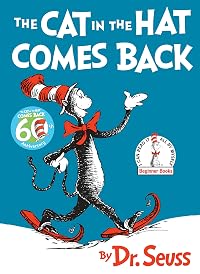
The riotously funny follow-up to The Cat in the Hat celebrates its 60th Anniversary! The Cat is back--along with some surpise friends--in this beloved Beginner Book by Dr. Seuss. Dick and Sally have no time to play. It's winter and they have mountains of snow to shovel. So when the Cat comes to visit, he decides to go inside and to take a bath. No problem, right? Wrong! The pink ring he leaves in the tub creates is a very BIG pink problem when he transfers the stubborn stain from the bath show more onto Mother's white dress, Dad's shoes, the floors, the walls, and ultimately, over the entire yard full of snow! Will the kids EVER clean up the mess? You bet they will, with some help from the Cat and his helpers: 26 miniature cats (AKA Little Cats A-Z) who live inside the Cat's hat! This classic Dr. Seuss story is the perfect choice for beginning readers and read-alouds, especially on snow days! And with a peel-off 60th Anniversary sticker on the front cover, it makes a perfect gift for all ages. Originally created by Dr. Seuss, Beginner Books encourage children to read all by themselves, with simple words and illustrations that give clues to their meaning. show lessTags
Recommendations





Member Reviews
Of the two, I remember The Cat in the Hat Comes Back much better from childhood readings. Something about the illustrations of that pink stain and the way it just keeps getting transferred from one thing to another--and getting bigger and bigger--has stuck with me, almost sharply. And then it finally gets taken care of through a kind of magical absurdity. I find this slightly unsettling now, and I suspect/half remember that I did as a kid too. The idea of a problem that resists efforts to fix it and just gets worse when you try *and* which the story doesn't tell you how to deal with in any kind of replicable way--look, I know it's a fun, silly kid's book designed to reinforce the alphabet and aid early reading, but it's kind of anxiety show more making, I have to say. show less
That troublemaking feline who first appeared in 1957, in Dr. Seuss' very first early reader, The Cat in the Hat, returns in this second, alphabetic adventure. As the narrator and his sister Sally shovel snow, the Cat in the Hat appears, dashing off into the house despite being told he is not welcome. Here he makes the predictable mess, and then unveils his helpers: little cats in hats, nested within his own hat like Matryoshka dolls, and named (one each) for the letters of the alphabet. This feline crew swing into action to clean up the big pink spot that persists, as a result of the original Cat in the Hat's shenanigans, with the deciding factor in their success being the invisible VOOM living under Cat Z's hat...
Originally published show more in 1958, the year after its predecessor, The Cat in the Hat Comes Back was Dr. Seuss's sixteenth children's book, and the second of what would grow to become a substantial collection of early readers. Although it can be read as a picture-book, it belongs to Random House's I Can Read It All By Myself Beginner Books collection, which encompasses all of the Dr. Seuss and Dr. Seuss-labeled early readers, as well as other titles. Like the earlier title, it is a book I recall reading and enjoying as a child, although perhaps not as often or as much as the first. I picked it up for this reread as part of my recently begun Dr. Seuss retrospective, in which I will be reading and reviewing all of of his classic children's books, in chronological publication order. This is a project I undertook as an act of personal protest against the suppression of six of the author/artist's titles - And to Think That I Saw It on Mulberry Street, McElligot's Pool, If I Ran the Zoo, Scrambled Eggs Super!, On Beyond Zebra! and The Cat's Quizzer - by Dr. Seuss Enterprises, due to the outdated and potentially offensive elements that they contain. See my review of And to Think That I Saw It on Mulberry Street, to be found HERE, for a fuller exploration of my thoughts on that matter.
As I mentioned in my recent review of The Cat in the Hat, although these books are not currently being suppressed through this recent decision on the part of the copyright holder, Dr. Seuss Enterprises, to cease publication, it may only be a matter of time until they have been added to that sad list. To quote myself: "Sadly, the censorious impulse - including, and perhaps especially, the self-censorious impulse, of which this recent decision is an example - only gains strength as it is fed, and this particular book has already run afoul of those same critics whose work seems to have informed Dr. Seuss Enterprises' recent action against the artistic and literary legacy that they are meant to be representing. Apparently the argument has been put forward, in such academic titles as Philip Nel's Was the Cat in the Hat Black?: The Hidden Racism of Children's Literature, and the Need for Diverse Books, that the titular Cat in this story is a descendant of the minstrel shows and blackface of earlier generations, and that his actions are a coded reflection of white fears about the disruptive nature of black power. I cannot comment upon Nel's argument, having not yet read the book - something I hope to do in the future - but some of the reviews of it that I have seen, reviews that mention all of the "decoding" done by the critic, in order to arrive at his conclusion, do make me wonder whether the text actually supports that conclusion, or whether the entire argument rests upon the imposition of the critic's own preexisting assumptions upon the text. I hope, at some point, to have an answer to that question, as well as a better understanding of the role of critics like Nel in this recent decision from Dr. Seuss Enterprises. Whatever the final argument put forward in his book, it is not my intention to assert that he can be held directly accountable for this act of censoriousness, simply by virtue of his having made a critique of Dr. Seuss' work. There is a difference, after all, between critique - even harsh critique - and calling for censorship. Of course, if Nel's book does indeed make an argument for suppressing books such as The Cat in the Hat and The Cat in the Hat Comes Back, or if Nel was one of the panel of "experts" Dr. Seuss Enterprises is said to have consulted, then that is a different matter, and some of the blame for this recent episode of cultural vandalism can indeed be laid at his feet."
Again, as with the first book, in light of this criticism I have given particular attention to the depiction of the Cat during this reread, in order to see whether I could detect any problematic racialized elements to his character. There is certainly a disquieting element to these stories - Nel is not wrong in labeling the cat disruptive! - that I recall finding rather striking, even as a young girl. Of course, my sense then was more that the Cat was being "naughty," and that the story represented the mischief children get up to, absent parental authority. This second story has an additional disturbing element, one I see referenced in quite a few online reviews, in that the alphabetical cat crew use play pop-guns in defeating the pink spot. This is interesting, because I don't recall the pop-guns from my girlhood reading of the book, making me think now that I just accepted them as a matter of course, understanding that they were toys, rather than the real thing. Truthfully, even reading as an adult, I find the pop-guns (referred to in some online reviews simply as "guns," with no reference to them being toys) less disturbing than the pink slime, which initially came off the Cat in the Hat himself, after taking a bath. In any case, I don't see any of these story elements, however disturbing - the Cat in the Hat's blithe disregard for the fact that he isn't welcome, the nasty pink slime, the alphabetical cat crew - as being in any way "coded" black. I will have to read further, in Nel's work, to get a sense of why he thinks otherwise.
I'll conclude by observing, as I did in my review of the first book, that "whatever interpretation the reader lands upon, when it comes to the meaning of the story and its creator's intentions, the experience of generations of children confirm that this is an immensely entertaining book. I can only hope that it will not be disappeared by our current climate of censoriousness, and that coming generations will also be able to enjoy its odd, disquieting charm." show less
Originally published show more in 1958, the year after its predecessor, The Cat in the Hat Comes Back was Dr. Seuss's sixteenth children's book, and the second of what would grow to become a substantial collection of early readers. Although it can be read as a picture-book, it belongs to Random House's I Can Read It All By Myself Beginner Books collection, which encompasses all of the Dr. Seuss and Dr. Seuss-labeled early readers, as well as other titles. Like the earlier title, it is a book I recall reading and enjoying as a child, although perhaps not as often or as much as the first. I picked it up for this reread as part of my recently begun Dr. Seuss retrospective, in which I will be reading and reviewing all of of his classic children's books, in chronological publication order. This is a project I undertook as an act of personal protest against the suppression of six of the author/artist's titles - And to Think That I Saw It on Mulberry Street, McElligot's Pool, If I Ran the Zoo, Scrambled Eggs Super!, On Beyond Zebra! and The Cat's Quizzer - by Dr. Seuss Enterprises, due to the outdated and potentially offensive elements that they contain. See my review of And to Think That I Saw It on Mulberry Street, to be found HERE, for a fuller exploration of my thoughts on that matter.
As I mentioned in my recent review of The Cat in the Hat, although these books are not currently being suppressed through this recent decision on the part of the copyright holder, Dr. Seuss Enterprises, to cease publication, it may only be a matter of time until they have been added to that sad list. To quote myself: "Sadly, the censorious impulse - including, and perhaps especially, the self-censorious impulse, of which this recent decision is an example - only gains strength as it is fed, and this particular book has already run afoul of those same critics whose work seems to have informed Dr. Seuss Enterprises' recent action against the artistic and literary legacy that they are meant to be representing. Apparently the argument has been put forward, in such academic titles as Philip Nel's Was the Cat in the Hat Black?: The Hidden Racism of Children's Literature, and the Need for Diverse Books, that the titular Cat in this story is a descendant of the minstrel shows and blackface of earlier generations, and that his actions are a coded reflection of white fears about the disruptive nature of black power. I cannot comment upon Nel's argument, having not yet read the book - something I hope to do in the future - but some of the reviews of it that I have seen, reviews that mention all of the "decoding" done by the critic, in order to arrive at his conclusion, do make me wonder whether the text actually supports that conclusion, or whether the entire argument rests upon the imposition of the critic's own preexisting assumptions upon the text. I hope, at some point, to have an answer to that question, as well as a better understanding of the role of critics like Nel in this recent decision from Dr. Seuss Enterprises. Whatever the final argument put forward in his book, it is not my intention to assert that he can be held directly accountable for this act of censoriousness, simply by virtue of his having made a critique of Dr. Seuss' work. There is a difference, after all, between critique - even harsh critique - and calling for censorship. Of course, if Nel's book does indeed make an argument for suppressing books such as The Cat in the Hat and The Cat in the Hat Comes Back, or if Nel was one of the panel of "experts" Dr. Seuss Enterprises is said to have consulted, then that is a different matter, and some of the blame for this recent episode of cultural vandalism can indeed be laid at his feet."
Again, as with the first book, in light of this criticism I have given particular attention to the depiction of the Cat during this reread, in order to see whether I could detect any problematic racialized elements to his character. There is certainly a disquieting element to these stories - Nel is not wrong in labeling the cat disruptive! - that I recall finding rather striking, even as a young girl. Of course, my sense then was more that the Cat was being "naughty," and that the story represented the mischief children get up to, absent parental authority. This second story has an additional disturbing element, one I see referenced in quite a few online reviews, in that the alphabetical cat crew use play pop-guns in defeating the pink spot. This is interesting, because I don't recall the pop-guns from my girlhood reading of the book, making me think now that I just accepted them as a matter of course, understanding that they were toys, rather than the real thing. Truthfully, even reading as an adult, I find the pop-guns (referred to in some online reviews simply as "guns," with no reference to them being toys) less disturbing than the pink slime, which initially came off the Cat in the Hat himself, after taking a bath. In any case, I don't see any of these story elements, however disturbing - the Cat in the Hat's blithe disregard for the fact that he isn't welcome, the nasty pink slime, the alphabetical cat crew - as being in any way "coded" black. I will have to read further, in Nel's work, to get a sense of why he thinks otherwise.
I'll conclude by observing, as I did in my review of the first book, that "whatever interpretation the reader lands upon, when it comes to the meaning of the story and its creator's intentions, the experience of generations of children confirm that this is an immensely entertaining book. I can only hope that it will not be disappeared by our current climate of censoriousness, and that coming generations will also be able to enjoy its odd, disquieting charm." show less
The cat in the hat, Dr. Seuss' arguably most well-known character, has never been one of my personal favourites. Rather than being a fun playmate to the children (whose house he happily invades) he makes messes, keeps them from their chores, and seem to actively be an agent of negative chaos. In this book, though, he is slightly redeemed, since through the many messes he causes (and subsequently cleans up) he actually winds up helping the children finish clearing the snow from their walkway. My supposition fro this roundabout story is that the car is nothing but a figment of imagination, dreamed up by the children to make their chores go faster through some ridiculous entertainment. No harm is done to the contents of their house (as show more seen caused by the cat's actions), so was any of it really real? show less
Summary: Sally and her brother are shoveling snow when the Cat in the Hat returns to cause all kinds of trouble for the two children. He starts by making a mess in the tub, which he cleans up using all sorts of unconventional means, so that the pink spot travels from object to object. Finally, the pink is transferred to the snow, and using the help of all of the Alphabet Cats inside of his hat and something called "Voom!" the Cat cleans up the spot, and finishes shoveling the snow for the children.
Review: This is a very fun book. The story is very original (after all, who else but Dr. Seuss could have thought of having 26 more cats in the hat?) and amusing. The illustrations are charmingly simple, and they complement the language of the show more story well. The language of this story is less inventive than some of Dr. Seuss's other books; the only made-up word in the entire book is "Voom!" All in all, a sequel that is better than most sequels are.
Central Idea of The Cat in the Hat Comes Back: Cats in Hats make for a very exciting and strange day. show less
Review: This is a very fun book. The story is very original (after all, who else but Dr. Seuss could have thought of having 26 more cats in the hat?) and amusing. The illustrations are charmingly simple, and they complement the language of the show more story well. The language of this story is less inventive than some of Dr. Seuss's other books; the only made-up word in the entire book is "Voom!" All in all, a sequel that is better than most sequels are.
Central Idea of The Cat in the Hat Comes Back: Cats in Hats make for a very exciting and strange day. show less
Sally and her brother are shoveling snow, when who should appear on the scene but that rascally Cat in the Hat. The kids know better this time, though; they warn the Cat away, because they are too busy to play. The Cat strolls into their house anyway. He decides to eat pink cake while taking a bath with the faucet and shower running. Sally's brother runs in and discovers that the Cat has left an ugly pink ring in the tub. Of course, the Cat in the Hat always has an answer. He'll just clean the tub with their mother's white dress. Then he has to clean the dress with their father's white shoes, and the shoes with the white rug, and the madness continues until the snow is completely stained pink. What will the Cat in the Hat do about show more that?
The Cat still has a few tricks up his sleeve, or his hat, as the case may be. With the help of little cats A through Z, he cleans away all the pink and wanders away, exhorting the kids to call on him if they ever need help with pink spots. The story is comical, and told with Seuss's flair for rhyme and zaniness. Everything works out in the end, thanks to (and no thanks to) the pesky Cat in the Hat. I like this story, although I think the first Cat in the Hat book is better, and I have a problem with the fact that the little cats use guns to shoot the pink snowballs. At least they are only cap guns, but I still don't like that message. My girls enjoy both books equally, and I know that the linguistic gymnastics and silly story line are the main draw. Seuss was a master, and his books always please. show less
The Cat still has a few tricks up his sleeve, or his hat, as the case may be. With the help of little cats A through Z, he cleans away all the pink and wanders away, exhorting the kids to call on him if they ever need help with pink spots. The story is comical, and told with Seuss's flair for rhyme and zaniness. Everything works out in the end, thanks to (and no thanks to) the pesky Cat in the Hat. I like this story, although I think the first Cat in the Hat book is better, and I have a problem with the fact that the little cats use guns to shoot the pink snowballs. At least they are only cap guns, but I still don't like that message. My girls enjoy both books equally, and I know that the linguistic gymnastics and silly story line are the main draw. Seuss was a master, and his books always please. show less
The behatted and bow-tied cat is back and up to all kinds of mischief. Sally and her brother are stuck in the yard shoveling snow, but that doesn't stop Cat from letting himself in to eat cake in their tub! When he leaves behind a 'big long pink cat ring', it proves very difficult to get rid of. As the big pink spot spreads within the house, Cat enlists the help of the ingenious Little Cats A through Z. But will the Little Cats be a help or a hindrance?
Summery: The Cat in the Hat is back up to his old tricks. While Sally and her brother are shoveling snow, the Cat goes into their home and takes a bath. He leaves a pink ring in the tub that he wipes up with the children's mother's dress, which ends up then on the walls, and then on their father's shoes, and so on and so on until the pink spot ends up all over the yard. The Cat brings out all of his friends from inside his hat--cats A, B, C, D, E, F, G, H, I, J, K, L, M, N, O, P, Q, R, S, T, U, V, W, X, Y, Z, and finally the smallest of them all, Voom. While all the others only make the mess worse, Voom gets it all clean in time for the children's mother to return.
Reflection: What a cute story! I think this is my favorite Seuss book so show more far. I can't help but laugh out loud reading this book. I was a bit of a trouble-maker growing up, and can relate to the Cat. I would do something I knew I'd get in trouble for and try to fix it, only to have the "solution" make the problem worse. If only I'd had a Voom...
Extension Ideas: I would use this book to get the children interested in writing poetry. I'd have the children work in groups to create a short poem. For a craft idea, the kids could make their own "Cat Hat" out of paper, and wear it while they share their group's poem with the class. show less
Reflection: What a cute story! I think this is my favorite Seuss book so show more far. I can't help but laugh out loud reading this book. I was a bit of a trouble-maker growing up, and can relate to the Cat. I would do something I knew I'd get in trouble for and try to fix it, only to have the "solution" make the problem worse. If only I'd had a Voom...
Extension Ideas: I would use this book to get the children interested in writing poetry. I'd have the children work in groups to create a short poem. For a craft idea, the kids could make their own "Cat Hat" out of paper, and wear it while they share their group's poem with the class. show less
Members
- Recently Added By
Lists

Favorite Childhood Books
1,651 works; 519 members

Childhood Favorites
427 works; 24 members

Recommended Reading List
219 works; 1 member

AR Level 2 in cloudLibrary
206 works; 1 member

Written and Illustrated By
805 works; 1 member

Books With Complete Sentence Titles
501 works; 17 members
Author Information

799+ Works 359,997 Members
Theodor Seuss Geisel was born in Springfield, Massachusetts on March 2, 1904. He wrote and illustrated more than 45 picture books under the pseudonym Dr. Seuss. His first picture book, And to Think That I Saw It on Mulberry Street, was published in 1937. His other books included The Cat in the Hat, The Butter-Battle Book, The Lorax, The Bippolo show more Seed and Other Lost Stories, Fox in Socks: Dr. Seuss's Book of Tongue Tanglers, What Pet Should I Get?, and Oh, the Places You'll Go. In 1984, he received a Pulitzer Prize for his contributions to children's literature. He died of oral cancer on September 24, 1991 at the age of 87. (Bowker Author Biography) show less
Some Editions
Series

Belongs to Publisher Series
Work Relationships
Is contained in
Dr Seuss 3-Book Collection: The Cat In The Hat, The Cat In The Hat Comes Back and Wacky Wednesday by Dr. Seuss (indirect)
Thinks You Can Think ~ ABC ~ Mr. Brown Can Moo ~ Tooth Book ~ Hand Hand Fingers Thumb ~ Ten Apples Up on Top ~ Go Dog Go ~ Would You Rather Be a Bullfrog ~ Cat in the Hat Comes Back ~ In a People House ~ The King's Wish ~ Hooper Humperdink (Dr. Seuss's I Can Read It All By Myself Beginner Books ~ Grolier Book Club) by Theo LeSieg
Common Knowledge
- Canonical title
- The Cat in the Hat Comes Back
- Original title
- The Cat in the Hat Comes Back
- Original publication date
- 1958
- People/Characters
- The Cat in the Hat
- First words
- This was no time for play.
- Last words
- (Click to show. Warning: May contain spoilers.)"And so, if you ever have spots, now and then, I will be very happy to come here again...with Little Cats A, B, C, D...E, F, G...H, I, J, K...L, M, N... and O, P...and Q, R, S, T...and Cat U and Cat V and Little Cats W X Y and Z!"
- Original language
- English
Classifications
Statistics
- Members
- 8,339
- Popularity
- 1,330
- Reviews
- 72
- Rating
- (3.79)
- Languages
- 9 — Afrikaans, Chinese, Dutch, English, Hebrew, Italian, Farsi/Persian, Polish, Spanish
- Media
- Paper, Audiobook, Ebook
- ISBNs
- 63
- UPCs
- 1
- ASINs
- 23