On This Page
Description
"In Edo period Japan, a strange new disease called the Red Pox has begun to prey on the country's men. Within eighty years of the first outbreak, the male population has fallen by seventy-five percent. Women have taken on all the roles traditionally granted to men, even that of the Shogun. The men, precious providers of life, are carefully protected. And the most beautiful of the men are sent to serve in the Shogun's Inner Chamber"--P. [4] of cover.Tags
Recommendations
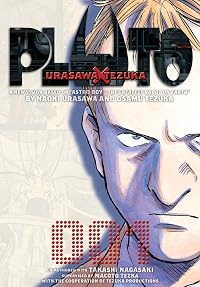
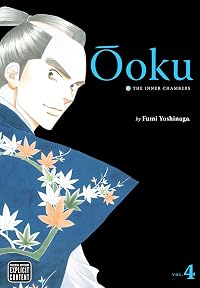
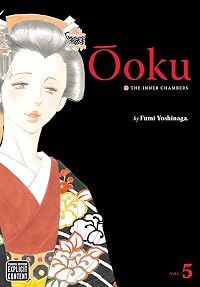

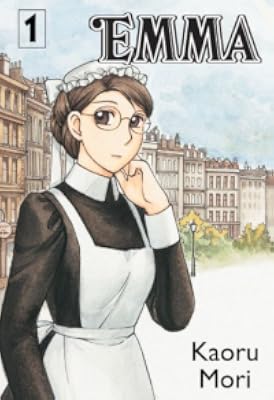
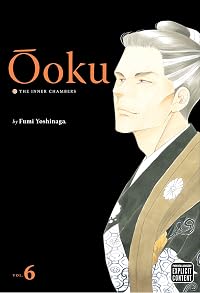
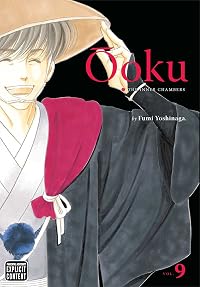
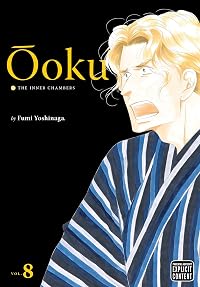
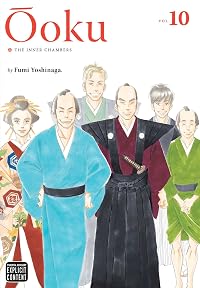

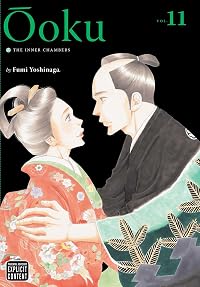

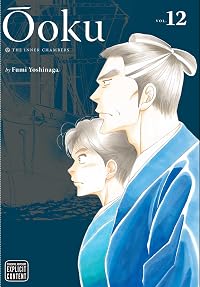

Member Recommendations
legxleg Both are comic books in which men are almost wiped out. Y: The Last Man is modern-day sci-fi while Ooku is an alternate history of Tokugawa Japan.
Also recommended by MyriadBooks
52
infiniteletters A different culture with few men (genetics vs plague).
40

infiniteletters Female power and the harem
Member Reviews
Out of all her series so far, Ōoku: The Inner Chambers is probably the one that has garnered the most awards and nominations for Fumi Yoshinaga, including the first ever James Tiptree, Jr. Award given to a manga. Even though Ōoku was the first of Yoshinaga's works that I learned about, I actually ended up reading, and thoroughly enjoying, several of her others before picking it up. The English edition of Ōoku is published by Viz Media as part of their Signature line. As of October 2009, five volumes of the series have been released in Japan and it is projected to run for a total of ten volumes. There is even a live-action adaption planned for October 2010. The release schedule is slower than most manga, only one volume per year, show more which results in some impatient readers, but also encourages the savoring of each individual installment.
After a brief introduction, most of the first volume concerns Yunoshin Mizuno. The year is 1716, more than eighty years have passed since the beginning of the Redface Pox epidemic; the male population of Japan has been reduced to nearly a quarter of what it once was. Out of necessity, women have taken on the roles previously held by men, including even the military rule of the country. In order to avoid an unwanted marriage and to best support his family, Mizuno decides to enter into service in the Ōoku, or Inner Chambers, of the Shogun. There, hundreds of men are kept and women barred except for the Shogun herself who may choose among the men for her concubines. Mizuno quickly realizes that life in the Inner Chambers is not exactly what he was expecting and finds himself caught up in others' political maneuverings. The first volume also give a good picture of Yoshimune Tokugawa, the current shogun--a strong-willed woman not afraid to challenges the status quo.
Ōoku is more serious overall than most of Yoshinaga's other work that I've read, but she still incorporates lovely moments of humor. Her artwork is as expressive as ever and I personally think it is some of her best. Backgrounds are slightly more detailed than I am used to seeing from Yoshinaga and her depictions of Edo era clothing are simply gorgeous. A few color plates are also included and are stunning. Viz's presentation is beautifully done, although occasionally a panel is cropped a little too closely, and the larger Signature format shows off the artwork nicely. All of the main characters have distinctive looks and even the secondary characters show a good variety of design, something that Yoshinaga seemed to struggle with in her earliest works but here is executed elegantly.
As any good alternate history should, Ōoku incorporates historically accurate elements--such as Japan's Edo era isolationism and the events surrounding the succession of the Shogunate--and gives them new meaning and reason. While the women are officially in charge, the men still have a tremendous amount of influence. Even so, Yoshignaga's women are strong and can hold their own--the Baron's smackdown of the Senior Chamberlain was brilliant, for one. Occasionally, Ōoku can be rather text heavy but the information conveyed is interesting and generally important. Unfortunately, the faux-Early Modern English is rather awkward when used. I think I understand what Viz was trying to do--capture the different levels of formality inherent in the Japanese language but no longer a prominent part of English--but they don't quite pull it off; the language is distracting. But overall, the first volume of Ōoku is a strong start to the series. Beautiful, emotional storytelling accompanies beautiful, expressive art. I am very much looking forward to continuing the series--I love what I've seen so far.
Experiments in Reading show less
After a brief introduction, most of the first volume concerns Yunoshin Mizuno. The year is 1716, more than eighty years have passed since the beginning of the Redface Pox epidemic; the male population of Japan has been reduced to nearly a quarter of what it once was. Out of necessity, women have taken on the roles previously held by men, including even the military rule of the country. In order to avoid an unwanted marriage and to best support his family, Mizuno decides to enter into service in the Ōoku, or Inner Chambers, of the Shogun. There, hundreds of men are kept and women barred except for the Shogun herself who may choose among the men for her concubines. Mizuno quickly realizes that life in the Inner Chambers is not exactly what he was expecting and finds himself caught up in others' political maneuverings. The first volume also give a good picture of Yoshimune Tokugawa, the current shogun--a strong-willed woman not afraid to challenges the status quo.
Ōoku is more serious overall than most of Yoshinaga's other work that I've read, but she still incorporates lovely moments of humor. Her artwork is as expressive as ever and I personally think it is some of her best. Backgrounds are slightly more detailed than I am used to seeing from Yoshinaga and her depictions of Edo era clothing are simply gorgeous. A few color plates are also included and are stunning. Viz's presentation is beautifully done, although occasionally a panel is cropped a little too closely, and the larger Signature format shows off the artwork nicely. All of the main characters have distinctive looks and even the secondary characters show a good variety of design, something that Yoshinaga seemed to struggle with in her earliest works but here is executed elegantly.
As any good alternate history should, Ōoku incorporates historically accurate elements--such as Japan's Edo era isolationism and the events surrounding the succession of the Shogunate--and gives them new meaning and reason. While the women are officially in charge, the men still have a tremendous amount of influence. Even so, Yoshignaga's women are strong and can hold their own--the Baron's smackdown of the Senior Chamberlain was brilliant, for one. Occasionally, Ōoku can be rather text heavy but the information conveyed is interesting and generally important. Unfortunately, the faux-Early Modern English is rather awkward when used. I think I understand what Viz was trying to do--capture the different levels of formality inherent in the Japanese language but no longer a prominent part of English--but they don't quite pull it off; the language is distracting. But overall, the first volume of Ōoku is a strong start to the series. Beautiful, emotional storytelling accompanies beautiful, expressive art. I am very much looking forward to continuing the series--I love what I've seen so far.
Experiments in Reading show less
I’m at the 6th volume in this series, and I heartily recommend it!!!
At first the premise might seem like it could lead to something light and romance-focused (a powerful woman who controls a harem full of handsome men!). In fact, this series is a very serious and thoughtful exploration of a reversal of gender roles and a demographic cataclysm.
- The political games takes centre stage — it’s palace intrigue at its best (I’m into 50-episode long Asian shows about dynastic conflict, and Ooku is on par with the best of those.)
- It really captures well the mores of the Edo period. It’s a ruthless time in many ways.
- The art is gorgeous.
- I’m very taken by the psychological drama the characters go through. It’s this constant show more push and pull between duty and one’s own desires and needs.
My only gripe is with the stilted English translation. Most historical novels don’t feel the need to go back to Elizabethan speech. You get used to the ”prithee” and the “fie” over time.
I would recommend it to readers who enjoy power games more than a sexy shojo in which a female character has a lot of men at her disposition. If that’s your poison, then do dive in into the wonderful world of Ooku! show less
At first the premise might seem like it could lead to something light and romance-focused (a powerful woman who controls a harem full of handsome men!). In fact, this series is a very serious and thoughtful exploration of a reversal of gender roles and a demographic cataclysm.
- The political games takes centre stage — it’s palace intrigue at its best (I’m into 50-episode long Asian shows about dynastic conflict, and Ooku is on par with the best of those.)
- It really captures well the mores of the Edo period. It’s a ruthless time in many ways.
- The art is gorgeous.
- I’m very taken by the psychological drama the characters go through. It’s this constant show more push and pull between duty and one’s own desires and needs.
My only gripe is with the stilted English translation. Most historical novels don’t feel the need to go back to Elizabethan speech. You get used to the ”prithee” and the “fie” over time.
I would recommend it to readers who enjoy power games more than a sexy shojo in which a female character has a lot of men at her disposition. If that’s your poison, then do dive in into the wonderful world of Ooku! show less
What Fumi Yoshinaga attempts in her manga is not so much a full-fledged alternate history (how would things have gone differently if "X" had or hadn't happened?) as an alternate explanation of the history (let's imagine why this historical turn occurred). The question of why seventeenth century Japan had to be so firmly closed off - one might even say quarantined - from outside influences and inquiries lurks in the background of this series.
The first volume lays out the core of this alternate causality, and it is a bit of a comics classic: an unknown source brings a strange plague to the island of Japan - the red pox - and it spreads quickly among the men, killing mostly the young swiftly and more than decimating the male population. show more Those of you who have read Y: The Last Man (or The Knife of Never Letting Go) may find this a familiar premise - the crucial difference is that this plague doesn't seem to obliterate a whole gender, but rather radically diminishes their numbers.
The importance of this shift in the ratio of men to women soon becomes clear. Some years later we find a nation in which the gender map of social hierarchy has been inverted. Since the men haven't been totally wiped out, what happens is an alteration in the economics of gender. Women are now the labor force, and both families and governmental structures have become matriarchal. Men are prized, but not for themselves so much as what they carry in their pants. They are regarded as creatures too delicate and precarious for harsh treatment, and much is done to preserve their value. But their value is utterly alienated from any sense of autonomy, any right to choose their actions or how they will contribute to the common wealth of family and nation, any sense that an individual man can pursue his personal happiness. Matriarchs regularly sell their sons' sexual services - temporarily or permanently - to the highest bidder to support the family. Marriage (which ties male procreative potential to a single womb) becomes the province of only the wealthiest families, those who can buy their daughters the exclusive rights to a man's bed. Poorer women muster their savings to afford a night at a brothel, and the hope that they might conceive.
[Excerpted from a longer review on my blog: http://sycoraxpine.blogspot.com/2010/08/sexual-ethics-ooku-inner-chambers.html] show less
The first volume lays out the core of this alternate causality, and it is a bit of a comics classic: an unknown source brings a strange plague to the island of Japan - the red pox - and it spreads quickly among the men, killing mostly the young swiftly and more than decimating the male population. show more Those of you who have read Y: The Last Man (or The Knife of Never Letting Go) may find this a familiar premise - the crucial difference is that this plague doesn't seem to obliterate a whole gender, but rather radically diminishes their numbers.
The importance of this shift in the ratio of men to women soon becomes clear. Some years later we find a nation in which the gender map of social hierarchy has been inverted. Since the men haven't been totally wiped out, what happens is an alteration in the economics of gender. Women are now the labor force, and both families and governmental structures have become matriarchal. Men are prized, but not for themselves so much as what they carry in their pants. They are regarded as creatures too delicate and precarious for harsh treatment, and much is done to preserve their value. But their value is utterly alienated from any sense of autonomy, any right to choose their actions or how they will contribute to the common wealth of family and nation, any sense that an individual man can pursue his personal happiness. Matriarchs regularly sell their sons' sexual services - temporarily or permanently - to the highest bidder to support the family. Marriage (which ties male procreative potential to a single womb) becomes the province of only the wealthiest families, those who can buy their daughters the exclusive rights to a man's bed. Poorer women muster their savings to afford a night at a brothel, and the hope that they might conceive.
[Excerpted from a longer review on my blog: http://sycoraxpine.blogspot.com/2010/08/sexual-ethics-ooku-inner-chambers.html] show less
Summary: In Edo Japan, a plague that affects only men has wiped out 75% of the male population. To make up for the lack, women now hold the important positions in government and society, while men are precious seed-givers relegated to the bedroom. In this world, Mizuno, a handsome young man, becomes a member of the Ooku, the Shogun’s Inner Chambers, and a concubine to the Shogun.
Review: Oh Yoshinaga Fumi, why must you be so awesome? One of the things I most admire about her is how genre-bending her work is. She is known primarily as a yaoi mangaka, but unlike other yaoi mangaka she touches upon broader, more universal themes and creates such amazing stories as Antique Bakery and now Ooku. For those of you who are in it only for the show more yaoi, know that so far Ooku does not have much other than a few suggestions. What Ooku is instead is an intelligent, sometimes amusing, reflection on gender, gender roles, and power.
Yoshimune, the Eighth Shogun, is the most interesting character, although she does not appear until halfway into the story since when Mizuno enters the Ooku it is still the rule of the sickly Seventh Shogun. But once Yoshimune enters (with a trip and a bang), she steals the spotlight. She is frugal, sharp, and brash, and she sets out restructuring the court with a gleeful vengeance. It is awesome to behold.
One of the things that has often frustrated me about anime and manga is the scarcity of strong female characters. I mean, there are plenty of strong females, but usually I get the sense that their strength and resolve are mediated through a male character. At first I was worried about Ooku, because despite its premises its focus is on the all-male Inner Chambers. I thought that maybe females would be a powerful but shadowy presence in the story. I am so glad to be wrong. There are plenty of scenes with Yoshimune alone with her female advisors. So men and women alike walk through the pages of this thoroughly intriguing alternate history.
The only thing that grated on me is the English translation’s use of old-fashioned, somewhat Shakespearian, language to render the old-fashioned Japanese inflections. I understand the need, and at times it does add a historic flair to the narrative, but other times it is stylistically unnecessary. Especially when the idioms are so very Renaissance England that it takes me out of the Japanese setting.
Conclusion: One of the best manga I’ve read in a while, and if the first volume is any indication, this is going to be one of Yoshinaga Fumi’s classics. show less
Review: Oh Yoshinaga Fumi, why must you be so awesome? One of the things I most admire about her is how genre-bending her work is. She is known primarily as a yaoi mangaka, but unlike other yaoi mangaka she touches upon broader, more universal themes and creates such amazing stories as Antique Bakery and now Ooku. For those of you who are in it only for the show more yaoi, know that so far Ooku does not have much other than a few suggestions. What Ooku is instead is an intelligent, sometimes amusing, reflection on gender, gender roles, and power.
Yoshimune, the Eighth Shogun, is the most interesting character, although she does not appear until halfway into the story since when Mizuno enters the Ooku it is still the rule of the sickly Seventh Shogun. But once Yoshimune enters (with a trip and a bang), she steals the spotlight. She is frugal, sharp, and brash, and she sets out restructuring the court with a gleeful vengeance. It is awesome to behold.
One of the things that has often frustrated me about anime and manga is the scarcity of strong female characters. I mean, there are plenty of strong females, but usually I get the sense that their strength and resolve are mediated through a male character. At first I was worried about Ooku, because despite its premises its focus is on the all-male Inner Chambers. I thought that maybe females would be a powerful but shadowy presence in the story. I am so glad to be wrong. There are plenty of scenes with Yoshimune alone with her female advisors. So men and women alike walk through the pages of this thoroughly intriguing alternate history.
The only thing that grated on me is the English translation’s use of old-fashioned, somewhat Shakespearian, language to render the old-fashioned Japanese inflections. I understand the need, and at times it does add a historic flair to the narrative, but other times it is stylistically unnecessary. Especially when the idioms are so very Renaissance England that it takes me out of the Japanese setting.
Conclusion: One of the best manga I’ve read in a while, and if the first volume is any indication, this is going to be one of Yoshinaga Fumi’s classics. show less
http://nwhyte.livejournal.com/1607789.html
It is an alternate history, set in a world where a gender-sensitive plague killed most of Japan's menfolk in the mid-17th century; the story itself is set a couple of generations later, in the early 18th century, in an era when men are prized as potential breeding stock but excluded from the levers of formal power. The first three of four issues collected here follow the story of Mizuno Yunoshin, a poor but good-looking boy who joins the Ōoku, essentially the harem of the shōgun, at a time of political change. (The fourth issue has the new shōgun looking into the archives and presumably setting up a framing narrative for historical flashbacks the next volume.)
It's a fascinating construction. show more This is a path that a couple of other writershave previously trodden, most notably John Wyndham in his story "Consider Her Ways" (where all men, rather than most, have become extinct). Apart from the information that men now become commodities to be traded on the marriage market, and that the plague has not affected other countries, most of this first volume simply looks at the inversion of gender relationships as applied to the shōgun's ōoku in our world. There's an extraordinary moment when the shōgun speaks to a visiting Dutch delegation from behind a curtain, so that they will not realise that she is a woman; and she then commands a historical exploration of why patriarchal nomenclature continues to be used. Indeed, although Mizuno Yonushin is the ostensible viewpoint figure of the first three issues, I found the new shōgun, Yoshitsune, much the most interesting character.
Anyway, I shall try and get hold of the remaining volumes - I see that the next three are available in English translation. Good for the Tiptree Award, for calling attention to fascinating works like this one. show less
It is an alternate history, set in a world where a gender-sensitive plague killed most of Japan's menfolk in the mid-17th century; the story itself is set a couple of generations later, in the early 18th century, in an era when men are prized as potential breeding stock but excluded from the levers of formal power. The first three of four issues collected here follow the story of Mizuno Yunoshin, a poor but good-looking boy who joins the Ōoku, essentially the harem of the shōgun, at a time of political change. (The fourth issue has the new shōgun looking into the archives and presumably setting up a framing narrative for historical flashbacks the next volume.)
It's a fascinating construction. show more This is a path that a couple of other writershave previously trodden, most notably John Wyndham in his story "Consider Her Ways" (where all men, rather than most, have become extinct). Apart from the information that men now become commodities to be traded on the marriage market, and that the plague has not affected other countries, most of this first volume simply looks at the inversion of gender relationships as applied to the shōgun's ōoku in our world. There's an extraordinary moment when the shōgun speaks to a visiting Dutch delegation from behind a curtain, so that they will not realise that she is a woman; and she then commands a historical exploration of why patriarchal nomenclature continues to be used. Indeed, although Mizuno Yonushin is the ostensible viewpoint figure of the first three issues, I found the new shōgun, Yoshitsune, much the most interesting character.
Anyway, I shall try and get hold of the remaining volumes - I see that the next three are available in English translation. Good for the Tiptree Award, for calling attention to fascinating works like this one. show less
There is something about this manga that is just so good, and I can't name what it is exactly. This is probably one of, if not the only, more adult manga I have read and it is scratching an itch I never thought I had. It is really interesting to see this look at gender and sexuality in a different way, and how even in a female ruled Japan men still have this almost unspoken power.
I think the only thing that puts me off is the translation, the use of an older form of English is interesting, but I'm not a big fan of it. I understand the use of it as a way to portray to the reader a bygone era that would almost be speaking a different language from the present day, but any humor or tense scenes fall flat for me. Maybe I should read more show more Shakespeare. show less
I think the only thing that puts me off is the translation, the use of an older form of English is interesting, but I'm not a big fan of it. I understand the use of it as a way to portray to the reader a bygone era that would almost be speaking a different language from the present day, but any humor or tense scenes fall flat for me. Maybe I should read more show more Shakespeare. show less
Interesting, brutal, tender... I grew up wishing I could be a knight, and this series rekindled that desire to have an honorable liege again. (It included plenty of examples of why that's a very dumb principle to build your society on, but I just never thought I would have that feeling again.)
Members
- Recently Added By
Lists

Best Science Fiction Originally Published in a Language Other Than English
449 works; 32 members

Japanese Literature
230 works; 40 members

Top Five Books of 2016
795 works; 229 members

Asia
178 works; 7 members

Books Read in 2011
684 works; 19 members

Read in 2011
81 works; 1 member
Author Information

97+ Works 6,469 Members
Some Editions
Awards and Honors
Awards
Distinctions
Series

Belongs to Publisher Series
Common Knowledge
- Canonical title
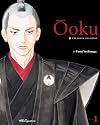
- Ōoku: The Inner Chambers, Vol. 1
- Original title
- 大奥 1
- Alternate titles
- Le pavillon des hommes (1) (1)
- Original publication date
- 2005-10-04 (Japanese edition) (Japanese edition); 2009-08-18 (American edition) (American edition); 2016-11-15 (American edition ebook) (American edition ebook)
- People/Characters
- Sadakichi
- Important places
- Japan
- Important events
- Edo period or Tokugawa period
- Original language
- Japanese
Classifications
- Genres
- Graphic Novels & Comics, Teen
- DDC/MDS
- 741.5952 — Arts & recreation Drawing & decorative arts Drawing Comic books, graphic novels, fotonovelas, cartoons, caricatures, comic strips History, geographic treatment, biography Asian Japanese
- LCC
- PN6790 .J33 .Y682813 — Language and Literature Literature (General) Literature (General) Collections of general literature Comic books, strips, etc.
- BISAC
Statistics
- Members
- 505
- Popularity
- 59,595
- Reviews
- 30
- Rating
- (3.96)
- Languages
- English, French, Italian, Japanese
- Media
- Paper, Ebook
- ISBNs
- 6
- ASINs
- 2