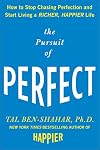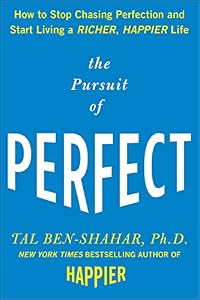
The Pursuit of Perfect: How to Stop Chasing Perfection and Start Living a Richer, Happier Life
by Tal Ben-Shahar
On This Page
Description
A Harvard professor argues that people are unhappy because they're caught in the Myth of Perfection--a dangerous trend fueling society's obsession with having it all. Ben-Shahar believes people need to be more realistic in their goals, and "The Pursuit of Perfect" shows them how.Tags
Recommendations









Member Recommendations
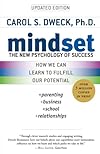
albanyhill Tal Ben-Shahar refers to Carol Dweck's work & the contrast he draws between perfectionism and "optimalism" reminded me of the two mindsets described by Dweck.
Member Reviews
Ben-Shahar's approach to perfectionism and achievement is a healthy one, supported by research, that drives home how pernicious perfectionism can be. The book takes the solid approach of contrasting perfectionism and "optimalism" (the practice of doing the best one can with what one has), and underlining how optimalism beats perfectionism on pretty much every count, *including* achievement. I'm listening to the audio version, and the reader has a good voice and is easy to listen to. The only problem with going audio for this book is that it's full of many useful exercises - the sort I'm used to being able to set the book down for so that I can complete them. A bit harder to do when I have to rush across the room and pause the CD!
 This review was written for LibraryThing Early Reviewers.
I was expecting this book to be a rather bland take on a typical self-help theme, something along the lines of being providing excuses for those who are willing to put in the necessary hard work needed for excellence.
Wow. That was incorrect. Ben-Shahar starts by debunking the perfection as a goal (and perfectionism as a attitude), replacing it with the concept of "optimalism", optimizing outcomes against the constraints of reality. He does this fully and from many angles. And thus finding happiness outside of perfection
And then he takes the concept further linking it to deeper philosophical, emotional, and psychological concepts.
I had thought that the notion of abandoning the drive for perfection would be contradictory to my overall show more approach to life. Instead, I learned that the converse is true. And that has made this the most eye-opening book I've read in years.
(I should elaborate by adding that I found the audio book a little tough to digest, so I bought the 'real' book... that worked much better.) show less
Wow. That was incorrect. Ben-Shahar starts by debunking the perfection as a goal (and perfectionism as a attitude), replacing it with the concept of "optimalism", optimizing outcomes against the constraints of reality. He does this fully and from many angles. And thus finding happiness outside of perfection
And then he takes the concept further linking it to deeper philosophical, emotional, and psychological concepts.
I had thought that the notion of abandoning the drive for perfection would be contradictory to my overall show more approach to life. Instead, I learned that the converse is true. And that has made this the most eye-opening book I've read in years.
(I should elaborate by adding that I found the audio book a little tough to digest, so I bought the 'real' book... that worked much better.) show less
This review was written for LibraryThing Early Reviewers.A self-help book! I think I would have liked Happier better; this book is directed at giving readers strategies to guide themselves in the direction of “optimalism” rather than perfectionism, accepting disappointment and long, hard roads to success. I was really struck by the ways in which the advice was removed from social context and individualized: other people showed up, basically, as potential sources of desired goods like love, but it was all about changing yourself. I guess I shouldn’t be surprised that the baseline for a self-help book was a highly independent self with a lot of social capital, such that success (or failure) at standard material/social goals was possible, but it was just so unlike what I usually read. show more Ben-Shahar argues that human nature is fixed (though he gives very little content to that fixity in this book, except to say that communism must fail and capitalism must succeed; he quotes Ayn Rand as a good guide to love!) but human behavior isn’t, and once he made that move, with no attempt to discuss power and how things get slotted into nature v. behavior and by whom, I kind of stopped paying attention. On the other hand, I did find earlier parts of the book useful: he makes a good case that modern Western culture too readily encourages people to suppress bad feelings instead of acknowledging them, which makes it harder to experience good feelings in the long run. show less
The main thought throughout the book is how trying to live a perfect life, to have perfect looks and perfect careers is actually ruining our lives. Shortly said, perfectionism is bad. On the other hand, we, the people obsessed with the perfect, should instead try to attain a state of optimalism, a term Mr. Ben-Shahar came up with. Tal Ben-Shahar is a perfectionist and he noticed long time ago that trying to have it all and avoiding failure, negative emotions and get the goals no matter what was making his life miserable. He had done a lot of research to find a way out of his misery and the outcome is The Pursuit of Perfect, in which we are presented with a solution: a middle ground and acceptance of our human nature. The book offers show more some simple, yet great exercises which do not require a lot of time or effort, and most importantly leave some space for error, since they need not be done perfectly. At the core of the whole book is that our society shuns pain, sorrow, unhappiness and requires us all to be always at our best behavior, always smiling, always being nice to customers and fellow employers and if there is a shadow of anger or sadness lurking about, we run to doctor’s for pills and therapies, because these emotions are absolutely unwelcome. Ben-Shahar argues that as humans we are equipped with tools within ourselves to deal with negative emotions and one of these tools is “going with it”, instead of burying a specific feeling we have and we don’t want to have, be it fear, jealousy, anger and so forth. The more we deny ourselves these emotions the more persistent they will be and sooner or later they will resurface making us miserable.
I have to say that despite my doubts about a self-help book ever working for me, The Pursuit of Perfect appealed to me a lot. First of all, even if perfectionism was never one of my many vices, I realized that I was too among the hordes of people trying to live up to societal expectations of the perfect. From the first pages I could tell that this book had a potential of opening my eyes and also giving me permission to just act according to my human nature, to be simply ‘good enough’ and not necessarily ‘better than’. Mr. Ben-Shahar’s writing is very accessible and quite persuasive. To give you an example, I have always been a person who would suddenly feel envy towards somebody else and then immediately I would scorn myself for feeling this horrible emotion, put it aside and in the end beating myself for the rest of the day about how I must be a bad human being for feeling envy towards somebody that most likely doesn’t deserve it. A few days ago, I was sitting in a public place, waiting my turn to be serviced and reading the part of the book which talks about not suppressing our negative feelings but instead accepting them. And wouldn’t you know, there comes a drop-dead girl, wearing sexy clothes and attracting stares of every male specimen in the room. I immediately start being jealous and think of all the reasons why she really is looking ridiculous and completely overdressed and how she truly is screaming for attention. But instead of suppressing these emotions of jealousy and low self-confidence, I decided to just stay with them and take a closer look at the girl. I allowed myself to feel the negativity, I accepted the fact that I indeed was being jealous and went back to reading my book. Hours later, when I left the building, I all of a sudden realized that I completely forgot about that girl, didn’t beat myself up for being jealous and I had a fairly good, relaxing time as opposed to being literally devoured by envy. So there you have it. It worked and I have a strong feeling that if this one worked, others might too. show less
I have to say that despite my doubts about a self-help book ever working for me, The Pursuit of Perfect appealed to me a lot. First of all, even if perfectionism was never one of my many vices, I realized that I was too among the hordes of people trying to live up to societal expectations of the perfect. From the first pages I could tell that this book had a potential of opening my eyes and also giving me permission to just act according to my human nature, to be simply ‘good enough’ and not necessarily ‘better than’. Mr. Ben-Shahar’s writing is very accessible and quite persuasive. To give you an example, I have always been a person who would suddenly feel envy towards somebody else and then immediately I would scorn myself for feeling this horrible emotion, put it aside and in the end beating myself for the rest of the day about how I must be a bad human being for feeling envy towards somebody that most likely doesn’t deserve it. A few days ago, I was sitting in a public place, waiting my turn to be serviced and reading the part of the book which talks about not suppressing our negative feelings but instead accepting them. And wouldn’t you know, there comes a drop-dead girl, wearing sexy clothes and attracting stares of every male specimen in the room. I immediately start being jealous and think of all the reasons why she really is looking ridiculous and completely overdressed and how she truly is screaming for attention. But instead of suppressing these emotions of jealousy and low self-confidence, I decided to just stay with them and take a closer look at the girl. I allowed myself to feel the negativity, I accepted the fact that I indeed was being jealous and went back to reading my book. Hours later, when I left the building, I all of a sudden realized that I completely forgot about that girl, didn’t beat myself up for being jealous and I had a fairly good, relaxing time as opposed to being literally devoured by envy. So there you have it. It worked and I have a strong feeling that if this one worked, others might too. show less
In 'the Pursuit of Perfect' Ben-Shahar expands on many of the ideas outlines in his prior book 'Happiness'. Delving into the details of how to get over our perfectionist mentality to achieve a happy life of satisfaction. While this book is essentially a self-help book, it reads like an interesting compendium of the scientific research into what differentiates happy people from unhappy people, specifically as this happiness relates to our pursuit of achievement and self fulfillment. In his recommendations Ben-Shahar takes into account a variety of human tendencies and how the status quo has led us to misunderstand why it is that we pursue certain goals. This book is extremely practical and enlightening for anyone who finds their show more ambitions to sometimes feel overwhelming, a poor fit for their true interests, and an impediment to their overall contentedness with life. Since our modern culture(s) offer so many distractions and diversions from what is truly important to each of us, this book offers a reminder what we should be focusing on and how to pursue that focus in a healthy manner. One criticism that has been levied at Ben-Shahar specifically, and happiness psychology generally, is that while this might be practical for people who are educated, working in professional positions, or who are independently wealthy, it seems to have little application to people who for one reason or another are downtrodden and struggling to have their most basic needs met. This criticism might be somewhat unfair, since Ben-Shahar himself recognizes that in order to pursue the type of happiness he is discussing, one's basic needs must not be in question. While I agree with this limitation of happiness psychology, that does not negate the suggestions for people who do have their most basic needs met, yet the recommendations in this book may facilitate greater enjoyment of those basic needs, if one can learn to recognize how. show less
This review was written for LibraryThing Early Reviewers.Ever since reading about Tal Ben-Shahar in a Boston Globe article (http://www.boston.com/news/local/articles/2006/03/10/harvards_crowded_course_to_happiness/ ) I've been interested to learn more about what he was teaching in his "sold out" Harvard course.
I haven't been disappointed. The main tenet of the book is that perfectionism often limits your success and even when it doesn't, you don't appreciate what you've achieved. He recommends becoming a optimalist (a new word he coined I believe) instead. An optimalist accepts failure as part of life, enjoys the journey instead of only the destination and is still able to achieve goals.
As one who has strong tendencies toward perfectionism, it's an especially useful read. He covers other show more useful areas like striking a balance between work, family and recreation, using personal examples. He uses his own life as an illustration on how to apply the principles he teaches. I find this quite helpful as it lets you in on his own experiences with perfectionism as well as giving you concrete examples to emulate in your own life.
I can't say whether this book had long-lasting affects yet but I plan to apply his suggestions in order to become an optimalist in time.
I agree with other reviewers that the reader detracted from the content. I would have preferred to hear the author read his book. show less
I haven't been disappointed. The main tenet of the book is that perfectionism often limits your success and even when it doesn't, you don't appreciate what you've achieved. He recommends becoming a optimalist (a new word he coined I believe) instead. An optimalist accepts failure as part of life, enjoys the journey instead of only the destination and is still able to achieve goals.
As one who has strong tendencies toward perfectionism, it's an especially useful read. He covers other show more useful areas like striking a balance between work, family and recreation, using personal examples. He uses his own life as an illustration on how to apply the principles he teaches. I find this quite helpful as it lets you in on his own experiences with perfectionism as well as giving you concrete examples to emulate in your own life.
I can't say whether this book had long-lasting affects yet but I plan to apply his suggestions in order to become an optimalist in time.
I agree with other reviewers that the reader detracted from the content. I would have preferred to hear the author read his book. show less
This review was written for LibraryThing Early Reviewers.'Readingextravaganza' has written an excellent review summarizing the main ideas in this book. I think that the author's advice to try to be an 'optimalist' rather than a 'perfectionist' is wise and helpful. Perfectionism can indeed make you miserable. If I had read the book instead of listened to it, I probably would have rated it with 3 or 4 stars.
I can't give this CD set a good review, however. In general, I have trouble appreciating audio books, and this one is no exception. The author's ideas merit pondering, and it's difficult to ponder while listening to a book being read. You could pause the CD and 'ponder' but that doesn't come naturally to me, And of course the index, notes, and excellent bibliography are missing.
The main show more problem with the CD version is, however, the reader. His voice is didactic, and he takes the opportunity to sound snide and sarcastic whenever he can fit it in. I've looked at the book itself, and find the author's writing 'personality' to be gentle and humorous, but this didn't come across at all. I can't help but wish that Mr. Ben-Shahar had read the book himself. As a Harvard professor, he's probably an accomplished lecturer. show less
I can't give this CD set a good review, however. In general, I have trouble appreciating audio books, and this one is no exception. The author's ideas merit pondering, and it's difficult to ponder while listening to a book being read. You could pause the CD and 'ponder' but that doesn't come naturally to me, And of course the index, notes, and excellent bibliography are missing.
The main show more problem with the CD version is, however, the reader. His voice is didactic, and he takes the opportunity to sound snide and sarcastic whenever he can fit it in. I've looked at the book itself, and find the author's writing 'personality' to be gentle and humorous, but this didn't come across at all. I can't help but wish that Mr. Ben-Shahar had read the book himself. As a Harvard professor, he's probably an accomplished lecturer. show less
This review was written for LibraryThing Early Reviewers.Members
- Recently Added By
Author Information

29+ Works 1,206 Members
Tal Ben-Shahar, Ph.D., is the New York Times bestselling author of Happier. Tal consults and lectures around the world to executives in multinational corporations, the general public, and at-risk populations.
Common Knowledge
- Original title
- The pursuit of perfect
Classifications
Statistics
- Members
- 163
- Popularity
- 200,249
- Reviews
- 18
- Rating
- (3.64)
- Languages
- Dutch, English, French, Spanish
- Media
- Paper, Audiobook, Ebook
- ISBNs
- 12
- ASINs
- 3