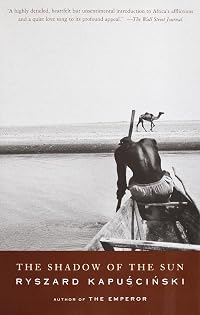
The Shadow of the Sun
by Ryszard Kapuściński
On This Page
Description
In 1957, Ryszard Kapuscinski arrived in Africa to witness the beginning of the end of colonial rule as the first African correspondent of Poland's state newspaper. From the early days of independence in Ghana to the ongoing ethnic genocide in Rwanda, Kapuscinski has crisscrossed vast distances pursuing the swift, and often violent, events that followed liberation. Kapuscinski hitchhikes with caravans, wanders the Sahara with nomads, and lives in the poverty-stricken slums of Nigeria. He show more wrestles a king cobra to the death and suffers through a bout of malaria. What emerges is an extraordinary depiction of Africa--not as a group of nations or geographic locations--but as a vibrant and frequently joyous montage of peoples, cultures, and encounters. Kapuscinski's trenchant observations, wry analysis and overwhelming humanity paint a remarkable portrait of the continent and its people. His unorthodox approach and profound respect for the people he meets challenge conventional understandings of the modern problems faced by Africa at the dawn of the twenty-first century. show lessTags
Recommendations









Member Recommendations
Member Reviews
I diari africani del grande Kapuściński, come sempre in grado di calarsi in qualsiasi situazione e andare al fondo delle persone e dei fatti con estrema umiltà.
Non giudica mai, non c'è mai superiorità nelle sue descrizioni, ma un continuo chiedersi la ragione delle cose, quella vera, e una naturale e incredibile capacità di guardare dietro le apparenze e trovare l'origine delle colpe.
Nonostante sia datato, credo che Ebano sia tutt'oggi uno dei migliori libri per conoscere le radici del disastro Africa.
Non giudica mai, non c'è mai superiorità nelle sue descrizioni, ma un continuo chiedersi la ragione delle cose, quella vera, e una naturale e incredibile capacità di guardare dietro le apparenze e trovare l'origine delle colpe.
Nonostante sia datato, credo che Ebano sia tutt'oggi uno dei migliori libri per conoscere le radici del disastro Africa.
The marriage of a persistent stream of lucid writing with flashes of genuine insight makes Ryszard Kapuściński's The Shadow of the Sun a treat, and one of the more original travel books I have read. Many travel books – particularly those about Africa – can't resist a sort of fawning orientalism, a fetishization of the 'dark continent' that presents it either as a hellish wasteland of rape and war or a vibrant, drum-playing kumbaya that puts the stolid West to shame. Perhaps Kapuściński is too worldly-wise, or too good a writer for untruths to survive in his prose, but The Shadow of the Sun manages to resist the allure of these fetishes and is bracingly realistic about Africa.
Kapuściński maintains a good balance between the two show more extremes. He can wax lyrical about the continent's treasures, but doesn't shy away from its poisons either; nowhere is this better shown than in the chapter on Rwanda (pp165-82), which remarks upon the beauty of the Rwandan mountains (pg. 170) but also gives an excellent summary of the tribal animosities that led to the appalling Rwandan genocide. And while Kapuściński is willing to discuss the very real effects of colonialism on the continent, he does not fall into the self-hating Western panacea of blaming all of Africa's problems on the white man's predation. The freed African-American slaves who returned to found Liberia established a caste system which enslaved the natives. The mountainous Rwanda, he notes, was largely untouched by the 18th- and 19th-century slave trade which impacted the plains societies; the murderous rancour between Hutu and Tutsi was something they generated themselves.
Kapuściński eulogises the immediate colours of the African dawn, but is also unperturbed about documenting some of the societies' self-defeating behaviours – for example, the unpaid airport staff who make their money from corruption, and so steal Kapuściński's travel documents upon arrival so he must buy them back from them (pg. 236). Another good example of this is the following observation: "If a tree trunk falls across the road, it will not be removed; people will go around it, onto the adjoining field, and eventually beat out a new road" (pg. 259). Endurance and a stoical determination, but also a short-termism that ensures the future will ultimately have the same unresolved problems as the present.
For all the criticism of Kapuściński that he may have invented or embellished certain stories, on a more fundamental level of writing he refuses to editorialise. The willingness to people his book with the idle "gapers of the world" (pg. 138) as well as with industrious and philosophical Africans gives you a sense of Africa that, you suspect, is a closer approximation of the truth. In one of his most astute observations in the book, he notes that when cultures meet it is not always in the best of circumstances, and "first contacts… were most frequently carried out by the worst sorts of people: robbers, soldiers of fortune, adventurers, criminals, slave traders". Such encounters set the tone, and naturally "respect for other cultures, a desire to learn about them, to find a common language, were the furthest things from the minds of such folk" (pg. 321). Kapuściński laments that this "cultural monopoly of crude know-nothings" (pg. 322) has had such a deep and destructive impact on our world but, in spending his own thoughtful words on the matter in The Shadow of the Sun, he has done what he can to try to break that monopoly. show less
Kapuściński maintains a good balance between the two show more extremes. He can wax lyrical about the continent's treasures, but doesn't shy away from its poisons either; nowhere is this better shown than in the chapter on Rwanda (pp165-82), which remarks upon the beauty of the Rwandan mountains (pg. 170) but also gives an excellent summary of the tribal animosities that led to the appalling Rwandan genocide. And while Kapuściński is willing to discuss the very real effects of colonialism on the continent, he does not fall into the self-hating Western panacea of blaming all of Africa's problems on the white man's predation. The freed African-American slaves who returned to found Liberia established a caste system which enslaved the natives. The mountainous Rwanda, he notes, was largely untouched by the 18th- and 19th-century slave trade which impacted the plains societies; the murderous rancour between Hutu and Tutsi was something they generated themselves.
Kapuściński eulogises the immediate colours of the African dawn, but is also unperturbed about documenting some of the societies' self-defeating behaviours – for example, the unpaid airport staff who make their money from corruption, and so steal Kapuściński's travel documents upon arrival so he must buy them back from them (pg. 236). Another good example of this is the following observation: "If a tree trunk falls across the road, it will not be removed; people will go around it, onto the adjoining field, and eventually beat out a new road" (pg. 259). Endurance and a stoical determination, but also a short-termism that ensures the future will ultimately have the same unresolved problems as the present.
For all the criticism of Kapuściński that he may have invented or embellished certain stories, on a more fundamental level of writing he refuses to editorialise. The willingness to people his book with the idle "gapers of the world" (pg. 138) as well as with industrious and philosophical Africans gives you a sense of Africa that, you suspect, is a closer approximation of the truth. In one of his most astute observations in the book, he notes that when cultures meet it is not always in the best of circumstances, and "first contacts… were most frequently carried out by the worst sorts of people: robbers, soldiers of fortune, adventurers, criminals, slave traders". Such encounters set the tone, and naturally "respect for other cultures, a desire to learn about them, to find a common language, were the furthest things from the minds of such folk" (pg. 321). Kapuściński laments that this "cultural monopoly of crude know-nothings" (pg. 322) has had such a deep and destructive impact on our world but, in spending his own thoughtful words on the matter in The Shadow of the Sun, he has done what he can to try to break that monopoly. show less
Dispatches from Africa spanning the decades from the independence movement to the Rwandan genocide. What makes Kapuscinski’s work so compelling is his willingness to break off, to leave a scene or a story just as it’s getting started, letting the reader’s imagination take over based on the cues and clues he’s provided. His voice is a economical and drily comical, with echoes of Sebald and (maybe just me) Werner Herzog.
The pieces in this collection range from single-scenes, vignettes, arrivals or departures in the desert, the slum, the savanna, to mini-essays like his unputdownable biography of Idi Amin. He never tries to downplay his outsider status, but he also understands that if it’s unbearably hot for him, it’s the same show more for the locals (in fact he ascribes many of the continent’s characteristics and customs to the largely inimical climate).
There’s stuff here on Sudan, Nigeria, Mali, Ghana, Niger, Ethiopia, Eritrea, Uganda, Rwanda, Zambia, Zanzibar, and many more places in passing. The guy was just a born journalist. show less
The pieces in this collection range from single-scenes, vignettes, arrivals or departures in the desert, the slum, the savanna, to mini-essays like his unputdownable biography of Idi Amin. He never tries to downplay his outsider status, but he also understands that if it’s unbearably hot for him, it’s the same show more for the locals (in fact he ascribes many of the continent’s characteristics and customs to the largely inimical climate).
There’s stuff here on Sudan, Nigeria, Mali, Ghana, Niger, Ethiopia, Eritrea, Uganda, Rwanda, Zambia, Zanzibar, and many more places in passing. The guy was just a born journalist. show less
It may be difficult not to love this man, yet his books about Africa are rather ethnocentric with plenty of condescending paternalism in it.
Kapuscinski has charm. He is a romantic. He appreciates how small, everyday acts of kindness can form the basis of a good story. Yet his tendency to exaggerate, generalize and sensationalize in a superficial way reflects his journalistic gaze, which scans for the exceptional, news-worthy at the expense of a full understanding, a complete picture, a critical take on ‘the obvious’.
Often one is tempted to shout out – Man! Start reading some books! For instance when he claims that apartheid was invented by Boers in South Africa (correct) and next observes that you can see it anywhere in Africa show more (not quite correct). How about reading some stuff about Lord Lugard and the British system of dual rule? Ever heard of segregation, British style? How about Mamdani’s book on Citizen and subject?
Yet in mediation for this blatant ignorance, Kapuscinski can be unconventional and charming in taking on old debates. For instance when he is accused of being white and thus guilty of suppressing Africans, robbing their countries blind, his response is – Why, me? ‘You were colonized? We, Poles, were also! For one hundred and thirty years we were a colony of three foreign powers. White ones, too.’. That’s Kapuscinski’s charm and humour. Interpersonally he must have been a joy to interact or work with.
The part of African society he has very well understood is the importance of social relations and exchange of gifts (sometimes of a very different order: something of symbolic value can be exchanged with something of material value). The story about the hole in Onitsha, I like best. Here Kapuscinski reveals something that few people realize: the emergent nature of buzzing activity, and the tendency to help fate a bit, if one can. Basically in the story Kapuscinski creates suspense by telling us about the nature and joy of open markets in Africa, of which the one in Onitsha, Nigeria, is purportedly the biggest. Driving there, Kapuscinski gets stuck in a long traffic jam. He walks ahead to assess what is blocking the (only) road to the market: a big hole, in which trucks and cars get stuck in the mud, and have to be hauled out by groups of young men (for a fee). Around this very hole a hive of activities occurs – street sellers making a buck, young men ganging up to be the next team to make a buck with hauling out cars, news collectors, everybody coalesces around the hole. Kapuscinski assesses the pace, and decides to turn back: it will take him three days to make it through the hole that separates him from this famous market place. He returns but not without catching the butt of the story: the hole moves, every now and then it appears in a different neighbourhood, thus spreading wealth and activity across different parts of town. show less
Kapuscinski has charm. He is a romantic. He appreciates how small, everyday acts of kindness can form the basis of a good story. Yet his tendency to exaggerate, generalize and sensationalize in a superficial way reflects his journalistic gaze, which scans for the exceptional, news-worthy at the expense of a full understanding, a complete picture, a critical take on ‘the obvious’.
Often one is tempted to shout out – Man! Start reading some books! For instance when he claims that apartheid was invented by Boers in South Africa (correct) and next observes that you can see it anywhere in Africa show more (not quite correct). How about reading some stuff about Lord Lugard and the British system of dual rule? Ever heard of segregation, British style? How about Mamdani’s book on Citizen and subject?
Yet in mediation for this blatant ignorance, Kapuscinski can be unconventional and charming in taking on old debates. For instance when he is accused of being white and thus guilty of suppressing Africans, robbing their countries blind, his response is – Why, me? ‘You were colonized? We, Poles, were also! For one hundred and thirty years we were a colony of three foreign powers. White ones, too.’. That’s Kapuscinski’s charm and humour. Interpersonally he must have been a joy to interact or work with.
The part of African society he has very well understood is the importance of social relations and exchange of gifts (sometimes of a very different order: something of symbolic value can be exchanged with something of material value). The story about the hole in Onitsha, I like best. Here Kapuscinski reveals something that few people realize: the emergent nature of buzzing activity, and the tendency to help fate a bit, if one can. Basically in the story Kapuscinski creates suspense by telling us about the nature and joy of open markets in Africa, of which the one in Onitsha, Nigeria, is purportedly the biggest. Driving there, Kapuscinski gets stuck in a long traffic jam. He walks ahead to assess what is blocking the (only) road to the market: a big hole, in which trucks and cars get stuck in the mud, and have to be hauled out by groups of young men (for a fee). Around this very hole a hive of activities occurs – street sellers making a buck, young men ganging up to be the next team to make a buck with hauling out cars, news collectors, everybody coalesces around the hole. Kapuscinski assesses the pace, and decides to turn back: it will take him three days to make it through the hole that separates him from this famous market place. He returns but not without catching the butt of the story: the hole moves, every now and then it appears in a different neighbourhood, thus spreading wealth and activity across different parts of town. show less
Kapuściński was a Polish journalist who died in 2007, and who spent time in Africa between the late 1950ies and the 1990ies. Africa was not his only beat, but when he spent time there he spent time with the people and shared their lives when he could. He was the first Polish foreign correspondent to cover Africa and he was always seriously underfunded compared with those representing the big European and American publications and agencies. What he lacked in funds he made up in ingenuity and a willingness to share in the lives of Africans with the result that he got the big stories (a coup in Zanzibar is the subject of one piece) but also the stories about the little people. He went to visit friends in remote villages where there show more wasn't enough to eat. He traveled in war zones. He met the dictators and sadists who were independent Africa's first rulers. Once traveling with Greek correspondent in the region of Lake Victoria, he took refuge in a hut where he collapsed, exhausted, into a bunk only to discover a huge Egyptian cobra coiled underneath. He and the Greek threw their weight behind a huge metal container (their only weapon) and tried to crush it. The canister did not cut into the snake and they had to wrestle it to death. He got cerebral malaria, nearly died, and lived with the after affects for years.The pieces in this book are beautifully written, undoubtedly due in part of the translator. Not like journalistic pieces one usually reads, with their pyramid structure and journalistic phrases and short cuts. Kapuściński's scope was broader, from the latest war or coup to serious attempts to characterize African people. He put himself on the line in every piece—it was personal, heartfelt and wise. He engaged seriously with people, didn't just watch from afar or "interview the participants".One learns a great deal about the history of Africa—and why in a sense there was no history until the Europeans started to divide Africa up into colonies and zones of interest. Why there'd never be a history because there were no documents at all, only the oral stories the people told. The chapter on Rwanda is worth the purchase of the book alone: Kapuściński put the genocide in a context which none of the several books I read on the subject of the Rwandan genocide was able to do. Similarly, another long chapter on a visit to Liberia developed a context for the awful civil wars which began when an army sergeant took charge and carved up the President in his bed—without even a plan for what he'd do when he became leader—and was eventually carved up himself. That essay ends when Kapuściński is allowed to travel up country and meet the tribal people (which the ruling Americo-Liberians called aboriginals when I visited in 1965). They are coming into Monrovia across a bridge and Kapuściński sees a naked man with a Kalashnikov, the others carefully stepping out of his way. "A madman with a Kalashnikov" is how he, quite appropriately, ends the essay.Kapuściński's focus in this book is mostly East Africa and the Sahara and Sanhel, a few mentions of West Africa, not much of Southern Africa. Not much about the more "civilized" parts of Northern Africa. show less
The forty years of experiences of Ryszard Kapuscinski in Africa will excite and amaze readers. He shows a rare and profoundly deep respect for the cultures of the regions in which he traveled. As apparent in Shadow of the Sun, Kapuscinski writes in stunning clarity, whether it be describing trying to navigate a vehicle through a traffic jam of sleepy buffalo or watching mustached cockroaches the size of small turtles; killing a cobra sleeping in a roadside hut or holding his breath while an elephant meanders through camp. Even tackling more serious topics like Uganda's decolonization and ultimate independence, the coup in Zanzibar, or the Tutsi/Hutu conflict is articulated with grace and respect.
Speaking of the Tutsi/Hutu conflict, a show more side note. I never thought about ideological training as a part of warfare. It is not widely discussed as a boot camp topic, but it makes sense. You need to indoctrinate your subordinates because it was clever to have every Rwandan Tutsi citizen guilty of murder; a crime committed by the masses.
They say the best artists suffer for their art. Kapuscinski has been jailed for his curiosity over forty times. He contracted cerebral malaria, which sounds pretty bad until you add tuberculosis to the mix. show less
Speaking of the Tutsi/Hutu conflict, a show more side note. I never thought about ideological training as a part of warfare. It is not widely discussed as a boot camp topic, but it makes sense. You need to indoctrinate your subordinates because it was clever to have every Rwandan Tutsi citizen guilty of murder; a crime committed by the masses.
They say the best artists suffer for their art. Kapuscinski has been jailed for his curiosity over forty times. He contracted cerebral malaria, which sounds pretty bad until you add tuberculosis to the mix. show less
A series of 'reportage' essays by a Polish reporter who spent a large part of 40 years in Africa, starting in 1958. The essays range around the centre of the continent (the north African, Mediterranean countries are not discussed, ditto South Africa), often sketches of everyday life and the experience of being in Africa and travelling from place to place, but also including his experience of political storms - of Idi Amin, Rwanda, and Liberia.
This is a brilliant book. Absolutely fascinating and informative as well as entertaining - some of the scenes are as dramatic as anything I've read in fiction or non (one decidedly terrifying encounter with a cobra in particular), others are interesting vignettes about life in lands very different show more from my own. His writing is great (in translation) and the whole thing is a real pleasure to read.
Only one thing prevents me giving this all five stars. Some reading around this book (his wiki page, obituaries from when he died in 2007 etc) - Kapuściński is clearly a controversial figure, partly for reasons that, while important, are not really relevant to this book (his supposed collaboration with the Polish communist government) and perhaps a touch unfair (many African writers seem to dislike his 'European' view of their continent...but he is European, and that's the way he sees it, right or wrong). A significant issue, however, are accusations that some of his stories might be embellished, or some outright invented. None of the stories in this book are mentioned in the accusations I've read, but it is a big proviso in a book posing as reportage. Probably not coincidentally, a lot of the charges seem to have been made since Kapuściński died, and without him here to defend himself, it's hard to give a definitive verdict.
Approached with the proviso in mind that some of the tales might be a little taller in the telling than in real life, however, I really can't recommend this enough - incredibly enjoyable. show less
This is a brilliant book. Absolutely fascinating and informative as well as entertaining - some of the scenes are as dramatic as anything I've read in fiction or non (one decidedly terrifying encounter with a cobra in particular), others are interesting vignettes about life in lands very different show more from my own. His writing is great (in translation) and the whole thing is a real pleasure to read.
Only one thing prevents me giving this all five stars. Some reading around this book (his wiki page, obituaries from when he died in 2007 etc) - Kapuściński is clearly a controversial figure, partly for reasons that, while important, are not really relevant to this book (his supposed collaboration with the Polish communist government) and perhaps a touch unfair (many African writers seem to dislike his 'European' view of their continent...but he is European, and that's the way he sees it, right or wrong). A significant issue, however, are accusations that some of his stories might be embellished, or some outright invented. None of the stories in this book are mentioned in the accusations I've read, but it is a big proviso in a book posing as reportage. Probably not coincidentally, a lot of the charges seem to have been made since Kapuściński died, and without him here to defend himself, it's hard to give a definitive verdict.
Approached with the proviso in mind that some of the tales might be a little taller in the telling than in real life, however, I really can't recommend this enough - incredibly enjoyable. show less
Members
- Recently Added By
Published Reviews
ThingScore 79
As literature, “The Shadow of the Sun” is in its way magnificent. As analysis, it can be strange. Mr Kapuscinski's account of Idi Amin's rule is inaccurate and his history of Rwanda is botched. Mysteriously, he travels from Djibouti to Gondar by way of Ndjamena: two sides of a huge triangle. Mr Kapuscinski tells it as it felt, rather than as it was, describing—sometimes, it seems, show more distastefully relishing—whatever is bizarre, humiliating, disgusting, exotic. show less
added by Serviette
The word 'reportage' appears twice in the jacket endorsements of this fine narrative study of African events and people, of African conditions and geography, by Ryszard Kapuscinski. According to John le Carré, Kapuscinski is the 'conjurer extraordinary of modern reportage'. According to Michael Ignatieff, who is no slouch in the same department, he has raised reportage 'to the status of show more literature'. show less
added by Serviette
He is lyrically succinct - in the stupor of noon a village was "like a submarine at the bottom of the ocean: it was there, but it emitted no signals, soundless, motionless" - and often hysterically funny.
added by mikeg2
Lists

Best Travel Writing - Non-Fiction
110 works; 6 members

Non-Fiction Worth Reading
1,015 works; 261 members

Favourite Non-Fiction
24 works; 1 member

Africa
109 works; 8 members

Books Set In Africa
81 works; 4 members

Allie's Favourite 150 Books
145 works; 3 members

My favourite books
96 works; 3 members

Favourite Books
1,819 works; 316 members

5 Best 5 Years
71 works; 4 members
Most Popular Books Tagged Africa
35 works; 3 members
LibraryThingers' 1001 Books You Must Read Before You Die
442 works; 30 members

Blackwell's Five Foot Bookshelf
72 works; 4 members

Best African Books
126 works; 46 members

Books We Couldn't Put Down
443 works; 197 members

02
28 works; 1 member
Author Information

Ryszard Kapuscinski was born in Pinsk, a city now in Belarus on March 4, 1932. He received a master's degree in history from the University of Warsaw. He worked for the Communist journal Sztandar Mlodych, The Flag of Youth. He wrote an article describing the misery and despair of steel workers at a new steel plant outside of Krakow that the party show more bosses had extolled as a showpiece of proletarian culture. He was fired and forced into hiding. Later his findings were confirmed by a blue-ribbon task force and he was awarded Poland's Golden Cross of Merit. In 1962, PAP, the Polish news agency, appointed him its only correspondent in the third world. His articles about third world conflicts eventually appeared in a series of books including The Emperor: Downfall of an Autocrat, about the lapsed life of Haile Selassie's imperial court; The Soccer War, which dealt with Latin American conflicts; Another Day of Life, about Angola's civil war; Shah of Shahs, about the rise and fall of Iran's last monarch; and Imperium, an account of his travels through Russia and its neighbors after the collapse of the Soviet Union. He also wrote for The New Yorker, The New York Times Magazine, and Granta. In 1981, the government of General Wojciech Jaruzelski stripped him of his journalistic credentials after he committed himself to the Solidarity trade union movement. He then began working with underground publishers, contributing poems, and supporting the dissident culture. He died January 23, 2007 at the age of 74. (Bowker Author Biography) show less
Some Editions
Awards and Honors
Series
Belongs to Publisher Series
Work Relationships
Is contained in
Common Knowledge
- Canonical title
- The Shadow of the Sun
- Original title
- Heban
- Original publication date
- 1998
- People/Characters
- Ryszard Kapuściński
- Important places
- Liberia; Ghana; Mali; Rwanda; Africa; Ethiopia (show all 10); Tanzania; Senegal; Eritrea; Unganda
- First words
- More than anything, one is struck by the light.
- Quotations*
- La vita lì (Itang - Etiopia) è un tormento, un penoso vegetare sempre al limite della morte.
Eppure, a parte un gruppo di medici e di membri di organizzazioni umanitarie, la gente non sa quasi nulla sull'argomento, dato... (show all) che il mondo isola scrupolosamente questi luoghi di sofferenza collettiva e non vuole sentirne parlare.
L'altro bene supremo, insieme all'ombra, è l'acqua. - Last words
- (Click to show. Warning: May contain spoilers.)But it is possible that one day a man will be born with such strength of vision and such willpower that, staring intently into the blackness, he will see the night begin to thicken, stiffen, coalesce into black crystals, and then will see these crystals compose themselves ever more clearly into the silent and dark visage of a wizard.
- Original language
- Polish
*Some information comes from Common Knowledge in other languages. Click "Edit" for more information.
Classifications
Statistics
- Members
- 2,317
- Popularity
- 8,540
- Reviews
- 54
- Rating
- (4.23)
- Languages
- 22 — Bulgarian, Catalan, Czech, Danish, Dutch, English, Esperanto, Finnish, French, German, Hungarian, Italian, Japanese, Norwegian (Bokmål), Norwegian, Farsi/Persian, Polish, Slovak, Slovenian, Spanish, Swedish, Portuguese (Brazil)
- Media
- Paper, Ebook
- ISBNs
- 63
- ASINs
- 11