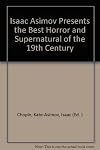
Isaac Asimov Presents : The Best Horror and Supernatural of the 19th Century
by Isaac Asimov (Editor), Martin Harry Greenberg (Editor), Charles Waugh (Editor)
Isaac Asimov Presents the Best of the 19th Century (Book 3)
On This Page
Description
EARLY SCIENCE FICTION STORIES TELL OF ROBOTS, NATURAL DISASTERS, AND INVISIBLE CREATURE, IMMORTALITY AND TIME TRAVEL.Tags
Recommendations




















Member Reviews
A collection of short fiction from the 19th century on the topic indicated by the title, this volume is often tedious, occasionally thrilling, once or twice actually disgusting, but almost always well-written, with a flair that only Victorians tend to possess. Many of the stories include a surprise "twist" ending, and nearly all of them would be pleasantly at home in Rod Serling's The Twilight Zone (one of them, Bierce's "An Occurrence at Owl Creek Bridge," was).
The volume includes:
"The Adventure of the German Student" by Washington Irving
"El Verdugo" by Honore de Balzac
"The Story of the Greek Slave" by Captain Marryat
"The Iron Shroud" by William Mudford
"Schalken the Painter" by J. Sheridan LeFanu
"The Tell-Tale Heart" by Edgar Allan show more Poe
"The Doom of the Griffiths" by Mrs. Gaskell
"Circumstance" by Harriet Prescott Spofford
"Torture By Hope" by Villiers de L'Isle-Adam
"The Diamond Necklace" by Guy de Maupassant
"The Strange Ride of Morrowbie Jukes" by Rudyard Kipling
"Markheim" by Robert Louis Stevenson
"Sleepyhead" by Anton Chekov
"His Unconquerable Enemy" by W.C. Morrow
"The Gravedigger's Daughter" by Leopold von Sacher-Masoch
"An Occurrence at Owl Creek Bridge" by Ambrose Bierce
"Vengance" by Lorimer Stoddard
"Desiree's Baby" by Kate Chopin
"The Squaw" by Bram Stoker
"A Dreadful Night" by Edwin L. Arnold
"The Dead Valley" by Ralph Adams Cram
"Pollock and the Porroh Man" by H.G. Wells
"The Story of the Brazilian Cat" by Sir Arthur Conan Doyle
"The Dead Smile" by F. Marion Crawford
"A Game of Chess" by Robert Barr show less
The volume includes:
"The Adventure of the German Student" by Washington Irving
"El Verdugo" by Honore de Balzac
"The Story of the Greek Slave" by Captain Marryat
"The Iron Shroud" by William Mudford
"Schalken the Painter" by J. Sheridan LeFanu
"The Tell-Tale Heart" by Edgar Allan show more Poe
"The Doom of the Griffiths" by Mrs. Gaskell
"Circumstance" by Harriet Prescott Spofford
"Torture By Hope" by Villiers de L'Isle-Adam
"The Diamond Necklace" by Guy de Maupassant
"The Strange Ride of Morrowbie Jukes" by Rudyard Kipling
"Markheim" by Robert Louis Stevenson
"Sleepyhead" by Anton Chekov
"His Unconquerable Enemy" by W.C. Morrow
"The Gravedigger's Daughter" by Leopold von Sacher-Masoch
"An Occurrence at Owl Creek Bridge" by Ambrose Bierce
"Vengance" by Lorimer Stoddard
"Desiree's Baby" by Kate Chopin
"The Squaw" by Bram Stoker
"A Dreadful Night" by Edwin L. Arnold
"The Dead Valley" by Ralph Adams Cram
"Pollock and the Porroh Man" by H.G. Wells
"The Story of the Brazilian Cat" by Sir Arthur Conan Doyle
"The Dead Smile" by F. Marion Crawford
"A Game of Chess" by Robert Barr show less
Members
- Recently Added By
Author Information

Isaac Asimov was born in Petrovichi, Russia, on January 2, 1920. His family emigrated to the United States in 1923 and settled in Brooklyn, New York, where they owned and operated a candy store. Asimov became a naturalized U.S. citizen at the age of eight. As a youngster he discovered his talent for writing, producing his first original fiction at show more the age of eleven. He went on to become one of the world's most prolific writers, publishing nearly 500 books in his lifetime. Asimov was not only a writer; he also was a biochemist and an educator. He studied chemistry at Columbia University, earning a B.S., M.A. and Ph.D. In 1951, Asimov accepted a position as an instructor of biochemistry at Boston University's School of Medicine even though he had no practical experience in the field. His exceptional intelligence enabled him to master new systems rapidly, and he soon became a successful and distinguished professor at Columbia and even co-authored a biochemistry textbook within a few years. Asimov won numerous awards and honors for his books and stories, and he is considered to be a leading writer of the Golden Age of science fiction. While he did not invent science fiction, he helped to legitimize it by adding the narrative structure that had been missing from the traditional science fiction books of the period. He also introduced several innovative concepts, including the thematic concern for technological progress and its impact on humanity. Asimov is probably best known for his Foundation series, which includes Foundation, Foundation and Empire, and Second Foundation. In 1966, this trilogy won the Hugo award for best all-time science fiction series. In 1983, Asimov wrote an additional Foundation novel, Foundation's Edge, which won the Hugo for best novel of that year. Asimov also wrote a series of robot books that included I, Robot, and eventually he tied the two series together. He won three additional Hugos, including one awarded posthumously for the best non-fiction book of 1995, I. Asimov. "Nightfall" was chosen the best science fiction story of all time by the Science Fiction Writers of America. In 1979, Asimov wrote his autobiography, In Memory Yet Green. He continued writing until just a few years before his death from heart and kidney failure on April 6, 1992. (Bowker Author Biography) show less
All Editions
Series

Belongs to Publisher Series
Work Relationships
Contains
Common Knowledge
- Canonical title
- Isaac Asimov Presents : The Best Horror and Supernatural of the 19th Century
- Original publication date
- 1983
Classifications
- Genres
- Fiction and Literature, Horror, Fantasy
- DDC/MDS
- 808.83 — Literature & rhetoric Literature, rhetoric & criticism Composition Literature Collections Collections of fiction
- LCC
- PN6120.95 .H727 .I8 — Language and Literature Literature (General) Literature (General) Collections of general literature Fiction
Statistics
- Members
- 19
- Popularity
- 1,328,821
- Reviews
- 1
- Rating
- (2.50)
- Languages
- English
- Media
- Paper
- ISBNs
- 1
- ASINs
- 1