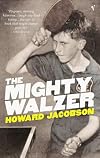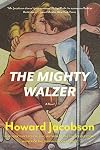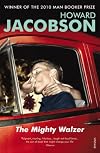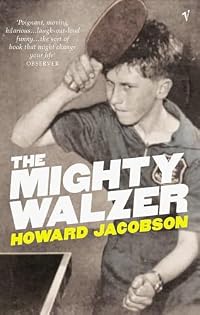
The Mighty Walzer
by Howard Jacobson
On This Page
Description
Oliver Walzer is shy, bookish, Jewish. He doesn't know how to talk to girls. But he can slice, flick and spin a ping pong ball better than any teenager in Manchester. Oliver channels his frustrated adolescent lust into the game he loves. That is until the heartbreaking Lorna Peachley and the prospect of a place at Cambridge take his eye off the ball.Tags
Recommendations











Member Recommendations
Member Reviews
I really like Howard Jacobson’s fluid, wry writing and welcomed the opportunity to snag an advanced reading copy of this book. I thoroughly enjoyed it, even though I know nothing about ping-pong. My Yiddish is pretty good, but I missed a couple of the terms, (had to phone up my mother). The British slang was challenging too, and I lived there for two years. Still, like reading Salman Rushdie or Junot Diaz, it’s possible to handle some foreign language phrases if the storytelling is sound. I sped through this Jewish coming-of-age novel set in 1950s Manchester, in just a few days. Jacobson is often compared to Phillip Roth. There are certainly comparisons to be made, but I feel that Jacobson just doesn’t hate his female characters show more quite as much. There’s more affection along with the abuse and frequent self-abuse, of all sorts. I thought this book was frequently hilarious and occasionally moving. show less
 This review was written for LibraryThing Early Reviewers.
You don't read The Might Walzer so much as experience it. I loved this book, and will definitely read it again one day. Jacobson shares with the reader a time and place which is so very specific (Manchester, England in the 40s and 50s) but also tells a story of coming-of-age and of the Jewish immigrant family which rings true for so many. Oh, did I mention Jacobson's wicked sense of humour, and his ability to play with the expressions and rhythms of both Yiddish and Shakespeare? I know some 'quick-to-judge' readers might object to the author's portrayal of women, but you have to take this book in the fondly satiric spirit in which it was written. And here's something I didn't expect: the depiction on the last page of the novel of a show more specific interaction between a male and a female (I don't want to give anything away) actually made me cry. Howard Jacobson is a truly brilliant writer who deserves a wider readership in North America. show less
This review was written for LibraryThing Early Reviewers.The Mighty Walzer is a coming-of-age novel served to American readers with a whole lot of backspin. That is because Oliver Walzer, hero of Howard Jacobson’s The Mighty Walzer, did his growing up in 1950s Manchester, England – specifically in a part of Manchester predominately populated by Jewish families like his own.
If shyness could kill, Oliver Walzer would never have reached puberty. That he did reach puberty, although he did not do a whole lot with the opportunities inherent to that stage of life, and go on to have a fairly “normal” life almost seems like an accident now, even to Oliver. The first accident was that he found a competition-grade Ping-Pong ball and brought it home with him one day. The second, was his show more discovery, by banging that ball off a wall with his hardbound copy of Dr. Jekyll and Mr. Hyde, that he was a Ping-Pong natural.
Ping-Pong, and his father’s insistence that Oliver use his unusual skills to meet other players ( as a way of forcing him out of the house for his own good), would be Oliver’s ticket to the rest of his life. Suddenly, he was among like-minded people who came to accept him as one of their own; he had teammates; he learned to at least talk a good game about women, even though he seldom practiced his skills in that arena; and he had a goal: to become a world champion Ping-Pong player. Well, that’s the good news, because I’m making Oliver’s transition to adulthood sound a whole lot easier than it was.
The odds were against Oliver from the start. Surrounded by a gaggle of sexually repressed aunts who loved to give him baths, it is little wonder that the little boy would himself be sexually confused. Witness his habit of cutting headshots of his aunts and pasting them onto the bodies of women in the risqué photos he spent hours visiting in the family’s one bathroom. But grow into a man Oliver does, and Howard Jacobson makes it an interesting, if somewhat frustrating transition (even for the reader, who is likely to want to shake some common sense into Oliver, or other family members, on more than one occasion).
That Jacobson often uses 1950s British slang and Yiddish references in the conversation between his characters might be off-putting to some, but this adds an authenticity to the conversations that would otherwise be missing – and it becomes easier and easier on the reader as he develops an “ear” for unusual words and phrases. Imagine Philip Roth “squared” and you will have the right first impression of The Mighty Walzer.
Rated at: 4.0 show less
If shyness could kill, Oliver Walzer would never have reached puberty. That he did reach puberty, although he did not do a whole lot with the opportunities inherent to that stage of life, and go on to have a fairly “normal” life almost seems like an accident now, even to Oliver. The first accident was that he found a competition-grade Ping-Pong ball and brought it home with him one day. The second, was his show more discovery, by banging that ball off a wall with his hardbound copy of Dr. Jekyll and Mr. Hyde, that he was a Ping-Pong natural.
Ping-Pong, and his father’s insistence that Oliver use his unusual skills to meet other players ( as a way of forcing him out of the house for his own good), would be Oliver’s ticket to the rest of his life. Suddenly, he was among like-minded people who came to accept him as one of their own; he had teammates; he learned to at least talk a good game about women, even though he seldom practiced his skills in that arena; and he had a goal: to become a world champion Ping-Pong player. Well, that’s the good news, because I’m making Oliver’s transition to adulthood sound a whole lot easier than it was.
The odds were against Oliver from the start. Surrounded by a gaggle of sexually repressed aunts who loved to give him baths, it is little wonder that the little boy would himself be sexually confused. Witness his habit of cutting headshots of his aunts and pasting them onto the bodies of women in the risqué photos he spent hours visiting in the family’s one bathroom. But grow into a man Oliver does, and Howard Jacobson makes it an interesting, if somewhat frustrating transition (even for the reader, who is likely to want to shake some common sense into Oliver, or other family members, on more than one occasion).
That Jacobson often uses 1950s British slang and Yiddish references in the conversation between his characters might be off-putting to some, but this adds an authenticity to the conversations that would otherwise be missing – and it becomes easier and easier on the reader as he develops an “ear” for unusual words and phrases. Imagine Philip Roth “squared” and you will have the right first impression of The Mighty Walzer.
Rated at: 4.0 show less
This review was written for LibraryThing Early Reviewers.This novel was a delight from start to finish. Jacobson writes with wit and clarity but without losing the unique voice of his narrator, Oliver Walzer, who is a rare blend of charming, disgusting, relatable and completely incomprehensible. It’s truly a period piece, giving the reader insight into the world of ping-pong in the 1950s and the life of a Jewish family in Manchester, but doesn’t descend into mere caricature and ridicule despite its long list of odd-ball characters. The Yiddish can be a bit daunting at first, but it fits with the narrative flow so well that it begins to seamlessly blend into the rest of the text.
This review was written for LibraryThing Early Reviewers.A highly entertaining Bildungsroman (Anglo-Jewish) which, as vegetrendian notes, celebrates (and often scorns) ping pong, sex and love, primarily in 1950s Manchester. Very funny (and Jacobson's surfeit of Yiddish flavourings add a satisfying crunch and are an aural delight), yet suffused with melancholy. While comparisons with Philip Roth were inevitable, they're apt. I'd also suggest an affinity with Mordecai Richler, and perhaps Steve Stern and Rebecca Goldstein.
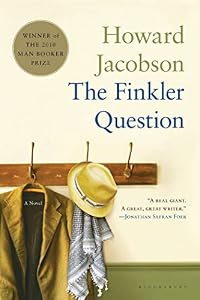
This review was written for LibraryThing Early Reviewers.As far as I'm concerned, The Mighty Walzer soundly trounces The Finkler Question, Jacobson's Booker-winning 2010 novel, much like Oliver Walzer easily defeats opponent after opponent at ping-pong. The Mighty Walzer is funnier and snappier than The Finkler Question and much easier to read as it doesn't get so bogged down in being an Important Modern Jewish Novel, but rather a novel that happens to be about Jewish characters. There are not too many books that make me laugh out loud more than once, but Jacobson has a very natural wit that is distinctly Jewish and yet very accessible no matter what your background. The story is not the most compelling ever written, but what this book really has to offer are its rich and incredibly engaging show more characters. Highly recommended. show less
This review was written for LibraryThing Early Reviewers.The Mighty Walzer is a book about love, sex, and ping pong in Manchester; written with Jacobson's witty wordplay, wry humour, and abundant energy. An excellent, funny, engaging book; I would recommend this to fans of early Philip Roth, some of John Irving, Peter Carey, or Gary Shteyngart. Well worth a read especially if you liked any of his other work. I would also recommend Kalooki Nights, and of course Booker-winning The Finkler Question (which, despite all the hullabaloo is not really a comic novel at all, Jacobson just can't help being funny). You should also see him read if you ever get the chance, as brilliant and funny in person as he is on the page.
This review was written for LibraryThing Early Reviewers.Members
- Recently Added By
Lists

The Guardian's 1000 Novels Everyone Must Read
1,005 works; 549 members

Dishonourable Mentions of 2013
189 works; 62 members

Jewish Books
367 works; 24 members

BBC Radio 4 Bookclub
300 works; 13 members
Author Information

30+ Works 6,537 Members
Howard Jacobson was born on August 25, 1942 in Manchester, England. He is a Man Booker Prize-winning British author and journalist. He studied English at Downing College, Cambridge under F. R. Leavis. He lectured for three years at the University of Sydney before returning to England to teach at Selwyn College, Cambridge. His later teaching posts show more included a period at Wolverhampton Polytechnic from 1974 to 1980. His time at Wolverhampton was to form the basis of his first novel, Coming from Behind, a campus comedy about a failing polytechnic that plans to merge facilities with a local football club. He also wrote a travel book in 1987, titled In the Land of Oz, which was researched during his time as a visiting academic in Sydney. His fiction, particularly in the six novels he has published since 1998, is characterised chiefly by a discursive and humorous style. His 1999 novel The Mighty Walzer, about a teenage table tennis champion, won the Bollinger Everyman Wodehouse Prize for comic writing. In October 2010 Jacobson won the Man Booker Prize for his novel The Finkler Question, which was the first comic novel to win the prize since Kingsley Amis's The Old Devils in 1986. In 2013 he made The New York Times Best Seller List with his title Whole Rethinking the Science of Nutrition which he co-authored with T. Colin Campbell. He will be at the Oz, New Zealand festival of literature and arts program in 2015 in London. (Bowker Author Biography) show less
Awards and Honors
Awards
Distinctions
Common Knowledge
- Canonical title
- The Mighty Walzer
- Original publication date
- 2000
- People/Characters
- Oliver Walzer; Sheeny Waxman; Joel Walzer
- Important places
- Manchester, England, UK; England, UK
- Epigraph
- where dreams and retail collide - Nike ad
- First words
- Small beginnings.
- Last words
- (Click to show. Warning: May contain spoilers.)Which is all any of us Walzers has ever asked.
Classifications
Statistics
- Members
- 231
- Popularity
- 140,044
- Reviews
- 24
- Rating
- (3.37)
- Languages
- English, Italian
- Media
- Paper, Ebook
- ISBNs
- 8
- ASINs
- 5