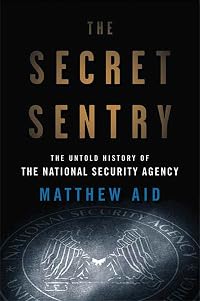
The Secret Sentry: The Untold History of the National Security Agency
by Matthew M. Aid, National Security Agency, (Associated Name)
On This Page
Description
In February of 2006, Matthew Aid's discovery of a massive secret historical document reclassification program then taking place at the National Archives made the front page of the New York Times. This discovery is only the tip of the iceberg of Aid's more than twenty years of intensive research, culled from thousands of pages of formerly top secret documents. In The Secret Sentry, he details the untold history of America's most elusive and powerful intelligence agency, the National Security show more Agency (NSA), since the end of World War II. This will be the first comprehensive history of the NSA, most recently in the news with regards to domestic spying, and will reveal brand new details about controversial episodes including the creation of Israel, the Bay of Pigs, the Berlin Wall, and the invasion of Iraq. Since the beginning of the Cold War, the NSA has become the most important source of intelligence in the US government: 60% of the president's daily briefing comes from the NSA. Matthew Aid will reveal just how this came to be, and why the NSA has gone to such great lengths to keep its history secret. A groundbreaking history of America's other, more powerful intelligence agency Matthew Aid is a leading intelligence historian and expert on the NSA, and a regular commentator on intelligence matters for the New York Times, the Financial Times, the National Journal, the Associated Press, CBS News, National Public Radio (NPR) and many others.. show less
Tags
Recommendations



























Member Reviews
Starting with the early years of the AFSA and other organizations, the book is structured chronologically through the last half century, revealing NSA's contributions to national security, military efforts, and intelligence-sharing. Detailing both NSA's successes and failures, politics and technology, and ever-changing challenges, Aid provides an fascinating account of an otherwise mysterious agency. Recently having read Bamford's "Body of Secrets", I appreciated Secret Sentry's logical progression and organization, as well as nearly a decade's worth of updated information. An excellent read.
From the Back:
In February 2006, while researching this book, Matthew Aid uncovered a massive and secret document reclassification program--a revelation that made the front page of the New York Times. This is only one of the discoveries Aid has made during two decades of research in formerly top-secret documents. In The Secret Sentry, Aid provides the first-ever full history of America's largest security apparatus, the National Security Agency.
This comprehensive account traces the growth of the agency from 1945 to the present through critical moments in its history, from the cold war up to its ongoing involvement in Afghanistan and Iraq. Aid explores the agency's involvement in the Iraqi weapons intelligence disaster, where evidence that show more NSA officials called "ambiguous" was used as proof of Iraqi WMD capacity, and details the intense debate within the NSA over its unprecedented role, pressed by the Bush-Cheney administration, in spying on U.S. citizens.
Today, the NSA has become the most important source of intelligence for the U.S. government, providing 60 percent of the president's daily intelligence briefing. While James Bamford's New York Times bestseller The Shadow Factory covered the NSA since 9/11, The Secret Sentry contains new information about every period since World War II. It provides a shadow history of global affairs over the last half-century.
My Take:
This book and the National Security agency, I fear, share a common struggle, information overload. Matthew Aid has put in the time and provides an overwhelming amount of information for one volume. Unfortunately, the information is presented with the excitement and enthusiasm that is generally reserved for RTA furniture instructions.
I did learn quite a bit from reading this book, however. Like I said before, there is a lot of information in the book. That information is slanted heavily to conform to the author's political views. Most of the book seems to focus more on the agency's failures than its actual successes. It is also very clear in the later sections of the book that Matthew Aid was strongly against the war in Iraq and the Bush administration in general. This is hardly surprising considering the liberal news agencies he provides commentary to.
Overall, I rate this book as average. It does contain tons of factual information. I just wish that it could have been presented in a more interesting way and also a politically neutral way.
About the Author:
Matthew M. Aid is a leading intelligence historian, expert on the National Security Agency, and regular commentator on intelligence matters for the New York Times, the Financial Times, the National Journal, the Associated Press, CBS News, NPR, and many other media outlets. He lives in Washington, D.C. show less
In February 2006, while researching this book, Matthew Aid uncovered a massive and secret document reclassification program--a revelation that made the front page of the New York Times. This is only one of the discoveries Aid has made during two decades of research in formerly top-secret documents. In The Secret Sentry, Aid provides the first-ever full history of America's largest security apparatus, the National Security Agency.
This comprehensive account traces the growth of the agency from 1945 to the present through critical moments in its history, from the cold war up to its ongoing involvement in Afghanistan and Iraq. Aid explores the agency's involvement in the Iraqi weapons intelligence disaster, where evidence that show more NSA officials called "ambiguous" was used as proof of Iraqi WMD capacity, and details the intense debate within the NSA over its unprecedented role, pressed by the Bush-Cheney administration, in spying on U.S. citizens.
Today, the NSA has become the most important source of intelligence for the U.S. government, providing 60 percent of the president's daily intelligence briefing. While James Bamford's New York Times bestseller The Shadow Factory covered the NSA since 9/11, The Secret Sentry contains new information about every period since World War II. It provides a shadow history of global affairs over the last half-century.
My Take:
This book and the National Security agency, I fear, share a common struggle, information overload. Matthew Aid has put in the time and provides an overwhelming amount of information for one volume. Unfortunately, the information is presented with the excitement and enthusiasm that is generally reserved for RTA furniture instructions.
I did learn quite a bit from reading this book, however. Like I said before, there is a lot of information in the book. That information is slanted heavily to conform to the author's political views. Most of the book seems to focus more on the agency's failures than its actual successes. It is also very clear in the later sections of the book that Matthew Aid was strongly against the war in Iraq and the Bush administration in general. This is hardly surprising considering the liberal news agencies he provides commentary to.
Overall, I rate this book as average. It does contain tons of factual information. I just wish that it could have been presented in a more interesting way and also a politically neutral way.
About the Author:
Matthew M. Aid is a leading intelligence historian, expert on the National Security Agency, and regular commentator on intelligence matters for the New York Times, the Financial Times, the National Journal, the Associated Press, CBS News, NPR, and many other media outlets. He lives in Washington, D.C. show less
Interesting, but detail was exhaustive at times. Still can't beat the access he's clearly had to many people who were there at the time.
Ratings
Members
- Recently Added By
Lists

Useful Spy Books
19 works; 1 member
Author Information

3 Works 258 Members

Classifications
- Genres
- Nonfiction, Politics and Government, History, General Nonfiction
- DDC/MDS
- 327.1273 — Society, government, & culture Political science International Relations: Spies Foreign policy and specific topics in international relations Espionage and subversion North America United States
- LCC
- UB256 .U6 .A53 — Military Science Military administration Military administration Intelligence
- BISAC
Statistics
- Members
- 185
- Popularity
- 178,003
- Reviews
- 3
- Rating
- (3.64)
- Languages
- English
- Media
- Paper, Ebook
- ISBNs
- 3
- ASINs
- 4