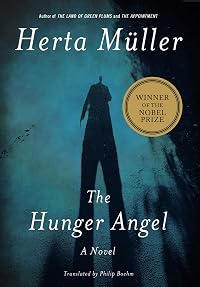
The Hunger Angel
by Herta Müller
On This Page
Description
January 1945, the war is not yet over : the Soviets begin the deportation of the German minority from the labor camps in Ukraine. This is the story of seventeen year old Leo Auberge, who went to the camp with the naive unawareness of the boy eager to escape provincial life. The last five years however he experienced daily hunger and cold, extreme fatigue and death.Tags
Recommendations





















Member Recommendations
by anonymous user
Member Reviews
Profoundly disturbing, exquisitely evocative, heartrending. I do not know how else to characterize this magnificent piece of writing. Muller uses language (and I read this in an English translation) as few writers I have ever read have been able to. I felt as if I was inside the soul of Leo, a young man sent to a Russian work camp at the end of WWII. I am anything but a squeamish reader, yet I repeatedly had to set this book down because of the pain evoked by the author's prose. Just as Leo is haunted for the rest of his life by the hunger angel, I will be haunted by this powerful novel!
"A cattle-train wagon blues, a kilometre song of time set in motion."
It's an interesting choice of words Müller has her protagonist make to describe the long train ride at the end of World War II, packed in like sardines, the long cold way to the camp in the East. After all, the blues arose from a culture where the people had been deliberately robbed of their own languages and had them replaced with a rudimentary one, with the idea that they wouldn't be able to say - and by extension think - much besides "Yes sir, whatever you say" and "Praise God." The blues, on its surface, is a simple, repetitive language that always follows the same pattern, the same 12 bars to describe the trauma that makes up your life: I woke up this morning, show more all I had was gone, I woke up this morning, all I had was gone, any day now I shall be released.
Of course, the characters of Atemschaukel (the English title will supposedly be the somewhat awkward Everything I Possess I Carry With Me) aren't slaves, at least not officially, and the camp they're off to isn't one of those camps. This is a few months later, January 1945, and the ones in the cars aren't Jews and Roma but Germans - well, sort of, it's a matter of language. As the Red Army conquered/liberated eastern Europe, one of their orders was that since the Germans were responsible for the destruction of their country, the Germans were expected to pay for its reconstruction. And hey, eastern Europe was full of ethnic Germans since the middle ages. Leo is 17, Romanian, homosexual, and German. As such, he's one of many who are given a couple of hours to pack what they need before they're shipped off to 5 years of hard labour deep in the Soviet Union.
Everything I possess I carry with me.
Or: Everything I own I carry on me.
I carried everything that I had. It wasn't mine. It was either intended for another purpose or belonged to someone else.
Atemschaukel ("breath swing" - the thing in your throat that may pass back and forth but can never be spat out or swallowed, chokes you up and keeps you alive, constantly on the threshold) is, on its surface, a harrowing Solzhenitsyan tale of everyday life in a forced labour camp; the cold, the hunger, the work, the guards, the inspections, the paranoia, the lice, the false cameraderie, the mistrust, the despair, the homesickness... and as such, it's a very strong work. But there's more to it.
It's a matter of language. Everyone but the guards and the people in the surrounding villages (where are they going to run to?) still speaks German, but in this new context the words have become poisoned, they lose their old meaning, all abstract ideas eventually starve and die. Leo can't read the books he brought along; he rips them up and sells Goethe and Nietzsche as cigarette or toilet paper. The commandant is called "Comrade". Love and marriage go together like a horse and a whip, one way of getting a little more to eat. Homesickness is hollowed out bit by bit until it means being sick for the place where you had food, but you don't get food unless you work, and so eventually "home" becomes the bowl and the shovel. And once language stops being reliable, stops working, there's nothing to hold everything together. Leo is set to carry cement, but the paper sacks are too heavy and too thin, and no matter how he tries the paper rips and the cement runs out into the mud or blows away on the wind or sticks to his skin and seals him up.
Without a language, without a binding element, you won't survive. You'll freeze, you'll starve, you'll have an accident and drown in concrete. So he has to create a new language to describe the new world - auf Deutsch, of course, the German language is famous for its ability to make new words simply by sticking two old ones together; grammar makes no moral judgement. Year by year, he transforms himself into someone who can survive, with a new world of ideas, and new words.
Hunger angel: The closest to a god or an ideal here, always hovers over you, controls your every thought, keeps you alive, stops you living.
Own bread: What's left of the bread you had for breakfast at the end of the day. Always smaller than the others'.
Bread court: The spontaneous court that judges and punishes whoever eats what belongs to someone else.
Heart shovel: Your dance partner, hundreds of shovels per day, until your entire biorhythm is controlled by work and hunger.
The great thing about novels is their ability to create or recreate something, whether factually true or false, and make the reader see the truth in it. In Atemschaukel, Müller does exactly that, with a lot of help from poet Oskar Pastior who (like Müller's mother) was in one of the camps and is the "real" Leo. But it does more than that. It's not just about a Soviet labour camp. For all the routine in its day-to-day chores, it's a tremendously inventive, sneaky and deathly serious piece of metafiction (meta reality?) where it's a matter of language. How the world forms the way we see the world, attaches certain meanings to certain words, and how it can fundamentally change us. "I know you'll come back", Leo's grandmother tells him before he leaves, and those words become a mantra that keeps him alive. But who's the man who comes back? They didn't even know who he was when he left, he would have been tossed in jail for who he was, or ended up in a different kind of camp. The man who comes back has had his entire concept of the world changed, his words no longer mean what their words mean. But he's free now, right? Bread just means bread again, a spade is just a spade.
The camp let me leave only to create the distance needed for it to take up more space in my head. Since I came home, my keepsakes don't say HERE I AM anymore, but they don't say I WAS THERE either. My keepsakes say: I'LL NEVER GET OUT OF THERE.
150 years ago, slavery was abolished. 65 years ago, fascism died. 20 years ago, the Wall came down. Democracy means democracy again. Freedom means freedom again. Fascism means fascism again. Worker means worker again. Hunger just means hunger again. Why are you still using those words to mean what they meant to you for a generation or ten? Here, look at the dictionary: bread is just flour, water and yeast, that's all. Get your act together. You're free now.
Blow yer harmonica, son. show less
It's an interesting choice of words Müller has her protagonist make to describe the long train ride at the end of World War II, packed in like sardines, the long cold way to the camp in the East. After all, the blues arose from a culture where the people had been deliberately robbed of their own languages and had them replaced with a rudimentary one, with the idea that they wouldn't be able to say - and by extension think - much besides "Yes sir, whatever you say" and "Praise God." The blues, on its surface, is a simple, repetitive language that always follows the same pattern, the same 12 bars to describe the trauma that makes up your life: I woke up this morning, show more all I had was gone, I woke up this morning, all I had was gone, any day now I shall be released.
Of course, the characters of Atemschaukel (the English title will supposedly be the somewhat awkward Everything I Possess I Carry With Me) aren't slaves, at least not officially, and the camp they're off to isn't one of those camps. This is a few months later, January 1945, and the ones in the cars aren't Jews and Roma but Germans - well, sort of, it's a matter of language. As the Red Army conquered/liberated eastern Europe, one of their orders was that since the Germans were responsible for the destruction of their country, the Germans were expected to pay for its reconstruction. And hey, eastern Europe was full of ethnic Germans since the middle ages. Leo is 17, Romanian, homosexual, and German. As such, he's one of many who are given a couple of hours to pack what they need before they're shipped off to 5 years of hard labour deep in the Soviet Union.
Everything I possess I carry with me.
Or: Everything I own I carry on me.
I carried everything that I had. It wasn't mine. It was either intended for another purpose or belonged to someone else.
Atemschaukel ("breath swing" - the thing in your throat that may pass back and forth but can never be spat out or swallowed, chokes you up and keeps you alive, constantly on the threshold) is, on its surface, a harrowing Solzhenitsyan tale of everyday life in a forced labour camp; the cold, the hunger, the work, the guards, the inspections, the paranoia, the lice, the false cameraderie, the mistrust, the despair, the homesickness... and as such, it's a very strong work. But there's more to it.
It's a matter of language. Everyone but the guards and the people in the surrounding villages (where are they going to run to?) still speaks German, but in this new context the words have become poisoned, they lose their old meaning, all abstract ideas eventually starve and die. Leo can't read the books he brought along; he rips them up and sells Goethe and Nietzsche as cigarette or toilet paper. The commandant is called "Comrade". Love and marriage go together like a horse and a whip, one way of getting a little more to eat. Homesickness is hollowed out bit by bit until it means being sick for the place where you had food, but you don't get food unless you work, and so eventually "home" becomes the bowl and the shovel. And once language stops being reliable, stops working, there's nothing to hold everything together. Leo is set to carry cement, but the paper sacks are too heavy and too thin, and no matter how he tries the paper rips and the cement runs out into the mud or blows away on the wind or sticks to his skin and seals him up.
Without a language, without a binding element, you won't survive. You'll freeze, you'll starve, you'll have an accident and drown in concrete. So he has to create a new language to describe the new world - auf Deutsch, of course, the German language is famous for its ability to make new words simply by sticking two old ones together; grammar makes no moral judgement. Year by year, he transforms himself into someone who can survive, with a new world of ideas, and new words.
Hunger angel: The closest to a god or an ideal here, always hovers over you, controls your every thought, keeps you alive, stops you living.
Own bread: What's left of the bread you had for breakfast at the end of the day. Always smaller than the others'.
Bread court: The spontaneous court that judges and punishes whoever eats what belongs to someone else.
Heart shovel: Your dance partner, hundreds of shovels per day, until your entire biorhythm is controlled by work and hunger.
The great thing about novels is their ability to create or recreate something, whether factually true or false, and make the reader see the truth in it. In Atemschaukel, Müller does exactly that, with a lot of help from poet Oskar Pastior who (like Müller's mother) was in one of the camps and is the "real" Leo. But it does more than that. It's not just about a Soviet labour camp. For all the routine in its day-to-day chores, it's a tremendously inventive, sneaky and deathly serious piece of metafiction (meta reality?) where it's a matter of language. How the world forms the way we see the world, attaches certain meanings to certain words, and how it can fundamentally change us. "I know you'll come back", Leo's grandmother tells him before he leaves, and those words become a mantra that keeps him alive. But who's the man who comes back? They didn't even know who he was when he left, he would have been tossed in jail for who he was, or ended up in a different kind of camp. The man who comes back has had his entire concept of the world changed, his words no longer mean what their words mean. But he's free now, right? Bread just means bread again, a spade is just a spade.
The camp let me leave only to create the distance needed for it to take up more space in my head. Since I came home, my keepsakes don't say HERE I AM anymore, but they don't say I WAS THERE either. My keepsakes say: I'LL NEVER GET OUT OF THERE.
150 years ago, slavery was abolished. 65 years ago, fascism died. 20 years ago, the Wall came down. Democracy means democracy again. Freedom means freedom again. Fascism means fascism again. Worker means worker again. Hunger just means hunger again. Why are you still using those words to mean what they meant to you for a generation or ten? Here, look at the dictionary: bread is just flour, water and yeast, that's all. Get your act together. You're free now.
Blow yer harmonica, son. show less
I carry silent baggage. I have packed myself into silence so deeply and for so long that I can never unpack myself using words
By sally tarbox TOP 500 REVIEWER on 23 Feb. 2014
Format: Paperback
In 1945, the Russians forced thousands of German Romanians into forced labour in their country. This novel follows 17 year old Leo Auberg, wrenched away from home to a new life, defined by constant hunger.
There are many books on such camps, but Ms Muller's work is entirely original and poetic, taking us inside Leo's head...recollections of home contrast with what's happening to him now; doubts as to whether his family even care about him; his personification of the 'hunger angel':
'The hunger angel climbs to the roof of my mouth and hangs his scales. show more He puts on my eyes and the heart-shovel goes dizzy, the coal starts to blur. He wears my cheeks over his chin. He sets my breath to swinging , back and forth...my brain twitches, pinned to the sky with a needle, at the only fixed point it has left, where it fantasizes about food...The hunger angel looks at his scales and says:
You're still not light enough for me. Why don't you just let go?'
Although Leo survives his 5 years in Russia, his life back home is scarred by the things he endured but cannot talk about. Stunning work. show less
By sally tarbox TOP 500 REVIEWER on 23 Feb. 2014
Format: Paperback
In 1945, the Russians forced thousands of German Romanians into forced labour in their country. This novel follows 17 year old Leo Auberg, wrenched away from home to a new life, defined by constant hunger.
There are many books on such camps, but Ms Muller's work is entirely original and poetic, taking us inside Leo's head...recollections of home contrast with what's happening to him now; doubts as to whether his family even care about him; his personification of the 'hunger angel':
'The hunger angel climbs to the roof of my mouth and hangs his scales. show more He puts on my eyes and the heart-shovel goes dizzy, the coal starts to blur. He wears my cheeks over his chin. He sets my breath to swinging , back and forth...my brain twitches, pinned to the sky with a needle, at the only fixed point it has left, where it fantasizes about food...The hunger angel looks at his scales and says:
You're still not light enough for me. Why don't you just let go?'
Although Leo survives his 5 years in Russia, his life back home is scarred by the things he endured but cannot talk about. Stunning work. show less
To say I enjoyed this is possibly the wrong choice of word, the subject matter is too harrowing for that, but it is admirably written and enthralling.
Leo is a German living in Romania when he is deported to work in the Russian labour camp. His Grandmother's last words to him are "I know you'll come back" and he hangs onto these words through what he relates. The title refers to the spirist of hunger that he imagine each person carries round with them in the camp - with the constant near starvation rations and the struggle just to survive. It's not an easy read, far too much pain and the more sordid side of humanity is presented to make it that, but it was hypnotic. There isn't a plot, as such; it's more a man who is disposed and the show more thoughts that occur to him. They aren't always coherent, they aren't always in any form of logical sequence and that combines with the quality of the writing to make this almost hallucinogenic at times. The sense of isolation, self reliance and a distance from time and place is all pervading.
So I can't say that I enjoyed it, but I certainly found something to admire in this book. show less
Leo is a German living in Romania when he is deported to work in the Russian labour camp. His Grandmother's last words to him are "I know you'll come back" and he hangs onto these words through what he relates. The title refers to the spirist of hunger that he imagine each person carries round with them in the camp - with the constant near starvation rations and the struggle just to survive. It's not an easy read, far too much pain and the more sordid side of humanity is presented to make it that, but it was hypnotic. There isn't a plot, as such; it's more a man who is disposed and the show more thoughts that occur to him. They aren't always coherent, they aren't always in any form of logical sequence and that combines with the quality of the writing to make this almost hallucinogenic at times. The sense of isolation, self reliance and a distance from time and place is all pervading.
So I can't say that I enjoyed it, but I certainly found something to admire in this book. show less
Lyric beauty, terror and violence are logistically incompatible. Yet, in Herta Muller’s “The Hunger Angel” they blend into one, united and breathless. Muller’s moving portrait of a young man’s life before he was placed in a forced Russian labor camp, his survival and life after his return is flawless. The author’s protagonist (Leo) and labor camp are symbolic of all people and camps involved during this horrendous time. Muller writes with poetic depth as she rhythmically describes the horror and hunger that pervades the camp. She share’s the narrator-Leo’s experience in a dream-like sequence with intermittent details expressed via a flat, detached voice. It is the only way for Leo to survive; by removing himself show more emotionally from the events that mark his stay. However, the novel is not character driven; it is not specifically about Leo. It is about the sheer terror and fear ignited by five years of psychological and physical deprivation. It is about Totalitarianism, its' inhumanity and how it affects the human condition before, during and after one is forcibly involved. Muller brings to light and describes this painful truth: no matter how relieved one is to return home, one can never truly “Go home”. The shadows follow and one is forever haunted by the past. It seeps into one’s life, uninvited. Friends and family do not know who you are; they cannot relate. Violence has become second nature. One must struggle to keep the demons at bay. Such is the life of one who has lived and experienced these, and other, “crimes against humanity”. Muller has written this novel with passion, courage and understanding; it is an exceptional work of literature. In 2009, Herta Muller won the Nobel Prize for literature. There is little reason to ask why. Her works speaks for itself. show less
 This review was written for LibraryThing Early Reviewers.
In her 2009 Nobel Lecture, Herta Müller speaks of objects, gestures and words as the elements that connect us to our existence. For Müller, it is the handkerchief that evokes memories and ties together the periods in her life. It is the handkerchief also that she references in recognition of Oskar Pastior, the poet who was her early collaborator in writing The Hunger Angel and who, based on his own experiences, supplied many of the book’s details of the Soviet labor camps. Unfortunately, Pastior passed away before the book was finished, but the handkerchief and compassion offered him by an elderly Russian woman, live on in the tale of Leopold Auberg, the book’s protagonist.
Leopold is a seventeen-year-old of German ancestry, living show more in 1945 Romania, when he is deported to the Soviet Union for a five-year term in a labor camp. Conditions in the camp are harsh, the work is physically demanding and dangerous, and the essentials of life are scarce. Workers die, crushed by coal cars, buried alive in cement, drowned in a mortar pit and poisoned by coal alcohol. Precious possessions are sold for salt and sugar, and crumbs of bread are traded in endless hopes of securing a larger portion. The hunger angel is a constant companion, a part of, yet separate from each person, and dictating every aspect of camp life.
As a reader, it is easy to be overcome by the bleakness of the camp conditions. Yet glimpses remain of what it means to be human. There is dignity in the way the workers embrace the routine of camp life and its backbreaking work, and resilience in the forced normality of Saturday night dances that otherwise seem almost grotesque. There is humanity in the unspoken rules that protect the weak, and in the standards of fairness and honesty that are unquestioningly accepted and enforced. And happiness is not fully absent. There are sudden, fragmented moments of ‘mouth happiness’ and ‘head happiness’, as well as the ‘onedroptoomuchhappiness’ that is found in the peaceful relief of death.
Despite its extreme deprivation, the camp becomes Leo’s home, a place of safety, familiarity and even fairness, where he is never alone. “I don’t need a day pass, I have the camp, and the camp has me. All I need is a bunk and Fenya’s bread and my tin bowl…I don’t even need Leo Auberg.” Upon his return to Romania, he suffers from an inability to adjust and the rejection of family members who have assumed him dead and erased his place in their lives. “By staying alive I had betrayed their mourning.” But the worst effect he must endure, the ultimate devastation to the human spirit, for which there is no healing, is his fear of being free.
Müller’s writing is spare yet poetic, and her literary technique is wonderful to observe. Color is used to reinforce the sense of desolation, the ubiquitous grayness of cement, mortar and fly ash covering even the white of winter, with only the occasional burst of yellow, pink, green or red as simple reminders that the world is not always this way. The simplicity of the narrative, its short chapters and focus on concrete images and the smallest of daily events, mirrors Leo’s physical and emotional fading. Müller uses the device of revealing her protagonist’s character through his interaction with objects in the environment. In Leopold’s world, objects take on their own personae, developing relationships with him. Words, feelings, hunger and even boredom, become objects to be treasured, taking over for feelings that can no longer be safely felt or expressed.
It is not difficult to see why Herta Müller was awarded the Nobel Prize in Literature. The Hunger Angel is of archival importance, documenting events that were real, brutal and inhumane, yet have been largely overshadowed in history by the horrors of Nazi Germany. Her writing is brilliant, reflective and full of moments that stand alone in their beauty, as with ”Monstrous tenderness gets tangled in guilt differently from intentional cruelty. More deeply. And for longer.”.
I highly recommend this book. show less
Leopold is a seventeen-year-old of German ancestry, living show more in 1945 Romania, when he is deported to the Soviet Union for a five-year term in a labor camp. Conditions in the camp are harsh, the work is physically demanding and dangerous, and the essentials of life are scarce. Workers die, crushed by coal cars, buried alive in cement, drowned in a mortar pit and poisoned by coal alcohol. Precious possessions are sold for salt and sugar, and crumbs of bread are traded in endless hopes of securing a larger portion. The hunger angel is a constant companion, a part of, yet separate from each person, and dictating every aspect of camp life.
… the hunger angel thinks straight, he’s never absent, he doesn’t go away but comes back, he knows his direction and he knows my boundaries, he knows where I come from and what he does to me, he walks to one side with open eyes, he never denies his own existence, he’s disgustingly personal, his sleep is transparent, he’s an expert in orach, sugar, and salt, lice and homesickness, he has water in his belly and in his legs.
As a reader, it is easy to be overcome by the bleakness of the camp conditions. Yet glimpses remain of what it means to be human. There is dignity in the way the workers embrace the routine of camp life and its backbreaking work, and resilience in the forced normality of Saturday night dances that otherwise seem almost grotesque. There is humanity in the unspoken rules that protect the weak, and in the standards of fairness and honesty that are unquestioningly accepted and enforced. And happiness is not fully absent. There are sudden, fragmented moments of ‘mouth happiness’ and ‘head happiness’, as well as the ‘onedroptoomuchhappiness’ that is found in the peaceful relief of death.
Despite its extreme deprivation, the camp becomes Leo’s home, a place of safety, familiarity and even fairness, where he is never alone. “I don’t need a day pass, I have the camp, and the camp has me. All I need is a bunk and Fenya’s bread and my tin bowl…I don’t even need Leo Auberg.” Upon his return to Romania, he suffers from an inability to adjust and the rejection of family members who have assumed him dead and erased his place in their lives. “By staying alive I had betrayed their mourning.” But the worst effect he must endure, the ultimate devastation to the human spirit, for which there is no healing, is his fear of being free.
By now I’ve realized that what’s written on my treasures is THERE I STAY. That the camp let me go home only to create the space it needed to grow inside my head. Since I came back, my treasures no longer have a sign that says HERE I AM or one that says I WAS THERE. What’s actually written on my treasures is: THERE I’M STUCK.
Müller’s writing is spare yet poetic, and her literary technique is wonderful to observe. Color is used to reinforce the sense of desolation, the ubiquitous grayness of cement, mortar and fly ash covering even the white of winter, with only the occasional burst of yellow, pink, green or red as simple reminders that the world is not always this way. The simplicity of the narrative, its short chapters and focus on concrete images and the smallest of daily events, mirrors Leo’s physical and emotional fading. Müller uses the device of revealing her protagonist’s character through his interaction with objects in the environment. In Leopold’s world, objects take on their own personae, developing relationships with him. Words, feelings, hunger and even boredom, become objects to be treasured, taking over for feelings that can no longer be safely felt or expressed.
I taught my homesickness to be dry-eyed a long time ago. Now I’d like it to become ownerless. Then it would no longer see my condition here and wouldn’t ask about my family back home. Then my mind would no longer be home to people, only objects. Then I could simply shove them back and forth across the place where it hurts, the way we shove our feet when we dance the Paloma. Objects may be small or large, and some may be too heavy, but they are finite.
It is not difficult to see why Herta Müller was awarded the Nobel Prize in Literature. The Hunger Angel is of archival importance, documenting events that were real, brutal and inhumane, yet have been largely overshadowed in history by the horrors of Nazi Germany. Her writing is brilliant, reflective and full of moments that stand alone in their beauty, as with ”Monstrous tenderness gets tangled in guilt differently from intentional cruelty. More deeply. And for longer.”.
I highly recommend this book. show less
This review was written for LibraryThing Early Reviewers.This is certainly not a light-hearted read; it is incredibly intense, and the horrors of forced labor so starkly captured that at times I needed to walk away from it. But it is a truly talented author who can keep a reader engaged in a story so profoundly sad.
The story is narrated by Leo, a 17 year old German living in Romania, who is conscripted into a Russian labor camp for 5 years. The author does a stunning job of using language to convey the ugly reality of the camp (and sometimes, moments of deep humanity in the midst of the brutality). This is not a story focused on character development or relationships; it is all about illuminating for the reader a darkened period of history, through the eyes of an everyman, Leo. Through the show more use of metaphor and language, the psychological impact of the camp, and its echo in Leo’s remaining years, is deftly captured and conveyed.
I can honestly say that I didn’t feel a deep connection to any of the characters, and this is typically quite important to me in reading a novel. However, deep character development would have been superfluous in an already very rich novel, and it’s a brilliant writer who can render character development superfluous. This is a truly profound novel that will likely expose new meanings with each reread. show less
The story is narrated by Leo, a 17 year old German living in Romania, who is conscripted into a Russian labor camp for 5 years. The author does a stunning job of using language to convey the ugly reality of the camp (and sometimes, moments of deep humanity in the midst of the brutality). This is not a story focused on character development or relationships; it is all about illuminating for the reader a darkened period of history, through the eyes of an everyman, Leo. Through the show more use of metaphor and language, the psychological impact of the camp, and its echo in Leo’s remaining years, is deftly captured and conveyed.
I can honestly say that I didn’t feel a deep connection to any of the characters, and this is typically quite important to me in reading a novel. However, deep character development would have been superfluous in an already very rich novel, and it’s a brilliant writer who can render character development superfluous. This is a truly profound novel that will likely expose new meanings with each reread. show less
This review was written for LibraryThing Early Reviewers.Members
- Recently Added By
Published Reviews
ThingScore 75
Von seltsamen Dingen, erschreckenden Erscheinungen hören wir in diesem Roman, vom "Hungerengel" und vom "Blechkuss", von "Kartoffelmenschen" und der "Atemschaukel". Der Hungerengel sitzt immer mit am Tisch, wenn die Insassen des Lagers die karge Ration Brot verzehren, die ihnen die "Brotoffizierin" zugeteilt hat, quälend langsam essen die einen, verzweifelt schlingen die anderen; der show more Hungerengel wacht über ihren Schlaf, er geht durch ihre Träume, begleitet sie in die Fabrik und auf das Feld hinaus, wo sie schuften, bis sie umfallen und in die Grube gekippt werden oder sich irgendwie aufrecht halten, um dann bis zum nächsten Tag in ihre Baracken zurückzukehren...
Der Roman ist aus 64 kurzen Abschnitten gebaut, ein jeder von ihnen schreitet ein Revier des Lagers, eine Höllenstunde des Lageralltags, ein Gefühl, eine Verlorenheit, einen Schmerz der Inhaftierten aus. Herta Müller hat für die "Atemschaukel" mit den Deportierten ihres Dorfes gesprochen, vor allem aber hat sie sich von Oskar Pastior, der als Jugendlicher in die Sowjetunion verschleppt wurde, immer wieder vom Leben und Sterben im Lager erzählen lassen. So sollte ein gemeinsames Buch beider entstehen, doch nach dem überraschenden Tod des Dichters im Herbst 2006 musste Herta Müller mit ihren Notizen, Aufzeichnungen, Plänen alleine zurande kommen und ihr eigenes Buch verfassen, das zwar auch die Lagergeschichte von Oskar Pastior erzählt, aber dennoch nicht als Schlüsselroman gelesen werden sollte show less
Der Roman ist aus 64 kurzen Abschnitten gebaut, ein jeder von ihnen schreitet ein Revier des Lagers, eine Höllenstunde des Lageralltags, ein Gefühl, eine Verlorenheit, einen Schmerz der Inhaftierten aus. Herta Müller hat für die "Atemschaukel" mit den Deportierten ihres Dorfes gesprochen, vor allem aber hat sie sich von Oskar Pastior, der als Jugendlicher in die Sowjetunion verschleppt wurde, immer wieder vom Leben und Sterben im Lager erzählen lassen. So sollte ein gemeinsames Buch beider entstehen, doch nach dem überraschenden Tod des Dichters im Herbst 2006 musste Herta Müller mit ihren Notizen, Aufzeichnungen, Plänen alleine zurande kommen und ihr eigenes Buch verfassen, das zwar auch die Lagergeschichte von Oskar Pastior erzählt, aber dennoch nicht als Schlüsselroman gelesen werden sollte show less
added by Goethe-InstitutAthen
Å overleve i helvete : Nobelprisvinner Herta Müllers nye roman skildrer fem år i en sovjetisk arbeidsleir. Boka forteller en viktig historie i en høyst særegen stil. Herta Müller mottok i 2009 Nobelprisen i litteratur. I begrunnelsen heter det at hun nekter å fortie om de inhumane sidene ved kommunismen.
På norsk har man fram til nå kunnet lese tre av hennes romaner. Alle skildrer de show more på et vis diktaturets konsekvenser; det dreier seg om mennesker utsatt for overvåkning, terror og fordrivelse. show less
På norsk har man fram til nå kunnet lese tre av hennes romaner. Alle skildrer de show more på et vis diktaturets konsekvenser; det dreier seg om mennesker utsatt for overvåkning, terror og fordrivelse. show less
added by annek49
Poesiens avslørende makt : Nobelprisvinner Herta Müllers metode når det gjelder valg av ord er original. Hennes blanding av poesi, nøkternhet og jordnærhet blir en enestående litterær reise.
added by annek49
Lists

Top Five Books of 2022
736 works; 272 members

Five star books
1,767 works; 110 members

Llibres que he llegit el 2010
35 works; 1 member

Books Read in 2022
5,168 works; 114 members

IMPAC Dublin Literary Award 2014 longlist
150 works; 3 members

Writers at Risk
106 works; 17 members

Mustich's 1000 Books to Read Before You Die: A Life Changing List
1,001 works; 19 members

Die besten Werke der deutschsprachigen Erzählliteratur von 1924 bis 2024
100 works; 2 members

.
184 works; 1 member
Author Information

90+ Works 5,146 Members
Born in Romania in 1953, Herta Müller lost her job as a teacher and suffered repeated threats after refusing to cooperate with Ceausescu's Secret Police. She succeeded in emigrating in 1987 and now lives in Berlin. The recipient of the European Literature Prize, she has also won the International IMPAC Dublin Literary Award for her previous show more novel, The Land of Green Plums. Müller was awarded the Nobel Prize in Literature in 2009. (Publisher Provided) Herta Müller was born in Nitzkydorf, Romania on August 17, 1953 to German parents. She studied German studies and Romanian literature at Timisoara University. While there, she became part of the Aktionsgruppe Banat, a group of idealistic Romanian-German writers seeking freedom of expression under the Ceaucescu dictatorship. After graduation, she worked as a translator in a machine factory, but was fired for refusing to cooperate with the secret police. Her first short story collection, Niederungen, was published in 1982 in a censored form. She immigrated to West Germany in 1987. She is a novelist, poet and essayist whose works depict the harsh conditions of life in Communist Romania under the repressive Nicolae Ceausescu regime. Her works include Herztier or The Land of Green Plums; The Appointment; Der Fuchs War Damals Schon der Jäger or The Passport; and Atemschaukel or Everything I Possess I Carry with Me. She has won numerous awards including the Marieluise-Fleißer Prize in 1990, the Kranichsteiner Literary Prize in 1991, the Kleist Prize in 1994, and the 2009 Nobel Prize in Literature. (Bowker Author Biography) show less
Some Editions
Awards and Honors
Awards
Distinctions
Series
Belongs to Publisher Series
Work Relationships
Is abridged in
Common Knowledge
- Canonical title
- The Hunger Angel
- Original title
- Atemschaukel
- Original publication date
- 2009 (original German) (original German); 2012 (English: Boehm) (English: Boehm)
- People/Characters*
- Leopold Auberg
- Important places
- Transylvania, Romania; USSR; Romania
- First words
- Alles, was ich habe, trage ich bei mir.
All that I have I carry on me. - Quotations
- 1 shovel load = 1 gram bread
- Last words
- (Click to show. Warning: May contain spoilers.)Dann war eine Art Ferne in mir.
(Click to show. Warning: May contain spoilers.)And then there was a distance deep within me. - Original language
- German
*Some information comes from Common Knowledge in other languages. Click "Edit" for more information.
Classifications
- Genres
- General Fiction, Fiction and Literature, Historical Fiction
- DDC/MDS
- 833.914 — Literature & rhetoric German & related literatures German fiction 1900- 1900-1990 1945-1990
- LCC
- PT2673 .U29234 .A9213 — Language and Literature German, Dutch and Scandinavian literatures German literature Individual authors or works 1961-2000
- BISAC
Statistics
- Members
- 1,115
- Popularity
- 22,734
- Reviews
- 60
- Rating
- (4.04)
- Languages
- 22 — Catalan, Chinese, Czech, Danish, Dutch, English, Finnish, French, German, Galician, Greek, Hungarian, Icelandic, Italian, Lithuanian, Norwegian (Bokmål), Portuguese, Romanian, Russian, Slovenian, Spanish, Swedish
- Media
- Paper, Audiobook, Ebook
- ISBNs
- 51
- ASINs
- 14
