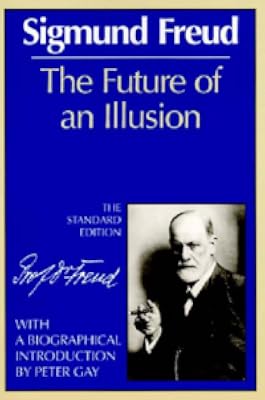
The Future of an Illusion
by Sigmund Freud
On This Page
Description
Declaring religion and science as mortal enemies, Sigmund Freud concludes that civilization can only be redeemed through new constructions of existence and ideas motivated by science.Tags
Recommendations

























Member Recommendations

Member Reviews
In The Future of an Illusion, Freud suggests as a germinal postulate of religion, “Life in this world … signifies a perfecting of man’s nature. It is probably the spiritual part of man, the soul …” (23). The Greek for soul is psyche. Psychoanalysis, which set itself the task of diagnosing and treating the psyche (and not merely the conscious mind, nor the organic brain as such), seems to be a phenomenon in some measure tailor-made to supplement, supplant, or substitute for religion. Freud presented a clear claim that religion is a mass neurosis, not only in The Future of an Illusion, but also in his later work Moses and Monotheism. To the extent that one sees the collective problem of religious ‘delusion’ as analogous to show more obsessional neurosis in the individual, one might take psychoanalysis, the custodian of techniques to address the latter, as a point of departure to cope with the former. And while he does not make light of the difficulty in coming to do without traditional religions, Freud insists on the desirability and even “fatal inevitability” of such “growth” in the human condition (55).
The “care of souls” is the pastoral function in Christian religion, and equally a mission of psychoanalysis as a therapeutic institution, with its priestly class of analysts. Freud does not hold himself back from the pleasures of religiously-based rhetoric. For example, he writes that “the questions which religious doctrine finds it so easy to answer” ... “might be called too sacred” to be addressed in a traditional, unquestioning manner (40). Taking a cue from the Dutch anti-colonialist Multatuli, Freud makes reference to “our God, Logos” slowly fulfilling the desires of mankind (69). And he sometimes shows a rather “religious” tendency (as he would perhaps describe it) to pick and choose among scientific theories for the sake of doctrinal coherence in psychoanalysis.
In one of his devil’s advocate passages in The Future of an Illusion, Freud remarks, “If you want to expel religion from our European civilization, you can only do it by means of another system of doctrines,” which would itself engender a functional religion, with all of the concomitant drawbacks (65-6). In replying to his own objection, Freud emphasizes the desired differences in his post-religious system: it is to be non-delusive and more capable of being corrected. It will be science, not religion. But Freudian psychoanalysis, for all of its scientific trappings, is already at some remove from the positivist territory of the physical sciences. It is no closer to, say, biology, than the monotheism of Moses was to the polytheistic religion of eastern Mediterranean antiquity. In effect, Freud’s proposal is that the superstitious religion of traditions focused on God should be replaced in the future with a scientific religion trained on the soul. show less
The “care of souls” is the pastoral function in Christian religion, and equally a mission of psychoanalysis as a therapeutic institution, with its priestly class of analysts. Freud does not hold himself back from the pleasures of religiously-based rhetoric. For example, he writes that “the questions which religious doctrine finds it so easy to answer” ... “might be called too sacred” to be addressed in a traditional, unquestioning manner (40). Taking a cue from the Dutch anti-colonialist Multatuli, Freud makes reference to “our God, Logos” slowly fulfilling the desires of mankind (69). And he sometimes shows a rather “religious” tendency (as he would perhaps describe it) to pick and choose among scientific theories for the sake of doctrinal coherence in psychoanalysis.
In one of his devil’s advocate passages in The Future of an Illusion, Freud remarks, “If you want to expel religion from our European civilization, you can only do it by means of another system of doctrines,” which would itself engender a functional religion, with all of the concomitant drawbacks (65-6). In replying to his own objection, Freud emphasizes the desired differences in his post-religious system: it is to be non-delusive and more capable of being corrected. It will be science, not religion. But Freudian psychoanalysis, for all of its scientific trappings, is already at some remove from the positivist territory of the physical sciences. It is no closer to, say, biology, than the monotheism of Moses was to the polytheistic religion of eastern Mediterranean antiquity. In effect, Freud’s proposal is that the superstitious religion of traditions focused on God should be replaced in the future with a scientific religion trained on the soul. show less
Freud é um grande escritor e sua maneira de ordenar as coisas, seu ensaismo, é fascinante, ao criar preâmbulos, exposições, contra-exposições, antecipações de críticas e um fechamento decisivo mas que abre ao que pensar (a decisão que estaria aberta à experimentação e incerteza). O futuro da ilusão trata da religião vista de modo geral como uma etapa infantil da sociabilidade, voltada para o asseguramento emocional e simplificação dos problemas; para estratégias de conforto social-psicológico frente à complexidade e dificuldade da manutenção da cultura perante os instintos desagregadores. Nisso, é bastante interessante e pertinente desde que observemos um caráter datado (foi escrito em 1927), especialmente no show more que diz respeito a uma contraposição massas x elite, caduca desde os tempos de indústria cultural 2.0. Parece-me também que para Freud o impulso religioso e o gregarismo da religião instituída estão juntos, mas imagino uma tomada diferente (de todo modo lembro dele dizer não compreender bem o "sentimento oceânico" em outro texto, creio que o mal estar na civilização). show less
But surely infantilism is destined to be surmounted. Men cannot remain children for ever; they must in the end go out into 'hostile life'. We may call this 'education to reality. Need I confess to you that the whole purpose of my book is to point out the necessity for this forward step?
This isn't exactly theory, but more a prose poem or maybe agitprop. Freud deftly employs a dialogue method aiming for some persuasive measure, though accepting that his words aren't likely to influence the unwilling. He does paraphrase his opponents well. While remaining a plea, the text is an eloquent one. His style is adroit and drenched in wit (see Freud's thoughts on Prohibition). There is much to be said about a sociology of the murderous: denizens show more who would overthrow the yoke of civilization at the first opportunity. Here's to austerity measures and prayer in schools. show less
This isn't exactly theory, but more a prose poem or maybe agitprop. Freud deftly employs a dialogue method aiming for some persuasive measure, though accepting that his words aren't likely to influence the unwilling. He does paraphrase his opponents well. While remaining a plea, the text is an eloquent one. His style is adroit and drenched in wit (see Freud's thoughts on Prohibition). There is much to be said about a sociology of the murderous: denizens show more who would overthrow the yoke of civilization at the first opportunity. Here's to austerity measures and prayer in schools. show less
interesting perspective on the illusion of religion from the king and creator of psycho-analysis. this is an extremely short read, and one that i will have to re-read again to get a firmer understanding of his analysis.
his scientific tactic of breaking down the creation and dissemination of religious ideas over centuries, using psycho-analysis, is quite fascinating and frankly, hard to rationally argue. it really only leaves ones' 'faith' to believe in the absurdities of religious doctrine, or as he puts it, '[the church] maintains that religious doctrines are outside the jurisdiction of reason - are above reason. Their truth must be felt inwardly, and they need not be comprehended.' which begs the next statement that i thoroughly enjoy show more because it creates a nasty, yet accurate slippery slope, 'Am I to be obliged to believe in every absurdity? And if not, why this one in particular?'
moreover, he discusses the formation of religion from both the achievement and shortcomings of civilization. and answers how the world would handle the non-existence of it, as a civilization.
its nice to read a purely scientific analysis of religion. not opinion, but analysis using the same method he used to make modern psychology what it is today.
but i guess this is a moot point when we as humans are not capable of understanding divine power and wisdom. show less
his scientific tactic of breaking down the creation and dissemination of religious ideas over centuries, using psycho-analysis, is quite fascinating and frankly, hard to rationally argue. it really only leaves ones' 'faith' to believe in the absurdities of religious doctrine, or as he puts it, '[the church] maintains that religious doctrines are outside the jurisdiction of reason - are above reason. Their truth must be felt inwardly, and they need not be comprehended.' which begs the next statement that i thoroughly enjoy show more because it creates a nasty, yet accurate slippery slope, 'Am I to be obliged to believe in every absurdity? And if not, why this one in particular?'
moreover, he discusses the formation of religion from both the achievement and shortcomings of civilization. and answers how the world would handle the non-existence of it, as a civilization.
its nice to read a purely scientific analysis of religion. not opinion, but analysis using the same method he used to make modern psychology what it is today.
but i guess this is a moot point when we as humans are not capable of understanding divine power and wisdom. show less
This is a short book (Ten Chapters in 92 pages) but is especially important for understanding Freud’s mature thought. This was published in 1927 after Freud had already made a name for himself in the early 1900’s. Although Freud mentions that this book might never have been published in his lifetime or ever, this work is given to readers after the First World War and prior to the Second World War. Freud, for all his bluster about the virtues of science and the uselessness of religion, stayed in Vienna, Austria until the advent of the Nazis before fleeing to England where he died in 1939. It seems he was not able to read the signs of the times in which he lived.
Freud fancied himself a world figure in the history of ideas and his show more psychoanalysis as a central part of humanity’s evolution to pass beyond the “Illusion of Religion” and the psychical origin of religious ideas. Freud clearly sees himself as an equal to Thomas Hobbes, Jean Jacques Rousseau, G.W. Hegel, and Immanuel Kant.
The rigidity of all western religious prohibitions, he says, is a universal neurosis of western civilization which we must leave behind. He says that it is like children’s obsessional neurosis (e.g., Oedipus complex) which is a temporary disavowal of the reality. Here he is trying to parallel Hegel’s phenomenology of spirit which poses the triumph of self-consciousness of spirit as inevitable in world history.
The unusual positions Freud takes here in The Future of an Illusion is indicative that he has said all he needs to say already and is just cleaning up the last fragments his wildest ideas excised from his previous other publications. Here’s a sample: all people are instinctual, and their first impulses are a lust for killing, incest, and cannibalism; God’s existence cannot either proven or disproven; the two most important issues for real science are how did the world begin and what is the relation between mind and body. Freudianism is still present in deconstructive philosophy (Derrida) but on its own it has lost any real logical force or influence. A good short read which will illustrate Freud’s pomposity as a self-asserted world leader of western Science.
Index, Bibliography of Freud’s work, Footnotes are the editors’ citations. show less
Freud fancied himself a world figure in the history of ideas and his show more psychoanalysis as a central part of humanity’s evolution to pass beyond the “Illusion of Religion” and the psychical origin of religious ideas. Freud clearly sees himself as an equal to Thomas Hobbes, Jean Jacques Rousseau, G.W. Hegel, and Immanuel Kant.
The rigidity of all western religious prohibitions, he says, is a universal neurosis of western civilization which we must leave behind. He says that it is like children’s obsessional neurosis (e.g., Oedipus complex) which is a temporary disavowal of the reality. Here he is trying to parallel Hegel’s phenomenology of spirit which poses the triumph of self-consciousness of spirit as inevitable in world history.
The unusual positions Freud takes here in The Future of an Illusion is indicative that he has said all he needs to say already and is just cleaning up the last fragments his wildest ideas excised from his previous other publications. Here’s a sample: all people are instinctual, and their first impulses are a lust for killing, incest, and cannibalism; God’s existence cannot either proven or disproven; the two most important issues for real science are how did the world begin and what is the relation between mind and body. Freudianism is still present in deconstructive philosophy (Derrida) but on its own it has lost any real logical force or influence. A good short read which will illustrate Freud’s pomposity as a self-asserted world leader of western Science.
Index, Bibliography of Freud’s work, Footnotes are the editors’ citations. show less
Freud, in most modern opinions, oscillates wildly between being beautifully right and spectacularly wrong. This book contains some of his most piercing insights and acerbic wit.
Freud analyzes the old dinosaur of religion as he saw it, finding it to serve as a type of cure for a childlike helplessness in the world. He delves briefly into his idea of a 'father complex', but this idea is well applied here - modern theorists have built off of his ideas here to an astonishing degree.
He also re-examines the role of religion in modern life, saying that it is very appealing to those who are most downtrodden in society - again, a statement that history has gratified. However, Freud also says that having a society totally reliant on atheism would show more also be a fault, too.
A profoundly interesting book, and one of the great ideas in history is here - one with which many still grapple. show less
Freud analyzes the old dinosaur of religion as he saw it, finding it to serve as a type of cure for a childlike helplessness in the world. He delves briefly into his idea of a 'father complex', but this idea is well applied here - modern theorists have built off of his ideas here to an astonishing degree.
He also re-examines the role of religion in modern life, saying that it is very appealing to those who are most downtrodden in society - again, a statement that history has gratified. However, Freud also says that having a society totally reliant on atheism would show more also be a fault, too.
A profoundly interesting book, and one of the great ideas in history is here - one with which many still grapple. show less
In 1927 Sigmund Freud was 71 years old and in failing health when he wrote this short book about religion. The title is a misnomer — there is hardly anything about the future here at all. Instead, it offers Freud’s ideas about religion, including why it exists at all. Freud is a surprisingly readable author, even for people with only limited knowledge of psychology. “It forms no part of the intention of this study to comment on the truth-value of religious teachings,” he wrote. “We are content to recognize that, psychologically speaking, they are illusions.” Freud refrained from mentioning in this book the anti-religious campaigns then taking place in the Soviet Union. But surely he had them in mind when he wrote that “it show more is certainly a nonsensical plan to seek to abolish religion by force and at a stroke. Principally because there is no chance of its succeeding.” He was certainly right about that. Recommended. show less
Members
- Recently Added By
Lists

Psicología - Clásicos
165 works; 2 members

Atheism, humanism, freethought, &c. — Best nonfiction books in favour of
167 works; 14 members

1001 Books You Must Read Before You Die
1,448 works; 1,134 members

10 Books that Screwed Up the World (And 5 Others that Didn't Help)
15 works; 1 member
Author Information

1,412+ Works 51,553 Members
Sigmund Freud was the founder of psychoanalysis, simultaneously a theory of personality, a therapy, and an intellectual movement. He was born into a middle-class Jewish family in Freiburg, Moravia, now part of Czechoslovakia, but then a city in the Austro-Hungarian Empire. At the age of 4, he moved to Vienna, where he spent nearly his entire life. show more In 1873 he entered the medical school at the University of Vienna and spent the following eight years pursuing a wide range of studies, including philosophy, in addition to the medical curriculum. After graduating, he worked in several clinics and went to Paris to study under Jean-Martin Charcot, a neurologist who used hypnosis to treat the symptoms of hysteria. When Freud returned to Vienna and set up practice as a clinical neurologist, he found orthodox therapies for nervous disorders ineffective for most of his patients, so he began to use a modified version of the hypnosis he had learned under Charcot. Gradually, however, he discovered that it was not necessary to put patients into a deep trance; rather, he would merely encourage them to talk freely, saying whatever came to mind without self-censorship, in order to bring unconscious material to the surface, where it could be analyzed. He found that this method of free association very often evoked memories of traumatic events in childhood, usually having to do with sex. This discovery led him, at first, to assume that most of his patients had actually been seduced as children by adult relatives and that this was the cause of their neuroses; later, however, he changed his mind and concluded that his patients' memories of childhood seduction were fantasies born of their childhood sexual desires for adults. (This reversal is a matter of some controversy today.) Out of this clinical material he constructed a theory of psychosexual development through oral, anal, phallic and genital stages. Freud considered his patients' dreams and his own to be "the royal road to the unconscious." In The Interpretation of Dreams (1900), perhaps his most brilliant book, he theorized that dreams are heavily disguised expressions of deep-seated wishes and fears and can give great insight into personality. These investigations led him to his theory of a three-part structure of personality: the id (unconscious biological drives, especially for sex), the superego (the conscience, guided by moral principles), and the ego (the mediator between the id and superego, guided by reality). Freud's last years were plagued by severe illness and the rise of Nazism, which regarded psychoanalysis as a "Jewish pollution." Through the intervention of the British and U.S. governments, he was allowed to emigrate in 1938 to England, where he died 15 months later, widely honored for his original thinking. His theories have had a profound impact on psychology, anthropology, art, and literature, as well as on the thinking of millions of ordinary people about their own lives. Freud's daughter Anna Freud was the founder of the Hampstead Child Therapy Clinic in London, where her specialty was applying psychoanalysis to children. Her major work was The Ego and the Mechanisms of Defense (1936). (Bowker Author Biography) show less
Some Editions
Series
Belongs to Publisher Series
Work Relationships
Is contained in
Common Knowledge
- Canonical title*
- Die Zukunft einer Illusion
- Original title
- Die Zukunft einer Illusion
- Original publication date
- 1927
- People/Characters
- Aristotle, 384-322
- Important events
- Prohibition; Scopes Trial, The State of Tennessee v. John Thomas Scopes, Scopes Monkey Trial
- First words
- When one has lived for quite a long time in a particular civilization and has often tried to discover what its origins were and along what path it has developed, one sometimes also feels tempted to take a glance in the other ... (show all)direction and to ask what further fate lies before it and what transformations it is destined to undergo.
- Last words
- (Click to show. Warning: May contain spoilers.)No, our science is no illusion. But an illusion it would be to suppose that what science cannot give us we can get elsewhere.
- Original language
- German
*Some information comes from Common Knowledge in other languages. Click "Edit" for more information.
Classifications
- Genres
- Nonfiction, Religion & Spirituality, General Nonfiction, Philosophy
- DDC/MDS
- 200.19 — Religion The Bible & Christianity Religion Systems, scientific principles, psychology of religion, philosophy and religion Psychological principles
- LCC
- BL53 .F67 — Philosophy, Psychology and Religion Religions. Mythology. Rationalism Religions. Mythology. Rationalism Philosophy of religion. Psychology of religion. Religion
- BISAC
Statistics
- Members
- 1,932
- Popularity
- 11,035
- Reviews
- 18
- Rating
- (3.61)
- Languages
- 11 — English, Finnish, French, German, Greek, Italian, Latvian, Portuguese, Russian, Spanish, Swedish
- Media
- Paper, Audiobook, Ebook
- ISBNs
- 61
- ASINs
- 41