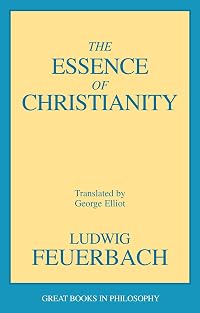
The Essence of Christianity
by Ludwig Feuerbach
On This Page
Description
Ludwig Feuerbach, the German philosopher and a founding member of the Young Hegelians, a group of radical thinkers influenced by G.W.F. Hegel, was an outspoken critic of religion, and the 1841 publication of this work established his reputation. In the first part of the book he examines what he calls the 'anthropological essence' of religion, and in the second he looks at its 'false or theological essence', arguing that the idea of God is a manifestation of human consciousness. These ideas show more provoked strong reactions in Germany, and soon other European intellectuals wanted to read Feuerbach's book. The 1843 second edition was translated by Marian Evans - who would become better known by her pen name of George Eliot - and published in Britain in 1854. Evans was influenced by Feuerbach's work, and many of his humanist ideas about religion are reflected in her novels. show lessTags
Recommendations



















Member Recommendations
Member Reviews
Man created God: here's what the German philosopher Ludwig Feuerbach affirms, in this classic, first published in 1841!
God? A product of our imagination; an 'Ideal', made up from everything we value as being admirable, besides being devoid of our own weaknesses.
This view is striking, not least because it's about making mankind the heart of religion: Man, aware of himself and of his own shortcomings, projecting himself into an abstract image, as if in a mirror but a mirror that reflects back only perfection. We are mortals? God is immortal! We depend upon nature? God controls it, even, better, created it! We have limited knowledge and abilities? God knows all and can everything! In other words, God's features are not divine because God show more possesses them, but, on the contrary, it's because such features are, first and foremost, 'divine' (akin to perfection) that *we* attributed them to God.
The interpretation is remarkable. First, because it helps explaining the attributes of other Gods, in other myths and religions. Feuerbach, in fact, also applies it to Norse and Greek mythologies. Then, because it gives a new meaning to Creation and faith, and from the place and importance of Jesus to the relevance of the sacraments; all new meanings that the philosopher explores in short chapters, as punchy as they are polemical.
Here's a powerful insight, then, that every atheist, of course, ought to read. But not only... As it will influence from Marx and Engels to, even, Freud, here's a key train of thought that everyone interested in philosophy in general might want to discover. Very, very interesting. show less
God? A product of our imagination; an 'Ideal', made up from everything we value as being admirable, besides being devoid of our own weaknesses.
This view is striking, not least because it's about making mankind the heart of religion: Man, aware of himself and of his own shortcomings, projecting himself into an abstract image, as if in a mirror but a mirror that reflects back only perfection. We are mortals? God is immortal! We depend upon nature? God controls it, even, better, created it! We have limited knowledge and abilities? God knows all and can everything! In other words, God's features are not divine because God show more possesses them, but, on the contrary, it's because such features are, first and foremost, 'divine' (akin to perfection) that *we* attributed them to God.
The interpretation is remarkable. First, because it helps explaining the attributes of other Gods, in other myths and religions. Feuerbach, in fact, also applies it to Norse and Greek mythologies. Then, because it gives a new meaning to Creation and faith, and from the place and importance of Jesus to the relevance of the sacraments; all new meanings that the philosopher explores in short chapters, as punchy as they are polemical.
Here's a powerful insight, then, that every atheist, of course, ought to read. But not only... As it will influence from Marx and Engels to, even, Freud, here's a key train of thought that everyone interested in philosophy in general might want to discover. Very, very interesting. show less
When Ludwig Feuerbach declared "Anthropology" to be "the secret of Christian Theology," he was not referring to (the not-yet-invented) cultural anthropology, but to a study-of-the-human combining disciplinary features we would now probably class with psychology and philosophy. This equation is the central thesis of his most famous work, The Essence of Christianity.
The body of the book is divided into two parts. The first and longer part focuses on retrieving philosophical truths from the morass of Christian belief, and thus accounting for the empirical success of Christianity. The second part is intent on exposing the falsity and incoherence of Christian teachings, abominating "Christian sophistry," and rejecting the enterprise of show more speculative theology. I suppose that that sequence was the one most rhetorically appropriate to Feuerbach's own 19th-century audience. He could soften them up with approbations of "the essence of" Christianity (albeit from his unusual perspective) before condemning its visible intellectual superstructure. It might be more useful for many readers today to consider the parts in the reverse sequence: Feuerbach thus points the way to an esoteric understanding of traditional Christianity that opens onto a neo-Christian perspective in which genuine religious sentiment can be divorced from theological obfuscation.
A long appendix to the work is made up of "Explanations--Remarks--Illustrative Citations." These add few if any new ideas, and much of the text is untranslated Latin in my copy of the George Eliot translation. There are some other difficult features of the Eliot translation. She uses "negativing" where we would now say "negating," and "subjectivism/objectivism" where we might have "subjectivity/objectivity." Probably the greatest consequence for today's reader comes from her choice to use "thou" and "thee" to maintain the du (dich, dir) of informal second-person pronouns in German. But, mostly on account of the King James Bible being the contemporary Anglophone's main site of exposure to those archaic pronouns, they are now psychologically charged with authority and formality, rather than intimacy and approachability.
I have found Feuerbach's later writings somewhat more congenial and useful to my own positive philosophy of religion, but I am grateful for his climactic discourse here on the contradiction between faith and love, in which he declares himself a partisan of the latter. And while by "love" he does mean a general goodwill and sense of human care, this sense expressly includes sexual love. Feuerbach anathematizes Christian prescriptions for celibacy, and defends the principle of sexual pleasure, as well as the nobility of the generative process. "All the glory of Nature, all its power, all its wisdom and profundity, concentrates and individualises itself in the distinction of sex. Why then dost thou shrink from naming the nature of God by its true name?" (78)
Another feature of this book that I found valuable is Feuerbach's reflections on the Christian sacraments. "Even the Protestant -- not indeed in words, but in truth -- transforms God into an external thing, since he subjects Him to himself as an object of sensational enjoyment" (199). He emphasizes that the pleasure taken in eating and drinking is declared to be holy by means of the Eucharist, and that the real power of a sacramental bath -- as contrasted with its perverted, imaginary effect in Christian doctrine -- is to unite the baptisand with Nature and the world.
In a footnote to the first part, recognizing that orthodox interpreters will view his readings of traditional Christian ideas as "atrocious, impious, diabolical," Feuerbach declares: "I would rather be a devil in alliance with truth, than an angel in alliance with falsehood" (155). The party of the devils is fortunate to have him. show less
The body of the book is divided into two parts. The first and longer part focuses on retrieving philosophical truths from the morass of Christian belief, and thus accounting for the empirical success of Christianity. The second part is intent on exposing the falsity and incoherence of Christian teachings, abominating "Christian sophistry," and rejecting the enterprise of show more speculative theology. I suppose that that sequence was the one most rhetorically appropriate to Feuerbach's own 19th-century audience. He could soften them up with approbations of "the essence of" Christianity (albeit from his unusual perspective) before condemning its visible intellectual superstructure. It might be more useful for many readers today to consider the parts in the reverse sequence: Feuerbach thus points the way to an esoteric understanding of traditional Christianity that opens onto a neo-Christian perspective in which genuine religious sentiment can be divorced from theological obfuscation.
A long appendix to the work is made up of "Explanations--Remarks--Illustrative Citations." These add few if any new ideas, and much of the text is untranslated Latin in my copy of the George Eliot translation. There are some other difficult features of the Eliot translation. She uses "negativing" where we would now say "negating," and "subjectivism/objectivism" where we might have "subjectivity/objectivity." Probably the greatest consequence for today's reader comes from her choice to use "thou" and "thee" to maintain the du (dich, dir) of informal second-person pronouns in German. But, mostly on account of the King James Bible being the contemporary Anglophone's main site of exposure to those archaic pronouns, they are now psychologically charged with authority and formality, rather than intimacy and approachability.
I have found Feuerbach's later writings somewhat more congenial and useful to my own positive philosophy of religion, but I am grateful for his climactic discourse here on the contradiction between faith and love, in which he declares himself a partisan of the latter. And while by "love" he does mean a general goodwill and sense of human care, this sense expressly includes sexual love. Feuerbach anathematizes Christian prescriptions for celibacy, and defends the principle of sexual pleasure, as well as the nobility of the generative process. "All the glory of Nature, all its power, all its wisdom and profundity, concentrates and individualises itself in the distinction of sex. Why then dost thou shrink from naming the nature of God by its true name?" (78)
Another feature of this book that I found valuable is Feuerbach's reflections on the Christian sacraments. "Even the Protestant -- not indeed in words, but in truth -- transforms God into an external thing, since he subjects Him to himself as an object of sensational enjoyment" (199). He emphasizes that the pleasure taken in eating and drinking is declared to be holy by means of the Eucharist, and that the real power of a sacramental bath -- as contrasted with its perverted, imaginary effect in Christian doctrine -- is to unite the baptisand with Nature and the world.
In a footnote to the first part, recognizing that orthodox interpreters will view his readings of traditional Christian ideas as "atrocious, impious, diabolical," Feuerbach declares: "I would rather be a devil in alliance with truth, than an angel in alliance with falsehood" (155). The party of the devils is fortunate to have him. show less
The beginning, middle and end of religion is MAN.
The dictum that one should “believe as a child” is a popular one among Christians of many stripes. Unquestioning belief is often held to be the true sign of piety, while scepticism and uncertainty are rejected out of hand. Yet so much of civilisation is based on rational discourse and philosophical enquiry. To claim that religion is completely ineffable would then seem to be reserving special privileges for one sphere of human existence, perhaps one of the most influential spheres. Is this justifiable? Or is it a sign of pusillanimity, a human fear of exposing the straw-man arguments on which many believers base their faith? Ludwig Feuerbach, a nineteenth-century German philosopher, show more would argue for the latter. In his fair-minded, densely written book, Feuerbach argues that, in essence, “theology is anthropology” – not in the narrow sense of anthropology as an academic study of human societies, but in a much broader sense: belief is solely a predicate of human existence, and, according to Feuerbach, Christianity is not based on the existence of an actual deity or real miraculous events, but rather based only on human needs and our limited understanding of the world. Obviously, that is a very, very condensed précis of what Feuerbach actually argues for around 300 pages. But it gives the gist of what he contends. Very controversial ideas, admittedly, whether we are talking about the nineteenth or twenty-first century.
The book is a work of philosophy that depends on a great deal of foreknowledge about the field, so it is not an easy read. And even if you have a working knowledge of Western philosophy, you will probably need to have a good amount of patience to get through it: Henry James-like paragraphs await the intrepid explorer of Feuerbach’s book, stuffed with quotations in Latin by the Church Fathers and many quotations from Luther (Feuerbach spares neither Catholicism nor Protestantism in his indictment of religion). The book is divided into two parts, the first concerning what Feuerbach calls “The True or Anthropological Essence of Religion”, in which he adopts a fairly positive tone in teasing out what he believes to be the core of religion. In the second part (“The False or Theological Essence of Religion”), however, Feuerbach pulls no punches in chastising religion for what he believes are its contradictions and inherent problems. Feuerbach can be very forceful here, and I can see why this book has upset people in the past.
An interesting note: the book was originally translated by George Eliot, and this is also the edition I read. I find it intriguing that Eliot would have been interested in this kind of book, as she is, on the whole, hardly a polemical writer. Being a translation, little of her own style really seeps through into the book, but it would be interesting to see how Feuerbach’s ideas penetrate Eliot’s own writing. There are a few grammatical problems with the translation as well, mostly related to the German use of du, which Eliot translates as thou, leading to a sometimes strange, anachronistic tone.
I thought The Essence of Christianity was an excellent philosophical work, but it certainly will not be for everyone. I did not agree with all of Feuerbach’s conclusions, but his humanist polemic certainly made me think. One should not reject this book merely because it might threaten one’s cherished beliefs. In fact, that is probably the best reason to read it. Complacency in one’s beliefs is surely as dangerous as heresy, and much more insidious. As a famous publication puts it, one should take part in “a severe contest between intelligence, which presses forward, and an unworthy, timid ignorance obstructing our progress.” It would be a shame to toss the book aside for its arguments. Its difficulty is another matter. show less
The dictum that one should “believe as a child” is a popular one among Christians of many stripes. Unquestioning belief is often held to be the true sign of piety, while scepticism and uncertainty are rejected out of hand. Yet so much of civilisation is based on rational discourse and philosophical enquiry. To claim that religion is completely ineffable would then seem to be reserving special privileges for one sphere of human existence, perhaps one of the most influential spheres. Is this justifiable? Or is it a sign of pusillanimity, a human fear of exposing the straw-man arguments on which many believers base their faith? Ludwig Feuerbach, a nineteenth-century German philosopher, show more would argue for the latter. In his fair-minded, densely written book, Feuerbach argues that, in essence, “theology is anthropology” – not in the narrow sense of anthropology as an academic study of human societies, but in a much broader sense: belief is solely a predicate of human existence, and, according to Feuerbach, Christianity is not based on the existence of an actual deity or real miraculous events, but rather based only on human needs and our limited understanding of the world. Obviously, that is a very, very condensed précis of what Feuerbach actually argues for around 300 pages. But it gives the gist of what he contends. Very controversial ideas, admittedly, whether we are talking about the nineteenth or twenty-first century.
The book is a work of philosophy that depends on a great deal of foreknowledge about the field, so it is not an easy read. And even if you have a working knowledge of Western philosophy, you will probably need to have a good amount of patience to get through it: Henry James-like paragraphs await the intrepid explorer of Feuerbach’s book, stuffed with quotations in Latin by the Church Fathers and many quotations from Luther (Feuerbach spares neither Catholicism nor Protestantism in his indictment of religion). The book is divided into two parts, the first concerning what Feuerbach calls “The True or Anthropological Essence of Religion”, in which he adopts a fairly positive tone in teasing out what he believes to be the core of religion. In the second part (“The False or Theological Essence of Religion”), however, Feuerbach pulls no punches in chastising religion for what he believes are its contradictions and inherent problems. Feuerbach can be very forceful here, and I can see why this book has upset people in the past.
An interesting note: the book was originally translated by George Eliot, and this is also the edition I read. I find it intriguing that Eliot would have been interested in this kind of book, as she is, on the whole, hardly a polemical writer. Being a translation, little of her own style really seeps through into the book, but it would be interesting to see how Feuerbach’s ideas penetrate Eliot’s own writing. There are a few grammatical problems with the translation as well, mostly related to the German use of du, which Eliot translates as thou, leading to a sometimes strange, anachronistic tone.
I thought The Essence of Christianity was an excellent philosophical work, but it certainly will not be for everyone. I did not agree with all of Feuerbach’s conclusions, but his humanist polemic certainly made me think. One should not reject this book merely because it might threaten one’s cherished beliefs. In fact, that is probably the best reason to read it. Complacency in one’s beliefs is surely as dangerous as heresy, and much more insidious. As a famous publication puts it, one should take part in “a severe contest between intelligence, which presses forward, and an unworthy, timid ignorance obstructing our progress.” It would be a shame to toss the book aside for its arguments. Its difficulty is another matter. show less
Another in the surprisingly large group of books, 'things that, although incomprehensible to people who don't understand Hegel, are read with great relish by people who don't understand Hegel because they can be used to re-affirm preexisting prejudices' (see also Marx, Kojeve, all the 'end of history' types, various aesthetic theories, etc etc).
Feuerbach's argument is, roughly, that Christianity is exactly what Hegel said it is, except that 'Geist' is the human species (which is probably what Hegel meant, too). He's far more intelligent and well read than any contemporary atheistical controversialist, and his argument is far better, inasmuch as he doesn't want to destroy religion; he just wants everyone to understand it properly. If we show more understand it properly, he says, we'll recognize that all the attributes of God (goodness, creativity, intelligence etc) are actually attributes of the human species as a whole, even though individuals quite often lack those attributes. Christianity is the 'highest' religion, since Christ is a really good, backdoor way of admitting that divine attributes are really human: Christ = the human species. In short, for Feuerbach Christianity is pretty much right, provided that you focus on the predicates of religious statements ('God is good,' 'God is love,' etc...) and not their subject. The predicates are 'true,' the subject is imaginary.
That's a great argument. This book, though, is tiresome for a twenty-first century reader: you really only need the opening chapters (and a good knowledge of the Ph. of Geist and Science of Logic) to get the point. Much of the rest is elaboration. The whole second part is a tour de force, in which Ludwig shows how his view of religion can explain various theological controversies: can we prove the existence of God? What is the status of revelation vs reason? What kind of thing is God, if he is a thing? What is the status of philosophical theology? How can we put the Trinity into words? What happens during baptism/eucharist? Why do Christians, who profess the gospel of love, hate so many people? None of this is at all interesting, inasmuch as his explanations are pretty mediocre, and many of the issues are dead.
It does show, though, that he knows something about the religion he's writing about (cf: Dawkins, Hitchens, Harris etc...) Ludwig's also much better at being a person than those writers. He doesn't use his attack on religion to drag humanity down; he doesn't want to say we're just animals or we're just matter or any such thing. He wants to say we're a part of nature, but that that means we have to understand nature much more widely than we usually do. Human activities, social activities, etc., are all 'natural,' on the right definition of nature. On the definition of nature most people operate under, though, they're supernatural: they can't be explained by natural science. This is not, for Ludwig, a reason to declare them non-existent or aberrant. It's a reason to re-examine religion, *and* the limits of empiricist thought. show less
Feuerbach's argument is, roughly, that Christianity is exactly what Hegel said it is, except that 'Geist' is the human species (which is probably what Hegel meant, too). He's far more intelligent and well read than any contemporary atheistical controversialist, and his argument is far better, inasmuch as he doesn't want to destroy religion; he just wants everyone to understand it properly. If we show more understand it properly, he says, we'll recognize that all the attributes of God (goodness, creativity, intelligence etc) are actually attributes of the human species as a whole, even though individuals quite often lack those attributes. Christianity is the 'highest' religion, since Christ is a really good, backdoor way of admitting that divine attributes are really human: Christ = the human species. In short, for Feuerbach Christianity is pretty much right, provided that you focus on the predicates of religious statements ('God is good,' 'God is love,' etc...) and not their subject. The predicates are 'true,' the subject is imaginary.
That's a great argument. This book, though, is tiresome for a twenty-first century reader: you really only need the opening chapters (and a good knowledge of the Ph. of Geist and Science of Logic) to get the point. Much of the rest is elaboration. The whole second part is a tour de force, in which Ludwig shows how his view of religion can explain various theological controversies: can we prove the existence of God? What is the status of revelation vs reason? What kind of thing is God, if he is a thing? What is the status of philosophical theology? How can we put the Trinity into words? What happens during baptism/eucharist? Why do Christians, who profess the gospel of love, hate so many people? None of this is at all interesting, inasmuch as his explanations are pretty mediocre, and many of the issues are dead.
It does show, though, that he knows something about the religion he's writing about (cf: Dawkins, Hitchens, Harris etc...) Ludwig's also much better at being a person than those writers. He doesn't use his attack on religion to drag humanity down; he doesn't want to say we're just animals or we're just matter or any such thing. He wants to say we're a part of nature, but that that means we have to understand nature much more widely than we usually do. Human activities, social activities, etc., are all 'natural,' on the right definition of nature. On the definition of nature most people operate under, though, they're supernatural: they can't be explained by natural science. This is not, for Ludwig, a reason to declare them non-existent or aberrant. It's a reason to re-examine religion, *and* the limits of empiricist thought. show less
One of the more difficult books I've ever read, but filled with great ideas. Basically Feuerbach says that Christianity (love of Christ) should really be about love of man, and this is simply because Christ sacrificed himself becasue of this love for man. Consequently, if we don't love and care for our fellow men, we are letting Jesus' sacrifice go to waste. More basically, he says that our version of God is really the divine virtues in ourselves, so religion is nothing more than self-worship (but not in a bad way).
I'm sure this was for Religion 311 back in college, and the underlining and margin notes in my handwriting indicate that I did, in fact, read it. But I can't for the life of me remember anything about it. Given my desperate shortage of shelf space, I should probably toss it, but I won't, since I'm a crazy pack rack and one day I might feel compelled to read this again.
http://nwhyte.livejournal.com/2332364.html
Writing about a subject I am only vaguely interested in terms which I cannot be bothered to try and understand.
Writing about a subject I am only vaguely interested in terms which I cannot be bothered to try and understand.
Members
- Recently Added By
Lists

Atheism, humanism, freethought, &c. — Best nonfiction books in favour of
167 works; 14 members
Author Information

Born in Landshut, Bavaria, Ludwig Andreas Feuerbach was the son of Anselm Feuerbach, the influential jurist and legal reformer. The young Feuerbach studied theology at Heidelberg and Berlin, transferring to philosophy in 1825 after hearing the lectures of Hegel. He received a doctorate at Erlangen in 1828, where he assumed a teaching position. In show more 1830 he published anonymously Thoughts on Death and Immortality, which charged that Christianity is an egoistic and inhumane religion. The essay caused a scandal, and when the identity of its author became known in 1837, Feuerbach was dismissed. He lived the remainder of his life on a small pension from the Bavarian government, the income from his writings, revenues from his wife's investments, and in later years on the generosity of his friends. Between 1836 and 1843, Feuerbach collaborated with Arnold Ruge on a journal published in Halle, in which many of his writings first appeared. He broke with Ruge in 1844, when the latter joined Karl Marx in publishing the German-French Annals, though Feuerbach contributed to the first issue. While the young Marx admired Feuerbach and his work, Feuerbach's political views were liberal rather than radical. Feuerbach's chief writings are The Essence of Christianity (1841), Principles of the Philosophy of the Future (1843), The Essence of Religion (1846), and Theogony (1857). He maintained an extensive correspondence with admirers of his work throughout Europe. Feuerbach, a leading representative of the "Young Hegelian" or "Left Hegelian" philosophical movement, interpreted Hegel's philosophy in a radically humanistic way. He held that metaphysics, including Hegelian speculative philosophy, is only a later and more intellectualized version of religious consciousness, which must be seen through and abolished if humanity is to be free. According to Feuerbach, the real object of our idea of God is the human essence-the human species considered ideally and collectively as a social whole. In primitive religion this idea is grasped intuitively but naively projected outward in the form of one or more separate beings. In later and less innocent stages of human history, the alienated idea of a divine lawgiver and judge is used to confirm the tyrannical power of rulers and priests over human beings. Like other Young Hegelians, Feuerbach advocated the abolition of religious consciousness. He maintained that doing so would liberate humanity from alienation and point the way to a reformed society of equals. In such a society self-denial would be replaced by the affirmation of life, and the human (especially sexual) love that is repressed by religion would be recognized as sacred in its own right. (Bowker Author Biography) show less
Some Editions
Series
Belongs to Publisher Series
Work Relationships
Common Knowledge
- Canonical title
- The Essence of Christianity
- Original title
- Das Wesen des Christentums
- Alternate titles
- Essence du Christianisme
- Original publication date
- 1841
- People/Characters
- Ludwig Feuerbach
- Original language
- German
Classifications
- Genres
- Philosophy, Religion & Spirituality, Nonfiction, General Nonfiction, History
- DDC/MDS
- 201 — Religion The Bible & Christianity Religious mythology, general classes of religion, interreligious relations and attitudes, social theology
- LCC
- B2971 .W4 .E5 — Philosophy, Psychology and Religion Philosophy (General) By period Modern By region or country
- BISAC
Statistics
- Members
- 1,041
- Popularity
- 24,832
- Reviews
- 12
- Rating
- (3.82)
- Languages
- 10 — Czech, Dutch, English, French, German, Hungarian, Italian, Latvian, Portuguese, Spanish
- Media
- Paper, Audiobook, Ebook
- ISBNs
- 61
- UPCs
- 1
- ASINs
- 26