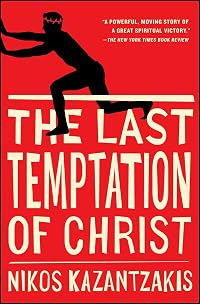
The Last Temptation of Christ
by Níkos Kazantzákis
On This Page
Description
In this story, Jesus is presented as both fully human and fully divine, free of sin but subject to all temptations.Tags
Recommendations













Member Recommendations


Member Reviews
“In order to mount the Cross, the summit of sacrifice, and to God, the summit of immateriality, Christ passed through all the stages which the man who struggles passes through…That part of Christ’s nature which was profoundly human helps us to understand him and love him and pursue his Passion as though it were our own…We struggle, we see him struggle also, and we find strength. We see that we are not all alone in the world: he is fighting at our side."–Nikos Kazantzakis, The Last Temptation of Christ
Any meaningful book about a religious figure is bound to cause strife, something Kazantzakis found out when he published The Last Temptation of Christ.
The book covers the last three years of Jesus’ life, from the start of his show more ministry to his death. Throughout, he fights against all temptations to stay on his path. At the end, as he is nailed to the cross, Satan comes to him with one last temptation: the chance for a normal human life. In a vision that lasts a fraction of a second, Jesus experiences the joys of marriage and fatherhood. As an old man reflecting on his life, he realizes that he has been deceived and rejects the false vision. The book ends with his acceptance of his death on the cross.
Kazantzakis’ depiction of Jesus as a man who struggled to fulfill his destiny caused a great deal of controversy. The Eastern Orthodox Church excommunicated him and the Roman Catholic Church placed the work on its Index of forbidden books. Religious organizations across America condemned the book–without, of course, having read it.
Those who read The Last Temptation of Christ will find that it is a moving book, written by a man of profound faith. Kazantzakis reminds us that true sacrifice must be difficult, that it must be a struggle, or it is meaningless.
I originally wrote this for The Tiger Print. It is reprinted with permission. show less
Any meaningful book about a religious figure is bound to cause strife, something Kazantzakis found out when he published The Last Temptation of Christ.
The book covers the last three years of Jesus’ life, from the start of his show more ministry to his death. Throughout, he fights against all temptations to stay on his path. At the end, as he is nailed to the cross, Satan comes to him with one last temptation: the chance for a normal human life. In a vision that lasts a fraction of a second, Jesus experiences the joys of marriage and fatherhood. As an old man reflecting on his life, he realizes that he has been deceived and rejects the false vision. The book ends with his acceptance of his death on the cross.
Kazantzakis’ depiction of Jesus as a man who struggled to fulfill his destiny caused a great deal of controversy. The Eastern Orthodox Church excommunicated him and the Roman Catholic Church placed the work on its Index of forbidden books. Religious organizations across America condemned the book–without, of course, having read it.
Those who read The Last Temptation of Christ will find that it is a moving book, written by a man of profound faith. Kazantzakis reminds us that true sacrifice must be difficult, that it must be a struggle, or it is meaningless.
I originally wrote this for The Tiger Print. It is reprinted with permission. show less
Unsurprisingly, a film (and this, its source material) that generated so much controversy amongst a certain subset of Christians, is, in actual fact, a profound statement of faith in Jesus Christ. Now, to be fair, at the time of the release of the Martin Scorsese-directed adaptation, I counted myself among those who hated it without having seen it. I have subsequently watched the film more than 20 times, usually during Holy Week (the week between Palm Sunday and Easter, of which Thursday and Friday are the most important days, being the time of the institution of the Holy Eucharist and the crucifixion, respectively).
To disabuse ourselves of the notion that this book is an attack about Christianity, let us read Kazantzakis' own words, show more from the end of the prologue (page 4, in my edition):
"This book is not a biography; it is the confession of every man who struggles. In publishing it I have fulfilled my duty, the duty of a person who struggled much, was much embittered in his life, and had many hopes. I am certain that every free man who reads this book, so filled as it is with love, will more than ever before, better than ever before, love Christ." show less
To disabuse ourselves of the notion that this book is an attack about Christianity, let us read Kazantzakis' own words, show more from the end of the prologue (page 4, in my edition):
"This book is not a biography; it is the confession of every man who struggles. In publishing it I have fulfilled my duty, the duty of a person who struggled much, was much embittered in his life, and had many hopes. I am certain that every free man who reads this book, so filled as it is with love, will more than ever before, better than ever before, love Christ." show less
This book outraged religious sensibilities when it appeared more than a half-century ago, as did the Martin Scorsese film based on it. One of the most sensational aspects was its portrayal of Judas as the only disciple who knew in advance what the carpenter's son planned. Indeed, Jesus encouraged him to perform the crucial role in carrying it out. Yet this possibility was implicit in the gospel narratives, as borne out by the publication a few years ago of the second-century Gospel of Judas.
More shocking was depicting Jesus coming down from the cross and enjoying the delights of conjugal love with the sisters Mary and Martha, numerous offspring, and a long life of satisfying labor in Bethany. Dan Brown has done his bit to diminish the show more shock factor of that supposition.
But even without these writings, ancient and modern, the outrage was misplaced, based as it was on mistaking this book's genre. In the first place, it's a novel, not a work of history or theology. Further, it doesn't fit the genre of historical fiction. If that were its intention, one would toss it aside, not out of shock at its allegations, but for its careless disregard of geography and history.
Instead, this book reconfigures names, places, and events known from the New Testament to weave a story that bears resemblance in its rough contours to the gospel accounts but differs from it in significant ways. This difference is not limited to the details that offended the pious. More tellingly, it presents a Jesus who assumes a strict opposition between body and soul, making him more ancient Greek than ancient Jew. And his assumptions about heart and mind are those of our time, not his.
Jesus struggles with these dichotomies, torn by his yearning for an ascetic life crowned by crucifixion and his love of the earth—not so much its people, but its soil, its elemental, vegetative power. He is wracked by uncertainty; which of these two absolute extremes is the path to God?
I'm referring to this figure for simplicity as Jesus, but I enjoyed the skill with which Kazantzakis avoided this name until the climactic final chapters, referring to him instead by a series of appellations: son of Mary, the carpenter's son, the son of man, the son of God. It seemed to me a tacit hint that this figure was the author's invention (much as Paul of Tarsus, when he finally meets the man who didn't really die on the cross, insists he'll tell the story his way nonetheless).
Because of this, rather than toss the book aside for its "inaccuracies," I settled down to enjoy it, much as I enjoyed Python's Brian. And it is an enjoyable tale, well-told. The opening paragraphs of each chapter could stand alone as prose poems. The prose, luminous even in translation, is full of striking observations and a love of the sinews and odors of life.
And yet … The novel closes with a Jesus dying on the cross, content because he has overcome the last temptation. Yet, did he really? After swooning as he's affixed to the cross, he fails to recognize the tempter and willingly, joyfully succumbs to the delights against which he's been struggling throughout his life. A long, satisfying lifetime passes in a few hours, then he regains consciousness to find himself on the cross after all. So in a sense, he has it both ways. show less
More shocking was depicting Jesus coming down from the cross and enjoying the delights of conjugal love with the sisters Mary and Martha, numerous offspring, and a long life of satisfying labor in Bethany. Dan Brown has done his bit to diminish the show more shock factor of that supposition.
But even without these writings, ancient and modern, the outrage was misplaced, based as it was on mistaking this book's genre. In the first place, it's a novel, not a work of history or theology. Further, it doesn't fit the genre of historical fiction. If that were its intention, one would toss it aside, not out of shock at its allegations, but for its careless disregard of geography and history.
Instead, this book reconfigures names, places, and events known from the New Testament to weave a story that bears resemblance in its rough contours to the gospel accounts but differs from it in significant ways. This difference is not limited to the details that offended the pious. More tellingly, it presents a Jesus who assumes a strict opposition between body and soul, making him more ancient Greek than ancient Jew. And his assumptions about heart and mind are those of our time, not his.
Jesus struggles with these dichotomies, torn by his yearning for an ascetic life crowned by crucifixion and his love of the earth—not so much its people, but its soil, its elemental, vegetative power. He is wracked by uncertainty; which of these two absolute extremes is the path to God?
I'm referring to this figure for simplicity as Jesus, but I enjoyed the skill with which Kazantzakis avoided this name until the climactic final chapters, referring to him instead by a series of appellations: son of Mary, the carpenter's son, the son of man, the son of God. It seemed to me a tacit hint that this figure was the author's invention (much as Paul of Tarsus, when he finally meets the man who didn't really die on the cross, insists he'll tell the story his way nonetheless).
Because of this, rather than toss the book aside for its "inaccuracies," I settled down to enjoy it, much as I enjoyed Python's Brian. And it is an enjoyable tale, well-told. The opening paragraphs of each chapter could stand alone as prose poems. The prose, luminous even in translation, is full of striking observations and a love of the sinews and odors of life.
And yet … The novel closes with a Jesus dying on the cross, content because he has overcome the last temptation. Yet, did he really? After swooning as he's affixed to the cross, he fails to recognize the tempter and willingly, joyfully succumbs to the delights against which he's been struggling throughout his life. A long, satisfying lifetime passes in a few hours, then he regains consciousness to find himself on the cross after all. So in a sense, he has it both ways. show less
The story of the gospel and passion of Jesus, told with a literary power it is difficult not to be moved by. The Jesus portrayed is as human as he is divine, and his attempt to reconcile those two poles of himself make for a poignant struggle.
What really shines through in this novel is the power and physicality of Kazantzakis writing. The world of the Gospels, one which is corrupt and fallen but still worth saving, comes across vividly. The apostles are striking in their humanity, but their camradaire and disagreements bring the ferment that surrounds Jesus to life.
Jesus comes through as an idealistic revolutionary, trying to reconcile the various aspects of a fallen world, trying to balance love with justice and the spirit with the show more flesh. And you really feel his struggle, the way he takes up an idea and then realizes he needs to reconsider. He finally grapples with the only road left to him, and we feel the inherent tragedy of the inevitable.
Even if you're not a religious person (I'm not), it makes for some very vivid, powerful reading. show less
What really shines through in this novel is the power and physicality of Kazantzakis writing. The world of the Gospels, one which is corrupt and fallen but still worth saving, comes across vividly. The apostles are striking in their humanity, but their camradaire and disagreements bring the ferment that surrounds Jesus to life.
Jesus comes through as an idealistic revolutionary, trying to reconcile the various aspects of a fallen world, trying to balance love with justice and the spirit with the show more flesh. And you really feel his struggle, the way he takes up an idea and then realizes he needs to reconsider. He finally grapples with the only road left to him, and we feel the inherent tragedy of the inevitable.
Even if you're not a religious person (I'm not), it makes for some very vivid, powerful reading. show less
The last life-of-Christ novel I read was Saramago’s The gospel according to Jesus Christ, a powerful satire of the whole notion of religious faith. Kazantzakis is at the extreme opposite end of the spectrum, someone who has spent his life exploring every philosophical and theological idea the nineteenth and twentieth centuries could throw at him, and has come down firmly on the side of religious faith. But his view of Christ, informed by his experience of Russia after the revolution and by the ideas of Nietzsche (and presumably also by his lifelong obsession with Odysseus), is hardly the conventional one. He has come to the conclusion that the conflict between the human and the divine sides of Christ’s nature is the key, and that it show more is only meaningful for us if it was a real conflict, if Christ was capable of succumbing to temptation.
I found this a much harder novel to get into than Christ recrucified: it got put back on the shelf several times before I got through the first few chapters. Peter Bien, the translator, admits that he had a hard time with Kazantzakis’s language, and it may be that he doesn't always get the tone quite right in English. I think it only really grabbed me when Kazantzakis gets to the Capernaum chapters. His fishermen are presented with a wonderful mix of humanity and cynicism that brings all the anguish and dreams-and-visions into some kind of context. From then on it had me riveted, and I read the rest of the book in a couple of days. show less
I found this a much harder novel to get into than Christ recrucified: it got put back on the shelf several times before I got through the first few chapters. Peter Bien, the translator, admits that he had a hard time with Kazantzakis’s language, and it may be that he doesn't always get the tone quite right in English. I think it only really grabbed me when Kazantzakis gets to the Capernaum chapters. His fishermen are presented with a wonderful mix of humanity and cynicism that brings all the anguish and dreams-and-visions into some kind of context. From then on it had me riveted, and I read the rest of the book in a couple of days. show less
Kazantzakis’ controversial story of Jesus Christ is humanistic in the sense that Christ is portrayed as a man, struggling with real temptations of the flesh, and dealing with real emotions. It’s also Nietzschean in the sense that Christ transcends those temptations through force of will, and in the process, achieves true freedom.
Despite those that would ban or burn the book, Kazantzakis was not trying to tear Christ down or cause controversy with the Church, he was trying to uplift Christ. It’s a spiritual story told by profound author. Kazantzakis was trying to illustrate the struggles that we all face between the flesh and the spirit, and by making Christ human, subject to all of our foibles, make him more powerful, and a source show more of greater strength to us.
Quotes:
On brotherhood:
“They are all brothers, every one of them, but they do not know it – and that is why they suffer.”
On death:
“Whoever has no fear of death is immortal.”
And:
“The two friends have parted and returned to their homes…the flesh to the soil and the soul to God.”
On eating animals:
“Good Lord, just think what poor old God must go through also,” he said with a laugh. “He certainly got himself in hot water when he created the world. The fish screams, Don’t blind me, Lord; don’t let me enter the nets! The fisherman screams, Blind the fish, Lord; make him enter the nets! Which one is God supposed to listen to? Sometimes he listens to the fish, sometimes to the fisherman – and that’s the way the world goes round!”
On God:
“He looked down and saw a preoccupied swarm of fat yellow-black ants filing hurriedly under his arches. Working in groups of twos or threes, they were carrying away the wheat in their roomy mandibles, one grain at a time. They had stolen it from the plain, right out of the mouths of men, and were transporting it now to their anthill, all the while praising God the Great Ant, who ever solicitous for his Chosen People the ants, sent floods to the plain at precisely the right moment, just when the wheat was stacked upon the threshing floors.”
On love, I love this one:
“If I were fire, I would burn; if I were a woodcutter, I would strike. But I am a heart, and I love.”
On temptation:
“Within me are the dark immemorial forces of the Evil One, human and pre-human; within me too are the luminous forces, human and pre-human, of God – and my soul is the arena where these two armies have clashed and met.” show less
Despite those that would ban or burn the book, Kazantzakis was not trying to tear Christ down or cause controversy with the Church, he was trying to uplift Christ. It’s a spiritual story told by profound author. Kazantzakis was trying to illustrate the struggles that we all face between the flesh and the spirit, and by making Christ human, subject to all of our foibles, make him more powerful, and a source show more of greater strength to us.
Quotes:
On brotherhood:
“They are all brothers, every one of them, but they do not know it – and that is why they suffer.”
On death:
“Whoever has no fear of death is immortal.”
And:
“The two friends have parted and returned to their homes…the flesh to the soil and the soul to God.”
On eating animals:
“Good Lord, just think what poor old God must go through also,” he said with a laugh. “He certainly got himself in hot water when he created the world. The fish screams, Don’t blind me, Lord; don’t let me enter the nets! The fisherman screams, Blind the fish, Lord; make him enter the nets! Which one is God supposed to listen to? Sometimes he listens to the fish, sometimes to the fisherman – and that’s the way the world goes round!”
On God:
“He looked down and saw a preoccupied swarm of fat yellow-black ants filing hurriedly under his arches. Working in groups of twos or threes, they were carrying away the wheat in their roomy mandibles, one grain at a time. They had stolen it from the plain, right out of the mouths of men, and were transporting it now to their anthill, all the while praising God the Great Ant, who ever solicitous for his Chosen People the ants, sent floods to the plain at precisely the right moment, just when the wheat was stacked upon the threshing floors.”
On love, I love this one:
“If I were fire, I would burn; if I were a woodcutter, I would strike. But I am a heart, and I love.”
On temptation:
“Within me are the dark immemorial forces of the Evil One, human and pre-human; within me too are the luminous forces, human and pre-human, of God – and my soul is the arena where these two armies have clashed and met.” show less
"The Last Temptation" marked my first true disappointment with Kazantzakis.
An author I deeply admire for his literary prowess, expressive richness, and boundless imagination, Kazantzakis here turns to a retelling—part narrative, part interpretation—of the life of Jesus Christ, drawing primarily from the Bible and the Gospels. Unfortunately, the novel's oscillation between a strict, almost reverent adherence to orthodox scripture and moments of literary experimentation felt more taxing than illuminating. Rather than offering a compelling synthesis, this tension often led to confusion, diluting both the spiritual depth and the creative vitality I’ve come to expect from his work.
An author I deeply admire for his literary prowess, expressive richness, and boundless imagination, Kazantzakis here turns to a retelling—part narrative, part interpretation—of the life of Jesus Christ, drawing primarily from the Bible and the Gospels. Unfortunately, the novel's oscillation between a strict, almost reverent adherence to orthodox scripture and moments of literary experimentation felt more taxing than illuminating. Rather than offering a compelling synthesis, this tension often led to confusion, diluting both the spiritual depth and the creative vitality I’ve come to expect from his work.
Members
- Recently Added By
Lists

1001 Books You Must Read Before You Die
1,448 works; 1,136 members

Best Historical Fiction
620 works; 261 members

Banned Books Week 2014
268 works; 63 members
Historical Fiction
889 works; 91 members

Unread books
1,063 works; 87 members

20th Century Literature
1,161 works; 54 members
1960s, Best books published therein
254 works; 22 members

Religious Fiction
58 works; 13 members

1,001 BYMRBYD Concensus
723 works; 27 members

Tammen Keltainen kirjasto
81 works; 1 member

The Essential Western Mystics
66 works; 4 members

Blue Pyramid 1,276 Best Books of All Time
1,248 works; 32 members

Art of Reading
188 works; 5 members

Best Books Involving Satan
63 works; 26 members

Recommended Reading : 600 Classics Reviewed, Editors of Salem Press, 2015
634 works; 6 members

Gen X Library
245 works; 4 members
Talk Discussions
Past Discussions
The lead-off article to start the discussion in The Arresting Life & Writings Of Nikos Kazantzakis (December 2012)
Author Information

143+ Works 12,381 Members
This distinguished novelist, poet, and translator was born in Crete and educated in Athens, Germany, Italy, and Paris, where he studied philosophy. He found time to write some 30 novels, plays, and books on philosophy, to serve his government, and to travel widely. He ran the Greek ministry of welfare from 1919 to 1921 and was minister of state show more briefly in 1945. A political activist, he spent his last years in France and died in Germany. Kazantzakis's character Zorba has been called "one of the great characters of modern fiction," in a novel that "reflects Greek exhilaration at its best" (TLS). A film version of 1965, starring Anthony Quinn, made Kazantzakis widely known in the West. Intensely religious, he imbued his novels with the passion of his own restless spirit, "torn between the active and the contemplative, between the sensual and the aesthetic, between nihilism and commitment" (Columbia Encyclopedia). Judas, the hero of The Last Temptation of Christ (1951) is asked by Christ to betray him so that he can fulfill his mission through the crucifixion. For this book Kazantzakis was excommunicated from the Greek Orthodox Church. The Fratricides, Kazantzakis's last novel, portrays yet another religious hero, a priest caught between Communists and Royalists in the Greek Civil War. (Bowker Author Biography) show less
Some Editions
Awards and Honors
Distinctions
Notable Lists
Series
Belongs to Publisher Series
Work Relationships
Has the adaptation
Common Knowledge
- Canonical title
- The Last Temptation of Christ
- Original title
- Ο τελευταίος πειρασμός
- Alternate titles
- Teleutaios peirasmos. English (Uniform title) (Uniform title)
- Original publication date
- 1955
- People/Characters
- Jesus Christ
- Important places
- Israel; Palestine; Jerusalem
- Related movies
- The Last Temptation of Christ (1988 | IMDb)
- First words
- A cool heavenly breeze took possession of him.
- Last words
- (Click to show. Warning: May contain spoilers.)And it was as though he had said: Everything has begun.
- Original language
- Greek
Classifications
- Genres
- Fiction and Literature, General Fiction, Historical Fiction
- DDC/MDS
- 889.3 — Literature & rhetoric Classical & modern Greek literatures Modern Greek literature Fiction
- LCC
- PZ3 .L — Language and Literature Fiction and juvenile belles lettres Fiction and juvenile belles lettres Fiction in English
- BISAC
Statistics
- Members
- 3,410
- Popularity
- 4,945
- Reviews
- 49
- Rating
- (4.00)
- Languages
- 20 — Arabic, Bulgarian, Dutch, English, Estonian, Finnish, French, German, Greek, Hungarian, Italian, Lithuanian, Norwegian (Bokmål), Polish, Portuguese, Romanian, Russian, Spanish, Swedish, Turkish
- Media
- Paper, Audiobook, Ebook
- ISBNs
- 53
- UPCs
- 3
- ASINs
- 39