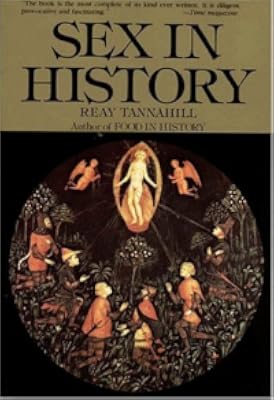
Sex in History
by Reay Tannahill
On This Page
Description
A straight record of historical fact about the role of sex through time.Tags
Recommendations

































Member Recommendations



Member Reviews
'Sex in History' is more than two decades old. It still provides an informed, often wry, and certainly intelligent review of the history of sexuality. It is a first point of call for anyone new to the subject, looking to understand how we became what we are both as a culture and as individuals (at least in the West).
Her judgement is excellent, given the facts at her disposal. I strongly approve her refusal to take at face value any late imposition of theory on how minds worked in the past. We can know nothing of past thoughts.
Similarly, the Freudianism that was still regarded as respectable when she was writing the book is now seen for what it is - another 'grand projet' from comfortably off dead white males and their camp-followers show more It gets only a couple of mentions and then with not much respect. Good!
Similarly, she is not sentimental. The Amerindians may have been treated appallingly by the Spanish conquistadores - their culture if not their persons by the incoming bishops - but the sexual laws of the Aztecs and Incas show no indication of 'noble savagery'.
On the contrary, if there is a message of this book, it is that increased state power and empire tend - whether from Constantine or any of the other thugs who get to the top - to increase interference in the life choices of persons. This alone must encourage a slight prejudice towards anarchy and against super-states and a very strong prejudice towards democracy and secularism.
Tannahill has also written an equally informative book on the role of food in history (as well as a book on cannibalism) so that, from this one author, you can be well primed on the nutritional and emotional drivers behind our history. The book ends with the AIDS epidemic of the 1980s and it does not include either the latest research into many of the stories she tells here nor does it tell the story of the last two decades.
Since 1989, the character of sexual liberation has changed yet again and entered a new world of interactive net-based communications. Still, this book gives us a grounding from an informed liberal perspective and it should have the effect, if read today, of enabling us to remain highly cautious of dabbling in our sexual lives by priests, governments and 'respectable' feminists.
If there is a criticism, it is that Tannahill takes perhaps at too much face value the mythic narrative of patriarchy, forgetting that male power is rarely a matter of black and white but has depended on women choosing to accept the situation and then manage it from within. The greatest enemy of both the free woman and the free man appears, so often throughout history and as demonstrated by Tannahill repeatedly, not so much the male as the authoritarian and conservative female to whom the powerful male will bend for the quiet life. Liberation is damned hard work!
Respectability, generally based on poor science and the desire to exclude the other and preserve privilege, has so often been cover for racist protectionism - as British wives came to Imperial India to enforce. Anglo-Saxon feminists promoted birth control not for the right reasons, to give women more control over their lives, but as a war on migrant, black or working class population growth.
It is rare nowadays to find a book that creates an inner anger but this one does, an anger less at the patriarchs (though these should cause disdain enough) than at the war on their sisters by middle class respectable women. The imposition by these harridans of prohibitionist morality created the illusion of the good society but it drove exploitation and villainy underground, institutionalising not merely hypocrisy across the West but, eventually, organised criminality in the US.
This is not to exonerate patriarchy by any means, but it is to question the accepted view that 'respectable' Judaeo-Christian morality did much more than protect some at the expense of others. Any good done was at the cost of a massive perversion of the human condition, encouraging an apartheid, quite conscious in some circles by the end of the nineteenth century, between men and women, a conspiracy of sexual silence and of exploitation at the expense of the less propertied, the uprooted and, bluntly, the more sexually aware.
Of course, the Catholic Church itself has to be the most disturbing organisation short of the Nazi Party ever to have interfered in human sexual relations. It is the death instinct institutionalised - a movement of self-reinforcing power that has managed not merely to last two thousand years but will undoubtedly be mounting missions to Mars in another two thousands.
There is a tendency to believe that some institutions cannot be criticised as too 'sacred' - the British monarchy, Parliament, Jewish mothers - but nothing is too sacred for criticism if it does bad things. The really bad thing with the Catholic Church is that it has set up a moral standard that drives sex so far underground as a taboo (unlike the spiritual traditions of Tantra or Tao or even the pragmatic reformism of solid European Protestantism) that vile acts are tolerated - as if not saying is not doing.
The scandal of child abuse by priests and of the treatment of 'fallen women' in Ireland is not recent. It is embedded within a culture of silence and hypocrisy. It is the same with the denial of condom use in Africa which is directly related to the mass murder of (potentially) millions.
Personally, I sympathise with the Church's position on abortion but the stand against sex education, contraception and homosexuality and for celibacy in the spiritual community, for sexual silence and for damn-close-to-enforced child adoption in the past are all expressions not of the right to life but of the death instinct and of the desert.
There are many good priests and catholics but the religion certainly has its dark side. It is a cheap shot to say that the Church had its own brothel during its Avignon period yet, while enforcing sexual continence on the masses, there is evidence enough (and it is only commonsense given the human condition) that some churchmen were far from celibate and often exploitative.
The justification has often been that the office and the man should be regarded separately - an attitude often translated to the modern corporate officer - but the difference here is that the office made claims affecting others while keeping back relevant information about its own conduct.
Not that Protestants were that much better when they started out - Luther saw sex as sinful - but the difference is that they recognised it as a reality instead of living in a fantasy of pure spiritual aspiration that asked for our world to be made more miserable.
The book is not only about Western attitudes - it covers East and South Asia and is generous about the Americas before and after the Spanish Conquest, as well as telling a reasonable tale of Muslim sexual mores and their translation into that peculiar revolution amongst the Frankish upper classes, courtly love.
The dialectic between Christian miserabilism (which has its Roman intellectual antecedents) and a courtly apartheid culture which objectified both men and women into stereotypes seems to be the story of a culture that, like Rome before it, was the most successful on the planet to date and yet doomed to destruction as soon as it could no longer expand to fill every vacuum.
The point of the courtly love model (which was a mere literary conceit when it started and only became serious with industrialisation) is that it turned women into wimps or harridans with nothing in between. How can you have a decent relationship with another human being if you are worshipped as a stereotype? How can you develop a relationship if you can only do it by becoming a stereotype?
The stereotypes are still deeply embedded in Western marital culture. Dialogue, any serious communication, is discouraged because any open discussion is almost inevitably going to expose 'difference' and 'difference' means that the stereotype ceases to be a stereotype.
If the marital deal was predicated on an ideal instead of on a dialogue, there is every incentive to avoid conversation and exposure of one's inner life in case it 'rocks the boat'. Eventually, if the illusion cannot be maintained, misery ensues or one or other party 'snaps' - going into hysteria or prostitution and secret sex in an age of restriction or divorce or detachment in an age of freedom.
'Respectable' people would like to legislate against prostitution and divorce but you cannot legislate against hysteria or for happiness. Indeed, one of Tannahill's themes is that respectability's attempts at legislative control of sexual behaviour is invariably disastrous in its consequences (Fawcett Society, please note). She also uses the case of the various British Contagious Diseases Acts, clumsy attempts to halt the spread of veneral disease through regulation of prostitution, as an example of the opposite - the damage caused to the community by moralists attacking basically sensible legislation!
The apartheid of courtly love created two dichotomies, not only between men and women but between 'us' (the tamed aristocracy of blood) and 'them' (humanity in the raw). Courtly love moderated the Judaeo-Christian death instinct that would have preferred castration and celibacy to sexual pleasure by bringing raw sexuality within some tolerable ideological bounds.
From there, allowing for aristocratic reversion to the animal in the eighteenth century, Christian virtue danced a dance of death with the aspirations of the propertied to maintain 'standards'. These standards, modelled on the aristocracy, were taken up by the middle classes in the nineteenth century and then by the working classes, especially the 'respectable' socialist working classes, in the twentieth.
An entire rapacious culture of 'respectability' not merely extended across the white settler world but became the basis of radical nationalism in Europe. It was copied by nationalists elsewhere who thought that they were liberating themselves from the West but whose cultural 'modernisation' merely meant a new slavishness to its mores.
We have noted elsewhere how the Meiji restoration and then the MacArthur period after 1945 imposed such modernisation in Japan - yet somehow, in the last half-millennium, only the Japanese have managed to resist cultural subjection in matters of sexuality.
Tannahill, without emphasising it, points out how the politicisation of Western women has had a direct relationship with eugenics, racial and class prejudice. The rise of women in politics is not quite the story of progressive enlightenment that we would like to believe. This was just one class of women determined on the control of the males of their own class and on the organisation and acculturation of everything below them to their 'standards'. These people were as culturally dangerous as any bunch of celibate priests.
In fact, other than in the mad 'kinder, kirche, kuche' era of interwar Europe and the separate hypocrisies of patriarchal catholicism, the Europeans have retained the basis for a healthy liberalism in sexual matters. Even the British come across as one of the more liberal of nations, successfully negotiating (in general) some sort of freedom out of the weight of respectability. America was another matter ...
America today, still culturally the dominant nation on earth, sends out two contradictory signals. The commercial marketplace operating since the 'liberatory' 1970s sends out a story of sexual liberation and licentiousness, a lack of privacy and discretion, that destabilises many traditional cultures whose upper caste, in aping this, rediscover sexual habits that they deny to their masses.
On the other hand, three hundred or so years of puritanism, patriarchy, respectable feminism and political fear have created a domestic political culture where the sight of a nipple on prime-time television causes a national cultural crisis, a politician is judged on his fidelity to his partner rather than his competence and sexuality is the subject of endless study and torment in which every act becomes a political one.
America is like an inconsistent parent - censorious one day, not caring the next. No wonder the world acts like a dysfunctional family.
The villain of the story is not feminism. On the contrary, widespread contraception and the women's movement of the 1970s democratised the war on patriarchy but it also created the conditions for an appropriate liberation of both men and women based on the elimination of the 'respectable' as a necessary condition for the good life.
It is a revolution that is still localised and metropolitan, still childish, certainly immature. Men, shell-shocked by being blamed for crimes about which they are still confused whether they committed them or not, are developing their own responses, based not on conduct required by an agrarian society out of time and place but on what men and women really are like over a life cycle - on the basis of true equality and respect.
The villain is that malign synthesis of the desert mentality of the Christian hermit and a model of the 'lady' that transmuted itself into that High Victorian horror, a culture of respectability where all went to church and where prostitution was the only deal able to be done by poverty-stricken women and men living an elaborate lie.
These respectable dames, whose attitudes would drift down into the class they oppressed (or gave employment to, if that suits you better), required leisure. While their menfolk employed thousands of prostitutes to give them something that could not be discussed at home (and brought back the risk of veneral disease), the girls had servants - thousands of them. 751,641 girls over ten were domestic servants in 1841. Within thirty years, the number has risen to 1,204,477. Given the conditions in which these girls worked, the labour use of their bodies and the lack of use of their minds was no better than prostitution unless you were determined on a morality of 'respectability'.
The institution of temple prostitute might have been a lot better for some of them than the drudgery and obligatory attendance at church on Sundays just to be told that everyone had their place. The issue comes up today when 'respectable' women, ensconced in nice jobs as lawyers, tell working women that their lap-dancing should be legislated out of existence so that they can be check-out girls at Sainsburys on a third of the wages.
As Tannahill points out, the High Victorian myth of the family and the respectable woman presided over an explosive increase in prostitution, an epidemic spread of veneral disease and the introduction of a morbid taste for masochism amongst the middle class male. She does not say but we would add that it created the conformist death instinct that materially contributed to the dumb willingness to die in a trench for an abstraction.
That abstraction, in one country, turned into a killing machine for the destruction of, symbolically, the race that kicked off the Judaeo-Christian ethic but then got left behind as its Frankenstein monster of Christianity transmuted into the hell of its opposite in national socialism. A Freudian might regard Auschwitz as the grandson attempting to murder the grandfather - Western culture is a continuum and not a series of revolutions.
Deal with the poverty of women and deal with the right of a man to be a man and society might be improved, but this has not been possible until recently because the cult of the 'lady', the cult of the perfect marriage (at its most demotic in the Hollywood romantic movie) and the separation of propertied interests from the unpropertied created a 'faux'-socialism. This was a top-down moralism that crushed the souls and spirits of many men and most women.
Since Tannahill wrote her book, we have seen further revolutions in the West - an increased (though still inadequate) economic equality between the sexes, the slow removal of the faiths from moral governance except where individuals, as is their right, choose to embrace them, the acceptance of non-exploitative consensual sexual difference as 'normal' and the acceptance of a variety of sexual partnerships and liaisons that merely require government to intervene to protect the weaker party.
The point of the revolution is that the culture of the desert has begun to be replaced by a culture of the oasis for many. The land is being irrigated slowly by a refusal of ordinary people to be told how to run their lives by 'essentialists'.
Of course, things 'may have gone too far' in the sense that children are being brought into the world without stability and that exploitation continues, especially in parts of the sex trade. But neither of these are insoluable. Both arise not from viciousness per se but from stupidity and liberal economics and globalisation. Education, the recreation of community, government regulation to deal with exploitation rather than morality and improved barriers on trade where it is exploitative should be sufficient.
Contrasted with the West in the book is what is now clearly its rival, China. This rivalry was far less clear in the 1980s and so China is placed alongside India and the Americas as just 'other'. Today, we must see China differently. It also offers us two contrasting traditions whose dialectic will be as influential as the Judaeo-Christian death instinct and courtly love have been in the creation of the Western soul.
The first tradition is the yin/yang patriarchial but ultimately sexually vibrant culture of Tao. The other is the conformist order-driven top-down culture of Neo-Confucianism which is not, by any means, anti-sexual but is concerned with public propriety.
A point made by the author here is that Chinese sexual life is rich but intensely private. We may extrapolate that Neo-Confucian resistance to Western radical sexual liberalism need not be assumed to mean puritanism in private, although foreign conquest and the malign influence of Western missionaries and Marxist earnestness (as well as state-driven population control) have driven much of the richness away and replaced it with a dogged seriousness that would gain the approval of many an Anglo-Saxon harridan seeking to re-moralise society.
It is impossible to predict the future but we can see a war of trends - private resistance to the commercialisation of sex just as it spreads around the world as an act of defiance against hypocritical leaderships and faith leaders, the continued rediscovery of sexual complexity and its normalisation in the urban West, the attempt of 'respectable' elites to contain a revolution from below driven, in part, by the new communications technology, cultural tensions within highly puritanical new powers as prosperity reintroduces dissident sexual indigenous traditions amongst the younger and more prosperous generations.
As for 'respectability' and social control, it is not dead. It remains strong, as always, on the alleged 'progressive' side of the political spectrum. It is interesting that the new freedom now inclines people to conservatism in the United Kingdom because politicians like Harriet Harman, in the dying days of the least competent centre-left administration in post-war European history, seem to want to use their last year of office to use a legislative sledgehammer to crack the serious nut of exploitation.
The Fawcett Society in its war on prostitution is the grim successor to Frances Willard and the Women's Christian Temperance Union, the dim-witted prohibitionist movement whose fruits have been the embedding of organised crime into American society. This book is recommended because it is humane. No-one humane could be a 'progressive' nowadays. show less
Her judgement is excellent, given the facts at her disposal. I strongly approve her refusal to take at face value any late imposition of theory on how minds worked in the past. We can know nothing of past thoughts.
Similarly, the Freudianism that was still regarded as respectable when she was writing the book is now seen for what it is - another 'grand projet' from comfortably off dead white males and their camp-followers show more It gets only a couple of mentions and then with not much respect. Good!
Similarly, she is not sentimental. The Amerindians may have been treated appallingly by the Spanish conquistadores - their culture if not their persons by the incoming bishops - but the sexual laws of the Aztecs and Incas show no indication of 'noble savagery'.
On the contrary, if there is a message of this book, it is that increased state power and empire tend - whether from Constantine or any of the other thugs who get to the top - to increase interference in the life choices of persons. This alone must encourage a slight prejudice towards anarchy and against super-states and a very strong prejudice towards democracy and secularism.
Tannahill has also written an equally informative book on the role of food in history (as well as a book on cannibalism) so that, from this one author, you can be well primed on the nutritional and emotional drivers behind our history. The book ends with the AIDS epidemic of the 1980s and it does not include either the latest research into many of the stories she tells here nor does it tell the story of the last two decades.
Since 1989, the character of sexual liberation has changed yet again and entered a new world of interactive net-based communications. Still, this book gives us a grounding from an informed liberal perspective and it should have the effect, if read today, of enabling us to remain highly cautious of dabbling in our sexual lives by priests, governments and 'respectable' feminists.
If there is a criticism, it is that Tannahill takes perhaps at too much face value the mythic narrative of patriarchy, forgetting that male power is rarely a matter of black and white but has depended on women choosing to accept the situation and then manage it from within. The greatest enemy of both the free woman and the free man appears, so often throughout history and as demonstrated by Tannahill repeatedly, not so much the male as the authoritarian and conservative female to whom the powerful male will bend for the quiet life. Liberation is damned hard work!
Respectability, generally based on poor science and the desire to exclude the other and preserve privilege, has so often been cover for racist protectionism - as British wives came to Imperial India to enforce. Anglo-Saxon feminists promoted birth control not for the right reasons, to give women more control over their lives, but as a war on migrant, black or working class population growth.
It is rare nowadays to find a book that creates an inner anger but this one does, an anger less at the patriarchs (though these should cause disdain enough) than at the war on their sisters by middle class respectable women. The imposition by these harridans of prohibitionist morality created the illusion of the good society but it drove exploitation and villainy underground, institutionalising not merely hypocrisy across the West but, eventually, organised criminality in the US.
This is not to exonerate patriarchy by any means, but it is to question the accepted view that 'respectable' Judaeo-Christian morality did much more than protect some at the expense of others. Any good done was at the cost of a massive perversion of the human condition, encouraging an apartheid, quite conscious in some circles by the end of the nineteenth century, between men and women, a conspiracy of sexual silence and of exploitation at the expense of the less propertied, the uprooted and, bluntly, the more sexually aware.
Of course, the Catholic Church itself has to be the most disturbing organisation short of the Nazi Party ever to have interfered in human sexual relations. It is the death instinct institutionalised - a movement of self-reinforcing power that has managed not merely to last two thousand years but will undoubtedly be mounting missions to Mars in another two thousands.
There is a tendency to believe that some institutions cannot be criticised as too 'sacred' - the British monarchy, Parliament, Jewish mothers - but nothing is too sacred for criticism if it does bad things. The really bad thing with the Catholic Church is that it has set up a moral standard that drives sex so far underground as a taboo (unlike the spiritual traditions of Tantra or Tao or even the pragmatic reformism of solid European Protestantism) that vile acts are tolerated - as if not saying is not doing.
The scandal of child abuse by priests and of the treatment of 'fallen women' in Ireland is not recent. It is embedded within a culture of silence and hypocrisy. It is the same with the denial of condom use in Africa which is directly related to the mass murder of (potentially) millions.
Personally, I sympathise with the Church's position on abortion but the stand against sex education, contraception and homosexuality and for celibacy in the spiritual community, for sexual silence and for damn-close-to-enforced child adoption in the past are all expressions not of the right to life but of the death instinct and of the desert.
There are many good priests and catholics but the religion certainly has its dark side. It is a cheap shot to say that the Church had its own brothel during its Avignon period yet, while enforcing sexual continence on the masses, there is evidence enough (and it is only commonsense given the human condition) that some churchmen were far from celibate and often exploitative.
The justification has often been that the office and the man should be regarded separately - an attitude often translated to the modern corporate officer - but the difference here is that the office made claims affecting others while keeping back relevant information about its own conduct.
Not that Protestants were that much better when they started out - Luther saw sex as sinful - but the difference is that they recognised it as a reality instead of living in a fantasy of pure spiritual aspiration that asked for our world to be made more miserable.
The book is not only about Western attitudes - it covers East and South Asia and is generous about the Americas before and after the Spanish Conquest, as well as telling a reasonable tale of Muslim sexual mores and their translation into that peculiar revolution amongst the Frankish upper classes, courtly love.
The dialectic between Christian miserabilism (which has its Roman intellectual antecedents) and a courtly apartheid culture which objectified both men and women into stereotypes seems to be the story of a culture that, like Rome before it, was the most successful on the planet to date and yet doomed to destruction as soon as it could no longer expand to fill every vacuum.
The point of the courtly love model (which was a mere literary conceit when it started and only became serious with industrialisation) is that it turned women into wimps or harridans with nothing in between. How can you have a decent relationship with another human being if you are worshipped as a stereotype? How can you develop a relationship if you can only do it by becoming a stereotype?
The stereotypes are still deeply embedded in Western marital culture. Dialogue, any serious communication, is discouraged because any open discussion is almost inevitably going to expose 'difference' and 'difference' means that the stereotype ceases to be a stereotype.
If the marital deal was predicated on an ideal instead of on a dialogue, there is every incentive to avoid conversation and exposure of one's inner life in case it 'rocks the boat'. Eventually, if the illusion cannot be maintained, misery ensues or one or other party 'snaps' - going into hysteria or prostitution and secret sex in an age of restriction or divorce or detachment in an age of freedom.
'Respectable' people would like to legislate against prostitution and divorce but you cannot legislate against hysteria or for happiness. Indeed, one of Tannahill's themes is that respectability's attempts at legislative control of sexual behaviour is invariably disastrous in its consequences (Fawcett Society, please note). She also uses the case of the various British Contagious Diseases Acts, clumsy attempts to halt the spread of veneral disease through regulation of prostitution, as an example of the opposite - the damage caused to the community by moralists attacking basically sensible legislation!
The apartheid of courtly love created two dichotomies, not only between men and women but between 'us' (the tamed aristocracy of blood) and 'them' (humanity in the raw). Courtly love moderated the Judaeo-Christian death instinct that would have preferred castration and celibacy to sexual pleasure by bringing raw sexuality within some tolerable ideological bounds.
From there, allowing for aristocratic reversion to the animal in the eighteenth century, Christian virtue danced a dance of death with the aspirations of the propertied to maintain 'standards'. These standards, modelled on the aristocracy, were taken up by the middle classes in the nineteenth century and then by the working classes, especially the 'respectable' socialist working classes, in the twentieth.
An entire rapacious culture of 'respectability' not merely extended across the white settler world but became the basis of radical nationalism in Europe. It was copied by nationalists elsewhere who thought that they were liberating themselves from the West but whose cultural 'modernisation' merely meant a new slavishness to its mores.
We have noted elsewhere how the Meiji restoration and then the MacArthur period after 1945 imposed such modernisation in Japan - yet somehow, in the last half-millennium, only the Japanese have managed to resist cultural subjection in matters of sexuality.
Tannahill, without emphasising it, points out how the politicisation of Western women has had a direct relationship with eugenics, racial and class prejudice. The rise of women in politics is not quite the story of progressive enlightenment that we would like to believe. This was just one class of women determined on the control of the males of their own class and on the organisation and acculturation of everything below them to their 'standards'. These people were as culturally dangerous as any bunch of celibate priests.
In fact, other than in the mad 'kinder, kirche, kuche' era of interwar Europe and the separate hypocrisies of patriarchal catholicism, the Europeans have retained the basis for a healthy liberalism in sexual matters. Even the British come across as one of the more liberal of nations, successfully negotiating (in general) some sort of freedom out of the weight of respectability. America was another matter ...
America today, still culturally the dominant nation on earth, sends out two contradictory signals. The commercial marketplace operating since the 'liberatory' 1970s sends out a story of sexual liberation and licentiousness, a lack of privacy and discretion, that destabilises many traditional cultures whose upper caste, in aping this, rediscover sexual habits that they deny to their masses.
On the other hand, three hundred or so years of puritanism, patriarchy, respectable feminism and political fear have created a domestic political culture where the sight of a nipple on prime-time television causes a national cultural crisis, a politician is judged on his fidelity to his partner rather than his competence and sexuality is the subject of endless study and torment in which every act becomes a political one.
America is like an inconsistent parent - censorious one day, not caring the next. No wonder the world acts like a dysfunctional family.
The villain of the story is not feminism. On the contrary, widespread contraception and the women's movement of the 1970s democratised the war on patriarchy but it also created the conditions for an appropriate liberation of both men and women based on the elimination of the 'respectable' as a necessary condition for the good life.
It is a revolution that is still localised and metropolitan, still childish, certainly immature. Men, shell-shocked by being blamed for crimes about which they are still confused whether they committed them or not, are developing their own responses, based not on conduct required by an agrarian society out of time and place but on what men and women really are like over a life cycle - on the basis of true equality and respect.
The villain is that malign synthesis of the desert mentality of the Christian hermit and a model of the 'lady' that transmuted itself into that High Victorian horror, a culture of respectability where all went to church and where prostitution was the only deal able to be done by poverty-stricken women and men living an elaborate lie.
These respectable dames, whose attitudes would drift down into the class they oppressed (or gave employment to, if that suits you better), required leisure. While their menfolk employed thousands of prostitutes to give them something that could not be discussed at home (and brought back the risk of veneral disease), the girls had servants - thousands of them. 751,641 girls over ten were domestic servants in 1841. Within thirty years, the number has risen to 1,204,477. Given the conditions in which these girls worked, the labour use of their bodies and the lack of use of their minds was no better than prostitution unless you were determined on a morality of 'respectability'.
The institution of temple prostitute might have been a lot better for some of them than the drudgery and obligatory attendance at church on Sundays just to be told that everyone had their place. The issue comes up today when 'respectable' women, ensconced in nice jobs as lawyers, tell working women that their lap-dancing should be legislated out of existence so that they can be check-out girls at Sainsburys on a third of the wages.
As Tannahill points out, the High Victorian myth of the family and the respectable woman presided over an explosive increase in prostitution, an epidemic spread of veneral disease and the introduction of a morbid taste for masochism amongst the middle class male. She does not say but we would add that it created the conformist death instinct that materially contributed to the dumb willingness to die in a trench for an abstraction.
That abstraction, in one country, turned into a killing machine for the destruction of, symbolically, the race that kicked off the Judaeo-Christian ethic but then got left behind as its Frankenstein monster of Christianity transmuted into the hell of its opposite in national socialism. A Freudian might regard Auschwitz as the grandson attempting to murder the grandfather - Western culture is a continuum and not a series of revolutions.
Deal with the poverty of women and deal with the right of a man to be a man and society might be improved, but this has not been possible until recently because the cult of the 'lady', the cult of the perfect marriage (at its most demotic in the Hollywood romantic movie) and the separation of propertied interests from the unpropertied created a 'faux'-socialism. This was a top-down moralism that crushed the souls and spirits of many men and most women.
Since Tannahill wrote her book, we have seen further revolutions in the West - an increased (though still inadequate) economic equality between the sexes, the slow removal of the faiths from moral governance except where individuals, as is their right, choose to embrace them, the acceptance of non-exploitative consensual sexual difference as 'normal' and the acceptance of a variety of sexual partnerships and liaisons that merely require government to intervene to protect the weaker party.
The point of the revolution is that the culture of the desert has begun to be replaced by a culture of the oasis for many. The land is being irrigated slowly by a refusal of ordinary people to be told how to run their lives by 'essentialists'.
Of course, things 'may have gone too far' in the sense that children are being brought into the world without stability and that exploitation continues, especially in parts of the sex trade. But neither of these are insoluable. Both arise not from viciousness per se but from stupidity and liberal economics and globalisation. Education, the recreation of community, government regulation to deal with exploitation rather than morality and improved barriers on trade where it is exploitative should be sufficient.
Contrasted with the West in the book is what is now clearly its rival, China. This rivalry was far less clear in the 1980s and so China is placed alongside India and the Americas as just 'other'. Today, we must see China differently. It also offers us two contrasting traditions whose dialectic will be as influential as the Judaeo-Christian death instinct and courtly love have been in the creation of the Western soul.
The first tradition is the yin/yang patriarchial but ultimately sexually vibrant culture of Tao. The other is the conformist order-driven top-down culture of Neo-Confucianism which is not, by any means, anti-sexual but is concerned with public propriety.
A point made by the author here is that Chinese sexual life is rich but intensely private. We may extrapolate that Neo-Confucian resistance to Western radical sexual liberalism need not be assumed to mean puritanism in private, although foreign conquest and the malign influence of Western missionaries and Marxist earnestness (as well as state-driven population control) have driven much of the richness away and replaced it with a dogged seriousness that would gain the approval of many an Anglo-Saxon harridan seeking to re-moralise society.
It is impossible to predict the future but we can see a war of trends - private resistance to the commercialisation of sex just as it spreads around the world as an act of defiance against hypocritical leaderships and faith leaders, the continued rediscovery of sexual complexity and its normalisation in the urban West, the attempt of 'respectable' elites to contain a revolution from below driven, in part, by the new communications technology, cultural tensions within highly puritanical new powers as prosperity reintroduces dissident sexual indigenous traditions amongst the younger and more prosperous generations.
As for 'respectability' and social control, it is not dead. It remains strong, as always, on the alleged 'progressive' side of the political spectrum. It is interesting that the new freedom now inclines people to conservatism in the United Kingdom because politicians like Harriet Harman, in the dying days of the least competent centre-left administration in post-war European history, seem to want to use their last year of office to use a legislative sledgehammer to crack the serious nut of exploitation.
The Fawcett Society in its war on prostitution is the grim successor to Frances Willard and the Women's Christian Temperance Union, the dim-witted prohibitionist movement whose fruits have been the embedding of organised crime into American society. This book is recommended because it is humane. No-one humane could be a 'progressive' nowadays. show less
Stop sniggering at the back there, it's more pop sociology than salacious. Somewhat dated now, it was originally published in 1990. There is some discourse on methodology, but it's more about how sex fits into society from post-glacial hunter-gather tribes to 20th century cities. Given the time-span, it tends to the superficial.
It's as much about how women fit into society as it is about mores, but it does give a good historical grounding in the varying attitudes to women, sex, marriage and procreation, and will help understand pre-pill attitudes.
I won't say recommended, but it would be useful reading for anyone designing a historical game setting.
It's as much about how women fit into society as it is about mores, but it does give a good historical grounding in the varying attitudes to women, sex, marriage and procreation, and will help understand pre-pill attitudes.
I won't say recommended, but it would be useful reading for anyone designing a historical game setting.
SEX IN HISTORY chronicles the pleasures- and perils- of the flesh from the time of mankind's distant ancestors to the modern day; from a sexual act which was bried, crude and purposeful, to the myriad varieties of contemporary sexual mores. Reay Tannahill's scholarly, yet accessible study ranges from the earliest form of contraception to some latter-day misconceptions.
More of a sociology book than a history book. Interesting, amusing and (dare I say it?) stimulating study of sex, within the context of the history of the relationship between the sexes. No moral stance, just the facts, ma'am. Explicit and definitely NOT for the kiddies (or your grandmother, either).
In interesting, informative, and in-depth look at how sex has changed as history continues. Gender roles, pornography, and religion are all considered in this book as ways that sex has shaped our history, and vice versa.
A fairly balanced look at the biological imperative, as interpreted throughout recorded history, with extensive notes and bibliography for those interested in learning more about the mystery dance.
The role of sex.
Members
- Recently Added By
Lists

LQW Research Reading List
75 works; 1 member
Author Information

22+ Works 4,115 Members
Some Editions
Series
Belongs to Publisher Series
Aula-boeken (63)
Common Knowledge
- Original title
- Sex in History
- Original publication date
- 1980-04
- Epigraph
- i suppose the human race
is doing the best it can
but hells bells thats
only an explanation
it is not an excuse
Don Marquis
Arch says - Dedication
- For Patricia Day and Sol Stein in the hope that they will accept the dedication in the spirit in which it is offered
- First words
- (Preface): The purpose of this book is to place the human sex drive and its social and moral consequences in their widest historical perspective, taking in the whole panorama of sexual attitudes, customs, and practices in al... (show all)l the world's major civilizations from earliest times until the present day.
In the year 4004 B. C. at precisely nine o'clock on the morning of October 23, "God created man in his own image, in the image of God created he him, male and female he them." - Last words
- (Click to show. Warning: May contain spoilers.)But not soon.
Classifications
- Genres
- History, Nonfiction, Sociology, General Nonfiction, Anthropology
- DDC/MDS
- 306.709 — Society, government, & culture Social sciences, sociology & anthropology Social Behavior - Dating, Marriage, Divorce Sexual relations Biography And History
- LCC
- HQ12 .T27 — Social sciences The family. Marriage, Women and Sexuality The Family. Marriage. Women Sexual life
- BISAC
Statistics
- Members
- 1,450
- Popularity
- 16,255
- Reviews
- 8
- Rating
- (3.95)
- Languages
- 6 — Dutch, English, French, German, Italian, Polish
- Media
- Paper
- ISBNs
- 14
- ASINs
- 13