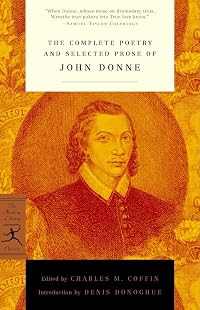
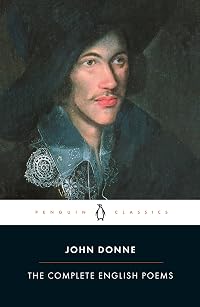
The Complete Poetry and Selected Prose of John Donne
by John Donne
On This Page
Description
An accessible and comprehensive gathering of the works of the metaphysical English poet John Donne, a writer who has continued to loom large on the literary landscape (after a long period of obscurity) since his championing by TS Eliot and others. With a new introduction, in a volume edited by Charles Coffin.Tags
Recommendations
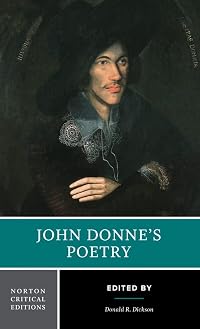











Member Reviews
I'd read some poems by Donne before, but it's amazing reading all his collected poems and being able to appreciate how consistently good they are--at least the sonnets and elegies which stand up being compared to those of Shakespeare. They're erudite, but accessible, although the edition I read didn't regularize the spelling--and frankly I think you only gain in readability if that's modernized and can't see what you'd lose unless you have a scholarly interest. Almost all the "Songs and Sonets" and "Elegies and Historical Epistle" that begin the Poetry section are love poetry, but they really run the gamut in tone. They're all witty and clever, and some are passionate and gorgeously romantic. Among those I particularly loved "The show more Good-Morrow," "The Sun Rising" and "Canonization." Others though are outrageous but funny ("The Flea") or bawdy ("Love's Progress") or surprisingly sensual, even erotic ("To His Mistress Coming to Bed"). Some are irreverent, cynical, even misogynist, and I'm not sure at times whether to take as tongue in cheek such humorous verse as "Go and Catch a Falling Star," "Woman's Constancy" or the last lines of "Love's Alchemy." "Hope not for mind in women: at their best sweetness and wit, they are but Mummy possessed." However, so many of the love poems seem to so strongly imply mutual love based on a respect for the beloved, it's hard to take seriously Donne's sometimes twitting of the female sex. (And reading his prose, which often speaks on topics concerning women, somehow doesn't clarify but only complicates the issue.) I have to admit grinning though at his epigram, "A Self Accuser:" Your mistress, that you follow whores, still taxeth you/'Tis strange that she should thus confess it, though 't be true.
The best of the poetry are definitely amazing "five star" reads, but I wasn't enchanted by all of his poetry. I can't say I found any of the "Satyres" or "Verse Letters" all that winning. The next section in which I could say I could list favorites were among his "Holy Sonnets" which included XVII "At the round earth's imagin'd corners," the famous X "Death Be Not Proud" and XIV "Batter my heart, three perso'd God." The believing Christian may find the section of Divine Poems even more appealing, but even an unbeliever like me could appreciate their brilliance and passion as every bit as extraordinary as the love poetry. All in all, I'd rate the poetry section about four or even four and half stars in terms of how much I loved them, despite some I wasn't taken with.
But then there's Donne's prose. It was moving, or at least interesting, reading some of his letters that dealt with his marriage, and there's the famous Meditation #17 From Devotions upon Emergent Occasions with its famous "no man is an island" passage. But I have to admit, I found most of the prose works a true slog I soon was skimming. It's not that I couldn't see there was a first rate mind still at work. But in the end I'm not a believing Christian, and the bulk of his prose works--half of them in the book are sermons--deal with very esoteric and dated religious issues I just couldn't care less about--and I'm the kind of person who actually read Lewis' Mere Christianity from beginning to end and counts Dante a favorite. So unless a reader has a scholarly interest in 17th century Christian theology, I'd find it hard to believe they would find reading these prose works interesting in the same way as, for instance, Montaigne's Essays written in the century before Donne which range wider in their topics and are still relevant and accessible to the modern reader. So unless you're a Donne scholar or have a particular interest in his times, you might actually be best off seeking a book with a selection of his poetry rather than this more comprehensive collection of his works of both his poetry and prose. show less
The best of the poetry are definitely amazing "five star" reads, but I wasn't enchanted by all of his poetry. I can't say I found any of the "Satyres" or "Verse Letters" all that winning. The next section in which I could say I could list favorites were among his "Holy Sonnets" which included XVII "At the round earth's imagin'd corners," the famous X "Death Be Not Proud" and XIV "Batter my heart, three perso'd God." The believing Christian may find the section of Divine Poems even more appealing, but even an unbeliever like me could appreciate their brilliance and passion as every bit as extraordinary as the love poetry. All in all, I'd rate the poetry section about four or even four and half stars in terms of how much I loved them, despite some I wasn't taken with.
But then there's Donne's prose. It was moving, or at least interesting, reading some of his letters that dealt with his marriage, and there's the famous Meditation #17 From Devotions upon Emergent Occasions with its famous "no man is an island" passage. But I have to admit, I found most of the prose works a true slog I soon was skimming. It's not that I couldn't see there was a first rate mind still at work. But in the end I'm not a believing Christian, and the bulk of his prose works--half of them in the book are sermons--deal with very esoteric and dated religious issues I just couldn't care less about--and I'm the kind of person who actually read Lewis' Mere Christianity from beginning to end and counts Dante a favorite. So unless a reader has a scholarly interest in 17th century Christian theology, I'd find it hard to believe they would find reading these prose works interesting in the same way as, for instance, Montaigne's Essays written in the century before Donne which range wider in their topics and are still relevant and accessible to the modern reader. So unless you're a Donne scholar or have a particular interest in his times, you might actually be best off seeking a book with a selection of his poetry rather than this more comprehensive collection of his works of both his poetry and prose. show less
I like John Donne. The language is different from modern English by the way he speaks so allusively.
Good footnotes can enhance your experience. The best parts for me were the Satires and the Elegies. Also, many of the Sonnets, some of the verse letters and divine poems as well. I didn't get too much out of the epicedes and obsequies. These were funeral poems and his read more like flattering the dead than the erotic charge and clever conceits of his more popular verse.
Good footnotes can enhance your experience. The best parts for me were the Satires and the Elegies. Also, many of the Sonnets, some of the verse letters and divine poems as well. I didn't get too much out of the epicedes and obsequies. These were funeral poems and his read more like flattering the dead than the erotic charge and clever conceits of his more popular verse.
Camille Paglia turned me on to John Donne. Just got the book a few weeks ago, gradually making my way through it.
One of my favorite poets of any century.
ereader ebook
Ratings
Members
- Recently Added By
Lists

University literature
145 works; 5 members

Trinity College Booklist (1951): Class Ten, English Literature
358 works; 5 members

New Lifetime Reading Plan by Fadiman and Major
225 works; 5 members

Books in the Bibliography of The History of Hell by Alice K. Turner
155 works; 1 member
Author Information

353+ Works 11,558 Members
Poet and churchman John Donne was born in London in 1572. He attended both the University of Oxford and the University of Cambridge, but did not receive a degree from either university. He studied law at Lincoln's Inn, London, in 1592, and was appointed private secretary to Sir Thomas Egerton, Keeper of the Great Seal, in 1598. He became an show more Anglican priest in 1615 and was appointed royal chaplain later that year. In 1621 he was named dean of St. Paul's Cathedral. Donne prepared for his own death by leaving his sickbed to deliver his own funeral sermon, "Death's Duel", and then returned home to have a portrait of himself made in his funeral shroud. He died in London on March 31, 1631. (Bowker Author Biography) show less
Some Editions
Awards and Honors
Notable Lists
Series
Belongs to Publisher Series
Common Knowledge
- Canonical title
- The Complete Poetry and Selected Prose of John Donne
- Original publication date
- 1952 (collection) (collection)
Classifications
Statistics
- Members
- 1,210
- Popularity
- 20,599
- Reviews
- 6
- Rating
- (4.42)
- Languages
- English
- Media
- Paper, Ebook
- ISBNs
- 9
- ASINs
- 28