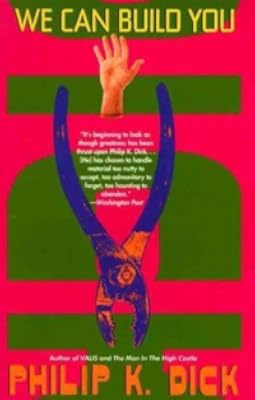
We Can Build You
by Philip K. Dick
On This Page
Description
Louis Rosen and his partners sell people--ingeniously designed, historically authentic simulacra of personages such as Edwin M. Stanton and Abraham Lincoln. The problem is that the only prospective buyer is a rapacious billionaire whose plans for the simulacra could land Louis in jail. Then there's the added complication that someone--or something--like Abraham Lincoln may not want to be sold. Is an electronic Lincoln any less alive than his creators? Is a machine that cares and suffers show more inferior to the woman Louis loves--a borderline psychopath who does neither? With irresistible momentum, intelligence, and wit, Philip K. Dick creates an arresting techno-thriller that suggests a marriage of Bladerunner and Barbarians at the Gate. show lessTags
Recommendations



















Member Recommendations
Member Reviews
Yet another classic PKD. :) A lot of great humor in this one, too. Lincoln and Edward Stanton, brought back to life and running a corporation that sells simulacra, android re-creations of real people? Well, that's hardly everything in this novel.
Most of it knocks the ball out of the park about relationships, madness, and a misdiagnosis. I really think it's not Schizophrenia he's talking about, but Autism. Or in the spectrum. And that's all kinds of cool, too, when it comes to modern novels. But of course, PKD has always jumped feet-first in that particular pool.
Interestingly enough, this novel deals with the pre-Do Androids Dream Of Electric Sheep time, with Simulacra JUST getting on the market, getting that push to take on and prepare show more colonies off Earth, and EVEN Mood Organs. :) So much of that is hilarious and/or disturbing when you think about how things go later on.
This is definitely one of the livelier and light PKD novels out there, focusing more on doomed relationships and fantasies than most. Kinda fitting, considering the theme. Are we just machines? Are we slaves to our passions, or are we making new slaves for our passions? Even funnier when you consider that LINCOLN himself has become a slave of sorts. :) show less
Most of it knocks the ball out of the park about relationships, madness, and a misdiagnosis. I really think it's not Schizophrenia he's talking about, but Autism. Or in the spectrum. And that's all kinds of cool, too, when it comes to modern novels. But of course, PKD has always jumped feet-first in that particular pool.
Interestingly enough, this novel deals with the pre-Do Androids Dream Of Electric Sheep time, with Simulacra JUST getting on the market, getting that push to take on and prepare show more colonies off Earth, and EVEN Mood Organs. :) So much of that is hilarious and/or disturbing when you think about how things go later on.
This is definitely one of the livelier and light PKD novels out there, focusing more on doomed relationships and fantasies than most. Kinda fitting, considering the theme. Are we just machines? Are we slaves to our passions, or are we making new slaves for our passions? Even funnier when you consider that LINCOLN himself has become a slave of sorts. :) show less
Just a warning to anyone thinking of reading this who's not already a Philip K. Dick fan: This is not really a sci-fi novel! Sure, a couple of major characters are robots, and it is set in a sort of dystopian future, but it's not really about that. It's more about obsession and mental health and... business? It really is all over the place.
As a fan (this was PKD book #33 according to Goodreads), I found myself cringing a few times at clumsy wording and the awkward behavior of certain characters, but overall it was still better than most non-PKD books I've read. I would have liked to see more mechanical Abe Lincoln, honestly. But the book was about Pris. For that matter, I would have liked to know more about Pris, but we only know what show more the narrator knows. And he's nuts. Oh well. show less
As a fan (this was PKD book #33 according to Goodreads), I found myself cringing a few times at clumsy wording and the awkward behavior of certain characters, but overall it was still better than most non-PKD books I've read. I would have liked to see more mechanical Abe Lincoln, honestly. But the book was about Pris. For that matter, I would have liked to know more about Pris, but we only know what show more the narrator knows. And he's nuts. Oh well. show less
Explores humanity and mental illness through the creation of lifelike androids based on Civil War figures, particularly Abraham Lincoln. Louis Rosen, a keyboard manufacturer, creates these robots to impress a businessman for a lunar colony, but becomes trapped in a toxic relationship with Pris Frauenzimmer, a troubled woman, while battling his deteriorating sanity.
Philip K. Dick is one of my favourite authors of all time, but it's fair to say that We Can Build You doesn't represent his best work. There's little to no action and it re-uses tropes that have been dealt with better elsewhere, such as simulacra, artifical intelligence, a lunar colony, small business management, the nature of consciousness. It also leans heavily on a rather disturbing sub-plot about the main character's sexual obsession with his business partner's barely-legal and mentally unstable daughter.
Dick is up to his usual psych tricks: A robot Abe Lincoln, with more soul than its schizophrenic teen creator, appears as deus ex machina.
A depressing Dick novel of a doomed, one-sided love affair that also had the usual Dick humor, realistic dialogue, and superb characterization. The book's only flaw was that it seemed to wander at times, but that was probably due to its emphasis not on plot (some of the problems seemed artificial, easily solved, and there just to advance the plot) but on character.
Despite it's hungarian title, this book is not about an android, simulacrum, impersonating Lincoln but much more a strange, sad love story. In the background there is everything makes a PKD book special. Great part of the population (allegedly) has mental illness, androids indistinguishable from humans, paranoia is a normal part of life, etc. Not his best by far, but if you like PKD, you won't be disappointed.
Members
- Recently Added By
Lists

Books Read in 2023
5,638 works; 147 members
Author Information

680+ Works 147,324 Members
Phillip Kindred Dick was an American science fiction writer best known for his psychological portrayals of characters trapped in illusory environments. Born in Chicago, Illinois, on December 16, 1928, Dick worked in radio and studied briefly at the University of California at Berkeley before embarking on his writing career. His first novel, Solar show more Lottery, was published in 1955. In 1963, Dick won the Hugo Award for his novel, The Man in the High Castle. He also wrote a series of futuristic tales about artificial creatures on the loose; notable of these was Do Androids Dream of Electric Sheep?, which was later adapted into film as Blade Runner. Dick also published several collections of short stories. He died of a stroke in Santa Ana, California, in 1982. (Bowker Author Biography) show less
Some Editions
Series
Belongs to Publisher Series
Fontana Science Fiction (4616)
サンリオSF文庫 (3-P)
Work Relationships
Common Knowledge
- Canonical title*
- Die Lincoln-Maschine
- Original title
- We Can Build You
- Alternate titles*
- Die rebellischen Roboter
- Original publication date
- 1972-07; 1962-10-04 (manuscript) (manuscript)
- People/Characters
- Louis Rosen; Edwin M. Stanton; Abraham Lincoln; Sam K. Barrows; Pris Frauenzimmer; John Wilkes Booth (show all 19); Maury Rock; Jerome Rosen; Colleen Nild; Doctor Hortowski; David Blunk; Doctor Ragland Nisea; Doctor Shedd; Bob Bundy; Chester Rosen; Miss Wallace; Silvia Devorac; Ralf; Julie
- Important places
- Ontario, USA; Boise, Idaho, USA; Klamath Falls, Oregon, USA
- Dedication
- To Robert and Ginny Heinlein,
whose kindness to us has meant more
than ordinary words can answer. - First words
- Our sales technique was perfected in the early 1970s.
- Last words
- (Click to show. Warning: May contain spoilers.)Somewhere inside the great buildings of Kasanin Clinic Pris Frauenzimmer sat carding and weaving virgin black sheep's wool, utterly involved, without a thought for me or for any other thing.
- Blurbers
- Spinrad, Norman
- Original language
- English
*Some information comes from Common Knowledge in other languages. Click "Edit" for more information.
Classifications
Statistics
- Members
- 1,489
- Popularity
- 15,665
- Reviews
- 19
- Rating
- (3.32)
- Languages
- 12 — Czech, Dutch, English, Finnish, French, German, Hungarian, Italian, Japanese, Polish, Spanish, Turkish
- Media
- Paper, Audiobook, Ebook
- ISBNs
- 48
- ASINs
- 19