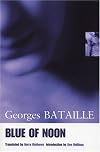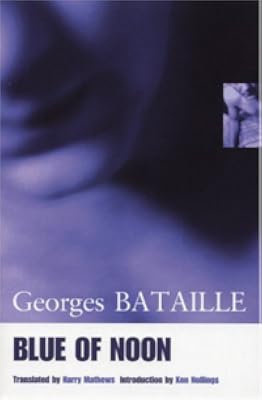
Blue of Noon
by Georges Bataille
On This Page
Description
Troppmann wanders erotically through the politically troubled Europe of the 1930s.Tags
Recommendations
























Member Reviews
I have a tendency to choose short books of relatively low merit by famous authors in preference to their classic texts. This foible arises in part from a more general distrust of texts as guides to life really lived. The marginalia of 'great minds' often brings them down to earth and reminds one that little good work comes without much persistent labour. Persistent labour can, however, sometimes remove the authenticity of feeling that belongs to a particular age.
'Blue Noon' is typical of that sort of work that gets pushed late to the public when other work has brought a man to prominence. The author is both flattered and resigned. Bataille's curt foreward to the 1957 first edition of this 1935 novella tells us as much. Others have show more prevailed on him to publish the manuscript, he no longer thinks like the late thirty-something man he was then (he has, indeed, 'moved on' as we say now) and he tries to explain that the ham-fisted clumsy style of the work is deliberate (which at least relieves us from the mistake of blaming some hapless translator for its leaden sentences).
So why bother with the book? Try treating it as a companion piece to the Henry Miller rant that we reviewed at: http://www.goodreads.com/book/show/3343410.The_World_of_Sex - two literary males trying to cope with a world where sex is pushed into the realm of the near-criminal and where both are trying to find a way of expressing their true natures. In this context, it is a social document of sorts, set amongst the bien-pensant prosperous and idle French middle classes of the 1930s who were adopting leftist views without enthusiasm or understanding and sensing the cataclysm to come.
Bataille was part of the Surrealist movement and the book is an uneasy marriage of dream sequence and realism - a brave attempt perhaps but unsatisfactory. And if Bataille is open about its clumsiness as a text, who are we to argue? The number of repetitions of the word 'ridiculous' alone are, well, ridiculous.
The hero is a whining, lacrymose, self-absorbed (apparently once self-harming) rather nasty, sickly, death-obsessed, depressive and mildly sadistic figure without character whose attempts to cope with a wife, a mistress, a mother-in-law, a lover and an odd sort of anti-woman, a political activist, are played out across Europe - London, Paris, Vienna, Catalonia (oh, how we miss Orwell's insights) and the Rhine Valley with a cast of walk on servants, gilded youth, anarchists, communists and young bright-eyed and bushy-tailed Nazis. Not forgetting a dream trip to the Soviet Union. All in under 130 pages!
The woman are not much better than our depressed and depressing hero. The wife with two kids left in Brighton and her mother come across as the most sympathetic characters probably because they are so thinly sketched. None are more than creatures of our 'hero's' tale. I may not always be the sharpest card in the deck when it comes to 'literature' but the obscurities and failures to communicate emotion, at least beyond the lachrymose and 'ridiculous', really do pall after a while.
The mistress and the lover are neurotic - the political activist cold and disturbed in an entirely different way as if a woman (or perhaps a man) who was not lachrymose, suicidal and lying wasted on their beds periodically was bound to become a political fanatic. Everyone is weak and moody. Yawn!
At one point we have the two neurotic women separately heading for Barcelona with the political activist in situ and what could have been a diverting comedy of manners or a tragedy of love turns into a rather dreary and sordid shuffling of persons around rooms while a general strike and some shooting goes on outside.
So why keep the book in the library? Because, as I noted above, it is striving to tell us something about the mind of the powerless lost souls of its time despite itself, about the ones who had no ideology and just wanted to live, but were surrounded by fanatics. The sex, by the way, is abrupt, honest in its way and real enough but don't let anyone sell this to you as under the counter pornography - the sex is just a metaphor for despair and rage and little more.
Now here's the spoiler because Bataille lets us into the secret of the book in a short exchange at the end:
Henri, listen - I know I'm a freak, but I sometimes wish there would be a war ...
This is a book about those who could see the cataclysm coming in the fanaticism of those around them and who just wanted the storm to break to put them out of their misery. To have something happen. Some would have actively sought war through fanaticism, whether that of the militarism of the Right or that of the reluctant revolutionary action of the Left, each feeding off the other, but the hysteria of the central character represents the real hysteria of the age - a shrill hope that the whole thing just go ahead because the tension was becoming unbearable!
No wonder that in 1957, our fifty-something writer wanted to make it clear that his opinion had changed - the bloodletting proved to be a lot nastier than anyone had envisaged.
Sartre wrote 'Nausea' in 1938 and, in addition to the general air of absurdity, there are moments when Bataille, in his observations of three years earlier, gets close to the imagery of the greater work. Since it is unlikely that Sartre read this work, either Bataille fiddled with the manuscript on the quiet later or this sense of 'nausea' (he uses the term) was widespread in European 'liberal' society. It is like the general air of despair amongst our middle classes as they contemplate the possibility that our society has broken down domestically as a result of the ideological 'war' betweem progressives and neo-liberals.
There is another reason to keep the book in the library - a few moments of brilliant clarity. Small sections - most notably at the very beginning and at the very end - give us small prose poems of desperate depravity that are filmic in quality. Another writer of the period bears comparison - Antonin Artaud, whose equally hysterical 'Heliogabulus' (reviewed rather negatively and not remaining in the library at http://www.goodreads.com/book/show/75887.Heliogabalus_Or_the_Crowned_Anarchist ).
Artaud and Bataille in this respect are two thin wedges from the past and the future respectively. Artaud writes as the last of the decadents and chooses an anti-modernist chaotic stance seeking to revel in the horrors to come and seeking comfort in insanity and paganism. Bataille writes as a confused Catholic-modernist and proto-existentialist avant la lettre periodically seeking immolation and death (albeit as a pose)as the tide of chaos created by competing rigid alternate conceptions of order rises.
Artaud is working in the context of dionysiac theatre and Bataille thinks like a post war film maker before his time. The presiding philosophers are a forgotten Nietzche and, despite a Catholic faith that is not present in this book, a Sartre yet to be discovered. The point here is that the marginalia of literature often conspires to give us a better picture of the stresses of society than the great works.
Artaud, Bataille and Miller are all, in their different ways, responding to a damaged failing bourgeois society that had repressed sexual passion and ecstasy. The failures saw this repression displaced into ideologies that competed to show off their ability to engage in violence for 'rational' ends. Things are much better now but the beast of psychic repression still lurks around our politics, waiting to return if it were but to be let it in.
So this unattactive self-indulgent short book has its small uses but reserve it for a day when you really have nothing much else to do. And, by the way, do not bother with the equally obscure and portentous 1982 introduction by Ken Hollings - life is short and you do not need to waste precious moments of your life trying to make sense of it. show less
'Blue Noon' is typical of that sort of work that gets pushed late to the public when other work has brought a man to prominence. The author is both flattered and resigned. Bataille's curt foreward to the 1957 first edition of this 1935 novella tells us as much. Others have show more prevailed on him to publish the manuscript, he no longer thinks like the late thirty-something man he was then (he has, indeed, 'moved on' as we say now) and he tries to explain that the ham-fisted clumsy style of the work is deliberate (which at least relieves us from the mistake of blaming some hapless translator for its leaden sentences).
So why bother with the book? Try treating it as a companion piece to the Henry Miller rant that we reviewed at: http://www.goodreads.com/book/show/3343410.The_World_of_Sex - two literary males trying to cope with a world where sex is pushed into the realm of the near-criminal and where both are trying to find a way of expressing their true natures. In this context, it is a social document of sorts, set amongst the bien-pensant prosperous and idle French middle classes of the 1930s who were adopting leftist views without enthusiasm or understanding and sensing the cataclysm to come.
Bataille was part of the Surrealist movement and the book is an uneasy marriage of dream sequence and realism - a brave attempt perhaps but unsatisfactory. And if Bataille is open about its clumsiness as a text, who are we to argue? The number of repetitions of the word 'ridiculous' alone are, well, ridiculous.
The hero is a whining, lacrymose, self-absorbed (apparently once self-harming) rather nasty, sickly, death-obsessed, depressive and mildly sadistic figure without character whose attempts to cope with a wife, a mistress, a mother-in-law, a lover and an odd sort of anti-woman, a political activist, are played out across Europe - London, Paris, Vienna, Catalonia (oh, how we miss Orwell's insights) and the Rhine Valley with a cast of walk on servants, gilded youth, anarchists, communists and young bright-eyed and bushy-tailed Nazis. Not forgetting a dream trip to the Soviet Union. All in under 130 pages!
The woman are not much better than our depressed and depressing hero. The wife with two kids left in Brighton and her mother come across as the most sympathetic characters probably because they are so thinly sketched. None are more than creatures of our 'hero's' tale. I may not always be the sharpest card in the deck when it comes to 'literature' but the obscurities and failures to communicate emotion, at least beyond the lachrymose and 'ridiculous', really do pall after a while.
The mistress and the lover are neurotic - the political activist cold and disturbed in an entirely different way as if a woman (or perhaps a man) who was not lachrymose, suicidal and lying wasted on their beds periodically was bound to become a political fanatic. Everyone is weak and moody. Yawn!
At one point we have the two neurotic women separately heading for Barcelona with the political activist in situ and what could have been a diverting comedy of manners or a tragedy of love turns into a rather dreary and sordid shuffling of persons around rooms while a general strike and some shooting goes on outside.
So why keep the book in the library? Because, as I noted above, it is striving to tell us something about the mind of the powerless lost souls of its time despite itself, about the ones who had no ideology and just wanted to live, but were surrounded by fanatics. The sex, by the way, is abrupt, honest in its way and real enough but don't let anyone sell this to you as under the counter pornography - the sex is just a metaphor for despair and rage and little more.
Now here's the spoiler because Bataille lets us into the secret of the book in a short exchange at the end:
Henri, listen - I know I'm a freak, but I sometimes wish there would be a war ...
This is a book about those who could see the cataclysm coming in the fanaticism of those around them and who just wanted the storm to break to put them out of their misery. To have something happen. Some would have actively sought war through fanaticism, whether that of the militarism of the Right or that of the reluctant revolutionary action of the Left, each feeding off the other, but the hysteria of the central character represents the real hysteria of the age - a shrill hope that the whole thing just go ahead because the tension was becoming unbearable!
No wonder that in 1957, our fifty-something writer wanted to make it clear that his opinion had changed - the bloodletting proved to be a lot nastier than anyone had envisaged.
Sartre wrote 'Nausea' in 1938 and, in addition to the general air of absurdity, there are moments when Bataille, in his observations of three years earlier, gets close to the imagery of the greater work. Since it is unlikely that Sartre read this work, either Bataille fiddled with the manuscript on the quiet later or this sense of 'nausea' (he uses the term) was widespread in European 'liberal' society. It is like the general air of despair amongst our middle classes as they contemplate the possibility that our society has broken down domestically as a result of the ideological 'war' betweem progressives and neo-liberals.
There is another reason to keep the book in the library - a few moments of brilliant clarity. Small sections - most notably at the very beginning and at the very end - give us small prose poems of desperate depravity that are filmic in quality. Another writer of the period bears comparison - Antonin Artaud, whose equally hysterical 'Heliogabulus' (reviewed rather negatively and not remaining in the library at http://www.goodreads.com/book/show/75887.Heliogabalus_Or_the_Crowned_Anarchist ).
Artaud and Bataille in this respect are two thin wedges from the past and the future respectively. Artaud writes as the last of the decadents and chooses an anti-modernist chaotic stance seeking to revel in the horrors to come and seeking comfort in insanity and paganism. Bataille writes as a confused Catholic-modernist and proto-existentialist avant la lettre periodically seeking immolation and death (albeit as a pose)as the tide of chaos created by competing rigid alternate conceptions of order rises.
Artaud is working in the context of dionysiac theatre and Bataille thinks like a post war film maker before his time. The presiding philosophers are a forgotten Nietzche and, despite a Catholic faith that is not present in this book, a Sartre yet to be discovered. The point here is that the marginalia of literature often conspires to give us a better picture of the stresses of society than the great works.
Artaud, Bataille and Miller are all, in their different ways, responding to a damaged failing bourgeois society that had repressed sexual passion and ecstasy. The failures saw this repression displaced into ideologies that competed to show off their ability to engage in violence for 'rational' ends. Things are much better now but the beast of psychic repression still lurks around our politics, waiting to return if it were but to be let it in.
So this unattactive self-indulgent short book has its small uses but reserve it for a day when you really have nothing much else to do. And, by the way, do not bother with the equally obscure and portentous 1982 introduction by Ken Hollings - life is short and you do not need to waste precious moments of your life trying to make sense of it. show less
(This review includes a cautionary spoiler that does not divulge the ending or ruin the narrative tension--I consider it important.)
Nothing is flattered in “Blue of Noon.” The backdrop of Europe’s march towards jingoism and war seems to be offered as cover fire for the unrepentant mess of Bataille’s frivolous, cruel and debauched characters. The various women on whom the parasitic narrator feeds are at different stages of their own personal decomposition, up to and including his own dead mother. Yes, if Bataille’s big surprise is going to be that the narrator has fucked the corpse of his dead mother, I’m going to raise a flag so that would-have-been-unsuspecting-readers don’t actually have to go there.
Of course, most show more people approach Bataille with the knowledge that he will attempt to be shocking or “perverse” or with the hopes that his prose will eroticize something unlikely in a thought-provoking way. Perhaps, Bataille is responding to such appetites with a punitive tableau intended to show that even the most unflinching readers can still be cowed by something abhorrent; but I don’t truly suspect him of such a moralistic or vengeful act. The fortified taboo that he places at the rotten core of his first-person narrator is more likely a summons to a whole series of psychoanalytical operations that would unravel the quartet of women named Xenie, Lazare, Dirty and Dead Mother. The progression is a bit self-evident and clearly overlaps with the succession of sick bodies, dead bodies, dying bodies, vomiting bodies, wax bodies, doll bodies, play coffins, dream coffins and real coffins which display a similar symbolic circularity to the eyes and eggs and testicles in Bataille’s “Story of the Eye.”
All of this could prove quite diverting to some readers; but I’m not currently that fascinated by this sort of writing. As a break from pure theory and philosophy, a novel in the tradition of Blanchot or Bataille, can be refreshing; but when such double-freighted works are introduced to the less overburdened company of good literature, they can seem a bit like a chore. However, the prose of Bataille’s novel moves quickly and has more in common with detective fiction or the swagger of novels wherein protagonists are quite proud of their glamorous self-destruction, than it does with critical theory. I thought this was because of Bataille’s humor; but when I went in search of examples of this, I realized that it might be stretching to define his crisper moments as comical: “Even in her debauchery, there was such candor in her that I sometimes wanted to grovel at her feet . . . Her mean, hunted look was driving me insane. She stopped—I think her legs were squirming under her dress. There was no doubt that she was about to start raving.” “When she came into the bar, her frazzled, black silhouette in the doorway seemed, in this fief of luck and wealth, a pointless incarnation of disaster; but I would jump up and guide her to my table.” “What I loved in her was her hatred: I loved the sudden ugliness, the dreadful ugliness that hate stamped on her features.”
And, finally, “I needed to stop thinking about myself, at least for the time being. I needed to think about other people and reassure myself that inside his own skull each was alive.” One feels that if the narrator had heeded this last statement more successfully, the book might have seemed more dimensional and human, which could actually have made it more shocking. I don’t regret reading this book. It kept me entertained and had some memorable lines. But its guts are rotten and the prose can seem rushed in odd contrast to its deliberate plotline. show less
Nothing is flattered in “Blue of Noon.” The backdrop of Europe’s march towards jingoism and war seems to be offered as cover fire for the unrepentant mess of Bataille’s frivolous, cruel and debauched characters. The various women on whom the parasitic narrator feeds are at different stages of their own personal decomposition, up to and including his own dead mother. Yes, if Bataille’s big surprise is going to be that the narrator has fucked the corpse of his dead mother, I’m going to raise a flag so that would-have-been-unsuspecting-readers don’t actually have to go there.
Of course, most show more people approach Bataille with the knowledge that he will attempt to be shocking or “perverse” or with the hopes that his prose will eroticize something unlikely in a thought-provoking way. Perhaps, Bataille is responding to such appetites with a punitive tableau intended to show that even the most unflinching readers can still be cowed by something abhorrent; but I don’t truly suspect him of such a moralistic or vengeful act. The fortified taboo that he places at the rotten core of his first-person narrator is more likely a summons to a whole series of psychoanalytical operations that would unravel the quartet of women named Xenie, Lazare, Dirty and Dead Mother. The progression is a bit self-evident and clearly overlaps with the succession of sick bodies, dead bodies, dying bodies, vomiting bodies, wax bodies, doll bodies, play coffins, dream coffins and real coffins which display a similar symbolic circularity to the eyes and eggs and testicles in Bataille’s “Story of the Eye.”
All of this could prove quite diverting to some readers; but I’m not currently that fascinated by this sort of writing. As a break from pure theory and philosophy, a novel in the tradition of Blanchot or Bataille, can be refreshing; but when such double-freighted works are introduced to the less overburdened company of good literature, they can seem a bit like a chore. However, the prose of Bataille’s novel moves quickly and has more in common with detective fiction or the swagger of novels wherein protagonists are quite proud of their glamorous self-destruction, than it does with critical theory. I thought this was because of Bataille’s humor; but when I went in search of examples of this, I realized that it might be stretching to define his crisper moments as comical: “Even in her debauchery, there was such candor in her that I sometimes wanted to grovel at her feet . . . Her mean, hunted look was driving me insane. She stopped—I think her legs were squirming under her dress. There was no doubt that she was about to start raving.” “When she came into the bar, her frazzled, black silhouette in the doorway seemed, in this fief of luck and wealth, a pointless incarnation of disaster; but I would jump up and guide her to my table.” “What I loved in her was her hatred: I loved the sudden ugliness, the dreadful ugliness that hate stamped on her features.”
And, finally, “I needed to stop thinking about myself, at least for the time being. I needed to think about other people and reassure myself that inside his own skull each was alive.” One feels that if the narrator had heeded this last statement more successfully, the book might have seemed more dimensional and human, which could actually have made it more shocking. I don’t regret reading this book. It kept me entertained and had some memorable lines. But its guts are rotten and the prose can seem rushed in odd contrast to its deliberate plotline. show less
Bataille brings his inimitable style to '30s nihilism and the threat of impending war, in both Spain and Germany.
Don't bother. Anything he was trying to do here is very weak and you'd be so much better off reading Isherwood.
Even the offensive debauchery here seems half-hearted.
Don't bother. Anything he was trying to do here is very weak and you'd be so much better off reading Isherwood.
Even the offensive debauchery here seems half-hearted.
In Blue of Noon, Bataille again utilizes the intertwined aesthetics of eros and death. The primary difference from his other novels is that they are not used for moral or artistic transgression, but for political commentary. This work is a surreal treatise against fascism, where attraction to the yoni is used as a symbol for the mystical allure of death and war.
While I didn't actually hate Georges Bataille's "Blue of Noon," I really didn't get it either. This supposed to be a novel that used eroticism to show how sex, violence and power is intertwined and that message really never came together for me.
The narrator is Henri Troppmann, who lives life to excess when it comes to alcohol and the debauched women who flit in and out of this life. Each woman is also on the decline for her own reasons. Henri is terrified of death and the novel is set against a backdrop of the first rumblings of the Spanish Civil War.
The book is certainly dark and not for the faint of heart (or prudish.) The most stunning scene of the book is near the end and is the novel's one true sex scene. Without giving too much show more away, I'll just say that scene did pull together some of the story for me, just not in the way Bataille apparently intended.
Perhaps I just don't know enough about the Spanish Civil War to understand what Bataille was going for. The novel seemed to be more of a book about depression, alcoholism and sexual dysfunction than a thought-provoking statement about politics for me.
Overall, I found the book to be just okay, but with a couple of worthwhile scenes that will stick with me for quite a while. show less
The narrator is Henri Troppmann, who lives life to excess when it comes to alcohol and the debauched women who flit in and out of this life. Each woman is also on the decline for her own reasons. Henri is terrified of death and the novel is set against a backdrop of the first rumblings of the Spanish Civil War.
The book is certainly dark and not for the faint of heart (or prudish.) The most stunning scene of the book is near the end and is the novel's one true sex scene. Without giving too much show more away, I'll just say that scene did pull together some of the story for me, just not in the way Bataille apparently intended.
Perhaps I just don't know enough about the Spanish Civil War to understand what Bataille was going for. The novel seemed to be more of a book about depression, alcoholism and sexual dysfunction than a thought-provoking statement about politics for me.
Overall, I found the book to be just okay, but with a couple of worthwhile scenes that will stick with me for quite a while. show less
A nihilist novel by Georges Bataille, Blue of Noon, is set during the Spanish Civil War and the early years of Nazi movement. The protagonist, Henri Timmermann is a sick man (physically and emotionally). This book is thankfully short, it is so horrible and not enjoyable in any sense of the word. The author has tried and achieved to include every human excretion and depravity in this novella. There are three women, Lazare--a political activist, Dirty--an alcoholic and Xenia--a young woman who nursed Troppmann back to health. Supposedly this is a rewrite of Don Juan but I have not read it so I wouldn't know and the author has used the writing of sex to describe the political climate. I do not feel this work has much merit.
Un cocktail azzurro puffo, ghiacciato, viscoso, amaro, secco, che prende alla testa e alle gambe. Ad alta gradazione alcolica.
Un teschio che morde un'amarena nera come guarnizione.
Un teschio che morde un'amarena nera come guarnizione.
Members
- Recently Added By
Lists

1001 Books You Must Read Before You Die
1,448 works; 1,132 members

Harold Bloom - The Western Canon: D. The Chaotic Age
833 works; 24 members
1,001 BYMRBYD Concensus
723 works; 27 members

My TBR
371 works; 3 members
Author Information

239+ Works 12,345 Members
Georges Bataille was a French poet, novelist, and philosopher. He was born in Billon, Puy-de-Dome, in central France on September 10, 1897. His father was already blind and paralyzed from syphilis when Bataille was born. In 1915, Bataille's father died, his mind destroyed by his illness. The death marked his son for life. While working at the show more Bibliotheque National in Paris during the 1920s, Bataille underwent psychoanalysis and became involved with some of the intellectuals in the Surrealist movement, from whom he learned the concept of incongruous imagery in art. In 1946 he founded the journal Critique, which published the early work of some of his contemporaries in French intellectual life, including Roland Barthes and Jacques Derrida. Bataille believed that in the darkest moments of human existence-in orgiastic sex and terrible death-lay ultimate reality. By observing them and even by experiencing them, actually in sex and vicariously in death, he felt that one could come as close as possible to fully experiencing life in all its dimensions. Bataille's works include The Naked Beast at Heaven's Gate (1956), A Tale of Satisfied Desire (1953), Death and Sensuality: A Study of Eroticism and the Taboo (1962), and The Birth of Art: Prehistoric Painting (1955). Bataille died in Paris on July 8, 1962. (Bowker Author Biography) show less
Some Editions
Awards and Honors
Series
Belongs to Publisher Series
Common Knowledge
- Canonical title
- Blue of Noon
- Original title
- Le bleu du ciel
- Original publication date
- 1935-36 (ms) (ms); 1957
- People/Characters
- Dirty
- Important places
- London, England, UK; Paris, Île-de-France, France
- Dedication
- For André Masson
- First words
- In London, in a cellar, in a neighbourhood dive - the most squalid of unlikely places - Dirty was drunk.
- Original language
- French
Classifications
Statistics
- Members
- 817
- Popularity
- 33,788
- Reviews
- 12
- Rating
- (3.44)
- Languages
- 9 — Dutch, English, French, German, Italian, Japanese, Lithuanian, Spanish, Swedish
- Media
- Paper, Ebook
- ISBNs
- 33
- ASINs
- 12