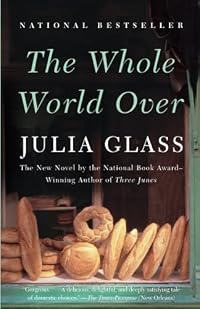
The Whole World Over
by Julia Glass
On This Page
Description
Fiction. Literature. HTML:From the author of the beloved novel Three Junes comes a rich and commanding story about the accidents, both grand and small, that determine our choices in love and marriage. Greenie Duquette, openhearted yet stubborn, devotes most of her passionate attention to her Greenwich Village bakery and her four–year–old son, George. Her husband, Alan, seems to have fallen into a midlife depression, while Walter, a traditional gay man who has become her closest show more professional ally, is nursing a broken heart.It is at Walter’s restaurant that the visiting governor of New Mexico tastes Greenie’s coconut cake and decides to woo her away from the city to be his chef. For reasons both ambitious and desperate, she accepts—and finds herself heading west without her husband. This impulsive decision will change the course of several lives within and beyond Greenie’s orbit. Alan, alone in New York, must face down his demons; Walter, eager for platonic distraction, takes in his teenage nephew. Yet Walter cannot steer clear of love trouble, and despite his enforced solitude, Alan is still surrounded by women: his powerful sister, an old flame, and an animal lover named Saga, who grapples with demons all her own. As for Greenie, living in the shadow of a charismatic politician leads to a series of unforeseen consequences that separate her from her only child. We watch as folly, chance, and determination pull all these lives together and apart over a year that culminates in the fall of the twin towers at the World Trade Center, an event that will affirm or confound the choices each character has made—or has refused to face.
Julia Glass is at her best here, weaving a glorious tapestry of lives and lifetimes, of places and people, revealing the subtle mechanisms behind our most important, and often most fragile, connections to others. In The Whole World Over she has given us another tale that pays tribute to the extraordinary complexities of love. show less
Tags
Recommendations


Member Reviews
This is a meaty novel by the author of the wonderful Three Junes. This one follows four different New Yorkers as they live their lives, reflect on the past, and struggle with life-changing events or decisions. Greenie is a pastry chef who feels restless as she and her husband seemingly grow apart. When the visiting governor of New Mexico tastes her coconut cake, he offers her a job as his chef. Greenie's husband Alan is adrift when she suddenly moves to New Mexico with their young son George, and he must reexamine his life while wondering what remains of his marriage and family. Walter is Greenie's friend and biggest cheerleader who encourages her move out West. Walter's orderly life is upended by a painful breakup and his generous show more offer to host and mentor his underachieving 19 year-old nephew for a year. Saga is a young woman recovering from a traumatic brain injury living in the care of her elderly uncle but on the periphery of his family. Ms. Glass weaves their stories together beautifully, and I felt really drawn to all of the characters. Best of all was the reappearance of Fenno McLoud, a favorite character from Three Junes. I would love to spend some more time with these people. show less
What a Great Book!
The first big surprise was that Walter was not to be a boring aside minor character in Greenie's rapidly widening circle.
His trajectory of love and humor was totally intriguing.
I'll miss Ray's conversations a lot! As well, Tall George and his plain-speaking words.
Despite feeling empathy for Saga, her travails became rather contrived, slow, and wore down the plot.
It was great to trade her for (finally) honestly angry Alan.
Maybe that was the ending draw for Greenie? Sure wish she had just divorced Alan and that he had
felt free enough to happily share George and, like Walter, to find his own great Fenno!
The first big surprise was that Walter was not to be a boring aside minor character in Greenie's rapidly widening circle.
His trajectory of love and humor was totally intriguing.
I'll miss Ray's conversations a lot! As well, Tall George and his plain-speaking words.
Despite feeling empathy for Saga, her travails became rather contrived, slow, and wore down the plot.
It was great to trade her for (finally) honestly angry Alan.
Maybe that was the ending draw for Greenie? Sure wish she had just divorced Alan and that he had
felt free enough to happily share George and, like Walter, to find his own great Fenno!
This is dense and delicious book, like a one of those chocolate cakes, "Death by Chocolate" or "Torta di Cioccolato", or something French with raspberries around the edges. Definitely layered, and definitely scrumptious.
I hadn't fully realized the time period in which it was set, but a reference to Windows on the World suddenly had me shifting my dread (for I anticipated something big happening) from a looming heart attack of a character to something much bigger and darker.
Glass handled all the characters in this book, and their worlds, beautifully.
I hadn't fully realized the time period in which it was set, but a reference to Windows on the World suddenly had me shifting my dread (for I anticipated something big happening) from a looming heart attack of a character to something much bigger and darker.
Glass handled all the characters in this book, and their worlds, beautifully.
After finishing Ms. Glass's "Three Junes" two summers ago and giving her five stars on this site, I was bereft that it would be years before I could be engrossed once again in her world populated by fascinating, real, eloquently perceived characters. I have just devoured "The Whole World Over" and vascillated between 4 and 5 stars, only because her earlier work set the bar so high.
There are no minor characters in the world created by Julia Glass- everyone has a story, a back-story, a depth of experience that creates fully-formed personalities whose actions and emotions feel natural because we know where they've been and how they got that way. She reprises her themes of family tensions, yearnings for parenthood, gourmet food show more preparation, dogs, gay relationships, and brings back Fenno McLeod and his parrot companion Felicity. Others have groused over the excessive detail about food and the lack of physical descriptions of characters. I find that one of the strengths of her writing - the details about what her characters do, what's important in their lives. We know them from their work, their actions, their emotions, and are free to conjure our own images of their physicality. I know people (except maybe for Governor Ray) exactly like those she's created, and so am even more impressed with her ability to flesh them out without actually coloring inside the lines.
The final chapters are reminiscent of Nicholas Rinaldi's "Between Two Rivers" - a book so deserving of a wider audience - where we come to know an eclectic and fascinating cast of characters who are ultimately confronted with the horror of September 11. Strongly recommended for Julia Glass fans who can't bear to wait for her next book. show less
There are no minor characters in the world created by Julia Glass- everyone has a story, a back-story, a depth of experience that creates fully-formed personalities whose actions and emotions feel natural because we know where they've been and how they got that way. She reprises her themes of family tensions, yearnings for parenthood, gourmet food show more preparation, dogs, gay relationships, and brings back Fenno McLeod and his parrot companion Felicity. Others have groused over the excessive detail about food and the lack of physical descriptions of characters. I find that one of the strengths of her writing - the details about what her characters do, what's important in their lives. We know them from their work, their actions, their emotions, and are free to conjure our own images of their physicality. I know people (except maybe for Governor Ray) exactly like those she's created, and so am even more impressed with her ability to flesh them out without actually coloring inside the lines.
The final chapters are reminiscent of Nicholas Rinaldi's "Between Two Rivers" - a book so deserving of a wider audience - where we come to know an eclectic and fascinating cast of characters who are ultimately confronted with the horror of September 11. Strongly recommended for Julia Glass fans who can't bear to wait for her next book. show less
The title refers to bird migration patterns found on a map in a small rest room in a small book store in New York. In the larger sense, it refers to the travels of this book's main characters, who drag their weak, or noble, or ambitious, or out-of-luck selves around the country from Maine to New York to New Mexico, and back home.
This story revolves around Saga (given name Emily), who has been injured and is not quite all the way back. We also have Alan and Greenie and Greenie's lover Chuck, and their son George. George commits the crime of releasing a herd of horses into the wild and Alan and Greenie have to deal with that; this episode brings up the environmental and animal-rights themes which so prevail in this book. (It's almost show more Kingsolver-esque.) Our friend Fenno (from Glass's prior "Three Junes") finds happiness at the end of this book. I apologize; my notes on the plot are inadequate. Trust me, however, when I say that when you read Julia Glass, you will get graceful prose in the service of touching stories, told with wisdom. Glass is a polished, satisfying, wonderful author, and I recommend anything by her.
http://bassoprofundo1.blogspot.com/2010/07/whole-world-over-by-julia-glass.html show less
This story revolves around Saga (given name Emily), who has been injured and is not quite all the way back. We also have Alan and Greenie and Greenie's lover Chuck, and their son George. George commits the crime of releasing a herd of horses into the wild and Alan and Greenie have to deal with that; this episode brings up the environmental and animal-rights themes which so prevail in this book. (It's almost show more Kingsolver-esque.) Our friend Fenno (from Glass's prior "Three Junes") finds happiness at the end of this book. I apologize; my notes on the plot are inadequate. Trust me, however, when I say that when you read Julia Glass, you will get graceful prose in the service of touching stories, told with wisdom. Glass is a polished, satisfying, wonderful author, and I recommend anything by her.
http://bassoprofundo1.blogspot.com/2010/07/whole-world-over-by-julia-glass.html show less
I’ve given a lot of thought to why Julia Glass’ second novel, The Whole World Over, has received so many lackluster reviews by avid fans of the author’s first novel, Three Junes. Obviously, fans of Three Junes were looking forward to another novel much like the first. They wanted another detailed character study. They wanted to get to know another character as intimately as Fenno McCloud, the much-loved main character at the center of Three Junes. What they got instead, was something entirely different.
The Whole World Over is a study about family. The novel has a wide assortment of main characters, each belonging to ever-widening and intersecting circles of family connections. The author deftly sculpts each character—but none show more have that breath of life that Glass was able to achieve with Fenno McCloud. How could she? There are just too many characters…and after all, that is not the purpose of this novel.
In this work, Glass delves deeply into the timeless question: “What does it take to make, or break, a family?” She gives us many families: a traditional family on the brink of a break-up; a hodge-podge family of friends, associates, and workers centered around a charismatic bachelor governor; a newly formed fragile group of three testing the possibilities of becoming a family; a father with one son, dealing with the possibility that he may have fathered another child who is totally unaware of his existence; a family that is shattered by how they deal with a mentally declining patriarch and a neurologically damaged sister; and many more. Glass takes us on a journey through these families. You won’t like all these characters, or their families, but each is fascinating and fundamentally unique. Each give us a view of family reality from another perspective.
In this book, not all the families have bonds of blood, and some of the people tied together by blood do not turn out to be real families at all. At the end of this novel, no one character, or one family, will stand out in your mind. Instead, you will be left with the author’s all-important message seared into your heart: to make a family, all it takes is commitment and unconditional love. Without these, a family will shatter…or slowly dissolve.
And, by the way, Fenno McCloud and his New York friends make a heart-warming appearance in this novel…and yes, they are most certainly one of the good and healthy examples of families that populate this remarkable book.
I thoroughly enjoyed this book and recommend it highly. It may not be as magnificent a novel as Three Junes, but it is still a powerfully-crafted and artful work of prose with an all-important message. show less
The Whole World Over is a study about family. The novel has a wide assortment of main characters, each belonging to ever-widening and intersecting circles of family connections. The author deftly sculpts each character—but none show more have that breath of life that Glass was able to achieve with Fenno McCloud. How could she? There are just too many characters…and after all, that is not the purpose of this novel.
In this work, Glass delves deeply into the timeless question: “What does it take to make, or break, a family?” She gives us many families: a traditional family on the brink of a break-up; a hodge-podge family of friends, associates, and workers centered around a charismatic bachelor governor; a newly formed fragile group of three testing the possibilities of becoming a family; a father with one son, dealing with the possibility that he may have fathered another child who is totally unaware of his existence; a family that is shattered by how they deal with a mentally declining patriarch and a neurologically damaged sister; and many more. Glass takes us on a journey through these families. You won’t like all these characters, or their families, but each is fascinating and fundamentally unique. Each give us a view of family reality from another perspective.
In this book, not all the families have bonds of blood, and some of the people tied together by blood do not turn out to be real families at all. At the end of this novel, no one character, or one family, will stand out in your mind. Instead, you will be left with the author’s all-important message seared into your heart: to make a family, all it takes is commitment and unconditional love. Without these, a family will shatter…or slowly dissolve.
And, by the way, Fenno McCloud and his New York friends make a heart-warming appearance in this novel…and yes, they are most certainly one of the good and healthy examples of families that populate this remarkable book.
I thoroughly enjoyed this book and recommend it highly. It may not be as magnificent a novel as Three Junes, but it is still a powerfully-crafted and artful work of prose with an all-important message. show less
I was disappointed in this book because I loved Three Junes, Julia Glass's first novel. The Whole World Over was actually one of the few books I committed to reading in the early days after giving birth, so I read it at all sorts of odd hours and probably in a variety of moods, but I don't think that really mattered. I found the characters to be unlikable and the plots to be boring. I liked the premise of the chef working in the governor's mansion, but otherwise didn't really like her character, or her husband's, and by the time we got around to 9/11 I was so weary of the way all their stories were woven together that I just didn't care anymore. Big disappointment.
Members
- Recently Added By
Lists

Allie's Wishlist
217 works; 2 members
Author Information

10+ Works 8,461 Members
Julia Glass was born March 23, 1956, in Boston, Massachusetts. Her debut novel, Three Junes, won the National Book Award in 2002. Her latest novel is entitled, The Widower's tale. She grew up in Lincoln, MA, and graduated from Yale in 1978. She lives in Marblehead, Massachusetts with her partner, photographer Dennis Cowley. She has two children show more and works as a freelance journalist and editor. (Bowker Author Biography) show less
Awards and Honors
Awards
Common Knowledge
- Original publication date
- 2006
- People/Characters
- Fenno McLeod
- Important places
- New York, New York, USA; New Mexico, USA; San Francisco, California, USA; USA; California, USA; Maine, USA (show all 7); New York, USA
- Important events
- September 11 Attacks
Classifications
Statistics
- Members
- 1,165
- Popularity
- 21,445
- Reviews
- 41
- Rating
- (3.55)
- Languages
- English, French, Italian, Portuguese
- Media
- Paper, Audiobook, Ebook
- ISBNs
- 20
- ASINs
- 6