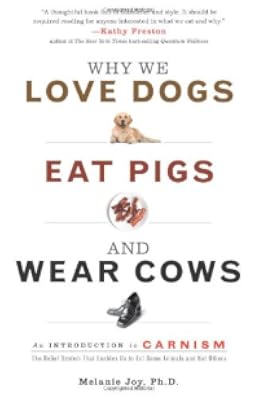
Why We Love Dogs, Eat Pigs, and Wear Cows: An Introduction to Carnism
by Melanie Joy
On This Page
Description
An Introduction to Carnism Why We Love Dogs, Eat Pigs, and Wear Cows offers an absorbing look at what social psychologist Melanie Joy calls carnism, the belief system that conditions us to eat certain animals when we would never dream of eating others. Carnism causes extensive animal suffering and global injustice, and it drives us to act against our own interests and the interests of others without fully realizing what we are doing. Becoming aware of what carnism is and how it functions is show more vital to personal empowerment and social transformation, as it enables us to make our food choices more freely-because without awareness, there is no free choice. show lessTags
Recommendations




Member Reviews
We have very precise terminologies to describe someone not eating meat but fish (pescatarian); to describe someone not eating any animal at all but otherwise eating some animal products (vegetarian); and, even, to describe someone not eating any animals and any animal products (vegan). Tellingly, though, we have no precise terminology to describe someone having no such ethical concerns when it comes to animal rights and/ or environmental issues (the keys, main reasons usually advanced to adopt vegetarian/ vegan diets) apart from "meat eater". Does it matter?
Language matters and it matters a great deal. As Melanie Joy's brilliantly shows here, there is indeed a reason why we merely describe meat eating as being simply, well, "meat show more eating": it prevents critical thinking in regards to such behaviours, besides sustaining the bogus paradigm according to which eating meat and/ or animal products is, as far as human needs are concerned, normal (it's not -at least as far as our meat and dairies are in fact produced...), necessary (it's absolutely not, contrary to what self-interested lobbies have been telling us...), and natural (it's not either -at least within the understanding that, it's not because it was done for millennia that we should keep doing it). Brilliantly too, she actually goes one step further than challenging our blind acceptance of such bogus paradigm and the behaviours that come with it (and that can only be described as both cruel and completely unnecessary e.g. the mass murdering of billions of animals a year, often in appalling conditions and merely to satisfy culinary pleasures which are -as she shows too- nothing but questionable cultural constructs) by proposing a far more suited term to describe meat eating: "carnism". What is that all about?!
This book -be warned!- is not for the morally faint-hearted, otherwise happy to go along with their own self-serving cognitive dissonances (e.g. claiming to be 'animal lovers' and/ or 'environmentalists' concerned about climate change, let alone concerned about human rights issues across the globe while, at the same time, consuming animals...!). Eating meat is here exposed indeed as the whole violent ideology that it is, yet which has so entrapped us that we can't even be bothered to see it most of the time. "Carnism", in other words, is the belief system according to which our perception of certain animals is being (ab)used to oppress and brutalise them, no matter the costs (for the animal concerned; for our health; for the environment; for our human rights).
Is this book preachy? No. Is it self-righteous? No either. What this book is, is an enlightened examination of a whole culture whereas good people otherwise intelligent and perfectly decent can claim being 'animal lovers' while having no qualm sustaining and supporting (by their consumption of meat and animal products) a whole murdering and abusive industry those catastrophic impacts upon our health and our planet has now started to show. What this book is, in other words, is a clear defining of a mindset and values leading to appalling behaviours (helped, again, by self-serving cognitive dissonances) this in order to create a new paradigm whereas carnism would be recognised for what it is: a toxic ideology which ought to be out-dated.
Now, on a personal note, at the time of writing this review I'm a vegetarian who has been trying to move towards a vegan diet (e.g. I still sometimes eat and drink dairies from animals; not because I morally want to but because I have yet to educate myself about alternatives...). On a personal note too, I usually don't like lecturing people about belief systems as I personally believe that life is a journey; that we're all each on our own path to betterment. After all, I was a meat-eater once and (again) I still eat animal products as it is! Who am I, then, to tell people that their dietary choices (when not vegan, that is...) are nothing but disguised complicity in cruelty on a grand scale and self-serving speciesism!? The thing is, meat-eating is indeed carnism at the core and so it ought to be phased out if we truly aspire to be better -for ourselves, for our planet, for our fellow animals. As it is, then, if this book hasn't turned me into a militant vegan it has, nevertheless, contributed to reinforce my convictions in regards to my ethical choices in matter of the food that I eat.
Is the concept of "carnism" a radical outlook? To those refusing to question the status quo and/ or how our attitudes and behaviours can miserably fail our values, Melanie Joy's stance will surely be considered so. To the rest of us, thought, such a concept will, on the contrary, offer a whole new frame of thinking to, not only think outside the omnivore box but, also and above all, happily discard that box altogether. Brilliant! show less
Language matters and it matters a great deal. As Melanie Joy's brilliantly shows here, there is indeed a reason why we merely describe meat eating as being simply, well, "meat show more eating": it prevents critical thinking in regards to such behaviours, besides sustaining the bogus paradigm according to which eating meat and/ or animal products is, as far as human needs are concerned, normal (it's not -at least as far as our meat and dairies are in fact produced...), necessary (it's absolutely not, contrary to what self-interested lobbies have been telling us...), and natural (it's not either -at least within the understanding that, it's not because it was done for millennia that we should keep doing it). Brilliantly too, she actually goes one step further than challenging our blind acceptance of such bogus paradigm and the behaviours that come with it (and that can only be described as both cruel and completely unnecessary e.g. the mass murdering of billions of animals a year, often in appalling conditions and merely to satisfy culinary pleasures which are -as she shows too- nothing but questionable cultural constructs) by proposing a far more suited term to describe meat eating: "carnism". What is that all about?!
This book -be warned!- is not for the morally faint-hearted, otherwise happy to go along with their own self-serving cognitive dissonances (e.g. claiming to be 'animal lovers' and/ or 'environmentalists' concerned about climate change, let alone concerned about human rights issues across the globe while, at the same time, consuming animals...!). Eating meat is here exposed indeed as the whole violent ideology that it is, yet which has so entrapped us that we can't even be bothered to see it most of the time. "Carnism", in other words, is the belief system according to which our perception of certain animals is being (ab)used to oppress and brutalise them, no matter the costs (for the animal concerned; for our health; for the environment; for our human rights).
Is this book preachy? No. Is it self-righteous? No either. What this book is, is an enlightened examination of a whole culture whereas good people otherwise intelligent and perfectly decent can claim being 'animal lovers' while having no qualm sustaining and supporting (by their consumption of meat and animal products) a whole murdering and abusive industry those catastrophic impacts upon our health and our planet has now started to show. What this book is, in other words, is a clear defining of a mindset and values leading to appalling behaviours (helped, again, by self-serving cognitive dissonances) this in order to create a new paradigm whereas carnism would be recognised for what it is: a toxic ideology which ought to be out-dated.
Now, on a personal note, at the time of writing this review I'm a vegetarian who has been trying to move towards a vegan diet (e.g. I still sometimes eat and drink dairies from animals; not because I morally want to but because I have yet to educate myself about alternatives...). On a personal note too, I usually don't like lecturing people about belief systems as I personally believe that life is a journey; that we're all each on our own path to betterment. After all, I was a meat-eater once and (again) I still eat animal products as it is! Who am I, then, to tell people that their dietary choices (when not vegan, that is...) are nothing but disguised complicity in cruelty on a grand scale and self-serving speciesism!? The thing is, meat-eating is indeed carnism at the core and so it ought to be phased out if we truly aspire to be better -for ourselves, for our planet, for our fellow animals. As it is, then, if this book hasn't turned me into a militant vegan it has, nevertheless, contributed to reinforce my convictions in regards to my ethical choices in matter of the food that I eat.
Is the concept of "carnism" a radical outlook? To those refusing to question the status quo and/ or how our attitudes and behaviours can miserably fail our values, Melanie Joy's stance will surely be considered so. To the rest of us, thought, such a concept will, on the contrary, offer a whole new frame of thinking to, not only think outside the omnivore box but, also and above all, happily discard that box altogether. Brilliant! show less
Melanie Joy is the leading researcher in the field of carnism, a field she invented. If that sounds a tad catty, sorry, but I'm laboring under the burden of having actually read her book.
Dr. Joy purports to give us a thoroughly researched discussion of the psychology of why we eat meat, and why we eat some animals and not other animals. This book has gotten a lot of praise, for it's fairness and respectful attitude towards people who eat meat. I'm honestly mystified by that praise. The assumption of the moral superiority of veganism is quite clear. It's true she does assume that us carnists are doing it because we're bad people. No, she assumes it's because we don't know any better, are ignorant, brainwashed, and perhaps not very show more bright. This book is poorly researched, poorly reasoned, and overall pretty silly.
One of the sillier and more annoying features of the book is her effort, repeated throughout the book, to suggest that eating meat is not natural--despite the fact that she concedes our ancestors have been doing it for two million years. Despite the fact that we've been eating meat since before we were fully human, we only eat meat because of an "ideology of carnism." Really? I want to read her explanation of how this "ideology of carnism" arose in Homo erectus, or among the tribes of chimpanzees who hunt, kill, and eat monkeys whenever they get the chance.
Saying that something our ancestors have been doing for two million years, since before we were fully human, is "not natural" is to strip the word "natural" of all meaning.
On the "lack of respect" point, I think it's rather hard to overlook the quotes used throughout the book, many about Nazis and how they treated the people they considered subhuman, some about slavery, some about misogyny. You're not being "respectful" when you imply that the people who disagree with you are like the Nazis. On the internet, that would be called a "Godwin violation" and the discussion would shut down. And I'll note an amusing little irony: Hitler was a vegetarian, and very concerned about humane treatment of animals. Does that make vegetarians bad? Does it make them like Nazis? Of course not! Nazis have nothing to do with this discussion, and it's a mistake for Dr. Joy to pretend that they do.
One of her basic points is that we perceive some animals as food, and some animals as family members, and still others as just icky. ("Icky" is my word, not hers.) In America, she says, we eat cows, and pigs, and chickens, because we perceive them differently than we perceive dogs. If only we were not so deluded and confused, we'd see that this difference in perception is silly, and that dogs, cows, pigs, and chickens are all really the same, sentient beings with feelings and identity. In Dr. Joy's view, it's all false perception on our part, and while she does not quite come out and use the phrase, "a rat is a dog is a boy," it's implied very strongly. There's no moral difference between eating a cow and eating a human being.
She also makes a big point of the fact that different cultures class different animals in the "animals we eat" and "animals we love" categories, implying that this proves the inherent invalidity of classing any animals as "okay to eat."
No, sorry, not true. We perceive dogs and cows and chickens differently because our relationships with them are different. Our relationships with them are very different because the animals themselves are very different. Dogs evolved out of wolves because early humans and early, proto-dog wolves had both similar social structures and complementary abilities and needs. Humans created middens of the bits of both plants and animals that were not edible to them but were edible to hungry wolves; the wolf proto-dogs who followed the human hunter-gatherer bands had better scent, hearing, and night vision, and raised the alarm when critters (human, wolf, or other) that weren't part of the established and recognized band. Everyone was better off, a little better fed and a little safer, and this evolved into a human-dog partnership--starting at least 14,000 years ago, and possibly, depending on which body of evidence and which reasoning about it you find most convincing, 250,000 years ago. If the extreme early date is at all accurate, proto-dog wolves starting partnering up with us when we were still making the transition from Homo erectus to Homo sapiens. If the latest, most recent date is correct, it was still while we were paleolithic hunter-gatherers with the beginnings of agriculture still thousands of years in our future.
Cows, on the other hand, evolved out of wild cattle that our ancestors hunted for food.
It's quite true that different cultures have different relationships with the same animals. Hindus don't eat cows; they revere them. Jews and Muslims don't eat pigs; they regard them as unclean. In China and Korea, and Dr. Joy somewhat gleefully tells us, people do eat dogs. She does note that in Korea, as more people keep dogs as pets, there's a growing movement to ban eating dogs.
What I think she's missing is that these differences are not random or accidental. Differences in food preferences and beliefs about food don't just happen. Judaism has some complex food rules that had the cultural benefit of differentiating them from their neighbors and keeping a small culture intact and cohesive, but the ban on pigs is different. There are real ecological reasons for pastoralist and subsistence agricultural cultures in the Middle East to avoid keeping pigs, no matter how tasty they are. That's why Muslims and Jews share that ban. (Note: I am talking about the practical origins, not the religious meaning it has to practicing believers.)
As for dogs and the eating and non-eating thereof: Even large dogs are much smaller than cows or pigs or horses, on the one hand, and not nearly as prolific and quickly-maturing as chickens. They're not an economic source of food, and they are eaten, where they are eaten, either as a delicacy or out of desperation.
Another area of silliness is her claim that we use different words for live animals (sheep, cows, pigs) and for the same animals when we eat them (mutton, beef, pork.) A minimal effort at research would have revealed to her--something she probably already knows, if she just stopped to think about it. This vocabulary difference comes from post-Norman Conquest England, where English peasants raised cows, pigs, and sheep, and talked about them in their own English language, while the meat was eaten by the Norman overlords--who spoke French. This vocabulary difference doesn't exist in, at least, most Western languages.
Meanwhile, Dr. Joy is overlooking two little details that undermine her point even without the linguistic history. First, when we eat chickens, we normally refer to the meat as "chicken." The same is true of turkeys and turkey. Rather an odd discrepancy, if the word differences have the "purpose" of making us forget that the meat on our plates used to be live animals. The other point is that, while the English eat mutton--the meat of adult sheep--Americans rarely do. When Americans eat the meat of sheep, we eat the meat of baby sheep--lambs. And we call that meat "lamb." Lamb chops. Leg of lamb. Rack of lamb.
It's hard to look at that fact and claim we're trying to hide the truth from ourselves because we couldn't bear to eat them otherwise.
Where her book is stronger is on the abuses of our meat production industry. Factory farming of cows, chickens, pigs, and sheep has produced terrible abuses, imperfectly and often ineffectively "regulated" by a USDA that is essentially a captive agency, charge with both regulating the industry and promoting its products. The conditions in factory farms are often appalling, and a typical slaughterhouse can be horrific. Our food animals generally don't live normal lives, and despite regulations intended to prevent it, often die in terror and pain. I try to make the best choices I can on the source of my food; I know people who are vegetarians, or effectively vegetarians, because they can't afford meat that meets their standards for humane production. This is a real issue. Our tax dollars are going to "farm" subsidies that in reality promote CAFOs (concentrated animal feeding operations) that are abnormal and unhealthy for the animals, compromise the safety of our food supply, and create environment-destroying pollution from runoff of animal waste and chemicals on a scale more traditional manufacturing factories are no longer permitted to do. There is absolutely nothing positive to be said about CAFOs; whether from animal welfare, human nutrition, or environmental safety, they're bad news.
Stop the subsidies, stop tilting the playing field in favor of these travesties, and our food would cost a bit more, but be dramatically healthier and more secure, while our environment would suffer much less damage.
But this brings us back to another silly claim: that locking up food production behind walls where most of us never see how our food animals are treated makes it easier for us to eat meat without picturing the live animals it came from and thereby being repelled by it. It seems a superficially reasonable argument, but it stumbles on reality. If this argument were correct, there should be more people eating meat, and eating more of it, than in past generations, most of human history, when people lived side by side with their food animals, their cattle, their sheep, their chickens, their pigs, when every animal was an individual, usually with a name. Or else deer and pheasants and rabbits were hunted, and had to be killed by the hunter and butchered by him or his wife so that they could eat. Vegetarianism should be on the decline, if Dr. Joy were correct about this.
But vegetarianism and veganism are on the rise, not on the decline. I think it's because people know, at a gut level, that there's something wrong with not knowing how your food animals are raised. We evolved as a species that knew, in the most visceral possible way, that the meat we ate came from living animals who valued their lives as much as we value our own. Most cultures have had rituals to respect the life of the animal killed, and the sacrifice being made when that life is taken to provide food for the humans. The reason we have more vegetarians and vegans, and many people who still eat meat eat less than they would have in the past, is because it's abnormal for meat to come in neatly wrapped packages bearing no resemblance to a living animal, and we know intuitively the dangers of not knowing how your food is raised. It's why urban farming is on the rise--the natural human drive to not be so disconnected from your food, and unaware of the lives of the animals you eat.
I cannot recommend this book, except for the advantages of knowing what otherwise-sensible people are saying and thinking.
I purchased this book. show less
Dr. Joy purports to give us a thoroughly researched discussion of the psychology of why we eat meat, and why we eat some animals and not other animals. This book has gotten a lot of praise, for it's fairness and respectful attitude towards people who eat meat. I'm honestly mystified by that praise. The assumption of the moral superiority of veganism is quite clear. It's true she does assume that us carnists are doing it because we're bad people. No, she assumes it's because we don't know any better, are ignorant, brainwashed, and perhaps not very show more bright. This book is poorly researched, poorly reasoned, and overall pretty silly.
One of the sillier and more annoying features of the book is her effort, repeated throughout the book, to suggest that eating meat is not natural--despite the fact that she concedes our ancestors have been doing it for two million years. Despite the fact that we've been eating meat since before we were fully human, we only eat meat because of an "ideology of carnism." Really? I want to read her explanation of how this "ideology of carnism" arose in Homo erectus, or among the tribes of chimpanzees who hunt, kill, and eat monkeys whenever they get the chance.
Saying that something our ancestors have been doing for two million years, since before we were fully human, is "not natural" is to strip the word "natural" of all meaning.
On the "lack of respect" point, I think it's rather hard to overlook the quotes used throughout the book, many about Nazis and how they treated the people they considered subhuman, some about slavery, some about misogyny. You're not being "respectful" when you imply that the people who disagree with you are like the Nazis. On the internet, that would be called a "Godwin violation" and the discussion would shut down. And I'll note an amusing little irony: Hitler was a vegetarian, and very concerned about humane treatment of animals. Does that make vegetarians bad? Does it make them like Nazis? Of course not! Nazis have nothing to do with this discussion, and it's a mistake for Dr. Joy to pretend that they do.
One of her basic points is that we perceive some animals as food, and some animals as family members, and still others as just icky. ("Icky" is my word, not hers.) In America, she says, we eat cows, and pigs, and chickens, because we perceive them differently than we perceive dogs. If only we were not so deluded and confused, we'd see that this difference in perception is silly, and that dogs, cows, pigs, and chickens are all really the same, sentient beings with feelings and identity. In Dr. Joy's view, it's all false perception on our part, and while she does not quite come out and use the phrase, "a rat is a dog is a boy," it's implied very strongly. There's no moral difference between eating a cow and eating a human being.
She also makes a big point of the fact that different cultures class different animals in the "animals we eat" and "animals we love" categories, implying that this proves the inherent invalidity of classing any animals as "okay to eat."
No, sorry, not true. We perceive dogs and cows and chickens differently because our relationships with them are different. Our relationships with them are very different because the animals themselves are very different. Dogs evolved out of wolves because early humans and early, proto-dog wolves had both similar social structures and complementary abilities and needs. Humans created middens of the bits of both plants and animals that were not edible to them but were edible to hungry wolves; the wolf proto-dogs who followed the human hunter-gatherer bands had better scent, hearing, and night vision, and raised the alarm when critters (human, wolf, or other) that weren't part of the established and recognized band. Everyone was better off, a little better fed and a little safer, and this evolved into a human-dog partnership--starting at least 14,000 years ago, and possibly, depending on which body of evidence and which reasoning about it you find most convincing, 250,000 years ago. If the extreme early date is at all accurate, proto-dog wolves starting partnering up with us when we were still making the transition from Homo erectus to Homo sapiens. If the latest, most recent date is correct, it was still while we were paleolithic hunter-gatherers with the beginnings of agriculture still thousands of years in our future.
Cows, on the other hand, evolved out of wild cattle that our ancestors hunted for food.
It's quite true that different cultures have different relationships with the same animals. Hindus don't eat cows; they revere them. Jews and Muslims don't eat pigs; they regard them as unclean. In China and Korea, and Dr. Joy somewhat gleefully tells us, people do eat dogs. She does note that in Korea, as more people keep dogs as pets, there's a growing movement to ban eating dogs.
What I think she's missing is that these differences are not random or accidental. Differences in food preferences and beliefs about food don't just happen. Judaism has some complex food rules that had the cultural benefit of differentiating them from their neighbors and keeping a small culture intact and cohesive, but the ban on pigs is different. There are real ecological reasons for pastoralist and subsistence agricultural cultures in the Middle East to avoid keeping pigs, no matter how tasty they are. That's why Muslims and Jews share that ban. (Note: I am talking about the practical origins, not the religious meaning it has to practicing believers.)
As for dogs and the eating and non-eating thereof: Even large dogs are much smaller than cows or pigs or horses, on the one hand, and not nearly as prolific and quickly-maturing as chickens. They're not an economic source of food, and they are eaten, where they are eaten, either as a delicacy or out of desperation.
Another area of silliness is her claim that we use different words for live animals (sheep, cows, pigs) and for the same animals when we eat them (mutton, beef, pork.) A minimal effort at research would have revealed to her--something she probably already knows, if she just stopped to think about it. This vocabulary difference comes from post-Norman Conquest England, where English peasants raised cows, pigs, and sheep, and talked about them in their own English language, while the meat was eaten by the Norman overlords--who spoke French. This vocabulary difference doesn't exist in, at least, most Western languages.
Meanwhile, Dr. Joy is overlooking two little details that undermine her point even without the linguistic history. First, when we eat chickens, we normally refer to the meat as "chicken." The same is true of turkeys and turkey. Rather an odd discrepancy, if the word differences have the "purpose" of making us forget that the meat on our plates used to be live animals. The other point is that, while the English eat mutton--the meat of adult sheep--Americans rarely do. When Americans eat the meat of sheep, we eat the meat of baby sheep--lambs. And we call that meat "lamb." Lamb chops. Leg of lamb. Rack of lamb.
It's hard to look at that fact and claim we're trying to hide the truth from ourselves because we couldn't bear to eat them otherwise.
Where her book is stronger is on the abuses of our meat production industry. Factory farming of cows, chickens, pigs, and sheep has produced terrible abuses, imperfectly and often ineffectively "regulated" by a USDA that is essentially a captive agency, charge with both regulating the industry and promoting its products. The conditions in factory farms are often appalling, and a typical slaughterhouse can be horrific. Our food animals generally don't live normal lives, and despite regulations intended to prevent it, often die in terror and pain. I try to make the best choices I can on the source of my food; I know people who are vegetarians, or effectively vegetarians, because they can't afford meat that meets their standards for humane production. This is a real issue. Our tax dollars are going to "farm" subsidies that in reality promote CAFOs (concentrated animal feeding operations) that are abnormal and unhealthy for the animals, compromise the safety of our food supply, and create environment-destroying pollution from runoff of animal waste and chemicals on a scale more traditional manufacturing factories are no longer permitted to do. There is absolutely nothing positive to be said about CAFOs; whether from animal welfare, human nutrition, or environmental safety, they're bad news.
Stop the subsidies, stop tilting the playing field in favor of these travesties, and our food would cost a bit more, but be dramatically healthier and more secure, while our environment would suffer much less damage.
But this brings us back to another silly claim: that locking up food production behind walls where most of us never see how our food animals are treated makes it easier for us to eat meat without picturing the live animals it came from and thereby being repelled by it. It seems a superficially reasonable argument, but it stumbles on reality. If this argument were correct, there should be more people eating meat, and eating more of it, than in past generations, most of human history, when people lived side by side with their food animals, their cattle, their sheep, their chickens, their pigs, when every animal was an individual, usually with a name. Or else deer and pheasants and rabbits were hunted, and had to be killed by the hunter and butchered by him or his wife so that they could eat. Vegetarianism should be on the decline, if Dr. Joy were correct about this.
But vegetarianism and veganism are on the rise, not on the decline. I think it's because people know, at a gut level, that there's something wrong with not knowing how your food animals are raised. We evolved as a species that knew, in the most visceral possible way, that the meat we ate came from living animals who valued their lives as much as we value our own. Most cultures have had rituals to respect the life of the animal killed, and the sacrifice being made when that life is taken to provide food for the humans. The reason we have more vegetarians and vegans, and many people who still eat meat eat less than they would have in the past, is because it's abnormal for meat to come in neatly wrapped packages bearing no resemblance to a living animal, and we know intuitively the dangers of not knowing how your food is raised. It's why urban farming is on the rise--the natural human drive to not be so disconnected from your food, and unaware of the lives of the animals you eat.
I cannot recommend this book, except for the advantages of knowing what otherwise-sensible people are saying and thinking.
I purchased this book. show less
recommended for: psychology & philosophy classes; public health-health professionals; all thoughtful people
As I read this book, I vacillated between saying to myself “well, duh!” and then thinking it was an exceptional book, one where this subject has never been written about before in this exact way. It’s a slim book but it contains a lot of food for thought.
I felt as though I were back in a college psychology class because my mind was being stimulated in just the way it was during some of those classes. It’s written in a very reader friendly manner and even though there’s a lot of terminology that might not be familiar to all readers, it doesn’t use a lot of jargon, it’s written so that any unfamiliar words will have a show more clear meaning with the reading of them.
Melanie Joy has coined the word carnism and I really like that the word is now in the vernacular.
The book is definitely written for and directed at the carnists, the vast majority of the population who accepts the dominant paradigm; those living as omnivores. However, vegetarians and vegans can also learn a lot from this book.
Unless I’m reading for a class of some sort, I rarely take notes when I read books for pleasure or edification, but I took many notes here. I’m going to leave most of them out of this review. I don’t want to just regurgitate the book’s contents here. I want readers to read the book for themselves.
This is a psychology and philosophy book and the author’s musings and hypotheses were what interested me most. I cared less for the material about the atrocities committed against farmed animals. However, I because I do believe the author was writing for those who’d maybe never questioned they way things are, that information might be necessary to put what she is saying into context, and it actually makes up a rather small part of the book. I really do love her though!: She specifically says that once we know the full extent and all the details of the suffering of animals, we no longer need to continually expose ourselves to graphic imagery in order to work on their behalf. Thank goodness! I’ve been reading what’s what for over two decades and sometimes it’s just too painful for me to put my focus on the specifics of what goes on.
I love the one or two quotes that start off each chapter; they’re so apt. I liked them so much so that I put a few of them in my Goodreads quotes.
For Americans who truly cannot care about the 20 billion animals killed for food in the U.S. every year, or even care about the devastation caused to the environment, the 300 million (human) animals might get their attention. I love how the author refers to these 300 million as the collateral damage of carnism: the factory farm workers, those who live near factory farms, and those who eat animal flesh.
Most people like to believe that they make their own choices, and that they’re in control of how they act. I’d like to challenge them to read this book because the author talks about how the pervasive and violent ideology of carnism is the norm, how most believe without questioning, how the system is set up so that much of the truth is hidden from the population, and how this system is so entrenched that it’s just the way things are, and most aren’t even aware of their philosophy or aware they even have a philosophy. Vegetarianism has been named because those people are doing something different. Carnism was never named because those people are just doing what everybody does. It’s invisible, legitimized, and unnamed until now.
The author writes about how every aspect of society, not just those making money off the killing of animals, goes along with this ideology of carnism, including the legal system and the news media. The system depends on its invisibility, on myth, on conformity, on objectification, deindividulization, dichotomization of the animals, and on confirmation bias, where people get fed what they already believe.
She contends that most people feel better if they attain integration, a state where their values and practices are in alignment, that most people are actually disgusted by what they think of as moral offenses, that in order to do what they’re doing as carnists dissociation and denial are widespread, because while society believes eating meat is normal, natural, and necessary, those aren’t really facts.
Studies have shown (she uses Stanley Milgram’s experiments as an example) that people will sometimes not obey their own consciences but will cede to those in authority. Joy encourages her readers to question that external authority and question the status quo, and pay attention to their own internal authority.
The book ends on a very hopeful note. The author believes that not only can we change and that the time is right for change, but that the vast majority of people would be more comfortable with their values and actions matching. So she believes that people can change and will want to change when they learn the truth. She gives some of those truths in this book. The reader can decide for herself/himself what to make of the information.
At the end of the book there is a list of useful resources, notes, a bibliography, and an index.
The way I figure it, even those people who are certain that they will want to eat animals their whole lives will appreciate this book. The ideas she proposes here can be generalized to all sorts of subjects, at least some that every reader will find beneficial to contemplate. show less
As I read this book, I vacillated between saying to myself “well, duh!” and then thinking it was an exceptional book, one where this subject has never been written about before in this exact way. It’s a slim book but it contains a lot of food for thought.
I felt as though I were back in a college psychology class because my mind was being stimulated in just the way it was during some of those classes. It’s written in a very reader friendly manner and even though there’s a lot of terminology that might not be familiar to all readers, it doesn’t use a lot of jargon, it’s written so that any unfamiliar words will have a show more clear meaning with the reading of them.
Melanie Joy has coined the word carnism and I really like that the word is now in the vernacular.
The book is definitely written for and directed at the carnists, the vast majority of the population who accepts the dominant paradigm; those living as omnivores. However, vegetarians and vegans can also learn a lot from this book.
Unless I’m reading for a class of some sort, I rarely take notes when I read books for pleasure or edification, but I took many notes here. I’m going to leave most of them out of this review. I don’t want to just regurgitate the book’s contents here. I want readers to read the book for themselves.
This is a psychology and philosophy book and the author’s musings and hypotheses were what interested me most. I cared less for the material about the atrocities committed against farmed animals. However, I because I do believe the author was writing for those who’d maybe never questioned they way things are, that information might be necessary to put what she is saying into context, and it actually makes up a rather small part of the book. I really do love her though!: She specifically says that once we know the full extent and all the details of the suffering of animals, we no longer need to continually expose ourselves to graphic imagery in order to work on their behalf. Thank goodness! I’ve been reading what’s what for over two decades and sometimes it’s just too painful for me to put my focus on the specifics of what goes on.
I love the one or two quotes that start off each chapter; they’re so apt. I liked them so much so that I put a few of them in my Goodreads quotes.
For Americans who truly cannot care about the 20 billion animals killed for food in the U.S. every year, or even care about the devastation caused to the environment, the 300 million (human) animals might get their attention. I love how the author refers to these 300 million as the collateral damage of carnism: the factory farm workers, those who live near factory farms, and those who eat animal flesh.
Most people like to believe that they make their own choices, and that they’re in control of how they act. I’d like to challenge them to read this book because the author talks about how the pervasive and violent ideology of carnism is the norm, how most believe without questioning, how the system is set up so that much of the truth is hidden from the population, and how this system is so entrenched that it’s just the way things are, and most aren’t even aware of their philosophy or aware they even have a philosophy. Vegetarianism has been named because those people are doing something different. Carnism was never named because those people are just doing what everybody does. It’s invisible, legitimized, and unnamed until now.
The author writes about how every aspect of society, not just those making money off the killing of animals, goes along with this ideology of carnism, including the legal system and the news media. The system depends on its invisibility, on myth, on conformity, on objectification, deindividulization, dichotomization of the animals, and on confirmation bias, where people get fed what they already believe.
She contends that most people feel better if they attain integration, a state where their values and practices are in alignment, that most people are actually disgusted by what they think of as moral offenses, that in order to do what they’re doing as carnists dissociation and denial are widespread, because while society believes eating meat is normal, natural, and necessary, those aren’t really facts.
Studies have shown (she uses Stanley Milgram’s experiments as an example) that people will sometimes not obey their own consciences but will cede to those in authority. Joy encourages her readers to question that external authority and question the status quo, and pay attention to their own internal authority.
The book ends on a very hopeful note. The author believes that not only can we change and that the time is right for change, but that the vast majority of people would be more comfortable with their values and actions matching. So she believes that people can change and will want to change when they learn the truth. She gives some of those truths in this book. The reader can decide for herself/himself what to make of the information.
At the end of the book there is a list of useful resources, notes, a bibliography, and an index.
The way I figure it, even those people who are certain that they will want to eat animals their whole lives will appreciate this book. The ideas she proposes here can be generalized to all sorts of subjects, at least some that every reader will find beneficial to contemplate. show less
Carnism: The Psychology of “Meat”-Eating 101
Recently, I had the pleasure of reviewing Melanie Joy’s WHY WE LOVE DOGS, EAT PIGS, AND WEAR COWS: AN INTRODUCTION TO CARNISM (2010) though the website Basil & Spice. As a former psychology major and vegan of five years (and vegetarian for eight years on top of that), CARNISM is right up my alley. Dr. Joy, a social psychologist and animal advocate, deconstructs our “meat culture,” identifying a number of key defense mechanisms that shield Westerners from an uncomfortable reality: how can we claim to “love” and “care for” nonhuman animals, yet enslave, torture, slaughter, dismember, process and consume them to the tune of tens of billions per year? The answer lies in our show more “carnistic system.”
Carnism, Joy posits, is the invisible belief system (or ideology) that underlies our unthinking consumption of “meat.” We have so internalized this behavior – “meat”-eating – that we do not even recognized it as a choice, but rather blindly accept it as a normal and necessary way of life; “meat” consumption is “just the way it is.” Carnism is the logical counterpart to vegetarianism: just as one can decide not to eat meat, so too is meat-eating a choice. And yet, while the terms “vegetarianism” and “veganism” are part of common parlance, we have no such word for “carnism.” Because the ideology that supports “meat” consumption remains unnamed, it’s seen as something natural, inevitable, existing outside of a belief system. Or it’s not seen at all – it’s invisible. We can avoid thinking about it because we lack the tools (words) with which to talk about it. In naming, there is power. Words matter.
This is, I think, is CARNISM’s greatest strength. With the introduction of one simple, short word, Joy gives us a tool with which to single out our “meat” culture for criticism and critique. “Carnism” unveils the choices behind the curtain – choices which are so incongruous with our innate sense of compassion, Joy argues, that we must go to great lengths to defend these choices from scrutiny. At a macro level, this is called psychic numbing: “we disconnect, mentally and emotionally, from our experience; we ‘numb’ ourselves. [...] Psychic numbing is adaptive, or beneficial, when it helps us to cope with violence. But it becomes maladaptive, or destructive, when it is used to enable violence.”
On both an individual and institutional level, we engage in a number of defense mechanisms that help us to achieve psychic numbing:
1. Denial: Also called “practical invisibility,” denial (as proposed by Joy) is the process by which the horrific realities of “meat” (and egg and dairy) production are literally kept invisible to us. For example, we “grow” billions of chickens, turkeys, pigs, cows, lambs, etc. for food every year; but where are they!? Few of us rarely, if ever, witness these animals grazing the land, rearing their offspring, sunning themselves in the grass or preening in the dirt. But they’re out there: crammed by the tens of thousands into massive, windowless buildings, located in large complexes on the outskirts of town. These animals are trucked to and from slaughter in unmarked vans; their only exposure to the outdoors comes when they await sale or death, on the auction block or at the slaughterhouse. Practically speaking, they remain invisible to us, as does their suffering. Because many of us enjoy eating “meat,” eggs and milk, this is how we like it.
2. Avoidance: The counterpart to denial, avoidance involves “symbolic invisibility”; it is “knowing without knowing.” The animal agriculture industry – with no small amount of help from the other major social institutions, such as the government and news media – feed us ridiculous, transparent lies about “meat” production, and we eagerly gobble them up. “Humane meat” is a joke; labels such as “organic,” “free range,” “grass fed,” etc. are rendered meaningless through industry lobbying and self-policing, and besides, no unnecessary death can ever be called “humane.” While the government has ostensibly established myriad rules regarding food safety, animal welfare, and environmental responsibility, again, these rules remain full of loopholes and usually go unenforced. For example, chickens aren’t considered “animals” under either the Animal Welfare Act or the Laboratory Animal Welfare Act. Polluting animal ag. monopolies may be ordered to clean up their manure-filled lagoons – but it’s usually the public footing the bill through tax monies.
3. Justification: We use a series of myths in order to convince ourselves of the “justness” of carnism. These myths typically involve the 3 Ns, as Joy refers to them:
Normal – Carnism has become normalized, such that its tenets are social norms. Social norms are both descriptive (telling us how things are now) and prescriptive (dictating to us how things ought to be).
Natural – If something is “natural,” it’s assumed to be “justifiable”: “The way ‘natural’ translates to ‘justifiable’ is through the process of naturalization. [...] When an ideology is naturalized, its tenets are believed to be in accordance with the laws of nature.” “Natural” = “the way things are meant to be.”
Necessary – Closely tied to the supposed “naturalness” of carnism, “meat’s” perceived “necessity” makes it seem inevitable; not a choice. But clearly “meat” consumption is a choice – in industrialized nations, anyhow – as any vegan or vegetarian can attest.
4. Objectification: Via objectification, we reduce living, sentient beings to nothing more than objects; we objectify them. Clearly, a cow is nothing like a television set – but both are considered pieces of property in our “modern,” “civilized” society.
5. Deindividualization: Through deindividualization, we strip animals of their individual identities, viewing them as pieces of a group and nothing more. One individual in the group is thought of as indistinguishable from all the rest; thus, the singular sentient beings become unfamiliar abstractions. (This is why Americans recoil at the thought of eating dog meat; most of us have either lived with or known at least one dog on a personal level. Dogs are individuals, familiars, whereas cows, pigs, fishes and chickens are not.)
8. Dichotomization: Dichotomization involves grouping animals into two distinct, often diametrically opposed, categories: food/not food, cute/ugly, dirty/clean. These categories are usually arbitrary and based on our own prejudices and stereotypes rather than any semblance of reality. Along with objectification and deindividualization, dichotomization allows us to “distance” ourselves from “food” animals at will.
9. Rationalization: To rationalize a behavior is to attempt to provide a rational explanation for a behavior that is, at its core, irrational. Animal agriculture is wasteful, unsustainable, harmful to human health and the environment, and – above all else – inherently cruel to the billions of nonhuman animals who are enslaved and killed for nothing more than human “taste” and “convenience” and corporate profits. Yet, our culture is replete with rationalizations for this most irrational of business and ethical models (for a few dozen examples, see the Defensive Omnivore Bingo cards).
10. Dissociation: Described by Joy as “the heart of psychic numbing,” dissociation is “is psychologically and emotionally disconnecting from the truth of our experience; it is the feeling of not being fully ‘present’ or conscious.” Often times, dissociation is triggered by a traumatic experience, for example, experiencing or witnessing a physical assault. Given that “meat” production involves the assault and murder of tens of billions of sentient beings per year – and “meat”- eating is, literally, the consumption of a once-living, once-feeling individual – it makes sense that the same psychological defense mechanism that protects us from reliving our own distressful experience also shields us from the uncomfortable truth that, with every animal-based meal, we are directly participating in another being’s living (and dying) hell.
In order to counter carnism, Joy says that we must “bear witness” – that is, make the invisible, visible. At its core, bearing witness involves naming, identifying, and challenging our “meat”-eating culture. This can be as simple as living vegan in a non-vegan world – indeed, for many, veganism is the moral baseline – thus acting as an example of an alternative way of being. Volunteering at or donating to an animal sanctuary, attending protests, writing, photography, art-as-activism, adopting a homeless animal in need, organizing a vegan bake sale, procuring vegan and animal rights books for your local library, raising a compassionate vegan child, engaging in open rescues, shooting undercover footage of a local animal exploitation business – all of these (and more!) are examples of bearing witness. Bearing witness begins – but does not end – on one’s plate.
Joy ties carnism to similar, human-directed “violent ideologies.” Throughout the text, she gives examples of how denial, avoidance, routinization, justification, objectification, deindividualization, dichotimization, rationalization and dissociation have been – are being – used to support sexist, racist, and colonialist systems of oppression. Hopefully, Joy’s inclusion of intersectionality in CARNISM will spur her audience to make these connections for themselves, in their everyday lives. Once you open your eyes and your mind to the idea that all oppressions are linked at a root or cellular level, these intersections become evident everywhere.
Here, it’s worth noting that CARNISM was obviously written with two audiences in mind: vegans and vegetarians who want to learn more about the psychological underpinnings of our “meat”-obsessed culture, and omnivores who are curious about or perhaps beginning to question their diet. While I understand the economic need for “multitasking” – casting as wide a net when writing and marketing a book – I sometimes find myself disappointed by the results.
For example, Joy spends much time explaining the basics of animal agriculture, of which many vegetarians and vegans are already aware. While Joy provides quotations from her own doctoral research, she also draws heavily from several animal welfare staples, which the vegetarians and vegans in her audience are likely to have already read. While I’ve no doubt that these discussions are both necessary and useful for convincing omnivores to eschew “meat,” for me personally, those pages would have been better spent delving further into the psychology of carnism. It’s a trade-off for which I blame neither Joy nor her publisher; if CARNISM had been written with a smaller, already-vegan audience in mind, the book might never have been published.
Also, Joy doesn’t really delve into the relationship between carnism and speciesism. Initially, I approached CARNISM with a touch of skepticism – what is carnism, how does it differ from speciesism (if at all), and why do we need two separate terms for what seem like the same/similar concepts? However, my doubt quickly turned to excitement; while carnism is obviously related to and informed by speciesism – carnism may best be described as a subset of speciesism – the two are distinct processes. While this became plainly evident to me as I progressed through CARNISM, those who are less familiar with veganism and animal advocacy issues may have more trouble making the connection. To this end, Joy doesn’t clearly situate carnism within the more global concept of speciesism.
Similarly, while Joy does mention eggs and dairy, most of the focus is on “meat” consumption. Presumably, the same processes at play in carnism also work to prop up the consumption of other animal-based foodstuffs. However, because of her use of “meat” as a sort of catch-all term throughout the book, I found myself zeroing in on animal flesh to the exclusion of eggs and dairy.
I hope it’s evident from my lengthy review that I quite enjoyed CARNISM, even if the amateur psychologist in me might have preferred book more scientific in nature (and the vegan, more radical in scope). Psychological theories and research of speciesism, animal exploitation and “meat” (and eggs and dairy!) consumption can only help us in our vegan activism and outreach, no matter the form it takes. To this end, CARNISM is a valuable addition to the anti-oppressive literature.
http://www.easyvegan.info/2010/03/01/on-carnism-why-do-we-love-dogs-eat-pigs-and...
http://challengeoppression.com/2010/01/17/carnism-meat-deconstructed/ show less
Recently, I had the pleasure of reviewing Melanie Joy’s WHY WE LOVE DOGS, EAT PIGS, AND WEAR COWS: AN INTRODUCTION TO CARNISM (2010) though the website Basil & Spice. As a former psychology major and vegan of five years (and vegetarian for eight years on top of that), CARNISM is right up my alley. Dr. Joy, a social psychologist and animal advocate, deconstructs our “meat culture,” identifying a number of key defense mechanisms that shield Westerners from an uncomfortable reality: how can we claim to “love” and “care for” nonhuman animals, yet enslave, torture, slaughter, dismember, process and consume them to the tune of tens of billions per year? The answer lies in our show more “carnistic system.”
Carnism, Joy posits, is the invisible belief system (or ideology) that underlies our unthinking consumption of “meat.” We have so internalized this behavior – “meat”-eating – that we do not even recognized it as a choice, but rather blindly accept it as a normal and necessary way of life; “meat” consumption is “just the way it is.” Carnism is the logical counterpart to vegetarianism: just as one can decide not to eat meat, so too is meat-eating a choice. And yet, while the terms “vegetarianism” and “veganism” are part of common parlance, we have no such word for “carnism.” Because the ideology that supports “meat” consumption remains unnamed, it’s seen as something natural, inevitable, existing outside of a belief system. Or it’s not seen at all – it’s invisible. We can avoid thinking about it because we lack the tools (words) with which to talk about it. In naming, there is power. Words matter.
This is, I think, is CARNISM’s greatest strength. With the introduction of one simple, short word, Joy gives us a tool with which to single out our “meat” culture for criticism and critique. “Carnism” unveils the choices behind the curtain – choices which are so incongruous with our innate sense of compassion, Joy argues, that we must go to great lengths to defend these choices from scrutiny. At a macro level, this is called psychic numbing: “we disconnect, mentally and emotionally, from our experience; we ‘numb’ ourselves. [...] Psychic numbing is adaptive, or beneficial, when it helps us to cope with violence. But it becomes maladaptive, or destructive, when it is used to enable violence.”
On both an individual and institutional level, we engage in a number of defense mechanisms that help us to achieve psychic numbing:
1. Denial: Also called “practical invisibility,” denial (as proposed by Joy) is the process by which the horrific realities of “meat” (and egg and dairy) production are literally kept invisible to us. For example, we “grow” billions of chickens, turkeys, pigs, cows, lambs, etc. for food every year; but where are they!? Few of us rarely, if ever, witness these animals grazing the land, rearing their offspring, sunning themselves in the grass or preening in the dirt. But they’re out there: crammed by the tens of thousands into massive, windowless buildings, located in large complexes on the outskirts of town. These animals are trucked to and from slaughter in unmarked vans; their only exposure to the outdoors comes when they await sale or death, on the auction block or at the slaughterhouse. Practically speaking, they remain invisible to us, as does their suffering. Because many of us enjoy eating “meat,” eggs and milk, this is how we like it.
2. Avoidance: The counterpart to denial, avoidance involves “symbolic invisibility”; it is “knowing without knowing.” The animal agriculture industry – with no small amount of help from the other major social institutions, such as the government and news media – feed us ridiculous, transparent lies about “meat” production, and we eagerly gobble them up. “Humane meat” is a joke; labels such as “organic,” “free range,” “grass fed,” etc. are rendered meaningless through industry lobbying and self-policing, and besides, no unnecessary death can ever be called “humane.” While the government has ostensibly established myriad rules regarding food safety, animal welfare, and environmental responsibility, again, these rules remain full of loopholes and usually go unenforced. For example, chickens aren’t considered “animals” under either the Animal Welfare Act or the Laboratory Animal Welfare Act. Polluting animal ag. monopolies may be ordered to clean up their manure-filled lagoons – but it’s usually the public footing the bill through tax monies.
3. Justification: We use a series of myths in order to convince ourselves of the “justness” of carnism. These myths typically involve the 3 Ns, as Joy refers to them:
Normal – Carnism has become normalized, such that its tenets are social norms. Social norms are both descriptive (telling us how things are now) and prescriptive (dictating to us how things ought to be).
Natural – If something is “natural,” it’s assumed to be “justifiable”: “The way ‘natural’ translates to ‘justifiable’ is through the process of naturalization. [...] When an ideology is naturalized, its tenets are believed to be in accordance with the laws of nature.” “Natural” = “the way things are meant to be.”
Necessary – Closely tied to the supposed “naturalness” of carnism, “meat’s” perceived “necessity” makes it seem inevitable; not a choice. But clearly “meat” consumption is a choice – in industrialized nations, anyhow – as any vegan or vegetarian can attest.
4. Objectification: Via objectification, we reduce living, sentient beings to nothing more than objects; we objectify them. Clearly, a cow is nothing like a television set – but both are considered pieces of property in our “modern,” “civilized” society.
5. Deindividualization: Through deindividualization, we strip animals of their individual identities, viewing them as pieces of a group and nothing more. One individual in the group is thought of as indistinguishable from all the rest; thus, the singular sentient beings become unfamiliar abstractions. (This is why Americans recoil at the thought of eating dog meat; most of us have either lived with or known at least one dog on a personal level. Dogs are individuals, familiars, whereas cows, pigs, fishes and chickens are not.)
8. Dichotomization: Dichotomization involves grouping animals into two distinct, often diametrically opposed, categories: food/not food, cute/ugly, dirty/clean. These categories are usually arbitrary and based on our own prejudices and stereotypes rather than any semblance of reality. Along with objectification and deindividualization, dichotomization allows us to “distance” ourselves from “food” animals at will.
9. Rationalization: To rationalize a behavior is to attempt to provide a rational explanation for a behavior that is, at its core, irrational. Animal agriculture is wasteful, unsustainable, harmful to human health and the environment, and – above all else – inherently cruel to the billions of nonhuman animals who are enslaved and killed for nothing more than human “taste” and “convenience” and corporate profits. Yet, our culture is replete with rationalizations for this most irrational of business and ethical models (for a few dozen examples, see the Defensive Omnivore Bingo cards).
10. Dissociation: Described by Joy as “the heart of psychic numbing,” dissociation is “is psychologically and emotionally disconnecting from the truth of our experience; it is the feeling of not being fully ‘present’ or conscious.” Often times, dissociation is triggered by a traumatic experience, for example, experiencing or witnessing a physical assault. Given that “meat” production involves the assault and murder of tens of billions of sentient beings per year – and “meat”- eating is, literally, the consumption of a once-living, once-feeling individual – it makes sense that the same psychological defense mechanism that protects us from reliving our own distressful experience also shields us from the uncomfortable truth that, with every animal-based meal, we are directly participating in another being’s living (and dying) hell.
In order to counter carnism, Joy says that we must “bear witness” – that is, make the invisible, visible. At its core, bearing witness involves naming, identifying, and challenging our “meat”-eating culture. This can be as simple as living vegan in a non-vegan world – indeed, for many, veganism is the moral baseline – thus acting as an example of an alternative way of being. Volunteering at or donating to an animal sanctuary, attending protests, writing, photography, art-as-activism, adopting a homeless animal in need, organizing a vegan bake sale, procuring vegan and animal rights books for your local library, raising a compassionate vegan child, engaging in open rescues, shooting undercover footage of a local animal exploitation business – all of these (and more!) are examples of bearing witness. Bearing witness begins – but does not end – on one’s plate.
Joy ties carnism to similar, human-directed “violent ideologies.” Throughout the text, she gives examples of how denial, avoidance, routinization, justification, objectification, deindividualization, dichotimization, rationalization and dissociation have been – are being – used to support sexist, racist, and colonialist systems of oppression. Hopefully, Joy’s inclusion of intersectionality in CARNISM will spur her audience to make these connections for themselves, in their everyday lives. Once you open your eyes and your mind to the idea that all oppressions are linked at a root or cellular level, these intersections become evident everywhere.
Here, it’s worth noting that CARNISM was obviously written with two audiences in mind: vegans and vegetarians who want to learn more about the psychological underpinnings of our “meat”-obsessed culture, and omnivores who are curious about or perhaps beginning to question their diet. While I understand the economic need for “multitasking” – casting as wide a net when writing and marketing a book – I sometimes find myself disappointed by the results.
For example, Joy spends much time explaining the basics of animal agriculture, of which many vegetarians and vegans are already aware. While Joy provides quotations from her own doctoral research, she also draws heavily from several animal welfare staples, which the vegetarians and vegans in her audience are likely to have already read. While I’ve no doubt that these discussions are both necessary and useful for convincing omnivores to eschew “meat,” for me personally, those pages would have been better spent delving further into the psychology of carnism. It’s a trade-off for which I blame neither Joy nor her publisher; if CARNISM had been written with a smaller, already-vegan audience in mind, the book might never have been published.
Also, Joy doesn’t really delve into the relationship between carnism and speciesism. Initially, I approached CARNISM with a touch of skepticism – what is carnism, how does it differ from speciesism (if at all), and why do we need two separate terms for what seem like the same/similar concepts? However, my doubt quickly turned to excitement; while carnism is obviously related to and informed by speciesism – carnism may best be described as a subset of speciesism – the two are distinct processes. While this became plainly evident to me as I progressed through CARNISM, those who are less familiar with veganism and animal advocacy issues may have more trouble making the connection. To this end, Joy doesn’t clearly situate carnism within the more global concept of speciesism.
Similarly, while Joy does mention eggs and dairy, most of the focus is on “meat” consumption. Presumably, the same processes at play in carnism also work to prop up the consumption of other animal-based foodstuffs. However, because of her use of “meat” as a sort of catch-all term throughout the book, I found myself zeroing in on animal flesh to the exclusion of eggs and dairy.
I hope it’s evident from my lengthy review that I quite enjoyed CARNISM, even if the amateur psychologist in me might have preferred book more scientific in nature (and the vegan, more radical in scope). Psychological theories and research of speciesism, animal exploitation and “meat” (and eggs and dairy!) consumption can only help us in our vegan activism and outreach, no matter the form it takes. To this end, CARNISM is a valuable addition to the anti-oppressive literature.
http://www.easyvegan.info/2010/03/01/on-carnism-why-do-we-love-dogs-eat-pigs-and...
http://challengeoppression.com/2010/01/17/carnism-meat-deconstructed/ show less
Before I start, let me declare my vegetarianism. Despite my inclination to be sympathetic toward animals, I found Joy's book to be naive in the extreme.
I was expecting a book on the cultural reasons for why Americans have differing attitudes toward consuming different animals, and, while she has included some of that, there is also content I was not expecting -- perhaps it is my own fault for thinking a book with an attractively cute title and describes itself as an introduction to "the belief system that enables us to eat some animals and not others" would be a bit more about that topic.
The one salient point of the book, in my opinion, is her discussion of the slaughtering process. Better oversight and more transparency is needed to show more ensure the safety of food that is consumed and to give food animals humane treatment at all steps of their lives.
The call to activism throughout the book is rather strident and unpleasant to get through. People can decide on their own whether to get involved, and providing some contact information at the end would be appropriate, but the oppressive nature of her encouragement is uncomfortable to get through.
Toward the end of the book, she encourages the reader to "view ourselves as strands in the web of life, rather than as standing at the apex of the so-called food chain." From where I sit, the food web includes animals eating other animals. Humans are omnivorous creatures, and simply because eating animals is not strictly necessary for a complete diet does not mean that people are required to, or should, suppress the urge to consume animals. show less
I was expecting a book on the cultural reasons for why Americans have differing attitudes toward consuming different animals, and, while she has included some of that, there is also content I was not expecting -- perhaps it is my own fault for thinking a book with an attractively cute title and describes itself as an introduction to "the belief system that enables us to eat some animals and not others" would be a bit more about that topic.
The one salient point of the book, in my opinion, is her discussion of the slaughtering process. Better oversight and more transparency is needed to show more ensure the safety of food that is consumed and to give food animals humane treatment at all steps of their lives.
The call to activism throughout the book is rather strident and unpleasant to get through. People can decide on their own whether to get involved, and providing some contact information at the end would be appropriate, but the oppressive nature of her encouragement is uncomfortable to get through.
Toward the end of the book, she encourages the reader to "view ourselves as strands in the web of life, rather than as standing at the apex of the so-called food chain." From where I sit, the food web includes animals eating other animals. Humans are omnivorous creatures, and simply because eating animals is not strictly necessary for a complete diet does not mean that people are required to, or should, suppress the urge to consume animals. show less
 This review was written for LibraryThing Early Reviewers.
One of the most noticeable display of cognitive dissonance exhibited by the modern apes in the west is their reaction to the infamous dog /cat eating rituals of apes in the south east asia regions ; The moral outrage , media backlash etc. predictable tribalistic symptoms are displayed -YET they do not bat an eyelid when it comes to factory farming. The neurosis is so deep that the ape cannot fathom how one could eat a dog and in the same breath chow down on a turkey while thanking imaginary deities! (Thanksgiving turkeys are impregnated with a blower at 11 secs for 3 turkeys and usually an undocumented immigrant)
I will have to agree with pretty much everything Melanie Joy has to say ; While she wont convert me to veganism but got me show more thinking on being more ethical and mindful on what gets put on my plate .
Melanie starts by exposing the mental defense mechanism towards the “meat-eating” culture and coins the word Carnism , detailing slaughter house horror stories , weakening of regulations , impact on environment etc show less
I will have to agree with pretty much everything Melanie Joy has to say ; While she wont convert me to veganism but got me show more thinking on being more ethical and mindful on what gets put on my plate .
Melanie starts by exposing the mental defense mechanism towards the “meat-eating” culture and coins the word Carnism , detailing slaughter house horror stories , weakening of regulations , impact on environment etc show less
The beginning of Why We Love Dogs, Eat Pigs, and Wear Cows introduces a concept that Dr. Melanie Joy uses throughout the book. It is a thought experiment of sitting down to a meal and enjoying a nice stew with friends when you ask what kind of meat the chef used. The response is that it is golden retriever. Joy asks you how you know feel about eating the meal. Your feelings and emotions change from enjoyment to nausea. The crux of the book is built around this scenario, why does our emotions and feelings allow for us to enjoy beef, but we do not eat dog.
The book is informative and persuasive. But I think that it needs to be mentioned that the book also devolves into a pro-vegan argument for the last half of the book. The first half show more focuses on the sociological and anthropological mores that allow for our mind to eat one type of animal but to shun another. The second half argues for the moral and physiological impetuses for shunning all types of meat.
As a personal aside to this review, after I read the book I decided to experiment with vegetarianism. I did not set a time limit for my abstaining from meat, but I wanted to see if I felt better and healthier with that change. I have not eaten meat in three weeks and I am finding that it is easier than anticipated.
Joy writes well and is passionate about her subject. Her doctoral thesis research went into the source material for some of this book. Personally, any book that causes me to think, to change, and to view the world in a different light is one that is successful, and this book fits that criteria. show less
The book is informative and persuasive. But I think that it needs to be mentioned that the book also devolves into a pro-vegan argument for the last half of the book. The first half show more focuses on the sociological and anthropological mores that allow for our mind to eat one type of animal but to shun another. The second half argues for the moral and physiological impetuses for shunning all types of meat.
As a personal aside to this review, after I read the book I decided to experiment with vegetarianism. I did not set a time limit for my abstaining from meat, but I wanted to see if I felt better and healthier with that change. I have not eaten meat in three weeks and I am finding that it is easier than anticipated.
Joy writes well and is passionate about her subject. Her doctoral thesis research went into the source material for some of this book. Personally, any book that causes me to think, to change, and to view the world in a different light is one that is successful, and this book fits that criteria. show less
This review was written for LibraryThing Early Reviewers.Members
- Recently Added By
Author Information

10 Works 487 Members
Melanie Joy, PhD, is a psychologist, international speaker, and bestselling author. Joy is the eighth recipient of the Ahimsa Award, which was previously given to Nelson Mandela and the Dalai Lama. She is also the founding president of Beyond Carnism. You can learn more about her at melaniejoy.org.
All Editions
Some Editions
Common Knowledge
- Canonical title*
- Perché amiamo i cani, mangiamo i maiali e indossiamo le mucche? Processo alla cultura della carne
- Original title
- Why We Love Dogs, Eat Pigs, and Wear Cows: An Introduction to Carnism
- Original publication date
- 2009
- Epigraph
- The greatness of a nation and its moral progress can be judged by the way its animals are treated.
— Mahatma Gandhi - Dedication
- For witnesses everywhere.
Through your eyes, we may find out way. - First words
- Imagine, for a moment, the following scenario: You are a guest at an elegant dinner party.
- Last words
- (Click to show. Warning: May contain spoilers.)And although those of us who choose to stand with the victim may suffer, as Herman says, "There can be no greater honor."
- Blurbers
- Robbins, John; Masson, Jeffrey Moussaieff; Mills, Heather; Bauer, Gene; Preston, Kathy
*Some information comes from Common Knowledge in other languages. Click "Edit" for more information.
Classifications
Statistics
- Members
- 414
- Popularity
- 75,041
- Reviews
- 22
- Rating
- (3.47)
- Languages
- 9 — Dutch, English, French, German, Italian, Portuguese, Spanish, Swedish, Turkish
- Media
- Paper, Audiobook, Ebook
- ISBNs
- 22
- ASINs
- 9